A police procedural is a story in which trained police officers or detectives solve a crime by working the case step by step, from the first call through evidence collection, interviews and arrest. The method of solving the crime is the plot, and the cast of characters works inside the machinery of law enforcement rather than against it.
That is the short answer to what is a police procedural and how does it work. The genre exists in books, in long-running novel series and in most crime drama on television, and it earns its name because the process itself is what the reader or viewer is watching.
One warning before we go further. When people search this question, plenty of the results are about procedural justice, a criminology concept about whether the public considers police procedures fair and respectful. That is a research debate, not a genre. Everything below is about the fiction and the television form. Everything in this guide was checked against the genre as it stands in 2026.
Table of Contents
- What Is a Police Procedural?
- How a Police Procedural Differs From Detective Fiction
- How Does a Police Procedural Work?
- The Investigation Structure: How a Police Procedural Actually Works
- Clues, Evidence, and Deduction
- Character and Conflict
- Common Police Procedural Conventions
- How to Write a Police Procedural
- What Makes the Genre Readable or Unsatisfying?
- Frequently Asked Questions
- What does procedural mean in simple terms?
- Why are cop shows called procedurals?
- Is a police procedural always a mystery?
- How realistic does a police procedural have to be?
- How is a police procedural different from a police drama?
- What are examples of police procedural books and TV series?
- Conclusion
What Is a Police Procedural?
In plain terms, a police procedural is a crime story whose engine is method. An officer answers a call, works a scene, logs evidence, waits on lab results, questions people and builds a case, and the reader follows that chain of cause and effect to the end.
The definition that matters has three parts. The protagonist is a police officer, detective or law enforcement agency rather than a private hire, an amateur or a criminal. The plot follows the investigation itself, including the slow and boring parts. And the emphasis is on procedural realism, which is the genre’s constant argument with itself about how much accuracy a story owes the working realities of policing.
The word itself is doing less work than people assume. Procedural simply means made of steps, like any other process. A report gets written, a scene gets secured, a warrant gets sworn out, a case gets reviewed. No special legal meaning is attached to the term.
The genre has recognisable ancestors. Emile Gaboriau’s Monsieur Lecoq (1866) is usually credited as the first full detective novel, and Wilkie Collins’s The Moonstone (1868) added the multi-suspect whodunit. French writers built the roman policier, the police-procedural tradition, and Lawrence Treat’s V as in Victim (1945) introduced it to American readers. Radio and then television’s Dragnet turned it into a nightly ritual from 1949 and 1951, Ed McBain’s 87th Precinct started in 1956, Sjowall and Wahloo’s Martin Beck books in 1965, Law & Order in 1990, and The Wire in 2002 moved the genre toward social realism just as streaming opened the field to older book series.
Not every mystery with a policeman in it counts. Charlie Chan and Columbo are detectives, but neither is a procedural in the strict sense, because the working methods are decoration and the pleasure is elsewhere. A useful test comes from reader forums, where people separate the how from the why: a procedural asks how he did it, a motive thriller asks why he did it.
How a Police Procedural Differs From Detective Fiction
The two terms overlap heavily, which is exactly why the distinction keeps confusing people. Detective fiction is the large family. The police procedural is one branch of it, and the branch is defined by who is doing the work and under what authority.
A plainclothes detective in a precinct, or a uniformed officer promoted into investigations, is an official. They work inside a chain of command, they need warrants and signatures, they hand finished cases to a prosecutor who decides what to charge. A private investigator or a hired gun is outside that system entirely. An amateur sleuth has no badge, no access to records and no legal authority, which is what makes their deductions charming and usually wrong.
Here is the honest version of the differences:
| Form | Protagonist | What drives the plot | Typical tone |
|---|---|---|---|
| Police procedural | Police officer, detective or law enforcement team | The investigation: evidence, interviews, procedure, arrest | Methodical, procedural realism, workplace friction |
| Hard-boiled or noir detective fiction | A private or freelance investigator, often outside official authority | A dangerous enquiry that costs the protagonist something | Weary, cynical, atmospheric, violent |
| Private investigator story | A hired professional with no badge | A client, a deadline and a secret | Street-level, transactional, blunt |
| True crime | No protagonist; real people and events | Documentation, records and reconstruction | Reported, often retrospective |
Police procedural and detective fiction are not rivals. The overlap is so wide that a fair number of series could claim both labels, and reviewers use them loosely. The sharper difference is with noir and the private-eye tradition, where the investigator usually cannot or will not work inside official channels, and where atmosphere is allowed to eat up procedure.
One complaint from readers on the Straight Dope message board is that modern shows are half workplace drama or more, with less about the crime itself. That is a real drift, not a misreading. When the interesting material is internal politics, promotion and paperwork, the procedural machinery becomes set dressing and the show belongs more comfortably in the police-drama category.
How Does a Police Procedural Work?
It works by turning each stage of a real investigation into the next problem. Every step produces an obstacle, and the obstacle produces the next chapter or episode. Change the order and the genre falls apart, because the plot is a chain rather than a series of shocks.
The Investigation Structure: How a Police Procedural Actually Works
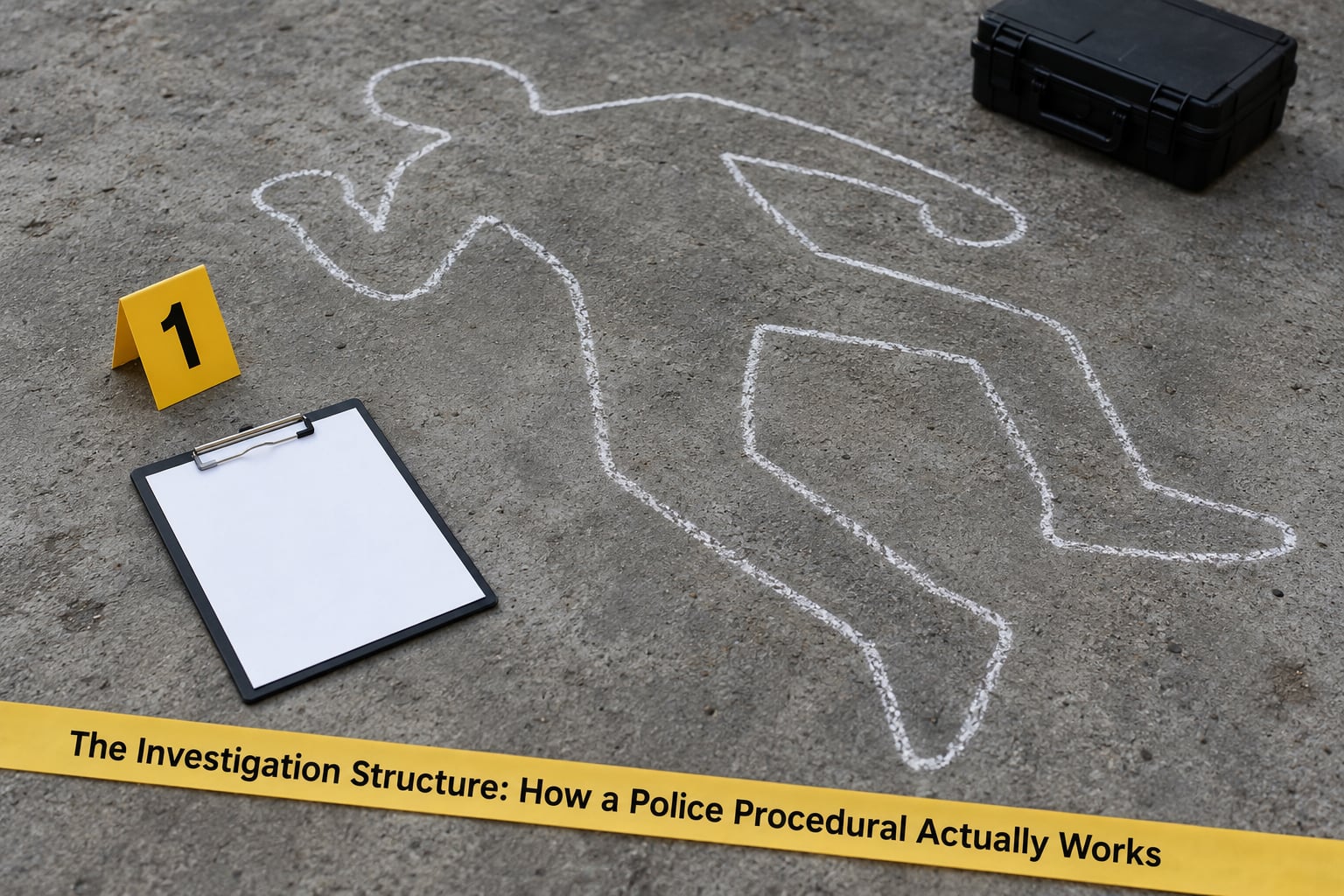
Most cases follow a sequence close to this one. Take a fictional killing in a shared parking structure at 2am, and watch what a procedural does with it.
- Dispatch and first response. The call comes in, uniforms secure the scene before anyone walks through it, and the first decisions are about preservation and who gets called.
- Attendance and scene control. Detectives walk the ground, note what the body position and the position of the victim’s phone actually suggest, and stop a night-shift cleaner from tidying up.
- Early canvass and witnesses. Neighbours, the security guard and a driver in the third row get separate statements, and two of the accounts turn out to be useful only in what they leave out.
- Physical evidence and chain of custody. A receipt, a fibre on a jacket and a partial plate are bagged, signed and logged, because a piece of evidence nobody can account for is worthless in court.
- Forensics. Toxicology, autopsy findings and a later pass over phone and location data come back on their own schedule, which is usually later than anyone wants.
- Suspect interviews. People are found through the evidence rather than by instinct: a work van, a card for the parking garage, a phone number in the margin of a statement.
- Warrant and arrest. An affidavit, a signature from a judge, and a suspect who now knows the police are close, which raises the risk and compresses the clock.
- Prosecution and court. The evidence decides what can be charged, and the arrest rarely equals the conviction.
Notice how much of that is waiting. A procedural is one of the few genres where waiting is plot, because the lab report that ruins the first theory is the point of the chapter.
Clues, Evidence, and Deduction
Clues do the work only when they change the investigator’s answer. A clue that merely decorates, a piece of evidence introduced, admired and never used again, is dead weight; good procedurals ration this carefully.
Four kinds of evidence carry most of the load. Physical evidence is documented and can be tested later. Testimony is the most fragile, because people forget, confuse what they saw with what they were told, and say different things on a second telling. Records are quiet and often decisive, covering timestamps, purchases, phone location and employment history. Digital forensics arrived late and changed the genre’s texture, since a phone can now be a witness that never blinks.
Deduction in a procedural is usually inductive rather than theatrical. Nobody stands in a room and announces that only one person could have done it because of the rain; the detective notices a discrepancy, checks a record, eliminates a suspect and states a narrower conclusion than they had an hour ago. Where the deduction is airtight and the reader can follow it in retrospect, the book is fair play. Where it is not, readers start arguing on forums.
The inverted detective story does the same work with the clock running the other way. We watch the culprit commit the crime and spend the whole story hoping the detectives fail, which is why the whodunit and the police procedural share so many techniques.
Character and Conflict
Case mechanics only carry a story so far. What keeps a procedural interesting once the method is familiar is the pressure on the people doing the work: an overworked detective sergeant, a pathologist who cannot sleep, a team that has buried one of its own.
Crime fiction writer Frank Zafiro puts it plainly: police procedurals are not about lone brilliance or sudden inspiration, they centre on realistic, often mundane, team-based work. That framing explains why ensemble casts beat solitary geniuses in the genre. Rank matters. Reports get overridden. A good supervisor protects a case from above; a bad one buries it.
Institutional friction does double duty, because it produces conflict without inventing a villain. Budget cuts, a case being reassigned, a family court hearing that runs over, a suspect who simply refuses to speak. Personal history is the other engine, and it is what separates a memorable procedural from a well-researched one.
Common Police Procedural Conventions
Most of the genre’s recognisable moves are conventions rather than rules. A story can break them on purpose and be better for it.
- The opening disturbance. The early coffee, the greeting at the front desk, the complaint that has already started; the Straight Dope board described one such beat as the defining texture of the modern procedural.
- Procedural realism. Evidence handling, limits on what officers may do without a warrant, and time that actually passes between events.
- Chain of command. Decisions about who runs the case and who signs off are plot, not paperwork.
- Forensic specialists. A pathologist or lab analyst who can read a body or a sample and change the theory.
- False leads. The obvious suspect who is innocent, on the assumption the reader wants a reversal as much as the detective does.
- Internal conflict. Rival units, bad information, a superior who wants the easy answer.
- A final explanation. The genre usually hands over the reasoning, which is its quiet contract with the reader.
Several variations sit on top of that skeleton. Nordic noir slows the pace and lets weather and bureaucracy do the work of the murderer. Cold case stories jump years forward and rebuild an investigation from paperwork. Workplace hybrids make the institution the story. Legal procedurals hand the last act to the courtroom. And the ripped-from-the-headlines tradition, which runs back to Christie, still shapes plots built on real cases.
Television added its own conventions. A case per episode suits a repeatable structure and a commercial break, while a serial season gives a procedural room for corruption arcs. Television also had to fight for realism: network script reviews and police consultants became standard because production departments objected to the paperwork.
How to Write a Police Procedural
The genre is hard for a specific reason. Every step you add has to be true, and every true step that is not interesting must go somewhere else.
- Start from one solvable question. Who killed this person, where is the child, who moved the money. One central question keeps the evidence from scattering.
- Plant clues that are load-bearing. Every clue you seed should be in play by the end. Check them the way a reader would.
- Control what the investigator knows. You decide which discoveries land in which chapter, and you cannot let your detective act on something the reader has not seen.
- Make the procedure pay. Ask why each step is here. Warrant, canvass, lab request: keep the ones that create a decision.
- Let the team carry the load. A lone genius solves a case by being cleverer than everyone, which is the opposite of the genre’s point.
- Keep the consequences. Readers forgive a lot of liberty. They do not forgive a detective breaking the law with no fallout at all.
- Respect the clock. Lab results, court dates and statute deadlines are the best pacing device in the genre.
Common pitfalls are the mirror image: procedure skipped for convenience, forensics explained with hand-waving, red herrings that turn out to be irrelevant, or a reveal that depends on a fact the reader was never given.
What Makes the Genre Readable or Unsatisfying?
A procedural works when the reader can always answer three questions: what do they want, what stops them, and what have they learned. Clear goals, escalating discoveries, procedures that survive scrutiny and personal stakes that keep rising will carry almost any amount of method.
It fails in predictable ways. Cases that stall without shifting. Solutions that arrive because a character suddenly remembered something. Forensic detail used as ornament rather than as argument. And the one readers mention most often, the workplace-drama drift, where the case becomes a pretext for internal politics and the reader is left waiting for a plot that never quite arrives.
The genre has been criticised for more than pacing. Scholars and commentators have argued that decades of procedurals distort public understanding of crime, overstate the frequency and character of serious offences, and present police work in ways that suit institution rather than reality. There is a real point underneath the complaint. Procedurals are among the most repeated images of policing most people ever see, which gives their accuracy more weight than their airtime alone would suggest.
Fair criticism does not make the genre useless. It makes accuracy a fair demand, and the books that hold up longest are usually the ones that treat the reader as someone who will notice.
Frequently Asked Questions
What does procedural mean in simple terms?
Procedural means made of set steps. In a police procedural the story shows how police work actually happens: a call comes in, officers secure the scene, evidence is logged and signed for, interviews happen, a case is built and handed to a prosecutor. Nothing secret or legalistic is implied by the word. It simply points at a sequence rather than at a chase or a twist.
Why are cop shows called procedurals?
Because the plot follows a procedure rather than a chase. The interesting question is how the detectives will find out what happened, and the show lets you watch each step of that: the scene, the canvass, the lab, the interview, the arrest. Dragnet set the pattern in the 1950s with almost no emphasis on the crime itself, and later shows added the crime back without dropping the process.
Is a police procedural always a mystery?
No. A procedural can end with the crime still unsolved on television, which is how some series handle a real-world case, and novels can end at the arrest without a reveal. The reverse also happens: Columbo and Charlie Chan solve mysteries without ever showing real police method. You can have a procedural without a whodunit, and a mystery without a procedural.
How realistic does a police procedural have to be?
There is no fixed standard, but readers notice quickly. Ask whether the evidence was logged, whether a warrant was needed, and whether the detective could legally do what they do on the page. Small liberties for pacing are fine. Bending the law with no consequence, or inventing a forensic result on demand, is what tends to break the spell. Consultants help in television; careful research does the same in print.
How is a police procedural different from a police drama?
Both live in the same world, but the centre of gravity differs. A police procedural is organised around the case: evidence, interviews, procedure and arrest. A police drama is organised around the institution: corruption, budgets, promotion, unions and the cost of the job. A good series runs both at once, which is also why some shows read more as workplace drama than as crime fiction.
What are examples of police procedural books and TV series?
Books include Ed McBain’s 87th Precinct, Sjowall and Wahloo’s Martin Beck series, Michael Connelly’s Harry Bosch, Ann Cleeves’ Vera Stanhope and Peter Grainger’s DC Smith books, all praised by readers for believable, team-based police work. On television, the key examples are Dragnet, Hill Street Blues, Law u0026amp; Order, NYPD Blue, CSI, The Wire and Bosch, plus Marcella and The Bridge for Nordic noir.
Conclusion
A police procedural is a crime story in which the solving of the crime is told as a process: official investigators, step-by-step method, and a cast that works inside the institution rather than outside it.
Try this on the next one you read. Find the single question driving the investigation, then list the clues in the order the detectives met them and check how many of them changed the answer. The ones that changed it are the story. The rest is atmosphere.