
To write suspects that all look guilty, give every character in the suspect pool a motive, means, and opportunity for the crime, plus a private secret that would be enough to convict them if nobody looked any further. The goal is not that each person is equally likely to be the killer. It is that each one has something real and shameful to hide, so the reader’s suspicion never settles anywhere for long.
That matters more than it sounds. A mystery usually dies somewhere around chapter three, when the reader picks a suspect and stops reading for the plot. They are not being dense; they are being polite. Once they think they know, the remaining two hundred pages become a waiting room. A flat suspect pool, where everyone looks bad for their own reasons, forces them to keep reading because the answer keeps moving.
Writers on writing forums describe the same failure from the other side: they set up half a dozen suspects and pick one at the end because the plot needed a body. Nothing in the text pointed there. Readers sense that, and what they feel is not surprise but irritation. It is the difference between a reveal that is surprising and inevitable and one that is merely announced.
The technique is also easier than most writers expect, because it is bookkeeping rather than inspiration. You decide the crime, give each suspect a distinct concealed fact, let their behavior carry more than one possible reading, then plant clues that separate them. Five or six steps, and most of the work happens before you draft a single scene of dialogue.
Table of Contents
- What You Need
- Step-by-Step: How to Write Suspects That All Look Guilty
- 1. Establish the crime and the question readers must answer
- 2. Give every suspect a different kind of secret so they all look guilty
- 3. Make each suspect’s behavior look guilty in context
- 4. Plant clues that separate the suspects
- 5. Control what the investigator reveals and when
- 6. Resolve the mystery without clearing every suspect at once
- Common Mistakes
- Frequently Asked Questions
- How do I make every suspect seem guilty without making one character the obvious culprit?
- Why does my mystery feel unfair if all the suspects have suspicious behavior?
- How many suspects should a short crime story have?
- What is the difference between a red herring and a false clue?
- How can I use false alibis to create multiple suspects?
- How do I plant clues that support a twist readers can discover?
What You Need
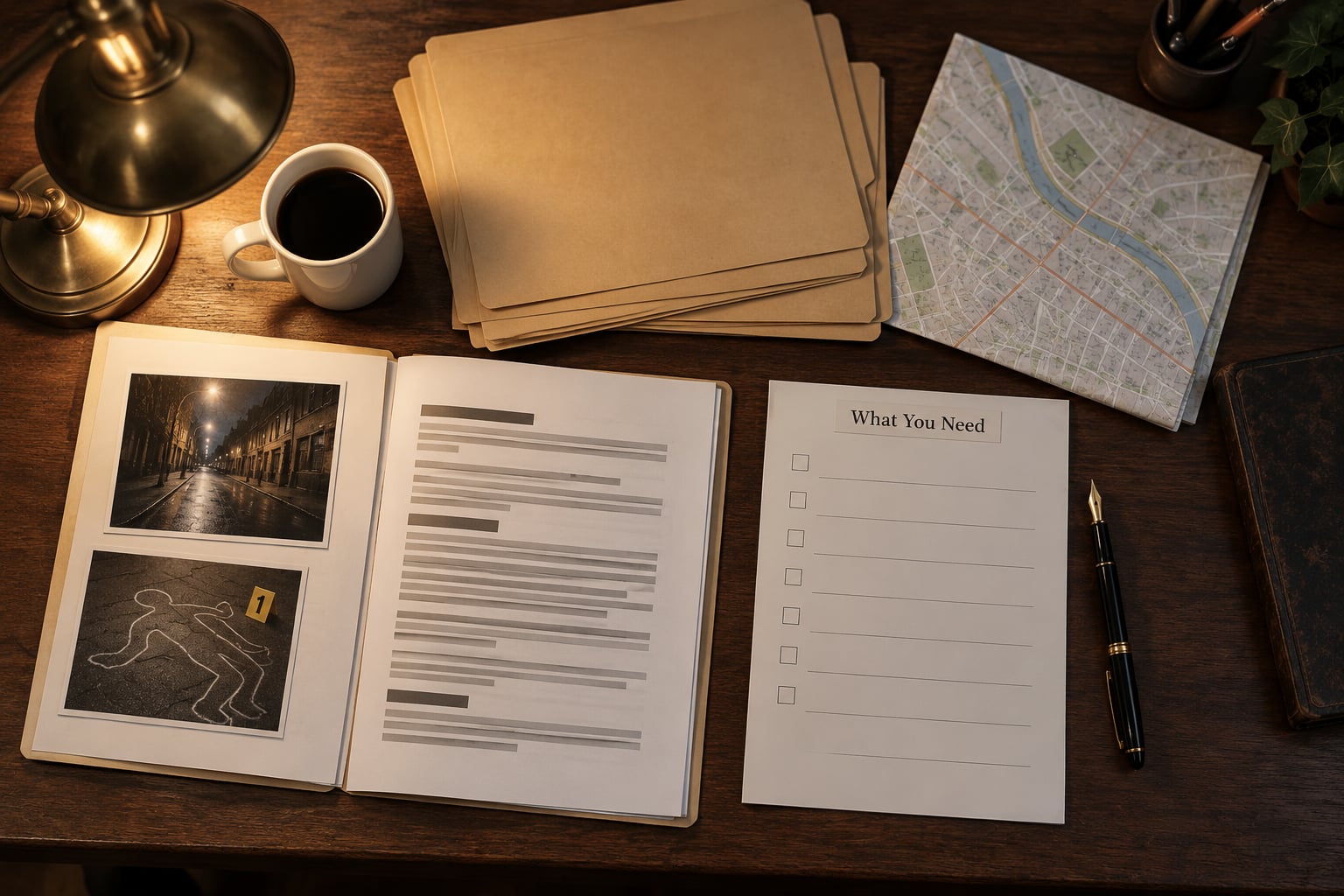
You need five things settled before drafting, and three planning artifacts to hold them.
The first is the central crime, described in one sentence with nothing hidden about the mechanics. Who did it, to whom, where, and between what times. If you cannot write that line, every suspect you build afterward will drift.
The second is a closed cast. Every suspect needs a credible path to the victim, which means they cannot all be strangers who happened to be in the building. Family, colleagues, business partners, old friends, whoever had access that week. This is the cast that goes in your suspect matrix.
The third is a clue system: a set of fair clues that point in more than one direction at the start, and a small set that resolves cleanly at the end.
The fourth is competing motives. Not one motive shared by several suspects, but a different flavor of reason per person, so no two of them are guilty for the same reason.
The fifth is the revelation. Know the answer, know why the clues point there, and know what the killer’s motive actually is before you write the first chapter.
For artifacts, a suspect matrix (one row per suspect, one column per element of the case) is the one that changes the most about a draft. A continuity timeline for the night of the crime comes next, because most false alibis are continuity errors rather than lies. A POV order, written down, comes third: it decides who the reader sees thinking, which is where most of the guilt actually gets communicated.
Give yourself a page to fill in the two questions that catch out new writers most often. Who, among your suspects, would be destroyed by an arrest even if nothing could be proven? And who benefits most if the investigation lands on somebody else? Between those two answers you usually find your decoys, and sometimes you find that the person you thought was your killer is the one who could least afford it.
One more thing worth deciding now: how many suspects you are actually using. Three to five is comfortable for a short story or a screenplay, where each person needs a scene of their own. Six to eight is workable in a novel if you rotate viewpoint and give readers periodic recaps. Past that, you are asking the reader to hold more names than a page-turning mystery gives them space to learn, and you should be certain the extra names earn their place.
Step-by-Step: How to Write Suspects That All Look Guilty
Six steps, in this order. The first three build the cast, the last three control what the reader does with it.
1. Establish the crime and the question readers must answer
One crime, one central mystery, and one specific question driving the investigation. Not “who killed him” in the abstract, but something narrower: who moved the body, who forged the will, who had the key at eleven. A precise question gives suspicious details a job to do instead of leaving them as atmosphere.
Then map three things: what the investigator knows, what each suspect knows, and what each suspect believes about the others. That third column is where the tension lives. A suspect who thinks someone else is covered up behaves differently from one who thinks they are the only one in trouble, and readers pick that up even when you never explain it.
2. Give every suspect a different kind of secret so they all look guilty
This is the strongest equalizer, and almost nobody uses it well. The mistake is giving four suspects the same secret shape, or worse, giving only the killer an interior life while everyone else just says no at the right moments. Assign each person a concealed fact of a different kind: a hidden debt, an affair nobody knows about, a false alibi covering something unrelated, a prior conviction, evidence quietly removed from the scene, a lie about where they were two months ago.
Here is what a filled-in matrix looks like for a four-suspect closed-circle setup.
| Suspect | Concealed secret | Path to the victim | Tell | How they are cleared |
|---|---|---|---|---|
| The nephew | Forged a signature on a loan document last month | Weekly access to the house, known key | Rehearsed answers, too smooth under questioning | The forgery was on a document dated after the death |
| The business partner | Was in the house the night before, uninvited | Shared office, shared alarm code | Burns a cigarette she quit years ago | The victim logged her entry at the front desk |
| The housekeeper | Her son is in custody, and she lied about it | Alone in the house from seven to nine | Cannot look at anyone when the police mention her son | Her car was on the forecourt, cameras confirmed |
| The solicitor | Removed a page from the will before the reading | Drafted the will, knows the safe combination | Adjusts his cuffs whenever the will comes up | The page was in his own case file, dated years back |
Notice that only one of those secrets is the murder. The other three would each be enough to end someone’s career if the detective simply stopped digging. That is what keeps the pool flat: the reader cannot tell which shame is the crime.
Two rules make the assignment work. First, vary the category, not just the content: one financial, one romantic, one legal, one about someone else entirely. A cast with four money secrets is a cast of four of the same person. Second, keep the killer’s secret the one that is hardest to explain away. The others can be resolved with a document or a phone record. The killer’s needs to be the one where the innocent explanation still leaves a gap.
Give each secret a moment in the text, ideally before the crime, so the reader has met it without recognizing it. A line about a housekeeper mentioning her son during a scene about laundry is doing better work than anything in the interrogation scene later.
3. Make each suspect’s behavior look guilty in context
Nervousness is not suspicion, and it is the least interesting way to make someone look guilty. Better is behavior that supports more than one reading at once.
Consider a suspect leaving an interview early. Read one way, he is hiding something. Read another, he is a grieving relative who cannot bear the questions. Read a third, he has realized the detective is close and wants to get to one person before she does. Same action, three interpretations, and the reader supplies the guilty one themselves, which is far more convincing than writing nervous hands on a collar.
Other useful moves: an unnecessary detail that nobody asked for, altered clothing with no explanation, an object that has gone missing from a room, and controlling the investigation itself by steering people away from a line of questioning. Innocent people steer too, because they have their own reasons to be uncomfortable.
4. Plant clues that separate the suspects
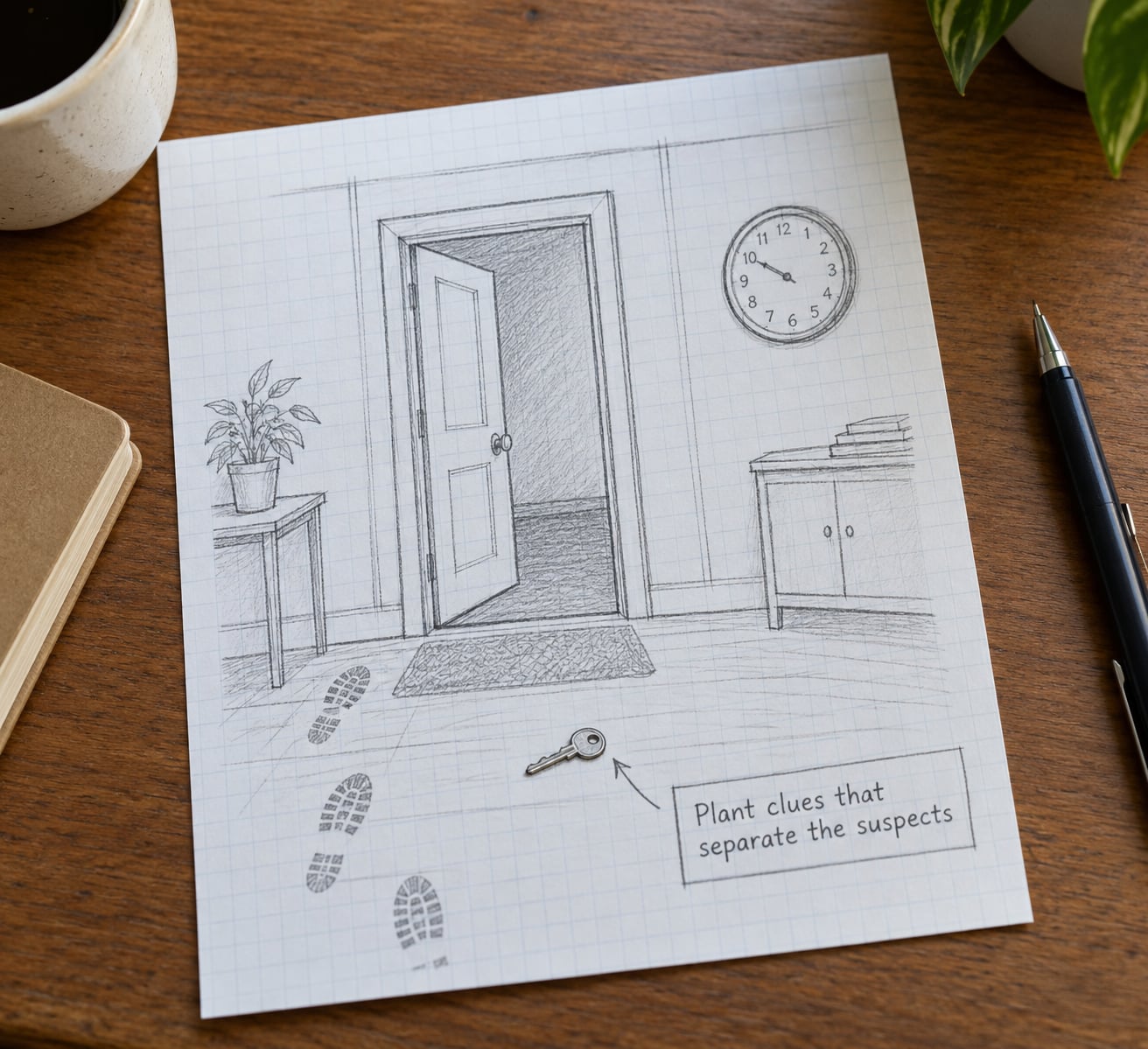
Three clues is the floor for a puzzle mystery: one pointing at suspect A, one at suspect B, one at suspect C, all of them fair, all of them readable by the reader before the reveal. Add one decisive clue, planted early and understood late, that changes what the other three mean.
Keep three categories apart in your notes, because writers mix them constantly. Evidence supports a conclusion. Atmosmosphere only produces a feeling, and it cannot be counted on to survive a rereading. A red herring is false information that the text actively invites the reader to accept.
The delayed reinterpretation is what makes a scene feel retrospectively convincing. The lock on the study door was broken in chapter two and mentioned once. At the end, the reader understands it was never about entry at all, and that reframes every quiet scene that happened before it.
Testing each clue this way keeps the puzzle honest. Read the clue, write down which suspect it incriminates, and write down why it could be innocent. A clue with no innocent reading is not strong, it is a label. A clue with two equally plausible readings is doing the job you want, and the second one can be the same physical detail seen from a different angle by the detective later on.
Keep the decoys plausible too. The strongest misdirection is a clue that points at someone for a reason that turns out to be true about something other than the murder: a locked door that really does mean someone lied, a financial trail that really is a financial crime. Readers accept the guilt because part of it is genuine.
5. Control what the investigator reveals and when
Plan the information order rather than discovering it in the draft. Suspicion, then contradiction, then reinterpretation, in that rhythm, is roughly one cycle per suspect per third of the book.
Withholding one fact can build a false conclusion on purpose: a time stamp, a phone record, an item left out of a description. Revealing that same fact at the wrong moment flattens the mystery, because the reader assembles the case early and then waits. The test is simple. For every piece of evidence you plant, ask which suspect it damages and when the reader should start believing it.
6. Resolve the mystery without clearing every suspect at once
Name the culprit. Then let the others stay guilty of something. The nephew still forged the signature. The partner still was in the house that night. The housekeeper still lied about her son. A good ending finds the murderer and declines to absolve anyone else, because the book’s question was never whether these people are innocent. It was what they are capable of.
Aftermath does work here. A confession that explains the motive, a detail the detective got wrong, a loose end that never closes, all of it lets the moral ambiguity survive the last page.
Before you call it done, run the fair-play check. Cover the solution and read the draft yourself, marking every clue you can find without the answer in front of you. You need at least three for the culprit, all visible before the reveal. Then do the same for each of the three strongest decoys. If a decoy cannot be explained away by something the reader already saw, you have a cheat rather than a red herring, and readers notice even when they cannot name it.
Common Mistakes
Six failures account for most drafts where the suspect pool is not flat.
One suspect is obviously guilty. Usually because the others have no secret at all. Fix: go back to the matrix and give every non-culprit at least one fact they would be ruined by. Then cut any clue that only the culprit could have produced.
Everyone behaves the same. Four people who jump at the same question read as one person with four names. Fix: give each suspect a different tell drawn from a different category, one verbal, one physical, one behavioral, one relational.
Clues point nowhere. Suspicious objects are not clues if they support no conclusion. Fix: write the conclusion next to each clue in your notes. If you cannot, it is atmosphere, and atmosphere has to be labelled as such.
The twist depends on withheld information. The answer needs a fact the reader never had, and that is a cheat no amount of fair-play framing repairs. Fix: any fact the reveal relies on must have appeared earlier in a form that looked unimportant.
The villain picks the culprit at the end. Readers on writing forums describe this failure constantly: six suspects set up, one chosen arbitrarily, no planted clue pointing at them. Fix: reverse it. Work backwards from your answer, list every clue that had to be in the book, and confirm each one was placed.
Suspects blur into each other. Fix: rotate POV so the reader spends real time inside two or three of them, and give each a distinct voice and a distinct vocabulary. A reader who has heard someone think for a chapter remembers them.
Two habits help before revision. Run the recap test: after each chapter, can you state what is known about every suspect? If not, the reader will not be able to either, and a short chapter-end beat fixes it cheaply. And keep the detective competent, because bumbling police are the most reliably complained-about element in the genre, and a detective who fools themselves for 200 pages is the same failure with a sympathetic face.
Frequently Asked Questions
How do I make every suspect seem guilty without making one character the obvious culprit?
Give each suspect a different kind of concealed fact, not the same nervous energy repeated four times. A hidden debt, an affair, a false alibi about something unrelated, a prior conviction, evidence quietly removed from the scene. Only one of those secrets is the crime. The rest would each end someone’s career if the detective stopped digging, which is exactly why the reader cannot tell which one matters.
Why does my mystery feel unfair if all the suspects have suspicious behavior?
Suspicion is not the problem. Withholding the answer is. Fair play means every clue the solution depends on was visible to the reader before the reveal, and every false trail can be explained by something already in the text. A decoy that cannot be explained away reads as a cheat even when you follow every convention. Check each decoy the way you check the solution: could a careful reader account for it using only what you gave them?
How many suspects should a short crime story have?
Three to five works for a short story or a screenplay. Each addition costs you something real: an introduction, a voice the reader has to learn, a set of clues to track, and a suspect who needs at least one scene of their own. Going past six is possible in a novel, but only if you rotate viewpoint and give readers occasional recaps of who is a suspect and what is known. Below three, you lose the flat pool entirely.
What is the difference between a red herring and a false clue?
A red herring is false information the text invites the reader to accept as significant, and it usually has a real cause the story explains later. A false clue is a smaller thing: a detail that points somewhere inaccurate, sometimes by accident of your plotting. Red herrings are deliberate structural tools. False clues are usually errors, and they are the reason a mystery can feel unfair even when nothing was technically hidden from the reader.
How can I use false alibis to create multiple suspects?
Give each suspect an alibi that is specific, checkable and slightly wrong. A detail that fails verification, a time someone could not account for, an account that relies on someone who is lying too. The key is that each false alibi must be falsified for a different reason, and only the killer’s needs to be a deliberate lie rather than a mistake. Build a continuity timeline first, since most broken alibis turn out to be continuity errors.
How do I plant clues that support a twist readers can discover?
Plan three clues for the real culprit and place all of them in the first half, so an attentive reader can solve the book early and feel clever rather than cheated. Then add three more pointing at different suspects, and one decisive clue planted early and understood late that reframes the others. Cover the solution and reread the draft marking what you can find. If you cannot find them without the answer in front of you, no reader can.
Start with the matrix, not the first chapter. If you do one thing from this, build the suspect matrix before you write prose. One row per suspect, one column for each element of the case, plus the secret and the tell. The rows will not be even, and that is useful information. The suspect with a real motive, real access and nothing to hide is the one readers will find first.
Then hand the finished book to a reader who has not seen your solution and ask them to guess the culprit at the halfway mark. If three of them guess correctly and for the same reason, that reason is your answer, and the other suspects need harder work. The craft question behind how to write suspects that all look guilty is never whether they can all look bad. It is whether you have given each of them something they cannot afford to have exposed.