
A Goodreads star rating tells you what a self-selected group of readers felt about a book, nothing more. This guide walks through how to understand Goodreads ratings for crime novels: what the average hides, why the rating count and the distribution carry most of the information, and when to ignore the number altogether.
Crime fiction is a strange genre for this. Readers routinely hand out five stars to books that frightened them, disturbed them or kept them awake, and the aggregate says nothing about whether the plot was fair or the prose earned its ending.
Table of Contents
- Goodreads Ratings for Crime Novels at a Glance
- What Does a Goodreads Rating Measure?
- How to Interpret the Average Rating for a Crime Novel
- How to Understand Goodreads Ratings for Crime Novels: the Practical Verdict
- How to Read the Rating Distribution and Review Count
- What Reader Patterns Can Reveal About a Crime Novel
- How Ratings Differ Across Novels and Editions
- How to Compare Goodreads Ratings With Other Reader Signals
- What Goodreads Ratings Do Not Tell You
- Frequently Asked Questions
- Is a 4.0 Goodreads rating better than a 3.9?
- Why does the number of Goodreads ratings matter?
- Do high Goodreads ratings mean a crime novel is well written?
- Can ratings differ between the print and ebook editions?
- Should I avoid a crime novel because its Goodreads rating is low?
Goodreads Ratings for Crime Novels at a Glance
Seven signals sit on or behind a Goodreads book page. Only the first is the number most people look at.
| Signal | What it actually tells you | What to do with it |
|---|---|---|
| Average star rating | Mean of the stars submitted, to one decimal place | Treat as an entry point, never a verdict |
| Rating count | How many people submitted any star at all | Set a floor before you trust the average |
| Rating distribution | The share of each star from one to five | Read the shape: broad enthusiasm or a split verdict |
| Written reviews | Reviews with text, far fewer than the star count | Read ten, focusing on repeats |
| Review activity | Shelved counts and want-to-read spikes | Tells you about demand, not satisfaction |
| Edition differences | Separate scores for hardcover, paperback, ebook, audiobook | Check you are reading about your edition |
| Change over time | How the score moved since publication | Backlist reissues often climb, then settle |
What Does a Goodreads Rating Measure?
A Goodreads rating is a one-to-five star average submitted by readers, displayed to one decimal place. It measures the summed opinion of whoever chose to rate, not the quality of the book.
Two things follow from that. The displayed score is not a sample-size-corrected figure, so a book with a single five-star rating sits at 5.0 and looks identical to a book that ruined a thousand people’s evenings. And it is not a critical consensus either: reviewers who expect a book to be excellent weigh it against their expectations, while casual readers are scoring whether they had a good time.
An analysis on the Higher Order blog put it plainly: plenty of books of real interest have exactly one rating, that rating is five stars, and the average reads 5.0. The same post argued that reader review metascores are meaningless as a ranking tool and proposed a confidence-bounded score instead. Nothing about the average has changed since.
How to Interpret the Average Rating for a Crime Novel
In crime fiction, a 3.7 is a good average. Below about 3.5 on a well-reviewed book, something specific has gone wrong; above 4.2 on a mainstream title you are usually looking at selection, not excellence.
The reason the scale runs high is that crime readers often rate the experience rather than the craft. A novel with sustained domestic abuse, a cold body count or a genuinely frightening unreliable narrator can score five stars from a reader who enjoyed every minute of being unsettled. A reader who found the violence gratuitous scores the same book two. The average hides that split completely, and it means the star number carries less information in this genre than in most.
| Average | Plain-English reading in crime fiction | How much to trust it |
|---|---|---|
| 4.3 and above | Very well received by the people who finished it | Usually genre-enthusiast warmth, rarely objective quality |
| 4.0 to 4.2 | The crowd value for any popular book | Nearly meaningless on its own; everything nearby sits here too |
| 3.7 to 3.9 | Solid and liked, with real reservations | Worth reading if you enjoy the sub-genre |
| 3.4 to 3.6 | Ambitious and divisive, or unevenly executed | Read the reviews before deciding |
| Below 3.4 | Readers found something they could not forgive | Find out what it was; slow openings draw this often |
Differences of a tenth rarely mean anything. Between 4.0 and 4.1 you are usually comparing two samples of different readers, not two books of different merit.
How to Understand Goodreads Ratings for Crime Novels: the Practical Verdict
Use the average as a doorway, then walk through five checks before you decide whether a crime novel is worth your time.
- Check the rating count. Under 50 ratings means the average describes a handful of people, often the author’s own circle. Treat it as noise. Between 500 and 5,000 you can read patterns. Above 5,000 you are looking at a broad sample and the shape of the distribution becomes meaningful.
- Read the distribution, not just the mean. A 4.2 built from 70% five-stars is broad enthusiasm. The same 4.2 built from 60% five-stars and 30% one-stars is a divided audience, and those books feel completely different in the hand.
- Separate written reviews from star-only ratings. One reader on r/books estimated leaving a written review on roughly 40% of books but a star on 100%. The stars over-represent casual readers, so the text is where the actual reasoning lives.
- Look for repeats in the reviews. Ten reviews that mention the same flaw are a pattern. One review ranting about a slow first act is a preference.
- Match the book to the sub-genre, not to crime fiction in general. Cozy mysteries, Nordic noir, police procedurals and domestic noir have different reader expectations, and readers rate against the promise the book made.
How to Read the Rating Distribution and Review Count
The rating count is the single most informative number on the page, and it is the one people skip. Two books with the same average can tell opposite stories purely because of how many people are behind the number.
| Book | Average | Ratings | What the score means |
|---|---|---|---|
| Obscure Nordic debut | 4.0 | 30 | Ten friends and a book club; the true score could sit anywhere from 3.4 to 4.5 |
| Established series opener | 4.0 | 30,000 | A stable genre verdict, with a distribution you can actually trust |
| Announced thriller, pre-release | 4.6 | 400 | Mostly fans rating a book nobody has read yet |
| Backlist classic reissue | 4.1 | 12,000 | New readers plus an older rating cohort; check the trend line |
The failure mode is worth naming out loud, because it happens constantly with new crime fiction: a pre-release title accumulates ratings from fans rating an announcement, and the page shows a confident average over a book that has not been written yet. Goodreads has tightened this by requiring reviewers to disclose where they received their copy, and that source stays attached to the review, so you can now spot the pattern rather than infer it.
What Reader Patterns Can Reveal About a Crime Novel
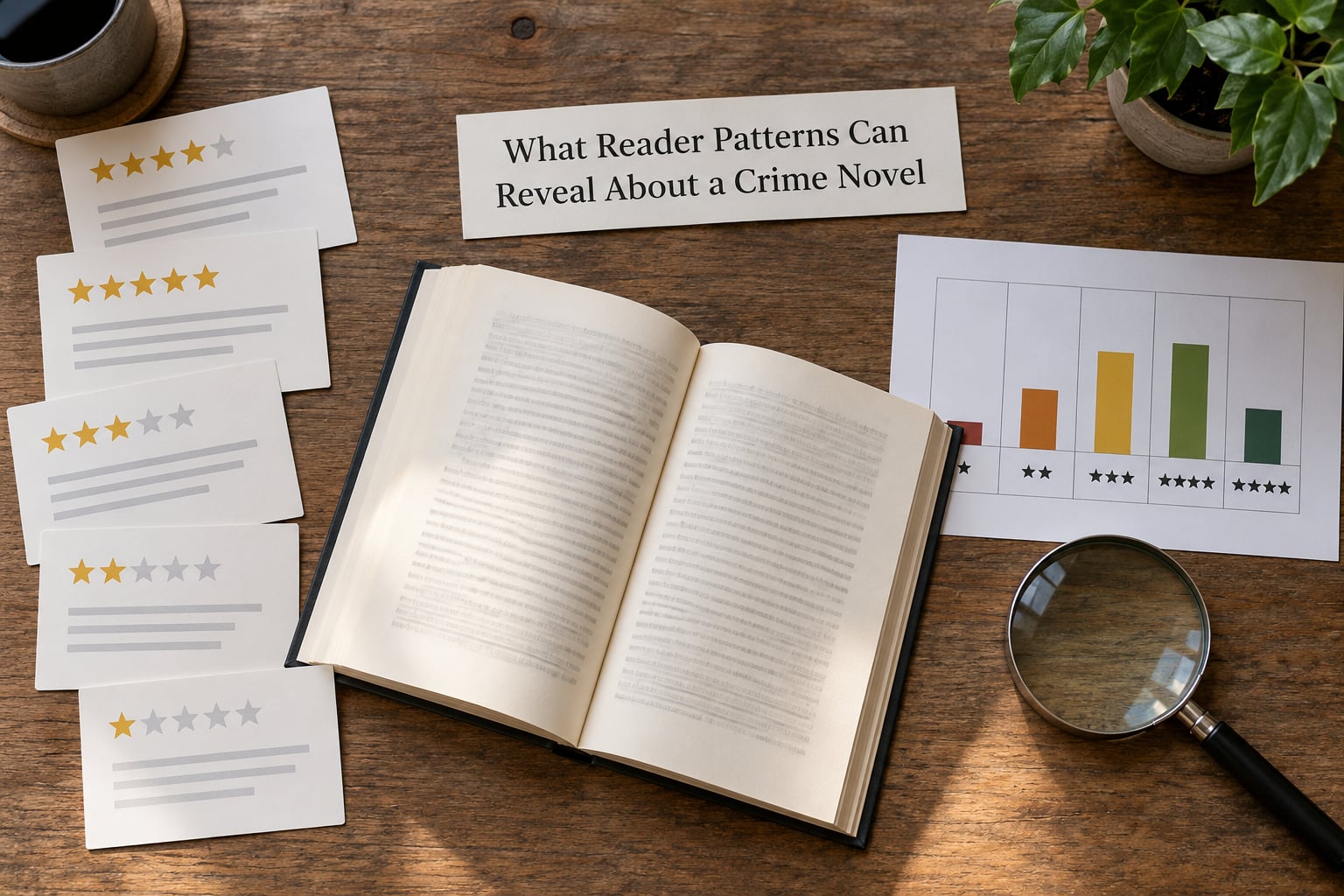
Reviews say things a star cannot. In crime fiction, the recurring complaints cluster into a small number of buckets: a slow first act, a twist built on a technicality, a body count that felt like padding, an ending that answered the case but not the theme, or narration the reader found coy rather than stylish.
What matters is frequency and specificity. A pattern of readers describing the middle third as sagging tells you something a 3.8 conceals. One dissenting review about a favourite character tells you almost nothing about the book’s quality.
Mind the reviews written before the book ends. Readers often rate on the first fifty pages, which is the same threshold behind the 50-page rule that governs quitting, and the companion 3-book rule treats a poor run of three as a reason to stop trusting your own taste. Books abandoned at either point still receive ratings, and those ratings land in the average as though a reader had finished the case.
One more habit worth knowing about: readers admit to quietly raising a rating weeks or months after finishing, usually by a star. If a score climbs steadily a year after publication, part of that movement is revision rather than new readers.
How Ratings Differ Across Novels and Editions
A Goodreads page can carry separate scores for hardcover, paperback, ebook and audiobook, and they diverge more often than readers expect. The cause is usually the physical object rather than the text: a translation that reads flat, an audiobook narrator who flattens the menace, a cover that pulled in the wrong crowd, or an edition with a typographic error in the dialogue.
Translation matters most in Nordic noir and translated European crime, where two editions of the same novel can sit a full star apart. Narrator performance matters most in psychological and domestic noir, where tone carries the whole effect. When the edition you own is not the edition with the good score, the review text usually explains which is which.
How to Compare Goodreads Ratings With Other Reader Signals
Use the rating as one input among several, never as the deciding vote. Three or four other signals carry more weight.
- Consistency across platforms. A book that scores well on Goodreads, on StoryGraph and on retailer reviews is a book that pleased several different crowds, which is stronger evidence than one large sample from one platform.
- StoryGraph’s finer scale. StoryGraph allows half-star and quarter-star ratings, and the same book often lands on a different displayed average there. That gap is the cleanest proof that the number is an artefact of the platform’s mechanics rather than a property of the book.
- Review substance over review volume. Ten specific reviews beat five hundred stars.
- Awards, press and adaptation. Prize wins and screen adaptations tell you something about reception, though never about whether you will like the pages.
- The author’s stated genre aims. A book marketed as slow-burning and atmospheric is being measured against a promise, and readers who wanted a sprint will rate it low.
Recent research on what Goodreads data can and cannot represent, including work on sponsorship and its effect on the platform’s record, is worth reading if you use these numbers for analysis rather than for choosing a book.
What Goodreads Ratings Do Not Tell You
- A high average does not guarantee you will enjoy it. Scores measure past enjoyment by other people, not your preferences.
- A low average does not mean poor writing. Slow openings, dense geography and heavy content draw low scores from books many readers admire.
- A high rating count measures popularity, not quality. A book club pick with fifty thousand readers can be a 3.4.
- The score says nothing about whether the mystery is fair. Whether the clues were planted, whether the twist followed from the setup, whether the ending resolved the case: none of that reaches a star rating.
- It does not tell you the book is original. A derivative thriller with a great twist lands in exactly the same band.
- It does not separate craft from tolerance. A five-star rating is often a verdict on the violence, not the prose.
- It is not a fair measure across genres. Comparing a Nordic noir average to a cozy mystery average compares two different promises.
Frequently Asked Questions
Is a 4.0 Goodreads rating better than a 3.9?
Not in any useful sense. A tenth of a star sits inside the margin of difference produced by a different mix of raters, so two books at 4.0 and 3.9 are effectively tied unless the rating counts are wildly different. Look at the distribution and the review count instead, which tell you something a tenth cannot.
Why does the number of Goodreads ratings matter?
Because an average is only as meaningful as the sample behind it. One five-star rating displays as a 5.0 and says almost nothing. As the count climbs past a few hundred, patterns in the star distribution become readable, and past several thousand you are seeing a genuine cross-section of crime readers. Below 50 ratings, treat the average as decoration.
Do high Goodreads ratings mean a crime novel is well written?
They mean a lot of people rated it highly, which is a different claim. Crime readers frequently reward intensity, atmosphere and fear, so a five-star score can describe an experience rather than craft. The written reviews are where you find out whether the prose held up or whether the reviewer simply had a good time.
Can ratings differ between the print and ebook editions?
Yes, and often noticeably. Goodreads can hold separate scores for hardcover, paperback, ebook and audiobook. Translation quality, narrator performance, cover design and typographic errors all land on the edition rather than the text, and in translated European crime the gap between editions can approach a full star. Check which edition the reviews you read belong to.
Should I avoid a crime novel because its Goodreads rating is low?
No. A low score often reflects a slow opening, a dense atmosphere or content a reader was not prepared for, rather than weak writing. Read the reviews and find out whether the complaints are specific and repeated. If several readers describe the same problem, that is worth knowing. If the complaints are scattered, the book may suit you better than the average implies.
Check the rating count and the distribution before the average. If the count is low, the distribution is lopsided, or the reviews contradict the stars, read the reviews and ignore the number.
If the count is solid, the distribution is broad and the written reviews keep mentioning the same things, the average is worth something. That is as much as a Goodreads rating can tell you, and it is not a verdict on whether the mystery was fair.