Here is how to read graphic novels for the first time in the shortest version possible: read left to right and top to bottom, panel by panel, taking in each drawing together with its speech balloons and caption boxes. Manga flips the direction and reads right to left. That is genuinely all the mechanical knowledge you need to start.
A 200-page graphic novel usually takes two to three hours, which is about the length of a single long chapter in a novel you would finish in one sitting. The pictures do some of the work that prose normally carries, so it reads faster than the page count suggests.
The part that trips up first-time readers is not the reading order. It is the back catalogue anxiety — picking up an issue from the middle of a series that has been running since the 1960s and wondering whether you are missing 400 pages of setup. You are not obligated to do any of that. Start with a story that begins at the beginning.
Table of Contents
- What You Need
- Step-by-Step
- How to Read Graphic Novels for the First Time
- Choose a Beginner-Friendly Graphic Novel
- Follow the Panel and Page Flow
- Use Dialogue, Captions, and Visual Details Together
- Read at Your Own Pace and Mark Questions
- Look for the Story Between the Panels
- Finish the Book and Reflect
- Common Mistakes
- Frequently Asked Questions
- How are you supposed to read graphic novels?
- In what order should comic panels be read?
- Which way do manga read compared with Western comics?
- Do I have to read comic books in order?
- Is reading graphic novels good for your brain?
- How long does it take to finish a graphic novel?
- Conclusion
What You Need
Almost nothing. This is the most equipment-free reading format there is, which is why libraries hand them to reluctant readers without hesitating.
- A chosen book. One story, ideally self-contained or labelled Volume 1.
- An hour or two of quiet. Longer if the book runs past 200 pages, and split it across two evenings if that helps.
- A notes method, optional. A phone note, a bookmark, or a scrap of paper. Useful only if you care about names and timeline questions.
- A reader app with a direction setting, if you read on a tablet. Needed for manga, ignored for Western books.
Skip the study guides, the reading-order wikis, and the franchise timelines. Those tools are for readers who already know how the format works and want to go deep. On a first read they add friction and take away the part that makes graphic novels fun, which is that you are assembling the story yourself from pictures.
One more thing worth having: the willingness to be confused for a while. Everybody is on their first ten pages. The story clarifies faster than it feels like it will.
Step-by-Step
How to Read Graphic Novels for the First Time
Sit down, open to the first page, and work through in order without stopping to research anything. When something is unclear, keep going — most graphic novels explain themselves within ten or twenty pages, and looking something up mid-book breaks the spell more than it solves.
The mechanics, once, so they never bother you again:
- Start at the top-left panel. On Western books, read across a row of panels left to right, then drop down to the next row and start again at the left.
- Follow your eye down the page. Artists arrange panels so the natural reading path is obvious: descending from the top, generally moving right and down.
- Read the drawing and the words together. A face and posture tell you as much as the line attached to them.
- Read sound effects as part of the picture. Large stylized lettering is onomatopoeia and belongs to the action, not to the dialogue.
- Turn the page when the page ends. Most publishers put a panel that bleeds off the edge of the page to signal the turn.
If you want the two directions side by side, the difference is small and mechanical. Western books open at the back cover and run left to right, top to bottom. Manga opens the same way but runs right to left, top to bottom — so you start with the top-right panel and move leftward down the page. If a book has Japanese characters and vertical text, it is manga.
Choose a Beginner-Friendly Graphic Novel
Pick something that starts where it begins. That single rule solves most beginner problems, and it is the rule long-time readers on r/comicbooks and r/graphicnovels repeat most often: begin with a self-contained story, an origin retelling, or a Volume 1 that actually starts the plot.
What makes a book beginner-friendly:
- Self-contained arc. The story finishes. You are not left needing a second volume to understand how it ended.
- Length. Under 200 pages for your first attempt. That is one sitting and low risk.
- Genre match. Pick what you already read. Horror readers should start with horror, not with whatever is famous.
- Content warnings. Mature graphic novels carry publisher ratings and content warnings on the back cover. Check them before buying for a child.
- Art you can parse. Busier page layouts are harder to read. Simpler line work with clear panel borders is a gentler start.
- Standalone versus series. Standalone means no homework. Series means more of the same once you finish, if you like it.
What to avoid on a first read: issue one of a series that has been running for fifty years, anything described as issue 237 or chapter 900, and omnibus editions that collect forty volumes you have not read.
Beginner-safe first reads that veteran readers name constantly, across moods:
- Watchmen by Alan Moore and Dave Gibbons — a self-contained mystery, dense with technique, and a good first look at how deliberate panel layout works.
- Maus by Art Spiegelman — a memoir drawn in a second visual language, entirely self-contained, and the most commonly recommended first book in these discussions.
- Persepolis by Marjane Satrapi — a memoir in black and white, roughly 150 pages, and about as welcoming an entry point as exists.
- Batman: Year One by Frank Miller — an origin retelling, so no prior continuity required, and a clean demonstration of why wider panels make a scene feel important.
- Blankets by Craig Thompson — a quiet, standalone graphic novel with almost no action, useful if you assumed the format is all fights.
- They Called Us Enemy by George Takacs — a memoir graphic novel that works well as an adult’s first read and as a shared read with an older teenager.
- Spinning by Tillie Walden — an autobiographical story with a clear timeline and no franchise baggage.
- Fruits Basket, volumes one through three — a good manga entry, since each volume covers a short, closed stretch of time.
Follow the Panel and Page Flow
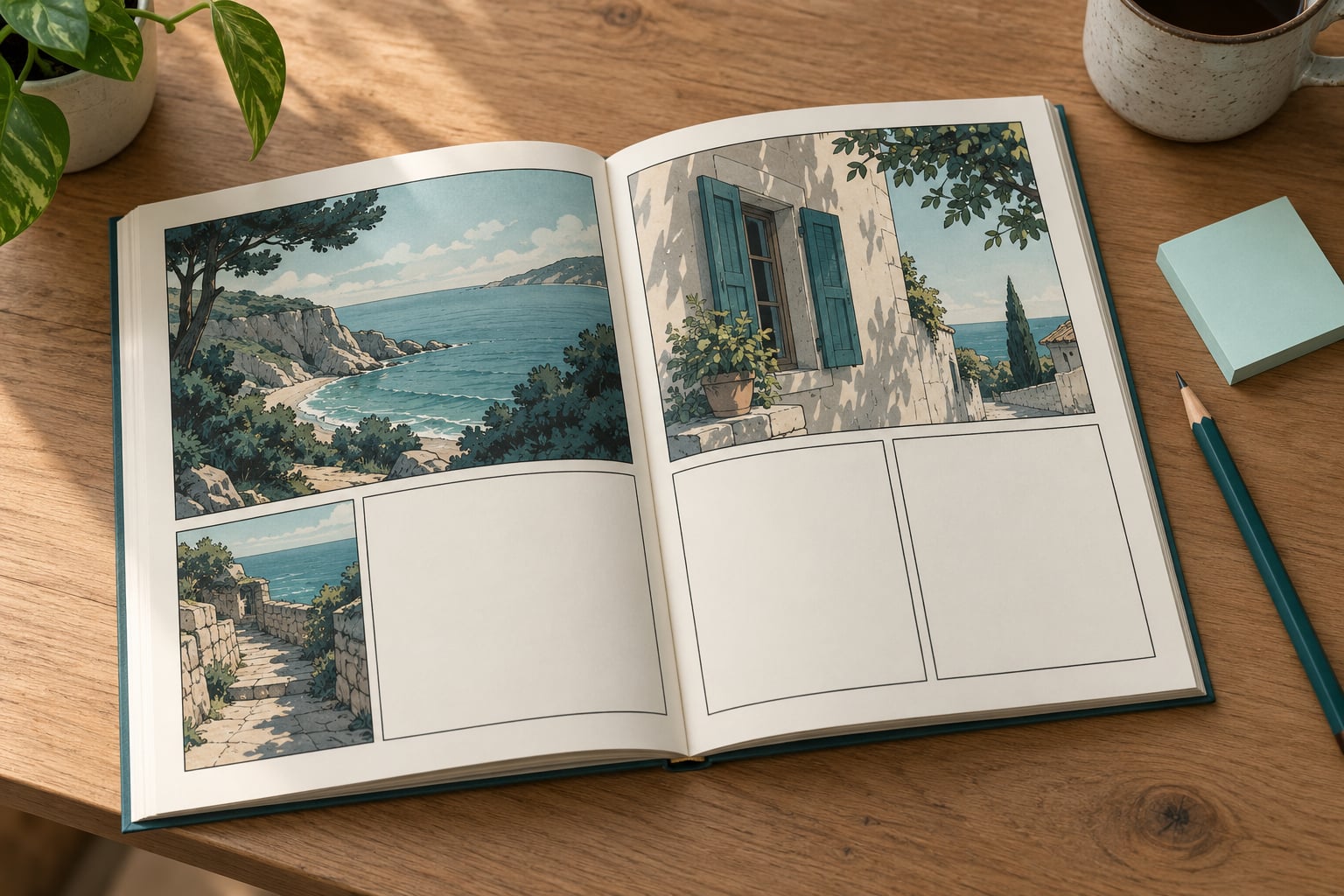
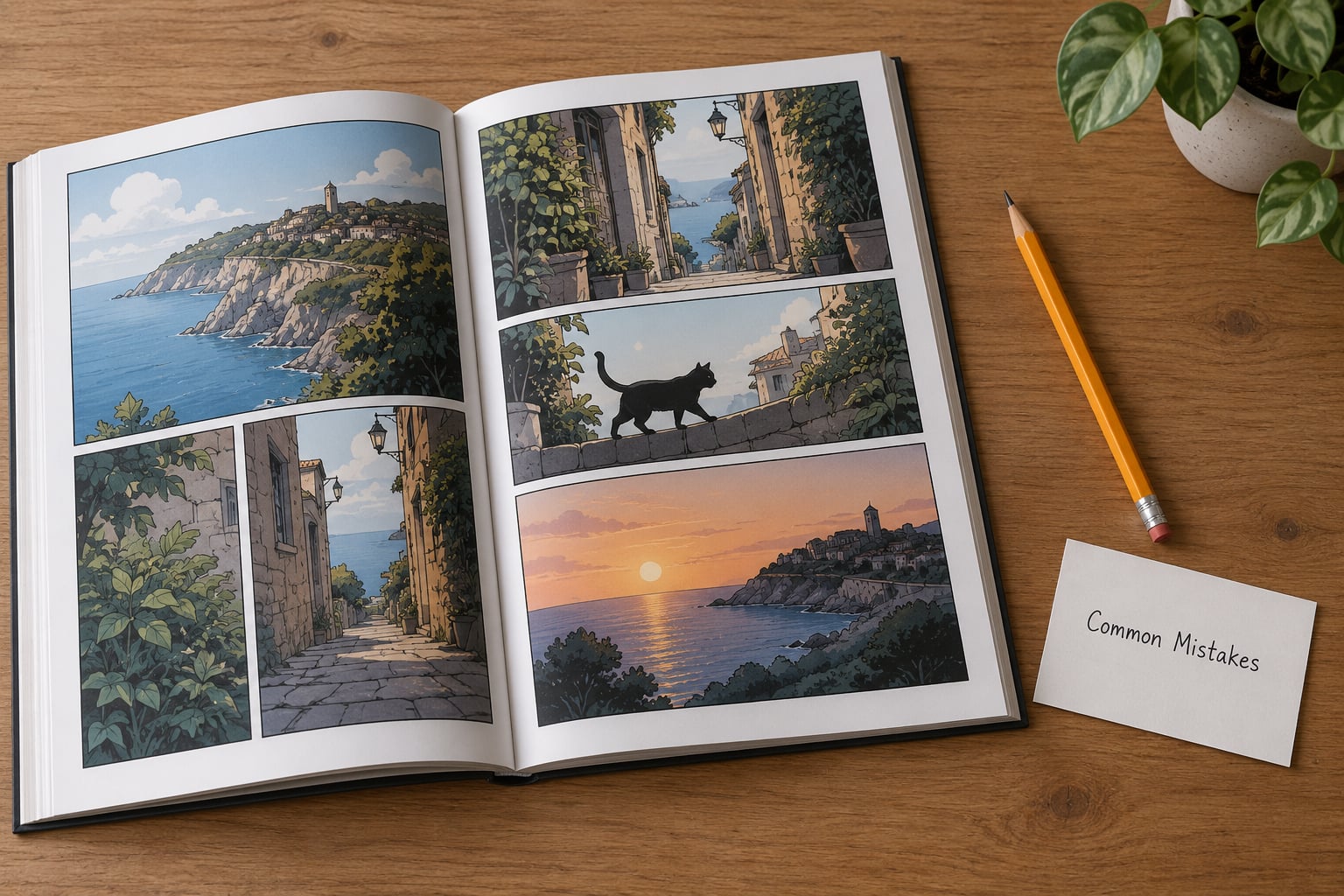
The space between two panels is called the gutter, and the panel shapes themselves tell you how fast a scene moves. A tall narrow panel feels like a moment stretching. A row of three small panels feels like rapid, nervous movement. A wide horizontal panel feels like looking at a whole landscape and holding still.
That is the part most beginners miss, and it is worth training your eye on early because it changes what you take from every page.
- Establishing shots show you where you are: a city, a house, a forest, a spaceship.
- Wide shots show a whole scene. Close-ups pull in on a face or a hand, and they almost always signal that something emotional is happening.
- Eye level versus low angle changes power. Looking up at a character makes them look imposing; looking down makes them look small.
- Two-page spreads that ignore the gutter are important. A character breaking through the centre line is often the moment everything changes.
- A splash page is a single image that fills the page, used when the artist wants you to stop.
Track your recurring characters the way you would track anyone in a novel. If a name appears in a caption and you do not recognise the face, glance back two or three pages. That is a normal thing to do.
Use Dialogue, Captions, and Visual Details Together
Four kinds of text appear on a page, and telling them apart is most of what people mean by learning to read comics.
- Speech balloons with a tail pointing at a character are spoken out loud.
- Thought balloons and bubbles made of small connected circles are thought, not speech.
- Caption boxes are narration — the closest thing comics have to a prose paragraph, and often where the time and place get established.
- Sound effects — large decorative lettering like WHAM or KRSH — are onomatopoeia, part of the drawing, and not meant to be read as a sentence.
Everything else in the panel is doing narrative work too. Lighting tells you where the danger is, because artists pool light around the important object. Repeated visual objects work like callbacks. A character holding an object differently from page forty tells you what has changed, and no caption spells it out.
Practical advice from readers who have done this a thousand times: it is completely legitimate to read the pictures first, then go back for the dialogue. Some of the most experienced readers do it in that order every time. You are consuming the story, not cheating.
Read at Your Own Pace and Mark Questions
Read fast. Graphic novels are built for speed, and pausing to analyse every panel turns a two-hour read into a four-hour one and drains most of the pleasure.
When you do slow down, slow down for a reason. Pause when a name lands and you want to remember it, when a scene does not make sense, or when an image is so good you want to sit with it. Skipping ahead because the artwork is doing the work for you is normal reading behaviour, not a shortcut.
A note system only needs to hold two things:
- Names. Four or five recurring characters is typical for a beginner book. Write the name with one detail about them.
- Open questions. Why did that character lie? What happened before this page? A running list of questions is enough.
Resolve the questions on a second read rather than during the first. Some of them answer themselves by the end, and others never resolve, which is its own kind of answer.
Look for the Story Between the Panels
Sequential art has one advantage prose does not: the gap between two panels is part of the storytelling. The most celebrated idea in the format is that the reader constructs the missing moment — the character picks up a phone, a door opens, a bomb falls — and every reader constructs it slightly differently.
Things worth noticing on a second reading:
- Repetition. The same panel or composition appearing three times, once per chapter, creates a pattern you only see at the end.
- Silence. A page with no dialogue at all is doing something deliberate. It is often the loudest page in the chapter.
- Page turns as punctuation. Writers place reveals on the far side of a page turn specifically to control your reaction.
- Screen tone and speed lines. The dotted shading textures used for shadow, mood, and distance; the radiating lines used for impact or speed.
- Recurring framing. The same window, doorway, or tree repeated across scenes carries meaning without a word of text.
You do not need to catch all of this on a first read. The point is only to know it is there, so a second reading of a book you liked rewards you in a way the first one did not.
Finish the Book and Reflect
Finish it. The temptation to abandon a graphic novel at page 40 is strong because the pace feels strange at first, and by page 40 you usually have forgotten that you felt that way.
Afterwards, five questions are enough:
- What happened, in your own sentences?
- Which character did you notice most, and why that one?
- What was the tone — funny, bleak, tense — and did it hold steady?
- Which single page stayed with you?
- Where did you get stuck, and was it confusion or just density?
If you can answer the first one without checking, you read it properly. That test matters because a lot of people finish graphic novels and cannot summarise them, usually because they spent the whole book reacting instead of reading.
Then make the next pick from the same creator, the same artist, or the same shelf in your library. The biggest beginner mistake is not picking the wrong book — it is picking one book, judging the format by it, and stopping.
Common Mistakes
Mistake 1: Starting in the middle of a long-running series. The fix is a hard rule for your first three books: something that starts the story. If the listing says Volume 1, that counts. If it says issue 60 or chapter 400, walk past it. You will lose nothing by starting later and everything by starting wrong.
Mistake 2: Treating every panel like a puzzle to decode. Panels are a sequence, not a hidden-object game. Read them in order at normal speed and the story assembles itself. Slow down to admire art, certainly, but not to work out what each frame means.
Mistake 3: Buying a stack instead of borrowing one. Libraries hold most of the canon and nobody will judge you there. Take out two, and if one works, buy that one afterwards. Shop staff are also genuinely helpful when you tell them plainly that it is your first time and what you usually read.
Mistake 4: Assuming comics are not real reading. This comes up constantly and it is worth a straight answer. Graphic novels are dense with inference, vocabulary, sequence, and the integration of visuals with text, which is why schools teach with them. The reading is real; the medium is just different.
Mistake 5: Reading a phone in the wrong mode. Most reader apps have both a scroll mode and a panel-by-panel view. Use panel view, and for manga check that the reading direction setting is set to right to left before you start.
Some flexible tips that work well. Re-read your first book, because second readings of visual storytelling are a completely different experience. Read with music off for dialogue-heavy books and with music on for atmospheric ones. Read a chapter before bed, since the format suits tired brains. If you get stuck on a long series, drop it and come back in a year without any guilt — that is what the second shelf is for.
For younger readers and for anyone who finds small text or fast page changes difficult, larger print editions exist for popular titles, most major digital platforms have text-to-speech options, and talking about each page as you go is a genuinely good way to read aloud with a child rather than narrating over the panels yourself.
Frequently Asked Questions
How are you supposed to read graphic novels?
You read them panel by panel in a fixed order. On a Western graphic novel, start at the top-left panel, read across left to right, then drop to the next row and start again at the left. Take each panel’s drawing together with its speech balloons, caption boxes and sound effects, then turn to the next page when the page ends. Nothing else is required.
In what order should comic panels be read?
In the order the page is designed to be read: generally top to bottom, moving left to right across each row. Artists arrange panel sizes and positions to make that path obvious, and bleeding panels and page-turn reveals signal where the story goes next. You are never decoding a hidden order, you are following the one the artist laid out.
Which way do manga read compared with Western comics?
Manga reads right to left and top to bottom, so you begin with the top-right panel and work leftward, while Western graphic novels run left to right and top to bottom. Manga binds the same way, opening at the back cover, but the panel order on the page is mirrored. Reader apps often have a reading direction setting that needs switching.
Do I have to read comic books in order?
No. For a series that runs in arcs, start with the trade that begins at Volume 1 or at a clear origin retelling rather than issue one. Reading order only matters once you want the full backstory, and many long runs are not written to be read that way. Pick self-contained stories first and follow an ongoing series later if you want to.
Is reading graphic novels good for your brain?
Graphic novels train comprehension skills that regular prose does not exercise: inferring events from images, connecting visual and textual information, and holding a sequence of cause and effect in working memory. That is why schools use them for reluctant readers and for students learning to summarise. For adults it is a low-friction way back into long-form reading.
How long does it take to finish a graphic novel?
Most are between 100 and 250 pages and take about two to three hours, because the images carry part of the plot that prose would spell out. A longer epic might take six hours or more. Break a book across two evenings rather than abandoning it, since many readers find the pace feels slow for the first ten pages and then impossible to put down.
Conclusion
Pick one self-contained graphic novel, or one trade marked Volume 1, and read it start to finish in a single sitting without looking anything up. Read the panels in order, take the words and the pictures together, and let yourself be confused for the first twenty pages. Then summarise it in your own sentences.
Everything above comes down to three habits: panel order, words and pictures read as one, and enough patience to stay confused for the first stretch. Get those right and how to read graphic novels for the first time stops being a question you have to look up.
That is the whole process. The rest is just choosing the second book.