
Knowing how to follow genre award season comes down to one repeatable system: an awards-year calendar, a short list of awarding bodies you actually care about, and a tracker where every longlist, shortlist and ceremony date lands in the same place. Set it up once and the Edgars, Anthonys, Agathas and CWA Daggers take about ten minutes a week to keep up with.
This guide is written for crime, noir, mystery and thriller readers and writers who want the season to work for them, not the other way around. The whole setup takes an evening, and it pays off for eleven months.
Table of Contents
- What You Need
- Step-by-Step: Build Your Genre Award-Season System
- 1. Define the Awards and Genres You Want to Track
- 2. Create an Awards-Year Calendar
- 3. Follow Official Submission and Eligibility Updates
- 4. Track the Books and Authors on the Lists
- 5. Schedule Reading, Review, and Voting Time
- 6. Monitor Final Results and Industry Developments
- 7. Archive the Season and Reset Your Tracker
- Common Mistakes
- Frequently Asked Questions
- When does genre award season usually begin?
- How do I know whether a book is eligible for a genre award?
- What is the easiest way to keep up with crime and noir fiction award announcements?
- Should I read every longlisted and shortlisted book?
- How can writers use award lists to find editors, agents, and publishers?
- Are award deadlines and submission rules always fixed?
- What to Do First: Follow Genre Award Season Without Drowning
What You Need

Four things cover almost everything: a current awards calendar, somewhere to record what you learn, the official websites of the bodies you follow, and a way to be told when something changes.
- An awards-year calendar. A shared or personal calendar running the full cycle, from submission windows through the final ceremony. Month-level entries are enough to start.
- A spreadsheet or task manager. One row per book, one column per award. This is where the real work happens, and it is the piece most people skip.
- Official awarding-body sites. Bookmark the pages where nominations, rules and ceremonies are announced, not aggregator posts about them.
- Publisher award pages and submission trackers. If you write or have a manuscript in circulation, your target publishers usually publish their own award pages with submission windows and reading preferences.
- Notification settings. Email alerts and calendar subscriptions, turned on once so the news reaches you instead of the other way round.
None of this costs anything, and none of it needs to be complicated. A free spreadsheet and a phone calendar handle a full season comfortably.
Step-by-Step: Build Your Genre Award-Season System
Following genre award season works best as a cycle rather than a series of one-off reactions to announcements. Seven steps cover it, and steps one and seven only need real attention twice a year.
1. Define the Awards and Genres You Want to Track
Narrow the field before you track anything, because the full list of crime and mystery prizes runs to dozens of bodies across a dozen countries. Pick four to six and ignore the rest for a season.
Start with the awards that match what you actually read. For most crime and noir readers that means the Edgar Awards from Mystery Writers of America, the Anthony Awards handed out at Bouchercon, the Agatha Awards at Malice Domestic, and the CWA Dagger Awards in the UK. Add the Macavity Awards from Mystery Readers International if you enjoy reading around the edges of the mainstream lists.
- Edgar Awards — Mystery Writers of America. Best novel and first novel in crime writing, US and international. Nominations and ceremony both land in spring.
- Anthony Awards — Bouchercon. The broadest crime and thriller field; the longlist is published ahead of the convention, then the shortlist and ceremony follow in autumn.
- Agatha Awards — Malice Domestic. Traditional mystery and cozy crime. Nominations are announced late in the year, the ceremony is in spring.
- CWA Dagger Awards — Crime Writers’ Association. UK-published crime and thriller writing. Shortlist early in the year, ceremony mid-year.
- Macavity Awards — Mystery Readers International. Reader-voted, category-based. Nominations and voting around the autumn.
- Ngaio Marsh Awards — New Zealand crime writers. NZ-published crime fiction across categories. Judging in spring, results in winter.
Regional bodies deserve a slot too. The Arthur Ellis Awards in Canada, the Ned Kelly Awards in Australia, the Glass Key in Scandinavia and the Le Grand Prix de Littérature Policière in France reward books most US and UK readers never hear about, and winning one usually travels.
2. Create an Awards-Year Calendar
Map the annual rhythm onto one calendar so the season runs as a cycle rather than a pile of dates you rediscover each time.
Each award you follow needs at least five entries: the eligibility cutoff, the submission or nomination deadline, the longlist date, the shortlist or final ballot date, and the ceremony. Some bodies also run a separate readers’ award with its own voting window, which is easy to miss because it usually sits well away from the main ceremony.
Expect the pattern roughly like this, with shifts year to year:
- Early months: previous season’s ceremonies wind down, while UK and Commonwealth awards are finalising ballots.
- Spring: Dagger shortlists, Agatha nominations and Edgar announcements land close together, and crime writing conferences become the week’s talk.
- Summer: submission windows for next year’s prizes open and close. This is the quiet stretch that writers should be using.
- Late summer: Anthony longlists appear and get argued over in reader forums.
- Autumn: the Anthony shortlist, Bouchercon itself, Ned Kelly announcements and Macavity voting.
- Winter: northern-hemisphere awards reach their winners, and the new year’s reading pile starts filling.
Mark every uncertain date as TBA rather than guessing. Announcements often firm up only weeks ahead, and a calendar that pretends to certainty ages badly.
3. Follow Official Submission and Eligibility Updates
Rules change more often than people expect, and the official page is the only place that matters.
When you set up an award, read its rules document end to end: the eligibility window, publication format, geographic or publishing-territory requirements, judging method and category definitions. The Dagger, for example, is restricted to works published in the UK, so a book that dominates US lists can be ineligible, and readers regularly misread this as a ranking.
Then bookmark the announcement pages on the awarding body’s own site and check the publisher’s awards page for your submissions. Publishers post submission windows, often with guidance on what they are reading for, and those pages usually carry a clear deadline rather than a vague open call.
How to follow genre award season means treating the awarding body as the source of truth and every other account as commentary. Forums are useful for reading mood and spotting rumour, which is a different job entirely.
4. Track the Books and Authors on the Lists
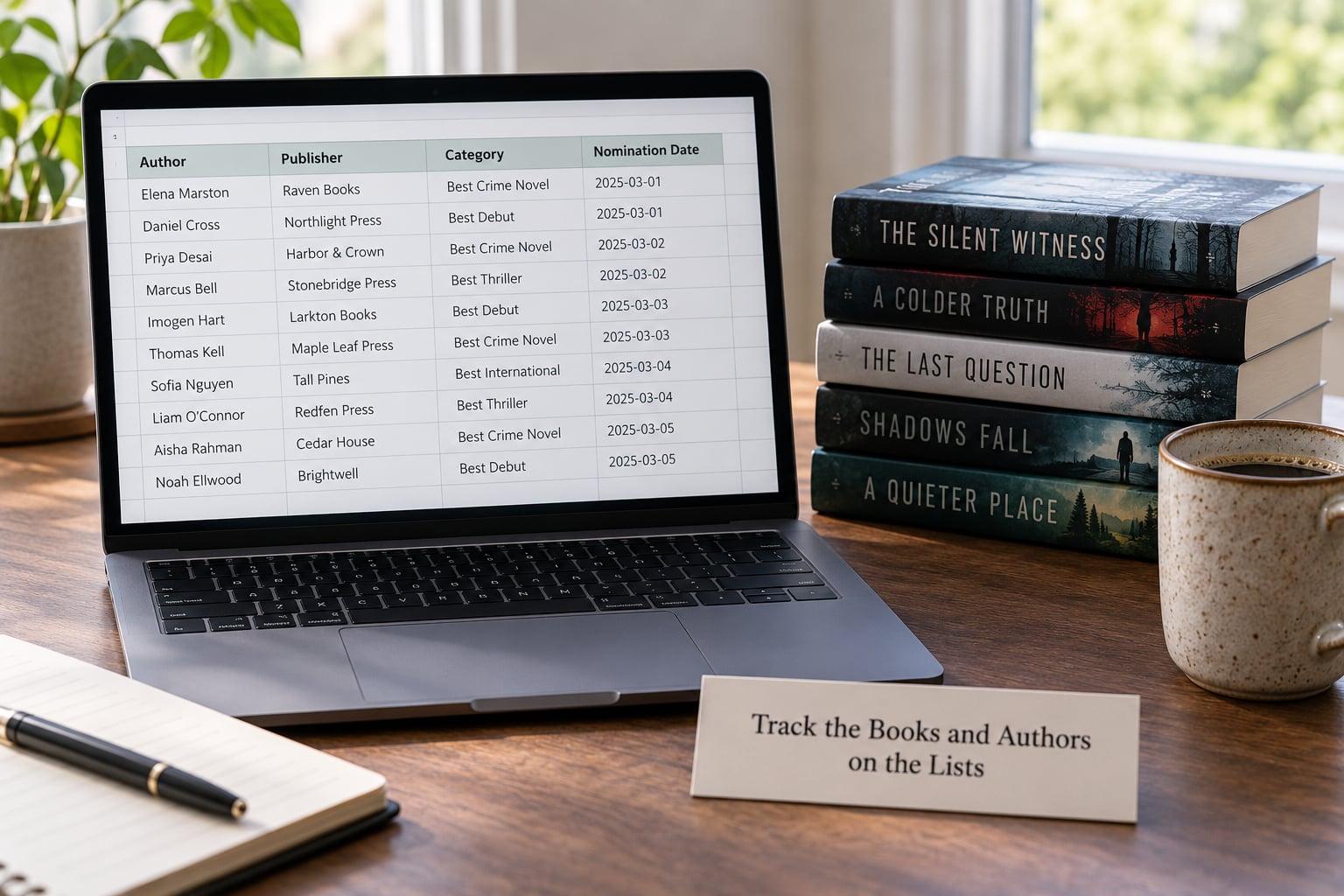
Longlists are long and unranked, which makes them hard to read and easy to over-track. A spreadsheet fixes that.
Give each book one row and give each column a job: author, publisher, imprint, award, category, date nominated, where you can get it, your read status and two lines of notes. The notes column matters more than it looks, because a season is long and your memory of why a book mattered in February is not reliable by April.
Add a rating column and a predicted-winner column if you enjoy that part. Community scoreboards built as shared spreadsheets are a well-worn way to follow a long race, and keeping one for literary prizes works exactly as well as it does for film.
For writers, the same sheet does a second job. When a book lands on a longlist in your genre, that is a signal about which publishers are buying that kind of book right now, and the shortlist tells you which editors to pitch next.
5. Schedule Reading, Review, and Voting Time
Awards only help if you read them, so put the reading on the calendar before the list arrives rather than after.
Block two or three sessions a month during shortlist season, and read by award rather than by author so you spread across names you would not have picked yourself. That is the whole value: a shortlist is a curated reading list generated by people who read far more of the field than you will.
Readers who vote in members’ ballots or readers’ awards should note the closing date and vote, because those awards swing on turnout more than anyone admits. If you review for a blog or a newsletter, the same list is your editorial calendar for three months.
For writers, keep a separate submissions calendar with a working-backwards deadline. Award bodies set deadlines by their own publication year, and missing one by a week is the most avoidable mistake in the whole cycle.
6. Monitor Final Results and Industry Developments
Result days are the busiest part of the calendar, and they reward a slow read rather than a fast one.
Winner announcements bring acceptance speeches, jury comments and a wave of trade coverage. The speeches often carry more information than the result itself, since authors tend to name the editors, agents and imprints who made the book possible.
Keep two things separate as you read the coverage: confirmed information and speculation. Category trends are worth noting, since a body adding or dropping a category tells you where the money and the acquisitions are moving, but avoid treating forecast posts as news. In the crime fiction forums the predictions are genuinely fun, and they are still just opinions.
For industry followers, note which publishers collect nominations across a season. That pattern is a reliable leading indicator, and it shows up months before the next round of deals.
7. Archive the Season and Reset Your Tracker
Close the loop properly, because an unarchived season is the same as no season at all.
At the end of each cycle, save the final lists, your notes, the ceremony dates you actually used and the publishers and editors worth contacting. Duplicate the tracker and clear the rows rather than starting a fresh file, which is how you lose the structure.
Then write three lines: which award turned out most useful, which source kept you best informed, and which one you should drop. Repeating a working system each year is how following genre award season becomes a habit that costs almost nothing.
Common Mistakes
Most lost seasons come down to a handful of predictable errors, and each has a simple fix.
Treating every award as equal priority. The fix is a hard cap of four to six tracked awards. A wider net produces a spreadsheet nobody opens.
Trusting reposts over official pages. Fix: the awarding body’s own site and the publisher’s awards page are your sources. Everything else is commentary.
Ignoring eligibility rules. Fix: record the eligibility window in the calendar row for each award, not just the ceremony date. This is why one book can appear on several lists in a single season without anything being wrong.
Missing a deadline because it moved. Fix: keep a separate alerts column and check for changes monthly. Postponements do happen, usually for venue or scheduling reasons, and they are announced on official channels.
Reading nothing but the shortlist. Fix: treat shortlists as one input rather than the whole list. Otherwise you end up rereading the same five books everyone else is reading and missing the debuts that never made a list.
Writing for the awards instead of writing the book. Fix: awards reward finished work read by judges under pressure. Chasing a trend produces books that age badly, and the trend itself is usually a year behind.
Two habits keep the balance sane. Read one book from outside the awards entirely each month, and cap award-related admin at a fixed weekly slot rather than letting it spread across the week.
Frequently Asked Questions
When does genre award season usually begin?
For crime and mystery writing it runs most of the year, with two busy peaks. Spring brings Dagger shortlists, Agatha nominations and Edgar announcements, while autumn brings the Anthony longlist, the Anthony shortlist and Bouchercon itself. The quieter stretch is summer, when submission windows for next year’s prizes open and close.
How do I know whether a book is eligible for a genre award?
Check the rules page of the awarding body. Eligibility usually turns on publication year, publishing territory and format. Some awards, such as the CWA Dagger, are open only to works published in the UK, while others accept any English-language edition. The same book can be eligible for several awards in one season for exactly this reason.
What is the easiest way to keep up with crime and noir fiction award announcements?
Bookmark the announcement pages of the awarding bodies you follow rather than the awards themselves. Add each awarding body and each publisher’s awards page to a reading list or newsletter feed, then mirror the handful of dates that matter into one calendar. That way the news arrives on its own and you read it in one sitting.
Should I read every longlisted and shortlisted book?
No. Longlists can run to dozens of titles, and reading all of them is how people give up. Read the shortlist and final ballot, sample the longlist for discovery, and let the spreadsheet’s notes column keep your impressions. If you vote in any award, read the full ballot for that award only.
How can writers use award lists to find editors, agents, and publishers?
Track which imprints collect nominations year after year. Publishers sitting on a run of shortlisted books are buying actively in that genre, and the acceptance speeches at ceremonies usually name the editors behind winning titles. A shortlist is a quiet, current list of which desks are doing the buying.
Are award deadlines and submission rules always fixed?
No. Submission windows, eligibility cutoffs and ceremony dates all shift, usually for venue or scheduling reasons. Announcements sometimes land only weeks ahead of a deadline. Read every date as provisional until the awarding body confirms it, and check the official rules page each season rather than trusting a calendar copied from another site.
What to Do First: Follow Genre Award Season Without Drowning
Pick four awards and open one spreadsheet tonight. Add the eligibility cutoff, longlist, shortlist and ceremony dates for each, mark anything unconfirmed as TBA, and let the calendar do the remembering from there. Ten minutes a week is enough once the system exists, and most of the value arrives in the reading it pushes onto your list.