Most major book prizes are not decided by a public vote. They are decided by a small panel of appointed judges who read every eligible book submitted, agree a longlist, cut it down to a shortlist, and then argue out a single winner in a room most readers will never see. Understanding how juried book prizes choose winners matters if you write, submit, or simply want to know why the book everyone is talking about got the nod.
I’ve spent a lot of time around awards-season conversations, and the same questions come up every year: who picks the judges, do they read on the cover, do they get paid, and can a board overrule them. Here is how the machinery actually works, stage by stage, with the differences between prizes left visible rather than smoothed over.
Table of Contents
- How Juried Book Prizes Choose Winners
- What Happens Before the Judges Read the Books?
- Does the judging panel read on the cover?
- How Does a Prize Jury Evaluate the Submissions?
- What happens inside a judging meeting
- What Do Judges Look for When Choosing a Winning Book?
- How Do Scoring Systems and Tiebreaks Work?
- Why Do Shortlists and Final Winners Sometimes Differ?
- What Powers Can Final Juries and Boards Have?
- Can Authors Influence Their Chances Without Gaming the Process?
- What Can Readers Learn from a Prize’s Judging Method?
- Frequently Asked Questions
- Do juried book prizes read every eligible submission?
- Are book-prize judges blind reads?
- How many books advance to a prize shortlist?
- Can judges change their scores during deliberations?
- Does winning a major literary prize guarantee book sales?
- Can a publisher or prize board overrule the jury’s choice?
- What to Check First Before Entering a Book Prize
How Juried Book Prizes Choose Winners
A juried prize picks its winner in stages: staff screen the eligible entries, judges read the submissions, scores or discussion produce a longlist and then a shortlist, and the full panel deliberates until one book remains. The chair usually holds a casting vote for when consensus fails.
That basic shape shows up almost everywhere, in prizes with completely different reputations. What changes between prizes is who sits on the panel, how much they are given to read, how they record their reactions, and how much power the sponsoring organisation keeps. Six stages cover nearly all of it:
- Submission. Publishers, agents or authors send books in during a fixed window. Most major prizes require publisher submission rather than direct author entry.
- Administrative screening. Staff check eligibility: publication dates, imprint status, category, and whether the entry meets the rules on format and fee.
- Appointment and briefing. An advisory committee or board appoints judges for a fixed term, disqualifies anyone with a conflict of interest, and gives the panel a written brief.
- Reading and longlisting. Judges read the eligible pool and each argues for a set number of books until the panel agrees a longlist.
- Re-reading and shortlisting. The same panel, or a subset, reads the longlist more closely. Titles must be actively championed by more than one judge to make the shortlist.
- Deliberation and the win. The full panel discusses the shortlist as a group, revises its positions in the light of the argument, and settles on a winner.
Stage five is where most confusion starts, because longlisting and shortlisting are two separate judging acts, not one long process wearing a different label. A book can clear the first filter easily and then fail to survive closer reading by exactly the panel that put it through the first.
What Happens Before the Judges Read the Books?
Before any literary judgement happens, a prize administrator handles the paperwork that keeps the process defensible. Screening is not evaluation: nobody is ranking books at this stage, they are removing entries that cannot legally or practically be considered.
Typical checks include publication date and edition format, whether the book was published by an imprint or self-published in a way the rules permit, which category it belongs in, whether an entry fee was paid where one applies, and whether the same book has already been entered. Prizes that restrict entry to UK and Commonwealth publishers, Irish publishers, or American publishers publish that rule as part of their eligibility terms, and non-compliant books are simply out of the running.
Conflict-of-interest screening happens alongside this. Judges are expected to declare relationships with authors, agents, publishers and jurors, and in several major prizes a judge is recused from a title rather than voting with a disclaimer attached. It is also common for a book submitted by a judge’s own publisher to be handled without that judge’s involvement.
Does the judging panel read on the cover?
Conventions differ and the honest answer is that practices have tightened over time. Many juries now read submissions as plain text or in plain covers where the rules allow it, to strip away marketing design and author reputation. Others still work from the finished book, because the cover and interior typography are part of what a reader receives.
What almost never survives is the author name at judging stage in the prizes that have formalised blind or semi-blind reading. A judge’s prior knowledge of a famous debut is treated as a problem to be managed rather than a bonus to be enjoyed.
How Does a Prize Jury Evaluate the Submissions?
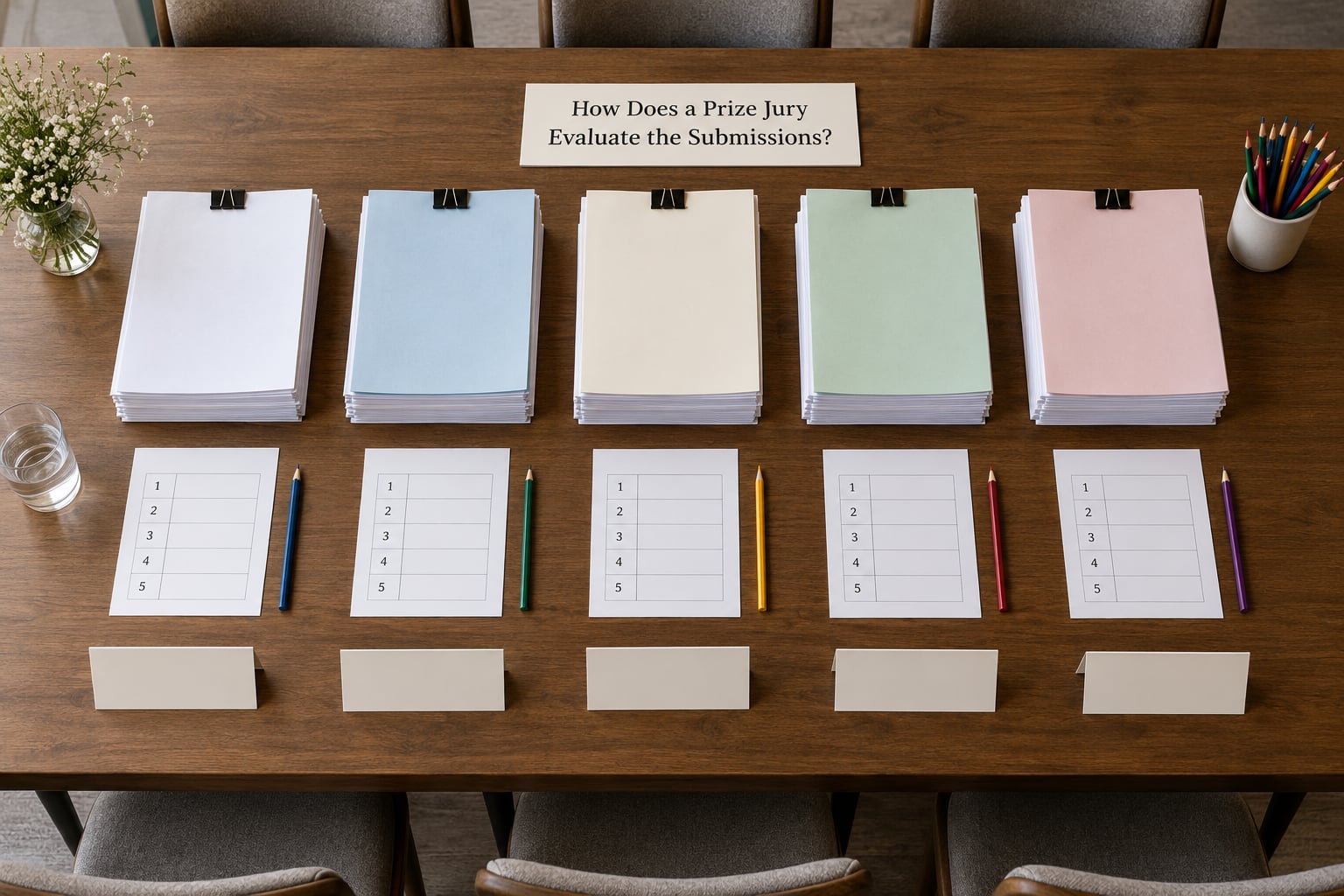
Judging is disciplined reading with written evidence behind it. Judges are typically writers, critics, editors, booksellers and academics, and they serve for a single award year rather than sitting on a panel indefinitely, which keeps repeat friendship and habit from compounding across cycles.
The Booker Prize is the most transparent public example of how panels get assembled. Five judges are appointed each year by an advisory committee drawn from writers, critics, broadcasters and academics, chosen for a broad spread of reading and a mix of professional backgrounds. Judge selection is a named, published process with a stated rationale for each appointment, and the prize dropped the Man from its name when sponsorship and remit changed in 2015, which is the clearest example of a major prize revising its own terms in public. Other prizes publish their rules with varying degrees of detail, which is itself a signal worth noting.
Are the judges paid? Usually not in the way a job is paid. Many prizes reimburse expenses and may pay a modest stipend or honorarium, but the standard is that judging is unpaid professional service, and prize administrators say so plainly. The bigger incentive is reputational and professional, which is one reason panels rotate rather than linger.
What happens inside a judging meeting
Judges read independently first and only then talk. Independent reading matters because a group that argues from book one tends to anchor on the opening impressions, so the panel is deliberately split up before any discussion begins.
When the discussion starts, judges argue for books rather than against them. Each judge brings nominated titles to the table, and a book advances only if more than one judge puts it forward. That rule is why large panels do not produce large shortlists: a title with one enthusiastic champion and no second reader is a title that dies quietly in the second round.
Judges also write annotations. A few lines on why a book moved them, what it risked, what weakened it. Those notes get shared in the room and they carry real weight in the final argument, because a claim backed by a written reaction is harder to wave away than a claim backed by a strong personality.
What Do Judges Look for When Choosing a Winning Book?
Judges assess the book as a whole rather than rewarding one conspicuous feature. A beautifully written novel that never goes anywhere and a relentlessly readable one that takes no risks both tend to lose to a book that holds craft, ambition and coherence together, and that is the trade the panel is usually trying to make.
The recurring criteria fall into a few clusters. Craft covers prose control, structure and pacing. Originality covers whether the book has an idea or an approach that felt necessary. Voice covers whether the writing sounds like a person rather than a style. Stakes cover whether the subject earns its length. And execution covers whether a genre book understands the genre’s pleasures well enough to play with them.
Published accounts of judging conversations tend to name two qualities that sit outside neat craft categories: courage and experimentation. Trade coverage of a Booker panel quoted judges on choosing work that took risks and experimented with form, qualities that sit awkwardly beside readability. If you want the long version of that conversation, it is worth reading the panel’s own announcement and any interviews the judges give afterward, because those are usually the only places a real rationale appears before the acceptance speech.
Three quieter biases are worth naming. Hype is one: a book with heavy pre-prize attention arrives with a frame attached, and experienced judges are supposed to discount it without pretending it does nothing. Length is another. Research from the University of Galway examined literary award shortlists and found longer novels were more likely to win, a pattern researchers named the rule of tome, and it is a live criticism of literary fiction judging in particular. The third is subject matter, which judges are asked to set aside, and which readers frequently believe they do not.
That last belief is worth taking seriously rather than dismissing. A recurring complaint in reader forums is that prize books often feel dry, and that the writing is judged to matter less than the importance of what it is about. There is a defensible answer: juries are explicitly optimising for something different from reader comfort, and a jury that picked the most immediately readable book on the list would not be doing its job. Whether that mandate serves readers well is a fair argument to have, but it is a different argument from whether the judges read the books.
How Do Scoring Systems and Tiebreaks Work?
No two prizes tabulate identically, but almost every method falls into one of a handful of patterns. Some combine scores, some record preference order, some decide entirely by discussion, and some run a ranked vote before anyone opens a conversation.
| Ranking method | How it works | Where it breaks down |
|---|---|---|
| Total score | Every judge scores each eligible book against published criteria; totals produce the longlist and shortlist. | A high score from one reader can outweigh three lukewarm ones, and criteria drift over a long reading pile. |
| Ranked preference | Judges order their own shortlist; the panel compares overlapping preferences. | Strong individual taste resists compromise and can stall agreement. |
| Nomination threshold | A book advances only if two or more judges put it forward in open discussion. | Produces small shortlists by design, and rewards books with more than one committed reader. |
| Longlist plus panel vote | Panel agrees a longlist first, then votes the winner from it. | Voting can harden positions that discussion would have softened. |
| Chair’s casting vote | If consensus fails, the chair chooses between the two leading books. | The last word moves from the panel to one person, however modest the panel was. |
| Board ratification | An independent jury recommends; a board or sponsors confirm the result. | The final authority sits outside the group that read the books. |
Tiebreaks are where a prize’s true philosophy shows. A prize that insists on consensus will deliberate longer rather than vote. A prize with a casting vote in its rules has already decided that deadlock is resolved by the chair. And a prize that ranks by vote has quietly accepted that a majority beats a room in agreement.
Scores themselves are not always sacrosanct. In several prizes the panel is explicitly permitted to move a score after hearing another judge’s case, which is the point of discussion rather than a flaw in the method. What is unusual is a prize that formally allows a judge to change a position during the final meeting, because that removes the discipline of committing to an assessment before hearing the counter-argument.
Why Do Shortlists and Final Winners Sometimes Differ?
A shortlist is a verdict on a book read once under pressure; a win is a verdict on a book read again with the whole panel’s objections in the room. Different books win those two contests, and the gap between shortlist and winner is where most reader disappointment with the process lives.
Three things change between the two stages. Reading depth changes: a shortlist title is re-read carefully rather than swept past in a stack. The comparison set changes: a judge who loved the fourth book on the longlist is now being asked whether it beats the other shortlisted titles, which is a harder question than whether it is good. And the panel dynamics change: the more confident voices tend to set the early frame of a shortlist deliberation, and a quieter judge with a late, strong read can shift the room if the chair lets the discussion stay open.
Separate panels also explain a lot of surprise results. A book can place differently under a panel that weights narrative invention heavily and a panel that weights characterisation and emotional precision. Genre juries work the same way: crime and noir juries tend to weigh plot architecture, procedural fairness and the quality of the mystery’s central turn, so a literary novel with an unresolved structure that would lose a general fiction panel can hold up well where the puzzle is the point.
None of this means a shortlist was a mistake. For most authors the shortlist does more work than the win itself, and plenty of books that did not take the top prize went on to sell, to travel and to pick up rights.
What Powers Can Final Juries and Boards Have?
Three arrangements exist, and they are easy to confuse. An independent jury reads the books and decides the winner, with nobody able to overrule it. A board or committee decision hands the final vote to a group that has not read the submissions, which is common in prizes funded by a sponsor or a professional body. A membership vote leaves the winner to the wider membership, sometimes after a jury has produced a shortlist.
Published rules tell you which one you are dealing with, and they also settle the questions readers argue about most. If the rules say the jury’s decision is final, that is the end of the process. If they say the board ratifies the jury’s recommendation, the board has a theoretical veto and everyone will know the day it is ever used. If they say the membership votes, then a juried shortlist has been combined with a public ballot, and the prize has quietly become a hybrid.
Critics of the sponsor model point out that an organisation funding a prize may also have commercial interests near the submissions. That is a real structural tension and it is why transparency about panel membership and about any conflicts declared matters so much to readers who want to weigh a prize’s credibility.
Can Authors Influence Their Chances Without Gaming the Process?
Most of what determines a result is outside an author’s control, and the honest list of levers is short. What you can control is eligibility, form and fit with the prize’s stated aims.
Practical guidance for writers: follow the formatting and eligibility rules, submit only eligible work, avoid advocacy aimed at judges, and focus on meeting the prize’s stated aims. Panels are reconstituted each award year, so the rules in front of you in 2026 are the only ones that govern this cycle, and they are often revised between years.
- Enter through the right channel. If the rules require publisher submission, a self-published book is outside the process from the start. Check this before anything else.
- Hit the window and the format. Late entries and non-compliant files are removed administratively, with no appeal.
- Match the prize’s category. A book entered in the wrong category is read by a panel looking for something it is not.
- Write to the prize’s stated aims. If the rules describe a shortlist of books that address a particular theme or readership, a book that ignores that aim is competing against itself.
- Never lobby the panel. Contacting judges about a submission is the one move that can end an author’s participation in a prize.
What you cannot control includes the panel’s taste, the year’s competition, how much attention a book arrived with, and the length of the pile in front of each judge. Writers who frame an award as a feedback process rather than a verdict tend to handle both outcomes better, and the submissions that get read most closely are almost never the ones with the loudest campaign behind them.
One caution for anyone paying entry fees. The Alliance of Independent Authors publishes guidance on contest red flags, and the number of book competitions running each year is in the thousands, many of them doing little more than selling an award badge. A prize that hides its judges, sells guaranteed placement, or cannot explain its screening is not running a jury.
What Can Readers Learn from a Prize’s Judging Method?
A prize’s judging method tells you what the prize is actually for, which is useful when you are deciding how much weight to give a win. A jury of five critics and writers optimising for craft and risk is a different instrument from a public vote, and from a membership ballot where booksellers and librarians choose. All three can be legitimate; they simply answer different questions.
Four details tell you the most. Whether the panel publishes its reasoning afterwards, whether panel members have declared interests, whether the longlist was decided by the same people who picked the winner, and whether the prize publishes its own rules and timelines. A prize that does all four is asking to be judged on its process, and that is a reasonable standard to hold it to.
The same lens works for the award lists attached to books. A prize with a named panel, published criteria and a documented timeline carries more information than a seal from a contest you have never heard of. Readers on forums ask this question constantly, and the answer is basically that transparency is the proxy for credibility.
Frequently Asked Questions
Do juried book prizes read every eligible submission?
At most major prizes, yes, at least in part, which is why panels are small and the reading period is long. A judge working alone might read several hundred books in a few months. In practice some prizes use unpaid first-round readers or assessment readers to filter a very large field, and the judging panel proper only reads what survives. The distinction matters, so check the rules for whether a panel reads everything or a screening stage sits in front of it.
Are book-prize judges blind reads?
It varies by prize and the rules have tightened. Blind reading means the author name is hidden, semi-blind means the identity is known but the work is judged on its own terms. Some juries read submissions as plain text with covers removed, others work from the finished book because cover and typography are part of the reading experience. What is common across established prizes is that any prior relationship between a judge and an author is declared and usually triggers recusal from that book.
How many books advance to a prize shortlist?
Shortlists are deliberately small, commonly somewhere between four and eight titles, with a handful of major prizes settling on six. The number is usually set in the rules rather than emerging from enthusiasm, because a jury can only hold a serious comparative argument across a limited set. Longlists, where they exist, run longer, often a dozen or so. Books that reach the shortlist but lose at the final meeting usually gain more than most debut titles do in years of ordinary sales.
Can judges change their scores during deliberations?
Usually yes. Most panels treat the score sheet as a record of an initial independent reading rather than a binding vote, and judges are expected to revise an assessment when another judge puts forward a case they had not considered. Some prizes are stricter and record final positions formally after the last discussion instead. The distinction is less about fairness than about how the last discussion is run, and the prize’s rules normally describe which practice applies.
Does winning a major literary prize guarantee book sales?
No. A win reliably lifts a title above the shelf, and that usually means more reprint orders, foreign rights interest, library and bookstore prominence, and speaking invitations. But the biggest commercial effect often arrives months later, at paperback or translation, and books with a large existing readership gain the least. Shortlisting alone often moves a debut further than the win moves a book that was already selling, which is why serious authors treat the longlist as the real prize.
Can a publisher or prize board overrule the jury’s choice?
That depends entirely on the rules. Where an independent jury makes the decision and its result is final, nobody can overrule it, and a board’s role is ceremonial. Where the rules give a board or sponsor ratification rights, the board holds a theoretical veto even though overruling a jury is rare and would become a story. Read the rules rather than assume, because juries, boards and membership ballots are often blurred together in coverage of the announcement.
What to Check First Before Entering a Book Prize
If you take one thing from this, make it the rules page rather than the prize’s reputation. The judging method is the only part of any award that is verifiable in advance, and it tells you whether you are eligible, who reads your book and how much of your entry fee goes anywhere but the prize itself.
Work through it in this order. Read the official rules end to end, including the eligibility section on who may submit. Confirm the deadline, the entry format and any fee before you prepare anything. Check the judging disclosures: panel size, how panels are appointed, whether members declare conflicts. Then verify the submission requirements against your manuscript and set aside the cost. If a prize cannot answer those four questions clearly, your money is better spent elsewhere.
And keep the outcome in proportion. A prize is one jury’s reading of one year, arrived at through a process with documented blind spots and a handful of recurring biases. It is a real achievement and it is not a verdict on the book.