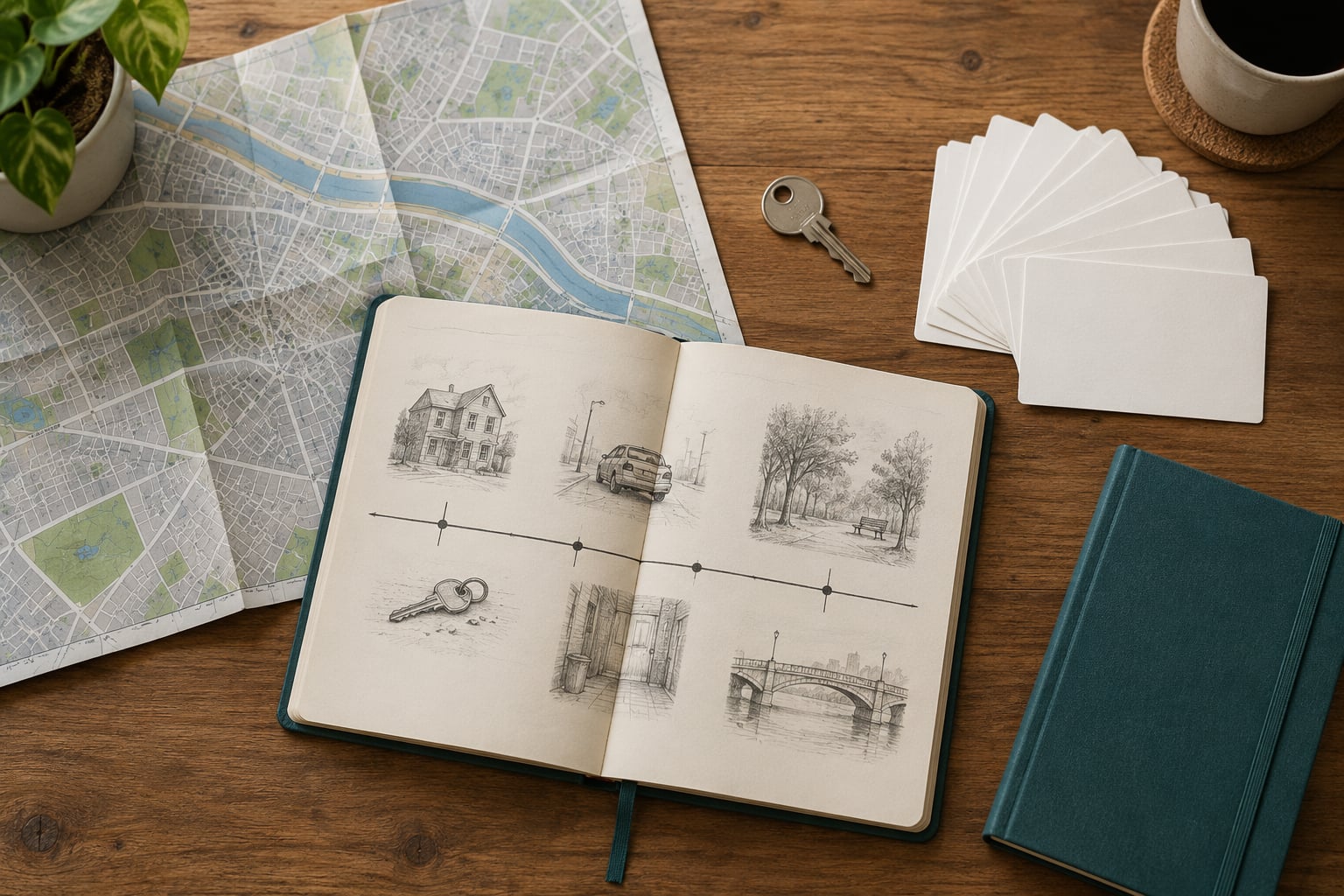
If you are wondering how to choose a setting for a crime novel, the answer is short: pick a specific place and time that actively produces your plot — the suspect pool, the possible crime, the pressure on your characters — not a backdrop you drop the story into. The process below takes an afternoon for a first novel and a long weekend if you are also planning a series. The genuinely hard part is not finding a good setting; it is throwing out one you are already attached to.
Writers get stuck on this step because they treat location as decoration. A rainy port reads as moody, so it goes on the cover, and then the plot has to fight its way back to the murder. Work the other way round instead: let the crime decide what kind of world it needs, then find the place that supplies it.
Table of Contents
- What You Need
- Step-by-Step: How to Choose a Setting for a Crime Novel
- Start With the Story’s Needs
- Generate Location Types, Not Just Famous Places
- Test the Setting’s Geography and Atmosphere
- Make the Social World Do Story Work
- Research Only What the Story Requires
- Map the Setting Onto the Plot
- How to Choose a Setting That Survives a Plot Rewrite
- Common Mistakes
- Frequently Asked Questions
- Do I have to use a real place in my crime novel?
- How do I research a setting I have never actually visited?
- Should my mystery be set in a small town or a big city?
- Can a crime novel have no named setting?
- How many separate locations should a crime novel use?
- How do I stop over-describing my setting?
- Start With the Crime, Not the Map
What You Need
Before you look at maps, get five things down on paper. Skipping this is why setting choices feel arbitrary later.
- The crime itself. Not a vibe, a sentence with a verb. A body in a hotel cistern is a different novel from a body in a shared allotment.
- Your protagonist’s want. A tired inspector wanting a quiet weekend and a grieving sister wanting an answer need settings that frustrate them in opposite directions.
- The mood. Hushed and claustrophobic, or bright and public with a private crime at its centre? The mood is a filter, and it will rule out half your options.
- The time period. Present day, thirty years back, or a dual timeline. Period adds a research load and a vocabulary you have to learn properly.
- Your research ceiling. How much time and money you can realistically spend. A place you have never seen and cannot visit is possible, but only if the story needs very little from it.
With those fixed, the test for any candidate is simple. A setting earns its place if it does at least one of three jobs: it creates pressure, it conceals information, or it changes how people behave. A street that is merely photogenic does none of those, however well it photographs.
One practical note on viewpoint while you are here. Your detective’s familiarity with the place is doing as much work as the place itself. A local who knows which shop backs onto the alley has access to information an outsider cannot buy, and that asymmetry is free plot.
Step-by-Step: How to Choose a Setting for a Crime Novel
Start With the Story’s Needs
Write the premise in one sentence and read it back with a place substituted for every noun it contains. “A woman vanishes from a rain-soaked industrial port in the week of a dock strike” behaves very differently from “a woman vanishes from a quiet suburban town during a school holiday” or “a woman vanishes from a crowded border city on the night of a market.” Same crime, three different novels, because each place supplies its own suspects and its own pressure.
Before you move on, settle three things. Who is investigating, and do they know the place? What does the place know that the reader will not learn until chapter twelve? And what does the place conceal? A canal system, a private hospital, a company town with one payroll office, a border with two languages — these are settings with secrets built in, and secrets are what a mystery spends.
Generate Location Types, Not Just Famous Places
Most stalled drafts are stalled because the writer is hunting for a place instead of a category. A category gives you ten options in ten minutes; a famous city gives you one, and the one you want probably already has four novels set in it.
Work from your conflict, not from a wishlist. A disappearance needs somewhere people arrive and leave: a transit hub, a festival, a ferry terminal, a commuter belt. A poisoning in an older couple’s house needs a place where the pharmacist knows the family. A disappearance in a place that has no press, no visitors and no leaving traffic is a different book again, and the absence of witnesses has to be the point rather than an accident.
That is the part of how to choose a setting for a crime novel that gets skipped. If you cannot name the location type in one line, you do not have a setting yet, and no amount of map browsing will produce one. This table is the shortcut I keep coming back to. It is not a ranking; it is a map of what each type hands you for free.
| Setting type | Crime opportunity | Suspect pool | Atmosphere it gives you | Research burden |
|---|---|---|---|---|
| Closed-circle island or remote village | High — nowhere to go | Very small, everyone has history | Isolation, weather, suspicion | Low, but logistics are fiddly |
| Small town | Medium — everyone knows everything | Small but overlapping networks | Familiar surface, buried pressure | Low if you know it, high if you don’t |
| Large city | Very high | Effectively unlimited | Scale, anonymity, indifference | High if you need street-level truth |
| Institutional space | Medium — controlled access | Fixed, known, dependent on hierarchy | Regiment, routine, procedural cold | Medium — needs insider vocabulary |
| Rural or agricultural | Medium — seasonal and isolated | Small, kinship-bound | Distance, silence, land | Medium — weather and seasons drive it |
| Historical period | Whatever the period allowed | Limited by who could act and travel | Distance from the reader, formality | Highest — language, policing, records |
Test the Setting’s Geography and Atmosphere
Now get physical. Distance from the nearest other place, number of ways in and out, sightlines, what the weather does in October, whether the streetlights work, where the cameras are, when the last bus runs. These are not set-dressing notes; they are the mechanics of your crime.
Map the means of entry and the means of escape before you map anything atmospheric. If your killer needs a vehicle, a winter road with no passing traffic is a different novel from a street with a bus stop every four minutes. If your victim lies in a place the neighbours hear everything through, then the alibi you need depends on a wall, a working television, or a baby crying.
Atmosphere is what remains once the mechanics are settled, and it comes from three or four precise details rather than a paragraph of weather. A bus that stops running at nine. Kettles whistling in every flat at the same hour. A tide that comes in over the footpath twice a day and makes the shortcut impossible after four. Readers register those as a world under pressure. They skim a third page of rain.
Make the Social World Do Story Work
A setting is not only geography. It is the set of unwritten rules about who may speak, who must defer, and what happens to people who ask the wrong question. That code decides who can be a witness and who cannot, what a suspect can say in front of a spouse, and which small humiliation a character is willing to accept rather than report.
Pick a place where those rules are visible and unequal. Class differences, a factory town where everyone owes the same foreman, a district where residents know the patrol rounds, a community where the police are welcome until they are not. In each of those, a character can be cornered by the setting itself, and a confession can be blocked by it too.
Kayte Nunn makes this argument directly: a place’s social context is where the themes of a crime novel actually live. The Pacific Northwest in her work is not scenery, it is a set of attitudes about outsiders, land and water that the plot leans on.
Research Only What the Story Requires
Decide what the novel needs to be true about, then stop. Usually that is a short list: how the police would actually receive this report, what the transport runs do after midnight, how a tenancy deposit dispute works, what the tide tables say in February, whether that bridge is open to cars in winter.
For each item, go to a primary source rather than a summary. Local news archives, planning documents, court reports, transport timetables, weather records, trade bodies. Write the finding in one line in a research file, with the date you checked it, because that is what you will need when you have forgotten it in month three.
Writing about a place you have never visited is entirely workable. Lizzy Barber wrote a Florida-set debut almost entirely from satellite imagery and street-level mapping, and the discipline of learning a place at that distance tends to produce sharper, more functional detail than a fortnight of wandering. What does not work is pretending to a level of familiarity you do not have. A novelist who misdescribes one street loses readers for the rest of the book, and they rarely say why.
If the research is running away from you, that is information, not failure. Shrink the scope of the place or move the story closer to a world you know.
Map the Setting Onto the Plot
Take your chosen setting and run it through the shape of the book. At the opening, what does the place make unavoidable? At the crime, what does it permit? During the investigation, what does it hide? At the midpoint, what does the character learn only because they are standing there? At the end, what does the place let them do that they could not have done anywhere else?
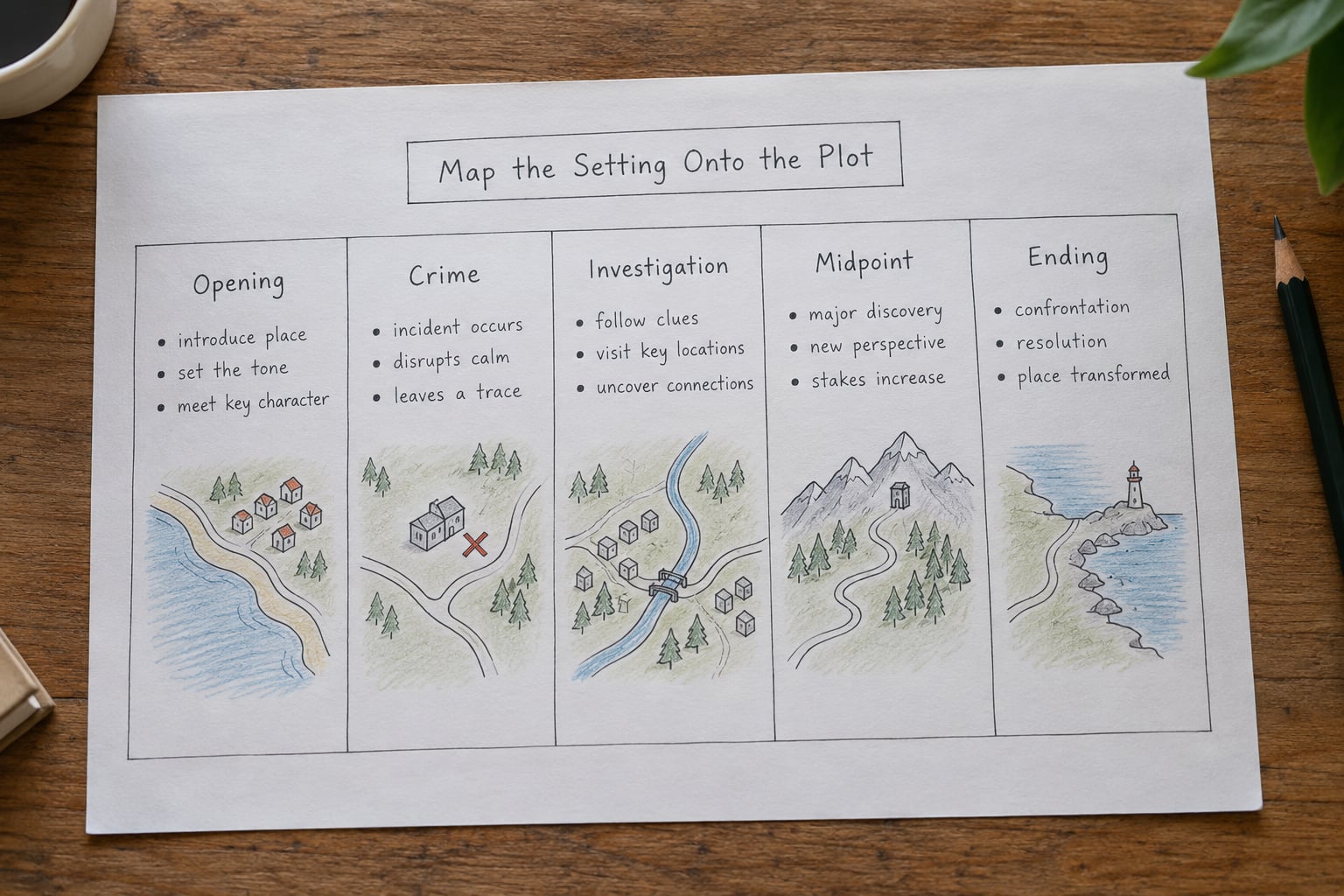
A worked example. A commuter town where the last bus stops at nine, with a flooded underpass that closes the shortcut from the station after heavy rain. Opening: the detective meets the victim’s sister at the depot because that is the only lit place left. Crime: the body is in a lock-up garage on a street that floods, so the ground under the car is clean while everything around it is wet. Investigation: the alibi holds until someone learns the underpass was open that night, which only a man who walks the route daily would know. Reversal: the person who knew was the one person who had no reason to walk there.
Four beats, all supplied by the same geography. If you cannot fill in that grid, the setting is decoration.
How to Choose a Setting That Survives a Plot Rewrite
Last, score your two or three finalists against the same criteria so the decision is not made on enthusiasm. Give each one a line per question, and be honest.
- Can a reader picture the geography from what is on the page?
- Does the place change at least one character’s decision?
- Does it hide something for the reader, or reveal something the characters cannot see?
- Can you name the research in under an hour, and have you done most of it?
- Does it support the mood without explaining it twice?
- Would you still want to write book two here?
That last question is the one writers skip and regret. Shannon Hollinger built a fictional Maine town after a trip that stuck with her, and kept writing there because the place had more than one story in it. Before you commit, try running a completely different crime through your finalist. If the setting still constrains the plot in an interesting way, it is doing its job. If the second crime would have worked anywhere, you have chosen a mood, not a setting.
Common Mistakes
Choosing a place before you know the story. You fall for a location, then spend a year writing a plot to justify it. Fix: write the crime sentence first, and only allow places that appear naturally in it.
Using atmosphere as a substitute for cause. Heavy weather and bleak imagery do not create tension if the plot would run identically somewhere sunny. Fix: for every atmospheric detail, ask what it prevents or delays.
Ignoring what the place actually permits. Murder methods, escape routes, phone coverage and opening hours are constraints, not details. Fix: verify the three logistics your plot leans on hardest.
Making every location equally vivid. If the crime scene, the family home and the police station all get the same loving paragraph, none of them register. Fix: reserve your sharpest sensory writing for the two places that matter to the outcome.
Over-researching what readers never need. A chapter on local government structure slows a book down and reads as homework. Fix: research what characters would know, argue about or get wrong.
Losing the plot in the setting. You have four hundred pages of a beautiful place and no murder. Fix: set a word limit for setting passages before you start, and treat it as a budget you spend on the two or three scenes that matter.
Three habits help more than any of the fixes above. Keep a single-page setting file with the non-negotiable facts, so you stop re-researching. Read two chapters of a novel set somewhere you have never been and notice how much specific detail the author trusts you with. And give yourself a permission slip to choose the less beautiful option, since the functional setting is nearly always the more interesting one.
Frequently Asked Questions
Do I have to use a real place in my crime novel?
No. Plenty of successful crime fiction is set in invented towns, and fiction gives you freedom over street layouts, businesses and local history. Using a real place with a changed name, or a real region with fictional communities, is the usual compromise. Whatever you choose, keep the geography internally consistent, because readers forgive an invented name far more readily than a map that contradicts itself.
How do I research a setting I have never actually visited?
Start with primary sources rather than impressions: local news archives, planning documents, court reports, transport timetables and weather records for the exact dates your story covers. Map the place at street level and note where a car cannot go, when the buses stop and which routes flood. Then interview someone who knows it, or a local writer. Write each fact down in one line with the date you checked it.
Should my mystery be set in a small town or a big city?
Pick whichever one creates the pressure your story needs. A small town gives you a small suspect pool where everyone has history and a social code that blocks certain conversations. A city gives you scale, anonymity and thousands of people who could have done it. A small town makes the solution easier to land; a city makes the alibi harder to break. Decide first, then choose.
Can a crime novel have no named setting?
Yes, though you pay a cost. An unnamed place feels vague unless the space itself does work: an unnamed island, an unnamed hospital, an unnamed border region. Readers can accept a setting that is never named as long as its rules are clear and consistent. They are far less forgiving of a story that simply never says where it is happening.
How many separate locations should a crime novel use?
Fewer than most first drafts use. Each new location costs you research, and readers remember the geography. A workable set is three: where the crime happens, where the protagonist lives or works, and one more that carries a specific function, such as a family home or an industrial site. Every additional place should change what a character can do or know.
How do I stop over-describing my setting?
Set a limit before you draft and treat it as a budget, then spend it on the two scenes where the geography changes the outcome. Prefer three precise details over a paragraph of weather: the bus that stops at nine, the underpass that floods, the shift change that empties a street for twenty minutes. If a description does not delay, expose or mislead, cut it and let the scene run.
Start With the Crime, Not the Map
Here is the first thing to do: write your crime in one sentence with no place names in it, then generate three location categories rather than three cities. The setting that wins will be the one where a character cannot do what they want, cannot say what they mean, and cannot leave.
W.A. Winter writes exclusively in his hometown of Minneapolis, and that decision is a reminder of the opposite case. Knowledge you actually have is a real advantage, and a setting you know deeply needs far less invention than one you have only read about. If you have that, use it and stop second-guessing whether it is interesting enough.