
To start a cozy mystery series, you need four things before you write a word: a promise you can keep for five books, a small town or setting readers can picture, one sleuth with a reason to keep finding trouble, and a working clue system. Most first drafts fail because the author solved the first murder and then had to invent four more.
It takes a committed weekend of planning, then the months it takes to draft a novel. The genre has real reader expectations, but they are easier to learn than most first-time writers expect.
Table of Contents
- What You Need
- Step-by-Step: How to Start a Cozy Mystery Series
- Step 1: Define Your Cozy Promise
- Step 2: Build a Repeatable Setting
- Step 3: Design a Core Mystery Engine
- Step 4: Create a Protagonist and Supporting Ensemble
- Step 5: Plan the First Book Before the Series
- Step 6: Map the Series Arc and Book Variations
- Step 7: Draft, Revise, and Protect Continuity
- Common Mistakes
- Frequently Asked Questions
- How many books should a cozy mystery series contain?
- Do I need a series-wide mystery to write a cozy mystery series?
- Can a cozy mystery series have a romantic subplot?
- Should every cozy mystery be written in the same setting?
- Can the books in a cozy mystery series be read independently?
- How do I keep clue and character details consistent across books?
What You Need
Before you draft, gather five things. Not nine. Five. Anything more and the planning stage eats the enthusiasm you started with.
- A core premise in one sentence. The version that reads like a back-cover blurb, not a plot summary. If you cannot say it in one breath, the concept is still blurry.
- A recurring setting. A small town, a specific neighborhood, a shop, a hospital wing, a church group. Somewhere with an actual address.
- A protagonist with access. Your sleuth needs a job, hobby, or volunteer role that explains why strangers tell her things. A hobby that puts her in a room with a body works; a hobby that only gets her a cup of coffee does not.
- A crime-solving mechanism. Your specific version of how she does it. Recipes that go wrong, a fixer who notices patterns, an innkeeper who hears everything twice.
- A series promise. One sentence about what a reader gets every time: the tone, the pace, the promise of a solved case and a happy ending.
Add two optional tools if you want them: three to five comp titles, meaning books already doing what you plan to do, and a one-page series bible. Every competitor article mentions series bibles. Very few tell you what to write in one.
Step-by-Step: How to Start a Cozy Mystery Series
Step 1: Define Your Cozy Promise
Your promise is the contract with the reader, and it needs to be short enough to repeat in every book’s description. Start with the emotional atmosphere in one word: festive, melancholy, sunlit, rainy, festive-and-slightly-tense.
Then set the danger level, because that single choice filters everything else. Most cozies deal in theft, fraud, sabotage, poisoning by accident, or a body discovered off-stage. A handful go darker with a killer who means it. Readers who buy cozies for the puzzle will forgive a lot, but they will not forgive feeling misled about the violence.
Next, name the central attraction. What is the reader actually returning for? Often it is the sleuth’s personality and the setting rather than the crime itself.
A usable template: Every book in this series, a [sleuth with a defining trait] investigates a [low-stakes crime] in [specific setting], with [one tonal promise] and a case closed by the final page.
You know it works if you could hand that sentence to a reader and they could tell whether any given book belongs to your series. If the sentence is generic enough to describe someone else’s books, tighten it.
Step 2: Build a Repeatable Setting
The setting is a character, and it has to survive five books without getting boring. The test is simple: can you name five different crimes that could plausibly happen in this place? If your town only supports murders, you will be inventing backstories by book three.
A good cozy town has layers of activity. A harbor town gives you smuggling, fishing disputes, missing boats, and tourist scams. A small town with a historic district gives you preservation fights, antiques fraud, and a feud three generations old.
Then define three things and keep them consistent. First, the rules of the place: who holds what authority, who talks to whom, what time the market shuts. Second, the social circles, which should overlap so a rumor can travel from one group to another. Third, the sensory anchors, the two or three things a reader expects to smell, see, and hear every time.
Those sensory anchors are what readers mention in reviews. They are also the cheapest continuity insurance you will ever buy, because you can check your draft against them in thirty seconds.
You know the setting works if you can describe it in a paragraph and the reader can predict both a location and a kind of trouble without being told.
Step 3: Design a Core Mystery Engine

A mystery engine is the repeatable spine your cases hang from. Readers learn it in book one and come back for it, the way they return to a favorite show’s opening credits.
Build it from four parts. The fixed frame is the part that never changes: how the crime gets reported, who the sleuth meets first, what she does in the first chapter. The variable case is what changes: the crime, the motive, the suspect pool. The series through-line is the unresolved thread that gives readers a reason to buy book two, and it should stay quiet enough to sit under the cases. The access reason is why trouble keeps arriving at her door.
That last part is where most amateur sleuths fail. A retired librarian does not attract murders. A former investigative reporter now running a small-town paper does, because people bring her things they found. Or she is on a neighborhood watch that meets monthly, which puts a new person in her kitchen every time.
Test your engine by writing one case and then asking: could this mechanism produce a different case next month with the same method and a different motive? If yes, you have a series. If the answer is no, fix the engine before you draft another outline.
Step 4: Create a Protagonist and Supporting Ensemble
A cozy protagonist needs to be capable enough that the reader follows her logic, and flawed enough that she is interesting. Relatability beats likability. Snoopy protagonists lose readers, and so do spotless ones.
Give her a wound and a want. The wound is why she takes the case when she should walk away. The want is what she is after across the series, and it does not have to be resolved in book one. A woman who lost her mother’s shop and wants it back has a want that generates five books on its own.
Then build the ensemble. For each supporting character, write a name, an occupation, a relationship to the protagonist, a want of their own, and one secret. That secret is future material. It might be a lie that gets exposed in book four.
Six to eight recurring characters is plenty. Beyond that, readers start mixing names up, and mixing names up means readers quit. Your murder victims, on the other hand, can be new each time, and having fresh suspects is one of the cheapest ways to keep a series feeling new.
Check that each supporting character exists for a reason. If a character only serves to hand your protagonist information, they are a plot device, not a person, and readers feel it.
Step 5: Plan the First Book Before the Series
Plan one complete novel first. Not a series, not seven books, one. Readers buy book one on its own terms, and most series die because the author treated the debut as a way to set up later instead of a story worth reading.
Your plan needs six pieces. The central case, stated as what happened. The protagonist’s goal, which is not always the same as finding out what happened. The investigation, as a sequence of scenes rather than a summary. The suspect pool, and four to seven is a healthy range: enough to misdirect, few enough that readers can hold them in their heads. The clue trail, every clue the reader needs placed before the reveal. And the ending, with the local situation resolved.
On length, most cozies land between 70,000 and 90,000 words, and shorter ones work fine in the 55,000 to 65,000 range if the cast is small and the plot is tight. Longer than 100,000 and you are writing a book with a cozy pace, which is usually not what you want.
Write the ending before you start. Knowing how it resolves changes every clue placement upstream, and it also stops the outline from drifting into a series pitch disguised as a novel.
Step 6: Map the Series Arc and Book Variations
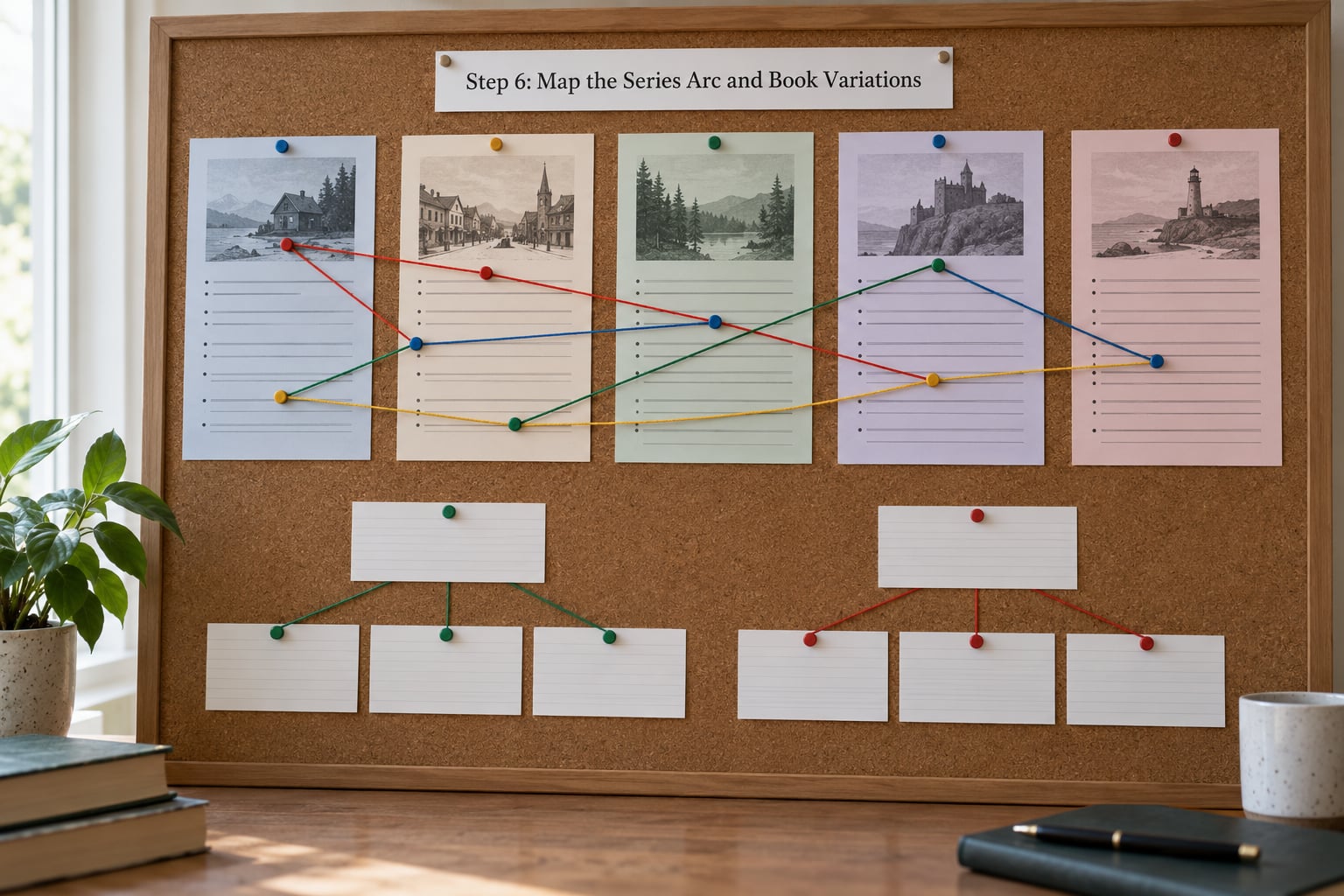
Now map the arc, but keep it light. A roadmap of five books, each with a one-line case, works. Detailed chapter outlines for books two through five do not. They go stale the moment book one changes, and you will maintain a document nobody reads.
Vary across five axes. Setting: use a different neighborhood, season, or corner of the town each time. Motive: greed, grief, shame, inheritance, loyalty. Suspect type: a stranger passing through, a long-term resident, someone the reader likes. Relationship dynamics: put two supporting characters in conflict and see what it does to the case. Threat level: if book one was a property crime, book three can raise the stakes without breaking your promise.
Readers are oddly good at spotting repetition and oddly forgiving about callbacks. A returning location or a running joke is a gift. The same victim type in the same chapter position three books running is where people stop reading.
On the series-wide mystery: yes, have one, but make it optional. Readers who want the long game follow it happily. Readers who bought the book for the case should be able to ignore it completely without feeling shortchanged.
One note on the theme or hobby, since it comes up constantly. Readers complain loudest when a cozy lectures them. In comment threads on cozy-mystery.com, the recurring note is that the balance has to be there, and the complaint is almost always about being taught technique mid-investigation. Use the theme as motive, setting, and character, not as instruction.
Step 7: Draft, Revise, and Protect Continuity
Draft book one as a standalone. Do not foreshadow books two and three so heavily that the first ending feels unresolved. A closing thread the reader can enjoy as a clean ending is worth more than a cliffhanger.
Then test it. Give the manuscript to three or four readers in your target audience and ask two questions only: where did you get bored, and where did you stop believing the sleuth. Readers rarely tell you about a flaw; they tell you they stopped reading, which is the same information with less detail.
Revise in a fixed order. Structure first, because everything else moves if the structure moves. Clue fairness second: lay out every clue the reader received before the reveal and check that each one pointed somewhere true, not just somewhere atmospheric. Prose and theme trim third.
Protect continuity with a series bible that has six tabs: characters with ages and relationships, timeline of events across all books, setting rules and sensory anchors, unresolved threads, style rules like word count and tone, and a per-book log. Update it the day you finish a draft, not the week before book two, because in six months you will not remember which town has the harbor.
Common Mistakes
Almost every stalled cozy series fails the same way. Here are the seven problems that come up again and again, and what to change.
The cases all feel the same. You wrote five variations of a locked-room theft. Fix it by assigning each book a different motive and a different suspect type on your step 6 grid, then check whether a reader could describe each one in a single sentence without repeating a word.
The protagonist is passive or snoopy. She asks questions because the plot needs her to, and everyone finds her charming in a way nobody in the book actually behaves. Fix it by giving her a wound that makes the case personal, and by cutting the scenes where she eavesdrops. Snooping without a reason reads as nosiness.
The cast is overstuffed. Nine recurring characters with names readers cannot hold. Cut to six or seven, and let the rest arrive per book as new suspects. A fresh suspect pool each time does more for series freshness than any amount of setting variation.
The clues do not add up. The reveal depends on information the reader never received, or on a detail dismissed as atmosphere that turns out to be decisive. Fix it by listing every clue before the reveal and asking of each one: did this point somewhere true, or did it just look nice?
The tone drifts book to book. Book one is warm and funny, book four has a genuinely bleak chapter. Readers pick up on this faster than authors expect. Write your promise sentence from step 1 down before each new draft and read it first.
The theme lectures. This is the complaint that shows up most often in reader discussions on cozy-mystery.com: getting taught quilting technique while a body sits unrecovered in the basement. Cut any passage whose main job is explaining how something works. If the reader learns the technique and it changes nothing about the case, it goes.
The worldbuilding blocks the plot. You spent eleven pages on town history, the harbor’s founding, and the naming of the diner. The mystery started at chapter four. Move the history into dialogue, cut the name origin, and get to the crime by chapter two. Readers want the town to feel lived in, not studied.
Frequently Asked Questions
How many books should a cozy mystery series contain?
Most cozy series that sustain reader interest run four to seven books, though plenty of successful ones stop at three. Plan for five and treat the first three as the core set, since that is where sales usually decide whether the series continues. Series with a strong through-line can stretch to ten or more, but only if the cases keep changing shape. Readers tend to abandon between books seven and nine, when they start predicting the ending.
Do I need a series-wide mystery to write a cozy mystery series?
No, and many strong cozy series skip it entirely. Each book can resolve its own case cleanly while quietly advancing a personal thread, such as the sleuth recovering her family’s history or rebuilding a relationship. A series-wide mystery works when you can keep it in the background without making readers feel the current case is unimportant. Decide early, though, because retrofitting one into four finished books is painful.
Can a cozy mystery series have a romantic subplot?
Yes, and it is common, but the mystery stays the engine. The safest structure gives the romance its own timeline across the series rather than tying it to a single case, so readers who dislike it can skim. Avoid turning the sleuth’s romantic partner into the obvious suspect, since that twist rarely lands well. Keep the tone light and the stakes modest, and the subplot adds rather than detracts.
Should every cozy mystery be written in the same setting?
Same town, yes. Identical locations within that town, no. Readers return for the sense of place, so changing the town between books breaks the attachment that makes them read-through. Vary within your world instead: a different neighborhood, a different season, a different corner of the same community. If you want an entirely new setting, start a new series with the same sleuth rather than moving the current one.
Can the books in a cozy mystery series be read independently?
They should be readable independently, which mostly means no information dumps and no required knowledge of earlier cases. Show the cast through behavior in action rather than summarizing who everyone is and what happened before. Recurring characters and running gags are fine and often add to the pleasure. A book that cannot be enjoyed without having read the four before it will lose readers, and readers who feel lost rarely come back.
How do I keep clue and character details consistent across books?
Keep a series bible with six sections: characters with ages and relationships, a timeline of events, setting rules and sensory anchors, unresolved threads, style rules, and a log of each book’s outcome. Update it the same week you finish a draft. The timeline is the tab that prevents the worst errors, particularly with injuries, birthdays, and seasons, since a character who cannot climb stairs in book two should still be limping in book six.
Start with step one tomorrow. Write your promise sentence, then write five crimes your setting could hold. If you can do both in an hour, you have a series. If you cannot, fix that before you buy a single notebook.