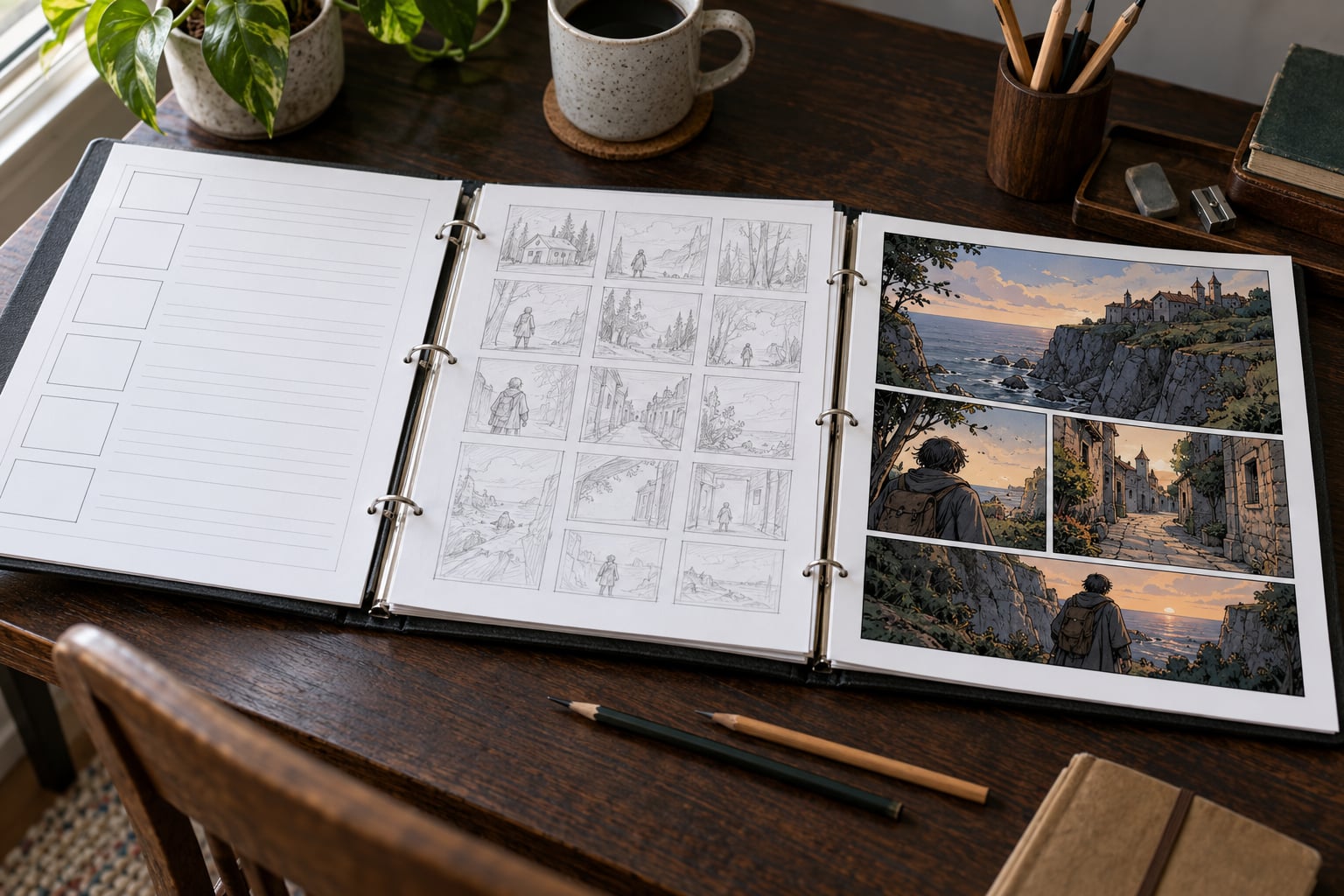
A graphic novel pitch is a proposal package you send to literary agents and editors before a single page is drawn: a logline, a synopsis, comp titles, an author bio, character descriptions, sample art, and either a script or a detailed outline. Getting it right takes most creators two to three weeks of revision, and the hardest single piece is the logline. Here’s how to write a graphic novel pitch that gets read.
Publishers buy comics on proposal rather than on a finished book, which flips the usual burden. Your pitch has to prove the story compels, the reader is obvious, and you can finish a long project. Everything below is what I look for when a package crosses my desk, plus the failure patterns that get files closed in under a minute.
Guidelines change, so check each publisher’s submission page in 2026 rather than trusting a blog post, including this one.
Table of Contents
- What You Need Before You Draft a Graphic Novel Pitch
- Step-by-Step: Seven Stages From Idea to Editor-Ready Pitch
- Start With the Story’s Central Dramatic Question
- Write a Logline With Character, Goal, and Stakes
- Build a Visual Story Spine
- Define the Protagonist, Antagonist, and the Relationship Between Them
- Summarize the Full Narrative Without Spoiling the Ending
- Select and Present the Right Sample Pages
- Package and Proof the Pitch for Submission
- Common Mistakes That Get a Graphic Novel Pitch Rejected
- Frequently Asked Questions
- How long should a graphic novel pitch be?
- Do publishers want a full script or only sample pages?
- What should a graphic novel pitch include?
- Can a graphic novel pitch be sent by email?
- How many sample pages should I submit to an editor?
- Conclusion
What You Need Before You Draft a Graphic Novel Pitch
You need seven things, and three of them must already exist before you write a single sentence of prose. If a piece is missing, finish it first — an incomplete package reads as an unfinished project, and editors are pattern-matching for exactly that.
- The pitch deck or proposal document. One PDF, the core of everything else. A single file beats a folder of loose attachments almost every time.
- A logline. One or two sentences. The hardest thing you will write in this process.
- A synopsis. The full story in paragraph form, ending section, and giving away the ending if the ending matters to whether the book works.
- Character detail. For each principal character: desire, fear, secret, contradiction, and narrative function.
- Sample pages. Ten or more finished pages if you draw. If you don’t, a script or thumbnail sequence instead.
- Project specifications. Trim size, page count, color or black and white, age range, standalone or series.
- The recipient’s submission guidelines. Read them twice, then check your package against them line by line.
Here is the length guidance most agents and editors work from. Treat it as a starting range rather than a rule, since every publisher has house style.
| Section | Recommended length | Notes |
|---|---|---|
| Logline | 1-2 sentences | Character, goal, stakes, and the central obstacle |
| Short synopsis | 200-300 words | Setup through the first major turn |
| Full synopsis | 500-1000 words | Spoilers strongly encouraged |
| Sample script | 30-50 pages broken into panels | Standard comic script template |
| Finished sample art | 10 or more pages | Some houses ask for roughly 25 percent of the book |
| Character bios | 50-100 words each | Include a physical description |
| About the creator | 100-200 words | Relevant platform only, no life story |
| Comp titles | 2-4 titles | Published recently, sold well, similar in tone not plot |
| Total deck | 8-20 pages | Plus a separate sample art PDF |
Keep the whole file under about 20 MB. Attachments that bounce leave your pitch unread, and you never get a second chance with that editor.
Step-by-Step: Seven Stages From Idea to Editor-Ready Pitch
Start With the Story’s Central Dramatic Question
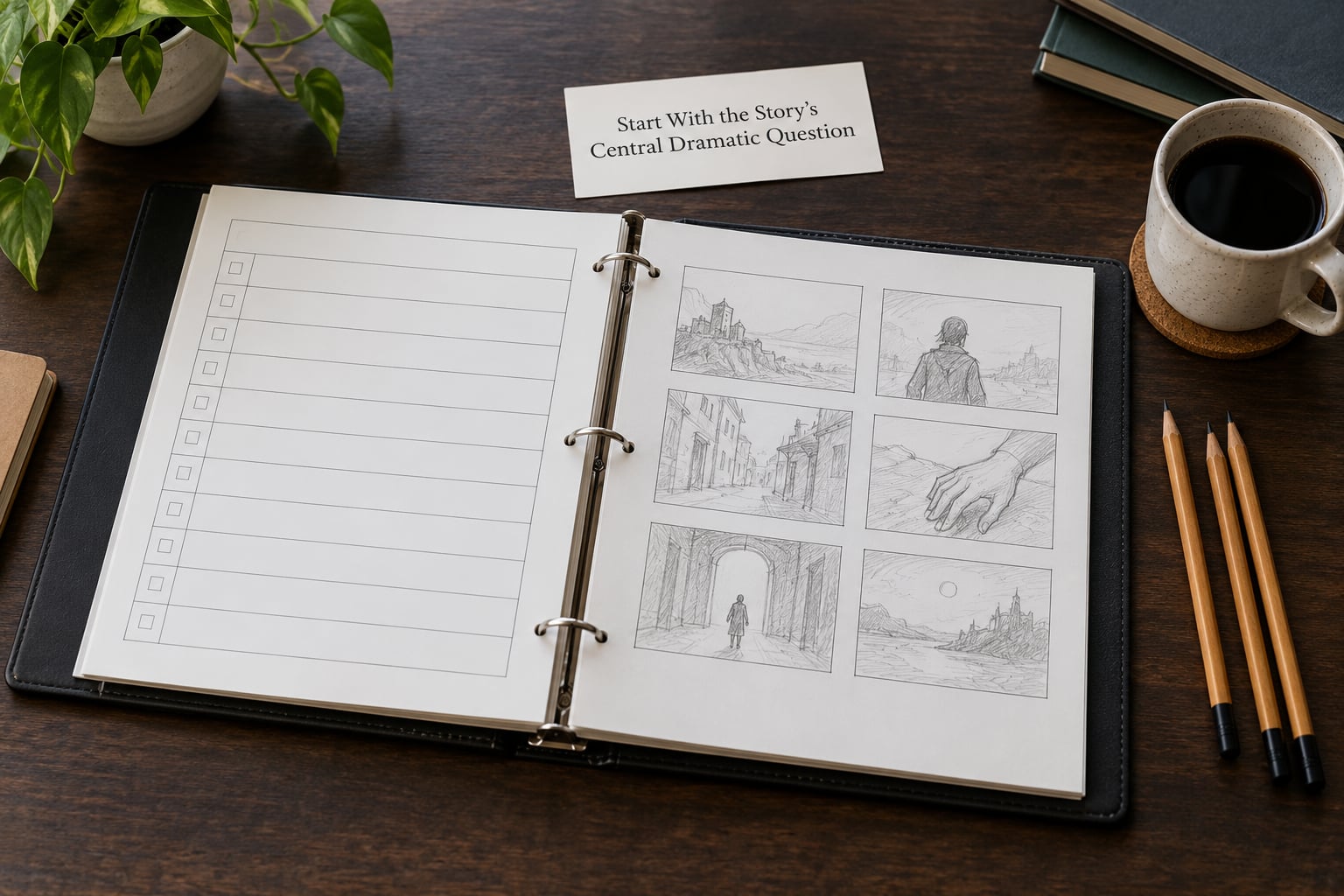
Before you describe anything, answer one question in a single sentence: can this protagonist get what they want, and what stops them? That sentence is the spine of the whole pitch. Everything after it — logline, synopsis, comps, sample choice — is a repackaging of that same conflict.
Test the question by writing three versions: the optimistic one, the pessimistic one, and the one that admits the protagonist is probably lying to themselves. The third version is usually the honest one, and for crime and noir work it is almost always the strongest.
You know it works when you can describe the ending in one line without naming a single character. If your question only makes sense with names attached, the premise is still too thin.
Write a Logline With Character, Goal, and Stakes
A graphic novel logline follows a simple formula: protagonist, plus inciting incident, plus goal, plus central conflict. Keep it under about 30 words.
A loose version: When a burned-out city archivist discovers a body that was never reported, she has one night to bury the evidence or lose the only job that still trusts her.
A tighter version for a noir piece: A coroner who falsified one report ten years ago gets a second body, the same night, same cause of death. Same story, fewer words, and the tension sits in the sentence rather than around it.
Write ten of them before you keep one. This is normal, not a sign you’re doing it wrong — a creator I know spent years on a single logline for a webcomic before the sentence finally locked. If your tenth attempt still doesn’t work, the problem is upstream in the premise, so go back to the dramatic question.
Build a Visual Story Spine
Comics are sold on pictures, so the spine has to be legible as images. Write eight to twelve beats, then thumbnail each one in a small square. Thumbnails cost you ten minutes and they expose pacing problems no paragraph will.
You’re looking for three things when you look at the wall: a visible escalation in stakes, a small number of recurring locations, and exactly one beat that could be a double-page spread. If nothing on the wall could be a spread, your story is a sequence of similar scenes and needs restructuring.
For dark material, resist the urge to make every thumbnail a silhouette. Editors buy range. A pitch that shows one mood across all eight beats reads as one idea, and a bright daylight panel in the middle of a noir book tells a sales team something useful about the back cover.
Define the Protagonist, Antagonist, and the Relationship Between Them
For each principal character, give five lines: what they want, what they fear, what they are hiding, what they believe that is false, and what they do to the plot. That last one is the one writers skip, and it is the one that reveals a flat character.
Then write the relationship in a single sentence of pressure. Not a description — a mechanism. She needs him to sign the report, and he needs her to stay quiet about the first one. That sentence is where the story’s tension lives, and it is what an editor is really buying.
You know the section works when you can delete any one character and see the plot collapse. If the book still functions without someone, cut them or merge them into another part.
Summarize the Full Narrative Without Spoiling the Ending
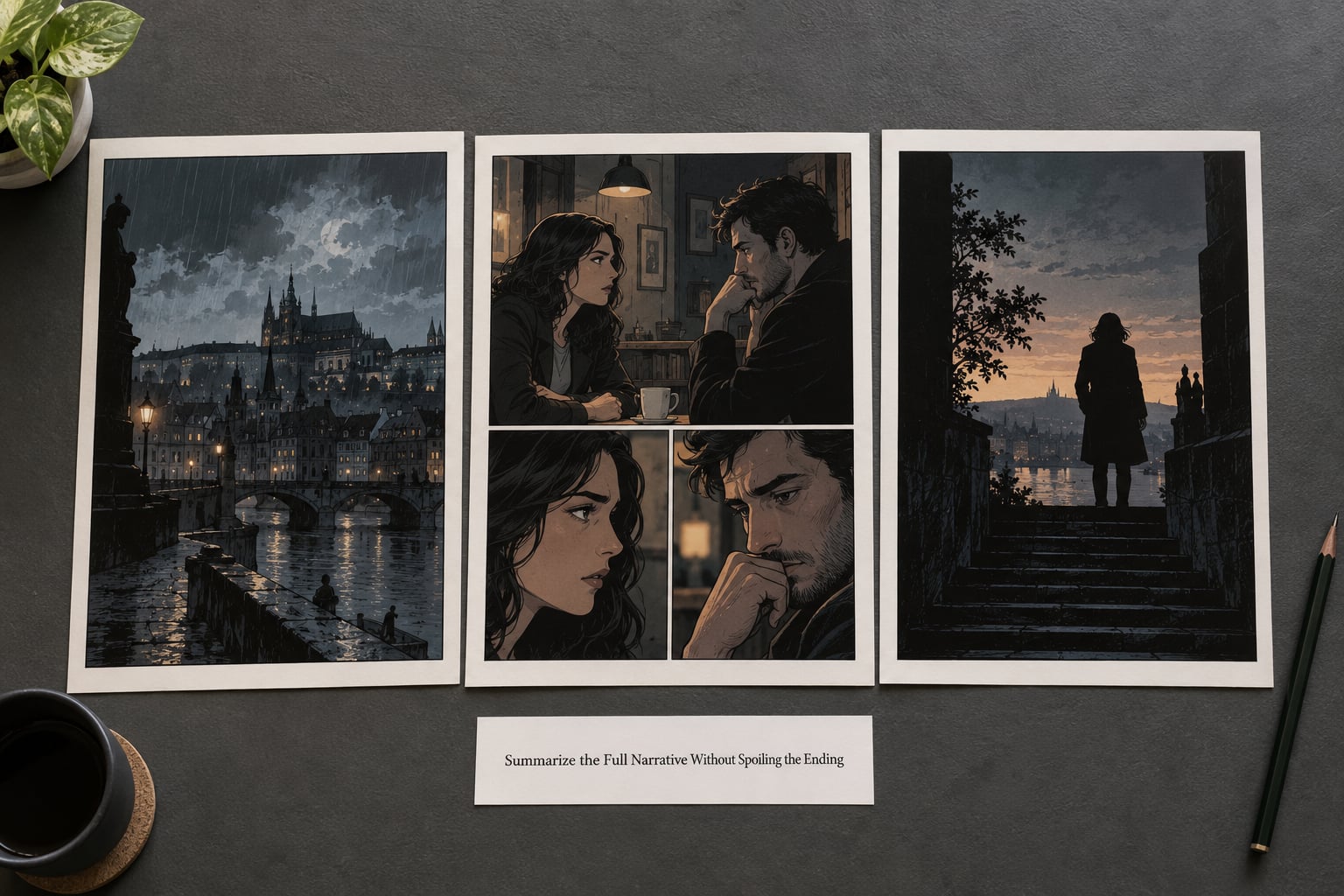
Write the synopsis as a Wikipedia article would cover the plot: setup, escalating complications, climax, resolution, and the ending. Hiding the ending is a mistake that costs you sales. If the twist is what makes the book buy, the synopsis has to contain the twist.
Keep it between 500 and 1,000 words. Organize it in labeled sections — Act One, Act Two, Act Three — with the act breaks at the real turning points rather than at even page intervals.
What you withhold is the surface-level surprise: a specific visual reveal, the exact wording of a last line, the face of someone in a background panel. An editor who reads your synopsis and the samples will connect those dots in about two seconds, and pretending otherwise reads as coy rather than clever.
Select and Present the Right Sample Pages
Pick pages that do four jobs rather than pages that look prettiest. Include an establishing panel that shows your sense of place, a dialogue scene that proves your character voices are distinct, a full page that demonstrates composition, and a sequence of three to five consecutive pages so the editor can see your page turns work.
That consecutive run matters more than beginners expect. An editor can admire a single splash page without knowing whether you can build rhythm across a spread. Show the rhythm.
Clean everything before it goes out. Tight, fully inked pages are the standard. Loose thumbnails are fine for an early-stage pitch where you don’t draw, but say plainly that they’re thumbnails and pair them with a script.
Captions and lettering should be in place. Text left as placeholder boxes is the single most common sign of an unfinished book, and it costs you the read. If you can’t letter yet, say so in the deck and offer to supply lettering samples separately.
Resolution: 300 dpi, exported as a single PDF, in reading order, with page numbers on every page so a reader who jumps around can find their place.
Package and Proof the Pitch for Submission
Assemble the deck in order of impact: title page, logline, short synopsis, audience and genre, length and format, comp titles, full synopsis, characters, about the creator, series potential if it applies. Each section earns the next one.
Credit everyone involved by full legal name and role. If you co-create, attach your collaboration agreement and flag it in your email, so nobody is surprised at contract stage.
Name the file something professional and self-explanatory, like Lastname_GraphicNovel_Pitch.pdf. Use the same naming for the sample art PDF. Sloppy file names are the first thing an assistant sees.
Then proofread twice: once for typos, once for the guideline checklist. Read the submission instructions from a stranger’s point of view, with the package closed, and confirm you’ve met every one. Editors reject unread packages automatically, and they do it without malice.
Follow up once, after six to eight weeks, with three sentences. If there’s no response, the file is either read and passed or never read. Move on and query the next person.
Common Mistakes That Get a Graphic Novel Pitch Rejected
Most rejections are packaging failures, not story failures. Here are the ones I see most, with the fix for each.
You ignored the submission guidelines. This is the fastest auto-rejection in the industry and it happens before a human reads a word. Wrong trim size, wrong page count, missing subject line format, art embedded in the body email. Fix it by turning each guideline into a checkbox and confirming every line before you hit send.
You pitched a closed publisher. Several large comic publishers do not accept unsolicited work at all. The fix is to check the submissions page directly, and to send one query rather than a mass email to every imprint on your list.
You sent a fully finished, inked and colored book as a debut. A newcomer who arrives with everything locked signals they cannot take editorial feedback, and an editor told one creator this is a deal breaker. An early book with 3 finished color pages and 24 pencilled pages negotiated from there is the more common successful pattern. Keep the book open to change.
Your pitch is too long. A 60-page proposal is not thorough, it is filed. The overlong pitch gets saved in a read-later folder nobody owns. Cut to the table above and resist adding a fourth comp title.
You submitted art that doesn’t exist yet. If you’re a writer without an artist, a strong script, outline, and character descriptions are enough for some editors and agents. Say explicitly that art is being sought and attach your strongest script pages. Silently omitting the art looks like an oversight; naming the gap looks like a plan.
You undersold yourself in the bio. A webcomic with 80 episodes, a self-published mini-comic, or a finished anthology chapter is proof you can finish. Include it. Founders get one or two sentences about why the book matters to you, then stop.
Your comp titles are stale or lazy. Titles from a decade ago, or four books that share a genre label but nothing else, tell an editor you didn’t research the market. Pick two to four recent books with a similar tone, age category, and format, and explain in one line each why the comparison holds.
A few habits that fix most of the above: put the logline in the first 50 words of the email so it survives a phone-screen read, name the one skill you bring that most creators in the pile can’t, and keep the scope realistic — a single volume reads far safer than an unproven 1,200-page epic.
Frequently Asked Questions
How long should a graphic novel pitch be?
Most professional graphic novel pitches run 8 to 20 pages, plus a separate sample art or sample script PDF. Within the deck, a 500 to 1,000 word synopsis is standard, the logline is one or two sentences, and character bios run 50 to 100 words each. Length is less important than order of impact, but going far over the range means the extra material is probably padding.
Do publishers want a full script or only sample pages?
It depends on whether you draw. Author-illustrators should submit 10 or more finished pages, plus a sample script of roughly 30 to 50 pages broken into panels. Writers shopping a script usually submit the script and thumbnails instead, and some houses dislike comics scripts entirely, so check the guidelines first and follow them over any general advice, including this article.
What should a graphic novel pitch include?
Nine sections work for almost every project: title page, logline, short synopsis, target audience and genre, length and format, comp titles, full synopsis with spoilers, character descriptions, and about the creator. Add a marketing plan and series potential only if the book is genuinely part of a series. Sample pages belong in a separate PDF.
Can a graphic novel pitch be sent by email?
Yes, and it is the most common method. Keep the email under about 150 words, state the book title and format, paste the logline directly in the body, attach the deck and sample art as two PDFs, and use a descriptive subject line. Some publishers prefer a submission portal or an agent’s form, so check the recipient’s page before pressing send.
How many sample pages should I submit to an editor?
Ten finished pages is the usual minimum, and some houses ask for closer to a quarter of the book. Include one establishing panel, one dialogue scene, one full page, and three to five consecutive pages so the editor can judge your page turns. Keep the file under roughly 20 MB and number every page.
Conclusion
Start with the reduction, not the formatting. Write the dramatic question in one sentence, turn it into a 30-word logline, thumbnail eight beats on a wall, and cut a three-page sequence that proves you can build rhythm across panels. Everything else in a graphic novel pitch is assembly, and assembly is the easy part. Do those four things and the rest of the package has a spine to hang on.