
To write a crime novel for beginners, you need one promise and a plan to keep it: a crime happens, a reader expects an explanation, and every clue you plant has to point honestly toward the answer you are hiding. That is the whole genre in one sentence, and it is why beginners stall: the craft feels like plotting tricks when it is really bookkeeping. This guide breaks the process into nine stages, from choosing the crime to revising a finished draft, so you always know what to do next.
It usually takes a beginner six months to a year to get a full draft down, most of that time spent in the chair rather than at the planning desk. Nothing here needs publishing knowledge, a course, or a talent you do not have yet.
Table of Contents
- What You Need
- Step-by-Step: How to Write a Crime Novel for Beginners
- 1. Choose a Crime and a Central Mystery
- 2. Create a Protagonist with a Motive
- 3. Choose a Setting and Time Period
- 4. Map the Timeline and Build the Plot
- 5. Plant Fair Clues and Red Herrings
- 6. Write Scenes That Create Suspense
- 7. Use Dialogue to Reveal Character and Clues
- 8. Draft the Complete Novel Without Stalling
- 9. Revise the Structure, Suspense, and Prose
- Common Mistakes
- Frequently Asked Questions
- How long should a beginner crime novel be?
- How do I make my crime mystery hard but fair?
- Do I need to plan every clue before writing?
- Can I write a crime novel from the villain’s point of view?
- Should I write the ending before drafting the mystery?
- How do I revise a crime novel without losing my clues?
- Conclusion
What You Need
You need seven things before you write a single scene, and none of them takes more than an afternoon to produce.
- A manageable premise. One sentence naming a person, a crime and a question. If it needs a semicolon, it is too big.
- A central mystery. A question the reader can hold in their head for 80,000 words, phrased so you can answer it in one line.
- A protagonist with a motive. A reason to be involved and a reason to keep going when investigating gets dangerous.
- A setting. A place and time period with its own rules, ideally one that makes the crime easier or harder to commit.
- A basic timeline. When the crime happened, when each person was where, and how long the investigation runs.
- A clue system. A short list of real clues and a matching list of false leads, written before you draft.
- A routine. A fixed time and a word target small enough that you can hit it on your worst day.
The clue list is the item beginners skip, and skipping it is the single biggest reason a draft falls apart in chapter twenty. If you cannot answer “how will the reader know” for every clue, you are not writing a mystery yet, you are writing a story where a detective guesses.
Step-by-Step: How to Write a Crime Novel for Beginners
1. Choose a Crime and a Central Mystery
Pick a specific crime with a specific question attached, because “somebody is murdered and the detective finds out who” is a genre, not a plot.
Write your central mystery as a question the reader can carry: why did the husband hire a solicitor three days before his wife died, why did a witness go back into the building alone, why does the missing girl appear in two wedding photographs from different years. A good central mystery has exactly one true answer, and you need to know that answer even if no reader sees it yet.
Then separate the crime from the story. The crime is the event; the story is why someone wanted it, what it costs, and who refuses to let it be solved. New writers often confuse the two and then spend 80,000 words investigating a murder that is only a device for a romance.
Two to four suspects is the working range. Anything above five becomes a list readers cannot hold in their heads, and anything below two means the answer is a given. Give each suspect a secret worth hiding, and give the killer the most boring, most ordinary secret of the lot.
2. Create a Protagonist with a Motive
Build someone who wants something specific and is bad at getting it, because a protagonist with no flaw gives a reader no reason to care.
Stakes do the work. A retired detective solving a cold case for a friend has something to lose. A teenager who witnessed something has something to hide. A journalist chasing a story has a deadline and an editor who will kill it. Vague involvement, like a neighbour who happens to be curious, produces flat scenes where nothing is risked.
Give the protagonist a private life that the case interrupts. That subplot does two useful jobs: it makes the character feel like a person rather than a question-asking device, and it gives you somewhere to go when the investigation stalls for a chapter.
Most successful amateur sleuths have no qualifications at all. A hobbyist with a nosy streak and no official authority can ask questions a detective legally cannot, and readers forgive a lot of method for a character who cares.
3. Choose a Setting and Time Period
Choose a setting that creates the crime rather than decorating it, because geography decides who could have done what.
Ask what your place makes easy. A small town with one bridge and no mobile signal creates alibis nobody can check. A private hospital with night staff overlap makes shift logs the whole case. A coastal town in winter has very few witnesses willing to stand outside in the rain.
Time period changes the toolkit. Contemporary settings are watched by cameras, phones and DNA, so a crime needs to be clever or offline. Setting a novel in 1994 or 1987 buys you landlines, filing cabinets and a forensic process that a beginner can describe in a sentence without researching it. A period book is the cheapest route to technical plausibility.
Use real place names sparingly, or invent one and keep a private glossary. Invented geography needs consistency, because a distance that contradicts itself in chapter nine will be noticed.
4. Map the Timeline and Build the Plot
Reconstruct the events before, during and after the crime on paper, because a mystery fails on chronology long before it fails on surprise.
Start with what the reader knows in chapter one, then list what changes and who learns it. Each discovery should be a beat: someone says something, a document turns up, a place gets searched, and the reader’s best theory shifts. If a discovery changes nothing, cut it.
| Act | What happens | What the reader holds |
|---|---|---|
| Act I | The crime is discovered, the investigator arrives, suspects are introduced, the first clue surfaces | A list of suspects and one working theory |
| Act II | Interrogations narrow the list, one suspect drops away, stakes rise, a private-life subplot collides with the case | An improved theory plus one thing that does not fit |
| Act III | A false solution is reached, an overlooked detail from Act I is re-read, the confrontation happens, the cost lands | The final answer and the reason it was there all along |
The Act III beat that matters most is the overlooked detail. Fair play means the decisive clue was on the page in chapter two, described plainly, and the reader has to want to go back and reread it.
5. Plant Fair Clues and Red Herrings
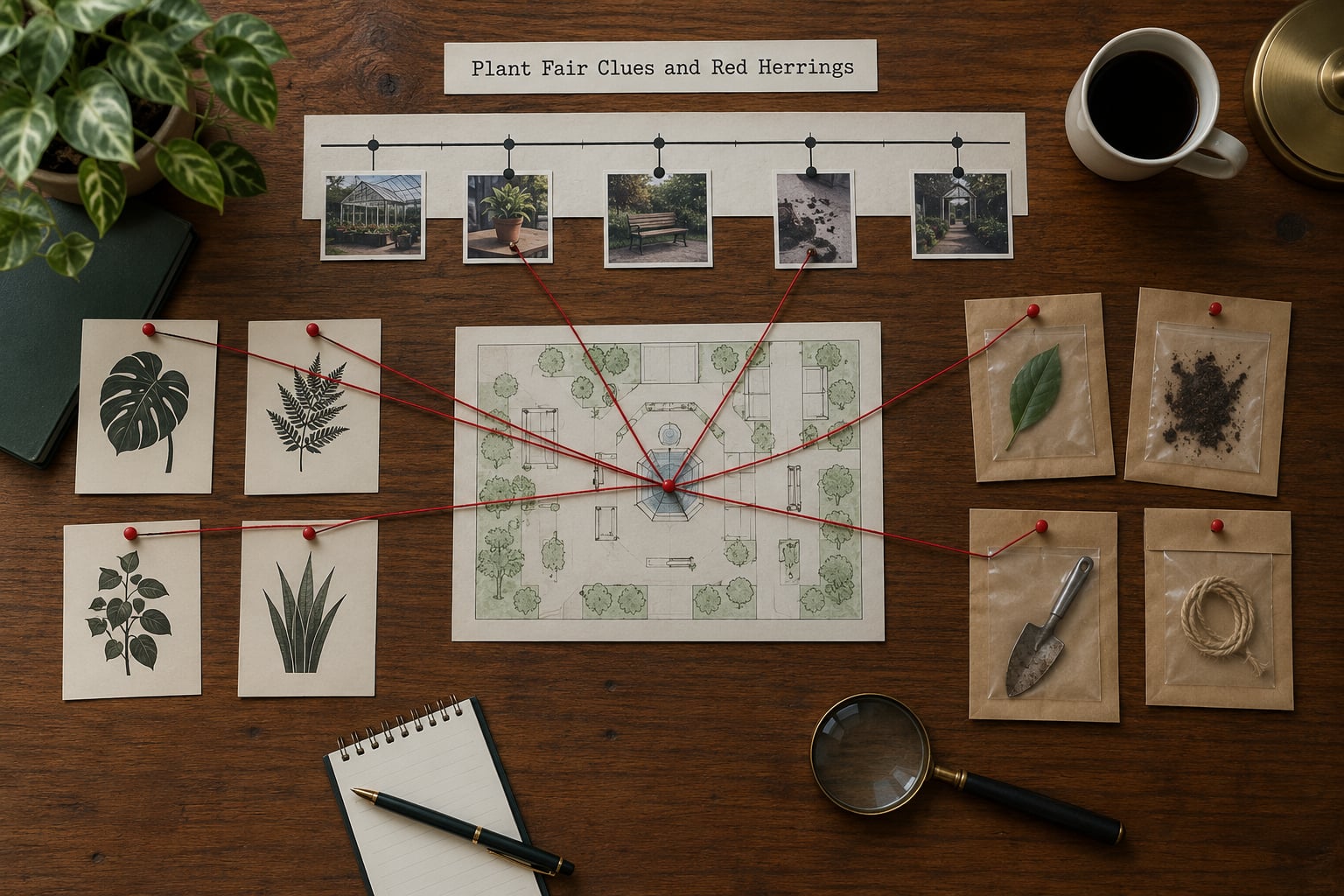
Plant every real clue where a reader can see it, and give every false lead a reason to be believable rather than a reason to be wrong.
A red herring is a detail that supports a wrong answer. It works when it comes from a real source, such as a suspect’s genuine secret, and it stops working the moment it exists only to be a decoy.
Keep a clue ledger: one row per clue, with the chapter it appears in, who notices it, when it resurfaces, and what it points to. Two to four honest clues will carry a solution if they are planted in view. Here is a worked example using a library theft.
| Clue | Planted | Who notices | Resurfaces | Points to |
|---|---|---|---|---|
| Wet mud on the shelf that never dries | Chapter 2 | Nobody | Chapter 19 | The conservator, who walks the roof route |
| Catalog card signed out by a colleague | Chapter 3 | Reader | Chapter 12 | The colleague, a red herring |
| Van in the staff log at 4pm, van parked at 6pm | Chapter 5 | The reader, and wrongly assumed to be staff | Chapter 21 | The conservator’s borrowed vehicle |
Run a fair-play test on each clue: is it visible, does it mean something, and would a careful reader have had the information needed to interpret it? If any answer is no, move it earlier or cut it.
Aim for difficulty that comes from interpretation rather than from hiding. Readers forgive being wrong; they do not forgive being unable to have been right.
6. Write Scenes That Create Suspense
Enter scenes late, leave early, and make every scene end with a consequence rather than a summary.
Start a scene a few lines after the interesting part has already happened, with a character in the middle of a problem. Cut the scene the moment the problem is resolved. The gap you create is tension, and tension is what keeps a reader awake rather than skipping to the next chapter.
Vary the pressure. Follow a hard interrogation with something quiet, a walk, a conversation where the real thing is unsaid. A book that runs at full speed for 90,000 words reads flat, because the reader has no baseline to be frightened against.
End scenes on questions, new information or a decision the reader cannot see the outcome of. A chapter that closes with a character going to bed has closed on nothing.
7. Use Dialogue to Reveal Character and Clues
Write every exchange with a purpose, because dialogue that only passes on facts reads as a transcript.
Each line of conversation should do at least one of four jobs: change a relationship, reveal a want, hand over a clue, or create a discrepancy the reader notices before the character does. If a line does none of them, it is either atmosphere you can earn through setting or a line to cut.
Give people different rhythms. One person answers questions, one asks them, one tells stories and one refuses to. Avoid the interrogation scene where the suspect answers everything asked, in order, without resistance.
Try this swap. Flat: “He said he was at the office all evening, and the security log confirmed it.” Clue-bearing: “He was at the office all evening. Ask anyone. Ask the log, ask the cleaner, ask the man who fixed the copier last Tuesday.” Same information, but the unnecessary detail and the defensive tone are now evidence, and the reader has something to pull on.
Read every dialogue scene aloud. If you run out of breath, the sentence is too long, and if you would not say it that way, rewrite it.
8. Draft the Complete Novel Without Stalling
Set a target you can hit on a bad day, protect it with a routine, and keep moving when a scene is not working.
A thousand words a day is realistic for a beginner with a job. At that pace an 85,000-word draft takes about twenty working weeks, which is five months of evenings. Larger targets create gaps; smaller targets finish books.
Write to a schedule, not to a mood. Same chair, same time, session over at the target even mid-sentence. Most momentum problems are schedule problems.
When a scene stalls, write a note in brackets, write the next thing you know, and come back. Do not spend forty minutes rewriting a paragraph you will change in revision anyway.
If the draft stops dead for weeks, treat it as a logic error rather than a mood. Go back to the last page that was working and check the timeline, the suspect list and the clue ledger. A blank page is usually a contradiction the writer cannot see yet.
Beginners report the same pattern repeatedly: attempts start well and fizzle in the middle. That is not a talent problem, it is a process problem, and the fix is a smaller target and a written ledger rather than more inspiration.
9. Revise the Structure, Suspense, and Prose
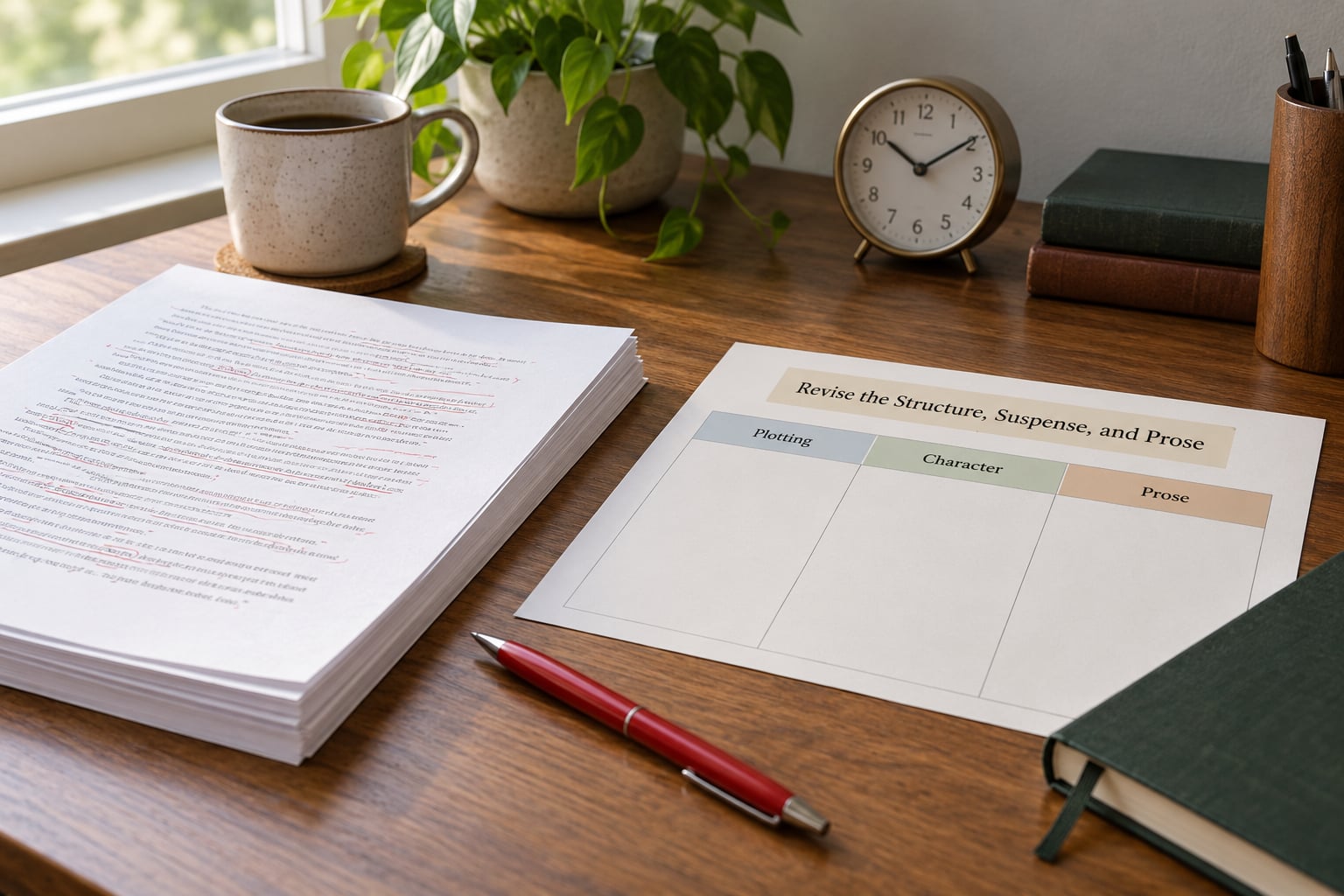
Revise in separate passes, and fix one category of problem per pass, because mixing structure and sentence-level edits at the same time guarantees you miss both.
Pass one is structure. Can you state the central mystery in a sentence, and can you point to the chapter where the reader first has the decisive clue? Check the timeline against the clue ledger, and look for scenes that change nothing.
Pass two is logic. Every suspect needs a real secret, every alibi needs a reason it holds or breaks, and any detail the solution depends on must already be in the text. This is where you find the plot holes an attentive reader will find.
Pass three is character and motive. For each major decision, ask what the person wanted at that moment and whether the text shows it.
Pass four is suspense and pace. Mark where tension drops, and either cut those pages or give them a quieter job. Then do the line pass last: read aloud, cut repeated words, and replace telling with something concrete.
Give it a rest of two to four weeks before the final pass. Fresh eyes catch the sentence you have read forty times.
Common Mistakes
Almost every beginner problem has a specific fix, so work through this list before you send a manuscript anywhere.
- The ending depends on a twist that was not set up. Fix: build the twist into the clue ledger during planning, not into the draft.
- One suspect is obviously guilty. Fix: give the most suspicious suspect the most boring secret.
- Too many suspects. Fix: cut to two to four, and give each a reason to be in the story.
- No motive for the killer. Fix: write the motive before you write the investigation, however brief.
- The opening drags. Fix: start at the moment the crime is discovered or the first body is found, not with weather and a description of the town.
- Uneven pacing. Fix: alternate pressure and quiet so the loud scenes register.
- Clue dumping. Fix: spread clues across the book and let two of them resurface in Act III.
- Dialogue used as exposition. Fix: give every line one of the four jobs, and cut the rest.
- Research used as procrastination. Fix: cap research time, keep notes, and accept that only a fraction of what you read reaches the page.
- Writing the whole book in your head first. Fix: a short outline is a plan, an 80,000-word outline is a second draft you never wrote.
One more worth naming: the dead body as a plot device. If the victim exists to get the investigator to a location, readers notice, and the book suffers for it. Give the victim a life, a name and a relationship to someone the protagonist has to face.
Frequently Asked Questions
How long should a beginner crime novel be?
Most debut crime novels land between 70,000 and 90,000 words, and the genre standard sits around 85,000. That length matters because readers of detective stories expect a fully developed case rather than a sketch. If your premise fits into 50,000 words, consider a short story or novella. Budget by act instead: roughly 20,000 words to present the crime, 45,000 for the investigation, and 20,000 for the reveal and resolution.
How do I make my crime mystery hard but fair?
Make the solution hard to reach but easy to recognise in hindsight. Plant every real clue in plain view without comment, make false leads come from genuine secrets rather than from concealment, and let the decisive detail sit near the beginning so readers meet it twice. Test the book by removing the final act: if the answer becomes unreachable, you have hidden something. If it stays obvious, you have not hidden enough.
Do I need to plan every clue before writing?
You need the solution and a short clue list before you draft, not a complete map. Roughly two to four honest clues plus a handful of red herrings are enough to build a fair mystery, and the rest can be discovered while writing. Keep a ledger open in a spreadsheet and add a row each time you plant something. What you cannot do is start writing before deciding who did it and why.
Can I write a crime novel from the villain’s point of view?
Yes, but only if the reader does not know the culprit is the viewpoint character, and that requires strict control of tense and knowledge. A past-tense villain viewpoint works because the narrator can reflect without spoiling anything, while a first-person villain story usually needs a second narrator to hold the mystery. Many successful books also split the book, giving the sleuth the first two-thirds and the killer the last.
Should I write the ending before drafting the mystery?
Yes, write the solution before the first chapter, and keep the last three or four scenes in a sealed note. Knowing where the case ends is what makes the middle bearable, and it stops you from writing yourself into a corner. What you do not need is a scene-by-scene outline of the final act. The journey there should stay adjustable until revision.
How do I revise a crime novel without losing my clues?
Revise from your clue ledger, not from the page. Print or open the ledger first, then walk the manuscript chapter by chapter and confirm each clue still appears, still means something, and still points where it did. After structural changes, re-check the timeline and any alibi that depended on a scene you moved. Doing clue bookkeeping last, after you have finished editing prose, prevents you from losing track of your own plot.
Conclusion
Writing a crime novel is bookkeeping with a thriller attached: choose the crime, decide the question, build a protagonist who wants something, choose a setting that creates the problem, and plant clues a careful reader could have used. Anyone learning how to write a crime novel for beginners follows the same order every time, and skipping a step shows up later as a draft that will not move.
Here is your next hour of work. Write one sentence in this shape: When [specific crime] happens in [specific place], [protagonist] must find out [central question], or [personal stake] is lost. If the sentence works, the rest of this guide applies to a real book, and your first task is the clue ledger, not the first chapter.