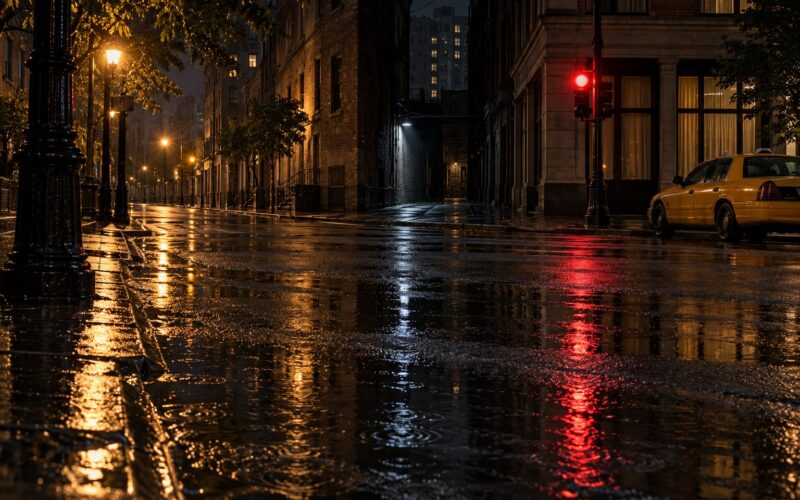
Learning how to write hardboiled prose without parody is mostly a matter of separating a genre’s surface traits from its machinery. Clipped sentences, a tarnished-silver comparison, a shrug at the client’s expense: those are the surface. What made Hammett and Chandler worth copying was everything underneath them. If you build that first, the surface stops sounding like a costume. Here is how, in seven steps.
This piece was revised for 2026, and it assumes you have a plot. The problem we are solving is not structure. It is that your prose keeps announcing a genre it has not earned.
Table of Contents
- What You Need
- Step-by-Step: Developing a Hardboiled Voice That Serves the Story
- 1. Start with character motive, not a voice imitation
- 2. Set the real time and place of the scene
- 3. Build a controlled hardboiled vocabulary
- 4. Make dialogue sound like people with different stakes
- 5. Use imagery and metaphor to pressure the viewpoint
- 6. Vary rhythm without losing the hardboiled economy
- 7. Edit for character integrity and remove imitation
- Common Mistakes: Why Hardboiled Prose Slips Into Parody
- Frequently Asked Questions
- How do I write hardboiled dialogue that doesn’t sound like Chandler?
- Why does my crime fiction read as a parody?
- What are the 20 rules for writing detective stories?
- Can you give me an example of a hardboiled detective?
- Who are some famous hardboiled detective writers?
- What is the hardest genre of fiction to write?
- Conclusion
What You Need
You need four things before you write a word of the register itself, and none of them is a list of banned words.
One objective your narrator wants badly. Not a personality, not a vibe. He wants the money, or he wants a name cleared, or he wants to get back at the man who put him on a train. Every choice you make in the prose can be tested against that objective.
A real place and a real hour. Hardboiled prose lives in specifics: a town with one traffic light, a bar that closes at one, a payphone that takes dimes. A setting you have not actually looked at gives you nothing to be precise about.
Three voice principles, not thirty mannerisms. Choose the qualities your narrator genuinely has. Irony, plainspoken authority, an appetite for work. Three you can sustain across 80,000 words. Thirty will collapse by chapter four.
A revision pass that tests prose against the story. You need a way to fail a line. If a sentence cannot be asked “does this reveal motive, setting or pressure?” it stays in on charm alone, and charm is where parody breeds.
Step-by-Step: Developing a Hardboiled Voice That Serves the Story
The process below moves you from imitation to ownership. Each step ends with a test you can run, because a step you cannot check is a step you will skip.
1. Start with character motive, not a voice imitation
Write the narrator’s want in one plain sentence before you write anything styled. “He needs eleven thousand dollars by Friday.” Now read your draft out loud and mark every sentence where diction, syntax or temperature cannot be traced back to that want. Those are borrowed lines.
Before:
The rain came down like a bad omen. I was hard, and I was tired, and I had seen it all.
After, with a motive behind it:
Eleven thousand by Friday. The clock on the wall of the bar was the only thing in the room that seemed to be helping me, and it was not helping much.
The second version is not more decorated. It is more specific, and its flatness comes from the man rather than the pose. Test: does this line tell me what he wants, or only that he sounds tough?
2. Set the real time and place of the scene
Place decides vocabulary. A 1937 Los Angeles street has streetcars, phone booths, a different kind of police car, and a class of people who would not talk to a man in a bad suit. A present-day city has none of that, and importing it is the fastest route to costume.
Time also decides what your narrator has not yet heard about. A detective in 1951 does not know the phrase burnout. A narrator who uses a word from after his own death in the story reads as a writer showing off, which is the exact tell readers punish.
Test: name three objects that would be in the room and could not be in the room twenty years earlier or later. If you cannot, your setting is a mood rather than a place.
3. Build a controlled hardboiled vocabulary
Hardboiled prose is defined by compressed observation, plainspoken authority, dry irony and metaphor used sparingly under pressure. What it is not defined by is the costume rack: the broad, a gal, a dame, my gat, the wintry drizzle, the broad-shouldered man, beat me down. Those words are period-accurate and reader-dead. Readers know them before your narrator does.
The fix is substitution, not subtraction. Replace the label with what the person does. Instead of “she was a looker,” give her the one detail your narrator would actually have fixed on, and let it be unflattering.
Before:
She was a looker. I clocked her the minute she walked in.
After:
She had a run in one stocking and a rolled-up sleeve on the left arm, the kind you get from working. The stocking was the interesting part.
The second line still tells you he looked. It also tells you he counts, and that the count is where his attention goes. Keep a hardboiled noun and verb economy and lose the shorthand. Test: replace every stock term with a concrete observation. If the paragraph loses nothing, the term was decoration.
4. Make dialogue sound like people with different stakes
Dialogue is the safest surface for the register, because characters rarely all talk like the narrator. Use that. Give each speaker an agenda in the scene, then let them interrupt, dodge, and change register under pressure. A person who wants money answers differently from a person who wants to be believed.
Before, everyone in the same voice:
“You want to know what I saw.”
“I want to know what you saw.”
“Nobody wants to know what I saw. I am telling you what I saw.”
After:
“You want to know what you saw.”
“I want to know if you’re going to write any of it down.”
“Depends.”
“On what.”
“On whether you were there Thursday.”
Nobody has stated anything. Five lines of deflection, one fact and one accusation, and the relationship is legible from the pattern alone. Test: read two lines aloud and swap the speakers’ names. If the exchange still works unchanged, those two people share a voice and one of them is wrong.
5. Use imagery and metaphor to pressure the viewpoint
The inflated comparison is the genre’s most recognisable fingerprint, which is exactly why it is the most dangerous. A comparison works when it comes from the narrator’s specific attention and shows you how he sees. It fails when it exists to sound clever and could have been written by anyone.
Compare the mechanism rather than the author. An earned comparison draws both halves of the image from the same field: a detail of the room and a detail of the man’s condition. Then it earns the humour from his self-awareness, not from the writer’s showmanship.
Weak: his face was like a cracked plate left in the sink.
Stronger: the office chair had a split in the leather arm, and the man in it kept touching the split the way you touch a tooth you have decided to ignore.
The second one is longer, which is the trade. You buy a real observation by giving up the punchline. What you must not do is escalate. Three comic comparisons in a row converts a voice into a performance, and performance is where readers stop believing the narrator and start watching the writer. Test: for each comparison, ask which of the character’s wants or wounds it exposes. None? Cut it.
6. Vary rhythm without losing the hardboiled economy
Short sentences are not the whole technique. Short sentences in a row are a drum beat, and a drum beat for ninety pages is a parody of pace. The hardboiled rhythm comes from alternation: a hard short line, then a longer observational sentence that does the real work, then another short one to close.
Before, all drum beat:
He came in. It was raining. He looked at me. I did not move. He spoke. I waited. He stopped. Then he sat down.
After, with the long sentences doing the observation:
He came in and stood just inside the door, letting the water off his coat collect on the floorboards, which he seemed to find more interesting than me. He had a hat in his hands. People bring hats when they have decided to be reasonable. I waited. He stopped being reasonable about four seconds later.
The mechanism is countable. In the second version you have four short sentences inside roughly seventy words, and the long sentences are where the character lives. That is how you keep the economy and lose the monotony.
A practical checklist for any paragraph: read it and underline only the short sentences. If more than a third of your sentences are short, you have a beat, not a voice. Then check whether your long sentences contain at least one concrete noun and one verb that is not “was.” If they do not, they are filler wearing a long coat.
7. Edit for character integrity and remove imitation
The final pass is an audit, and it is the only step most writers skip. Go line by line and ask of every tough-sounding line, joke, comparison and piece of slang: who exactly says this, and what does it tell me about them?
Four things signal imitation rather than voice. Borrowed cadence shows up as sentences that would fit equally in any book about a PI you have read. Generic menace is threat delivered without motive, which the narrator can do all day and reveal nothing. Authorial display is any line the writer clearly admires more than the character does. And detail inserted only to signal noir: the fedora, the neon sign, the rain, the second bottle, the reflection in a window nobody looks into.
Then run the mimicry test. Read your paragraph aloud. Read the passage you were emulating aloud next to it. If the resemblance is audible from across the room, you have copied cadence rather than absorbed technique. Cut ten percent and see whether anything is lost. Usually nothing is.
Test: hand the page to someone who has read the canon but does not know who wrote your draft, and ask what kind of person your narrator is. If the answer is a genre rather than a man, keep revising.
Common Mistakes: Why Hardboiled Prose Slips Into Parody
Copying a famous writer’s cadence instead of their method. A cadence is the surface rhythm of a particular writer. A method is the reasoning underneath it. Read Hammett to learn how he builds a scene around withheld information, and read Chandler to learn how one precise observation can carry a paragraph. Reading for rhythm alone is what produces indistinguishable copies.
Using cliches as shortcuts. Every hardboiled cliche was once a good description that got used until it stopped meaning anything. The fix is not to ban them; it is to notice when you reach for one. If your hand is already moving to “wintry drizzle,” you are avoiding the work of actually seeing the street.
Making every sentence ominous. Parody reads ominous because it performs darkness rather than inhabiting it. Real danger is often described flatly, with the narrator dealing with the practical problem of what happens next. Reserve the loaded language for the moments that earn it.
Overexplaining the atmosphere. Naming the mood and then describing it twice is the standard failure. One concrete detail carries an atmosphere better than three paragraphs of weather and mood lighting.
Flattening supporting characters. When everyone speaks in the narrator’s register, the narrator stops registering. Give your client, your antagonist and your police contact a different vocabulary and a different nervous habit. Their difference is what makes the narrator sound like anything.
Confusing simplicity with monotony. This is the mistake that punishes good instincts. Hardboiled prose is plain, and plain prose can still move. The cure is not decoration; it is variation in length, specificity and point of view.
Two revision tips carry most of the weight. First, cut every line that sounds impressive without revealing anything about the person saying it, since impressive lines are exactly where imitation hides. Second, replace the most telling cliché in each scene with something you would only write if you had actually been there, which is slower and much harder to fake.
One more thing worth saying plainly: pastiche is sometimes the right choice. A comic mystery set in 1949, a deliberate spoof, a book written as an homage to a specific writer and labeled as one, these are legitimate projects. The difference is intent made visible to the reader, and a piece that never claims to be more than an affectionate imitation does not need to survive the audit in this article.
Frequently Asked Questions
How do I write hardboiled dialogue that doesn’t sound like Chandler?
Give every speaker a different agenda in the scene and let them deflect rather than explain. Use interruptions, unfinished sentences and sudden drops into a professional vocabulary: a doctor says pressure, a broker says exposure. Chandler’s cadence is his own, so avoid the wry observation in dialogue and save the wit for the narrator’s narration, where the reader expects it. Then swap two speakers’ names and check whether the exchange still works. If it does, they share a voice and one of them needs to change.
Why does my crime fiction read as a parody?
Usually because the surface traits arrived before the machinery underneath them. Clipped sentences, a cynical shrug and a tarnished comparison can be pasted onto any plot, so the reader recognises the costume without feeling a person inside it. Emotional withholding is the master symptom: a narrator who never lets the reader see what a scene costs him. Fix the depth first: name his objective, ground the scene in a place and hour you have actually looked at, and let him be wrong in a specific way.
What are the 20 rules for writing detective stories?
They come from S. S. Van Dine’s 1928 essay, which set out twenty rules for the fair-play detective story, most famously forbidding anything that might offend a well-bred reader in mixed company. Roughly: the reader must be given every clue, the detective cannot be wrong for long, and no authorial intrusion, no coincidence and no romantic interest should get in the way of the puzzle. Hardboiled fiction exists as the deliberate inversion of almost every one of those rules.
Can you give me an example of a hardboiled detective?
Sam Spade in Dashiell Hammett’s The Maltese Falcon, Philip Marlowe in Raymond Chandler’s The Long Goodbye, and Lew Archer in Ross Macdonald’s The Galton Case are the three most cited. Each investigates rather than deduces, works for a living doing it, treats danger as an occupational hazard, and narrates the whole thing in a plain colloquial first person. Lew Archer is the useful one to study for the correction: he is tired, overqualified and not especially cool.
Who are some famous hardboiled detective writers?
The founders are Dashiell Hammett, Raymond Chandler, James M. Cain and Ross Macdonald. Elmore Leonard, Robert B. Parker and Sara Paretsky reshaped the form later, and Leonard in particular is the standard for dialogue that carries the register without announcing it. Contemporary writers working in the same territory tend to be deliberately less hardboiled than their models. If you are copying one writer rather than studying four, the register is the least interesting thing about them.
What is the hardest genre of fiction to write?
Hardboiled crime fiction is regularly named among the hardest, and the parody trap is a large part of why. The style is famous, widely imitated and instantly recognisable, so any slip looks like a costume rather than a choice. Fantasy and literary fiction forgive roughness because readers bring their own expectations. Readers of crime fiction arrive pre-fluent in the genre’s tics, and they check.
Conclusion
Voice first, surface second. Build the narrator’s objective, ground him in a real hour and place, keep the vocabulary plain and concrete, let different people speak differently, and let your imagery come from what he is actually looking at. Everything else is editing, and the editing is where parody is caught.
Do one thing today. Choose a single motive for your detective, write one scene using only imagery that comes from that scene’s situation, then cut every line in it that sounds impressive without telling the reader something new about him. That is the whole method in an afternoon.