A prison scene turns clichéd the moment it runs on stock parts: the sadistic guard, the tough cellmate, the easy vent, the shower ambush. Learning how to write a prison scene without cliches means replacing those with one specific institution, one specific character problem, and details that belong to nobody else’s book. The work takes a day of planning and a few focused drafting sessions, and the difference shows on the page immediately.
The reason these scenes fail is structural, not a matter of taste. Readers already know what a prison is supposed to look like, so anything you hand them that matches the mental image registers as filler. What they cannot predict is the particular bureaucracy your character is caught inside, or the specific thing they are trying to accomplish before the door opens.
Table of Contents
- What You Need
- Step-by-Step: Seven Beats for a Prison Scene That Works
- Decide What the Prison Space Controls
- Research the Exact Setting and Routine
- Give Every Detail a Point of View
- Build Stakes Into a Concrete Task
- Write Dialogue That Reflects Relationships and Risk
- Use Sensory Detail Selectively
- End With a Changed Situation
- Common Mistakes: How to Write a Prison Scene Without Them
- Frequently Asked Questions
- How do I research a prison scene accurately?
- What details make a prison feel realistic?
- Should a first-person narrator know what happens inside prison?
- How much violence belongs in a prison scene?
- How can I create tension without using obvious clichés?
- Can I write prison fiction without portraying every inmate as dangerous?
- Conclusion
What You Need
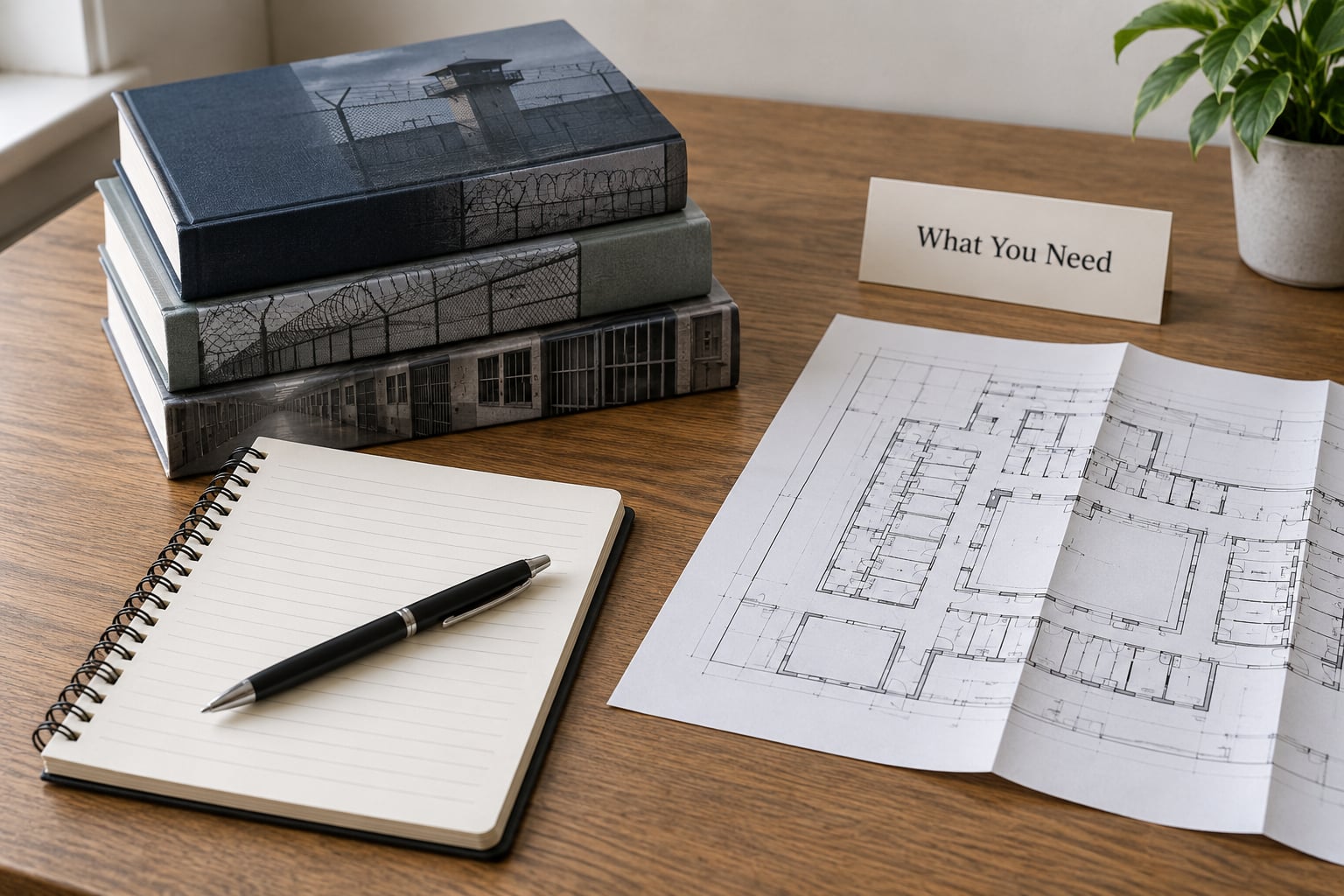
Most draft prison scenes are written with nothing but memory of films. That is why the bars feel wrong and the guards talk like props. Before you draft, gather four things.
One real institution. Pick a specific kind of facility: a maximum security US federal penitentiary, a county jail with a rotating population, a Victorian-era gaol, a military brig, a fantasy cell beneath a keep. The more specific, the less generic your prose becomes, because you are no longer writing “prison” in general.
The day, not the institution. Find out what a timeline actually looks like: when lights come on, how many meals, how long the movement to a yard or yard-free exercise period lasts, how showers are scheduled, how visitors are logged, what a disciplinary write-up involves. Schedules do more for credibility than atmosphere ever will.
Human sources. Read accounts from people who were held there rather than summaries about them. Interviews, oral histories, documentary transcripts and reform reporting will hand you the vocabulary your narration is missing. The people in those sources will also tell you what the food was actually like, which is usually stranger than what you would have invented.
A character with a specific objective. Not freedom. A concrete task: get a message to the man in the next block, survive a search at four, keep a hidden item past the noon inspection, get one question to the woman who visits on Thursdays. A character with a task generates scenes; a character who only wants out generates waiting.
A notebook and a floor plan help. Sketch the room, mark the door, the sightlines and the blind corners. You will not use the drawing, but knowing where the light comes from changes how you write the paragraph.
Step-by-Step: Seven Beats for a Prison Scene That Works
Run these seven steps in order. The first three build the container, the next three fill it, and the last one makes it matter. Each step comes with a simple test for whether it worked.
Decide What the Prison Space Controls
The point of architecture in a prison scene is control, so name exactly what the space restricts. Movement is the obvious one: who can reach which door, how far a character can get before someone notices. Then look at what the space does to privacy, to noise, to light, to sleep, to access to a phone or a razor or a clean towel.
Write that as a short inventory before you write any prose. For a Victorian gaol you might list cold stone, one barred window, a bucket, a door that is unlocked but guarded, and other prisoners visible through it. For a sci-fi brig you might list a hull section, a door that opens on a corridor anyone can walk down, and an atmosphere recycler that fails at night.
You worked if you can name three restrictions and three freedoms, and the freedoms feel earned rather than granted.
Research the Exact Setting and Routine
Now go get the details for the institution you picked. Look for its architecture, its daily schedule, its rules on property and visitors, the level of staffing on a night shift, and what happens procedurally after an incident.
The procedural part is where most writers stop and where most readers notice the gap. A character facing a strip search, a rule citation, a lockdown or a transfer is carrying real stakes, because those things have consequences that continue into the next chapter. If your guard can search a cell at any moment with no paperwork, you have given your character nothing to fear and nothing to plan around.
You worked if you can describe a normal Tuesday in this facility in under a hundred words and none of it sounds like a documentary voice reading a fact sheet.
Give Every Detail a Point of View
Neutral detail is wallpaper. Dramatic detail comes from a character noticing things because of what they feel, and what they feel in a cell is usually fear, guilt, resentment, exhaustion or a stubborn hope they refuse to give up.
Run the same observation through two states and watch it change. A cracked sink is nothing to a numb character and unbearable to one who has just decided they are going to use it. The light that stays on all night is a detail; light that falls on the hand of the man who signed the paperwork, and will not move, is a scene.
You worked if you can underline three sentences in your draft and say for each one which emotion the character was having when they noticed it.
Build Stakes Into a Concrete Task
Give the viewpoint character one thing to do during the scene, and make the environment interfere with it. The task can be small. That is the point. A character trying to hide a folded note under a mattress has a goal, an obstacle, a deadline when the door opens, and a result, which is exactly the shape a scene needs.
The task also solves the boredom problem writers complain about most often on writing forums, especially the ones whose prison is a single medieval cell with no yard and no amenities. Even with nothing but a bucket, a door and a length of wall, there is a character deciding what to do with several hours and no permission. The options are limited, which is what makes the choice interesting.
You worked if the scene would collapse if you removed the task. If it would not, you have written atmosphere.
Write Dialogue That Reflects Relationships and Risk
Dialogue in a confined space is dangerous for a reason nobody is watching. Every line is evidence. Use that instead of fighting it.
Interrupt often, because people do not get to finish sentences when a door opens or a guard walks past. Let characters answer the question that was asked about ten seconds ago. Let one of them say nothing at all, and make the silence do the work. Use code and euphemism when the topic is dangerous, and let the reader translate it a half-beat behind the character.
Keep the power imbalance visible in the lines themselves. A character being searched does not deliver a lecture about injustice. They comply, they deflect, or they go quiet, and the reader infers the rest. A guard doing an ordinary job, tired and by-the-book, is far more unsettling than a sadist, because your character cannot predict them.
You worked if you can cut one line of dialogue without anything changing. That line was explanation, not conflict.
Use Sensory Detail Selectively
Pick one or two senses per paragraph and load them fully. The known trap is the generic inventory, the cold damp stone, the clanking chains, the distant shout, all stacked together until nothing stands out.
Instead, choose details that are unusual and specific: the paint worn off a bar where hands have gripped it, the particular squeak of a door hinge in a building old enough to have been designed for holding people, the way a plastic cup sweats on a concrete ledge, the smell of a floor that has been mopped too recently. Add a temperature and a texture and you have an image no reader has seen before.
You worked if you can delete half your sensory sentences and the scene feels colder rather than emptier. That tells you the ones you kept were doing the work.
End With a Changed Situation
A prison scene that ends on mood is a scene readers skim. End it on a change: in the options, the relationships, the information, the danger, the body. The door opens and the search is worse than expected. The message gets delivered to the wrong person. The character learns the hearing is tomorrow instead of next week.
That last beat is what makes the next scene possible. It also means the confinement is doing narrative work rather than filling pages, which is the difference between a chapter set in prison and a chapter about something.
You worked if the last line contains a verb that moves something forward.
Common Mistakes: How to Write a Prison Scene Without Them
Most cliché prison scenes are assembled from the same short list of parts, and knowing how to write a prison scene without cliches means knowing that list well enough to subvert it. Here is what each part is and what to replace it with.
The corrupt guard who wants something. A guard on the take is the easiest way to create a bargain, a threat or a betrayal, which is why it appears constantly. Fix: let the guard follow procedure exactly and let the character be the one with the secret. The tension comes from a rule being applied honestly, and it is harder to write because you have to invent a cost the character actually pays.
The instant wardens boss. Power arrives in the first chapter as a hard-faced official who controls everything. Fix: spread the authority across several people who each hold a piece. The cook controls food timing, the officer on the block controls the door, the clerk controls the paperwork. The character has to learn the whole system, and the reader learns it too, which is suspense rather than scenery.
The cellmate as unlocker. The friendly, hardened cellmate exists to hand over contraband, backstory and a route out. Fix: make the cellmate self-interested and unhelpful, or simply indifferent. A relationship that gives the character nothing is more believable, and a small transaction is more revealing than a friendship.
The vent, the pipe or the crack in the wall. A fixed physical flaw is a promise to the reader, and the story is usually over before it is paid off. Fix: build the prison first, logically and consistently, and force the escape to work around a building that was not designed for it. If your characters cannot solve the problem you set up, change the prison rather than adding a second flaw.
Violence as a plot switch. Writers often feel obliged to include it, then regret it later, and the scene ends up serving nothing. Fix: if it belongs in your story, make it consequence rather than spectacle, and let the people it happens to keep having reactions afterwards. If it does not belong, the threat of it is usually stronger than the event, and it costs you nothing to leave it off the page.
The orderly arrival and processing. Handcuffs, the intake desk, the door closing, all delivered in the same register, read like a form being filled in. Fix: choose one strange, true detail about the processing and give it all your attention. What the officer does with the property bag, what the character is made to remove, which question gets asked twice.
Backstory delivered on request. A captive character will happily explain their entire history if you let the guard ask. Fix: cut the exposition and let the past leak out sideways through what the character refuses to say, misremembers or reacts to. A gap in an explanation is more intriguing than the explanation.
The rescue. An outside party arrives and resolves the situation. Fix: the change at the end of the scene should come from the character’s own choice, or from a decision made by an institution, not from a rescuer’s arrival.
One last tip that costs nothing: read your scene aloud. Phrases that sound inevitable in your head usually sound borrowed, and the ear catches them faster than the eye.
Frequently Asked Questions
How do I research a prison scene accurately?
Start with the institution rather than the prison in general. Look for its daily schedule, architecture, rules on visitors and property, and what happens procedurally after an incident. Then read first-person accounts from people held in comparable facilities, since summaries flatten the details that matter most on the page. Cross-check anything surprising; a single interview is a sample, not a rule.
What details make a prison feel realistic?
Schedules, materials and procedure do most of the work. When lights come on, how many meals there are, how long a movement lasts, what a rule citation involves, what a property bag is and who checks it. These are verifiable, specific, and almost never cliche, which makes them far safer than stacking up familiar imagery like cold stone and rattling chains.
Should a first-person narrator know what happens inside prison?
Only what they would plausibly learn from being there. A first-person narrator can know the schedule, the block, the local rules and the people they have dealt with, but not the institution’s internal processes or what is being said about them elsewhere. Working inside that limit is useful, because ignorance gives you a natural way to withhold information from the reader.
How much violence belongs in a prison scene?
Only as much as the story and the character require. Violence that is present for atmosphere usually reads as a plot switch, because it changes the situation without changing anyone. Consider whether the threat alone carries the tension, and whether the characters are still behaving differently a chapter later. If not, it is decoration, and the scene will be stronger without it.
How can I create tension without using obvious clichés?
Give the character a task the building can frustrate. A note to hide, a question to get asked, a search to survive, a visitor to reach. Tension then comes from time, procedure and the character’s own choices rather than from a threat arriving on cue. It also survives better, because a reader cannot predict how a determined person will handle a small problem.
Can I write prison fiction without portraying every inmate as dangerous?
Yes, and most credible prison fiction does. Real populations include people frightened, ill, elderly, coerced and simply tired, and showing that is more interesting than a permanent threat. It also gives you range. A cellblock where the pressure comes from boredom, hierarchy and bureaucracy can be more unsettling than one where everyone is a predator.
Conclusion
Prison scenes stop reading as filler once the building has its own logic and the character has something to lose on a specific afternoon. Choose the institution, name three restrictions and three freedoms, give the viewpoint character one concrete task, and filter every detail through what they are feeling. Then end on a change rather than a mood. That is how to write a prison scene without cliches in practice: research first, then filter everything through one person’s problem. Start there and the rest of the scene writes itself.