
An amateur sleuth investigates because staying out of it costs them something specific. To write an amateur sleuth who has a reason to investigate, name what the unsolved crime takes from your character, then build the access, the skill, and the nerve that let them act where professionals cannot. Do that character work first and every later clue gets easier, because each discovery is something the sleuth chose to chase rather than something that happened to land in their lap.
The word amateur comes from the French for one who loves, which is a useful reminder: this character is not obliged to investigate. They are drawn to it. Literary agent Janet Reid has said that in an amateur sleuth mystery her requirement is that the sleuth have a compelling reason to investigate, and writers working in this space treat that line as a gate rather than a suggestion. Motivation is usually the hardest thing to get right, and it is the first thing a reader quietly checks.
This guide walks through seven steps, from the inciting incident to the moment the answer changes the character, then covers the mistakes that flatten a premise and a set of tests you can run before drafting.
Table of Contents
- What You Need
- Step-by-Step: How to Write an Amateur Sleuth Who Has a Reason to Investigate
- 1. Start With the Inciting Incident, Not the Curiosity
- 2. Give the Motive a Personal Cost
- 3. Limit the Sleuth’s Knowledge and Access
- 4. Build a Chain of Fair Clues
- 5. Create Obstacles That Test the Motive
- 6. Add an Ethical Complication
- 7. Resolve the Mystery and the Character’s Change
- Common Mistakes
- Mistake 1: Using a Generic Reason to Investigate
- Mistake 2: Letting the Character Know Too Much
- Mistake 3: Making the Clues Convenient
- Mistake 4: Making the Investigation Cost Nothing
- Mistake 5: Choosing Between Right and Wrong
- Tips for Strengthening the Investigation
- Frequently Asked Questions
- What is a believable reason for an amateur sleuth to investigate?
- How do I make an amateur sleuth realistic without turning them into a detective?
- Should the investigator know more than the reader?
- How many clues should I include in a short mystery story?
- What if my sleuth’s motive is not revenge?
- How can I keep the investigation from becoming too complicated?
- Conclusion: Begin With a Reason That Cannot Stay Quiet
What You Need
Six materials, and you want all of them settled before you draft a scene.
- A specific protagonist. Age, job, and one habit that shapes how they look at a room. Amateur sleuths work best with a day job and a web of community ties, because that is where access comes from.
- An inciting disruption. A missing person, an unexplained death, a threatened business, a broken promise, a damaged reputation. Something that changes their week rather than their hobby.
- A personal or moral reason to investigate. Not curiosity in general. Who suffers if this stays unsolved, and what happens to the sleuth if they do nothing.
- A credible source of clues. A skill, a job, a relationship, or a physical location that lets them see or learn things a stranger could not.
- Real risks. Job loss, a damaged friendship, legal trouble, physical danger to themselves or someone they love.
- An escalation mechanism. The reason the case gets bigger after each discovery, so the investigation cannot simply end in chapter twenty.
Miss Marple, Nancy Drew, Flavia de Luce, and C. Auguste Dupin, who solves The Murders in the Rue Morgue in 1841, all had something ordinary in hand before they had anything clever. Yours can be smaller than theirs and still work.
Step-by-Step: How to Write an Amateur Sleuth Who Has a Reason to Investigate
1. Start With the Inciting Incident, Not the Curiosity
Begin with an event that forces a decision, not with a character who feels like looking into something. A body in a neighbour’s orchard, a sister who stops answering the phone, a business about to lose its insurance, a friend arrested in front of the whole town. Each of these changes the protagonist’s circumstances and creates a deadline.
Test the incident by asking what the character does in the twenty-four hours after it. If the answer is that nothing is possible because they have no reason and no access yet, the incident is too small. If the answer is a phone call, a drive to the station, or a door they feel compelled to knock on, you have a first scene.
2. Give the Motive a Personal Cost
A reason to investigate becomes real when inaction has a price. Specify who is affected, what is threatened, and why waiting is dangerous.
Instead of she wanted to find the truth, try her brother was the only witness and the defence had already appointed a lawyer. Instead of a nosy retiree notices things, try the shop that has kept the street alive for thirty years is being quietly bought out by someone who has never set foot there. The loss is concrete, and a concrete loss can escalate.
Skilled writers tend to start with an external obligation and let it mature into internal character. A missing father becomes an obsession with the case, then an excuse to avoid other problems. That arc works better when the external stake is specific enough to argue about.
3. Limit the Sleuth’s Knowledge and Access
Decide what your amateur can realistically observe, ask, find, or infer, and write the permissions down. Social position matters more than talent: the librarian gets asked things the outsider would not, the mechanic sees what the rich visitor left behind, the teenager is overlooked in a room full of adults.
Then write the blind spots. Every sleuth has them, and they are where the tension lives. A retired police officer knows procedure and not the current suspects. A journalist can talk to people but cannot get records. A teenager is fast on a bicycle and terrible at hiding a search of their own room.
Every important discovery should be traceable to something the sleuth did: asked, noticed, returned to, or risked. If a clue arrives because the plot needed it, the reader stops trusting the whole book.
4. Build a Chain of Fair Clues
Connect physical details, statements, records, and habits into a progression the reader could have followed. Physical evidence establishes what happened. Statements show what someone wants believed. Records contradict a story. Contradictions point at motive.
Make each clue do two jobs. The same detail should support two readings early on, and only resolve into its true meaning in the final third. A receipt with an unusual time on it is a scheduling problem in chapter ten and an alibi in chapter twenty-two.

Keep an explicit list as you draft: where the clue was planted, who could see it, and what the reader was meant to take from it at the time. If a clue has no location and no acquisition action, it is not fair.
5. Create Obstacles That Test the Motive
Resistance should make the investigation more complicated rather than merely longer. Use unreliable witnesses who are not lying, institutional barriers that are procedure rather than stupidity, misleading evidence that supports a wrong theory, and conflicting loyalties where helping one suspect hurts another.
Add your protagonist’s own assumptions. The flaw that drew them in should be the flaw that gets them hurt, so the same impulse serves them at the start and betrays them at the end.
Every obstacle should raise the cost of continuing and force a choice. If the last three chapters are things that happen to the sleuth, the reason to investigate has stopped doing any work.
6. Add an Ethical Complication
Make the investigation morally uncomfortable by putting the sleuth’s loyalty against something they also owe: a friend’s privacy, a family’s safety, a vulnerable person’s reputation, a promise made to someone else. The strongest version asks them to choose between two defensible harms rather than between right and wrong.
A librarian who finds proof against the man who saved her library is not weighing good against evil. She is weighing a debt against a truth that will end a family. That dilemma keeps readers with a protagonist they cannot simply admire, and it is where most amateur sleuths get interesting.
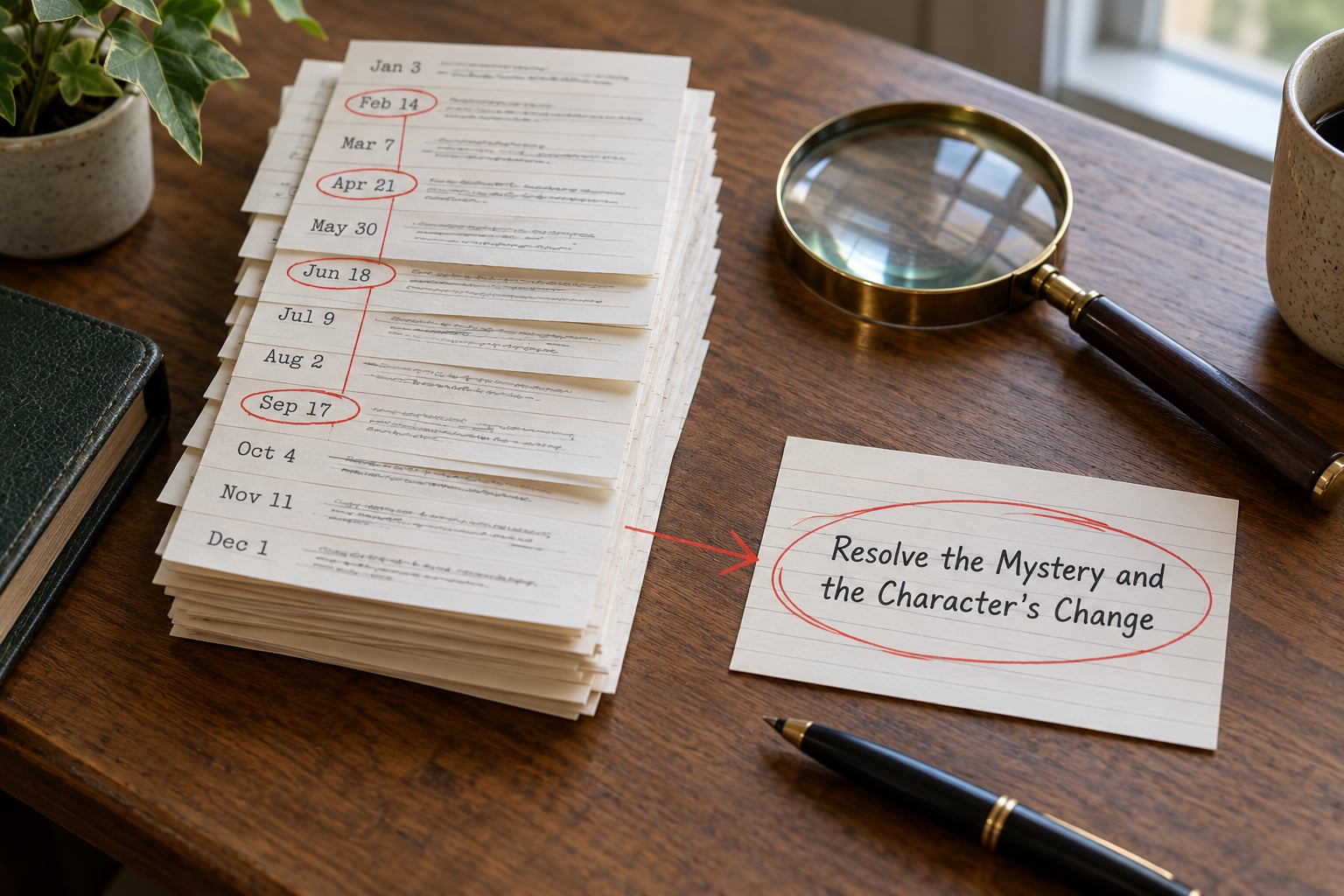
7. Resolve the Mystery and the Character’s Change
Tie the solution back to the opening incident, the central clue chain, and the original motive. Then show what the answer changes in the relationships, assumptions, or self-understanding your protagonist carried into chapter one.
A standalone can end with the case closed and one relationship altered. A series needs the reason to grow, change shape, or resolve across books: satisfied in book one, complicated in book three, and finally forgiven in book six.
Whatever the shape, the amateur must be the agent of the mystery. The evidence that clears the name or convicts the culprit has to come from them, not from a police rescue at the last page. Writers who have followed a sleuth through a whole novel find a rescue ending humiliating rather than dramatic, and that reaction shows up constantly in writing forums.
Common Mistakes
Mistake 1: Using a Generic Reason to Investigate
Make it right, find the truth, and follow my instincts all read the same because none of them name a victim. Revise by specifying who is affected, what is threatened, and why delay is dangerous. If you cannot name the loss in one line, the motive is a placeholder.
Mistake 2: Letting the Character Know Too Much
An amateur who already understands the whole case has nothing to discover, and the tension drains out. Keep the protagonist limited to what they could plausibly notice, obtain, or interpret, and let their conclusions be wrong for a while.
Mistake 3: Making the Clues Convenient
Discoveries that appear only when the plot needs them are the most common note readers leave. Give every major clue a source, a location, an acquisition action, and one plausible misinterpretation, so that a wrong reading costs the sleuth something.
Mistake 4: Making the Investigation Cost Nothing
An inquiry with no personal, social, or professional consequences feels weightless. Assign costs in the first scene and add to them after each discovery: a warning from an employer, a friendship that cools, a lie the sleuth can no longer take back.
Mistake 5: Choosing Between Right and Wrong
Flat moral choices produce flat climaxes. Create competing loyalties and competing harms instead, so the sleuth’s decision costs something whatever they pick, and their agency is what gets them to the ending.
Writers in r/writing and r/MysteryWriting also flag the reverse problem: an amateur sleuth written so that everyone else looks foolish. Readers will forgive an untrained detective. They rarely forgive a community that has stopped functioning.
Tips for Strengthening the Investigation
- Compress your motive into one sentence and check whether it contains a verb somebody could object to. It usually should.
- List your clue sources before you plot: who talks to this person, who can get that record, who saw that at that hour.
- Reverse one interpretation. Let the reader’s obvious reading of a scene turn out to be wrong for reasons they could have spotted.
- Increase the cost after every discovery rather than adding new mysteries. Cost is what keeps a single thread tense.
- Write down what the sleuth refuses to do. A protagonist who will not break a promise, or will not use a piece of evidence, becomes interesting fast.
- Give the police one missing piece and a good reason for it. Competent investigators missing one thing beat incompetent investigators every time.
Frequently Asked Questions
What is a believable reason for an amateur sleuth to investigate?
A believable reason names a specific person or value the sleuth stands to lose if the case stays unsolved, and it arrives through an event rather than a personality trait. A sibling who was the only witness, a business about to close, a friend accused of something they did not do, a habit of noticing details that now cannot be unnoticed. Curiosity is a flavour; a threatened relationship or an expiring deadline is a reason.
How do I make an amateur sleuth realistic without turning them into a detective?
Keep them trained in one narrow thing rather than in investigation. A chef reads a room, a physiotherapist knows how bodies move, a librarian knows what people are hiding behind what they request. Let them be genuinely untrained in the rest and let a professional handle the parts that require authority. Realism comes from limits, not from incompetence, and the limits should stay consistent across the book.
Should the investigator know more than the reader?
Usually not. Fair-play readers want to be able to look back and say they could have seen it. A sleuth who is ahead of the reader removes the pleasure of the search, while a sleuth who is behind the reader feels like the author is hiding something artificially. The better choice is to give the reader exactly what the sleuth has, and let both of them notice the same detail and read it differently.
How many clues should I include in a short mystery story?
Fewer than you think. A short story supports roughly five to eight meaningful clues, each of which can carry two possible meanings and one of which is a red herring. Every clue must point somewhere, be reachable by an action the sleuth takes, and change the shape of the case. If a clue only exists to fill a gap or repeat what the reader already suspects, cut it.
What if my sleuth’s motive is not revenge?
Most of the best ones are not. Duty, protectiveness, professional pride, curiosity about a specific unanswered question, or a sense of debt to someone who cannot ask are all stronger because they let the character change over the course of the book. Revenge locks the character in place. A softer motive lets you show what the investigation costs them and what it teaches them about themselves.
How can I keep the investigation from becoming too complicated?
Cap your cast and your clue count before you draft, and give every suspect one clear relationship to the victim. Track one timeline rather than three. Most confusion comes from too many people with motives rather than too many clues. If a suspect serves no purpose in the chain of fair clues, remove the suspect rather than adding an explanation for what they were doing at the time.
Conclusion: Begin With a Reason That Cannot Stay Quiet
Start with the inciting incident, write down the personal cost of doing nothing, and outline your first three clues before you add any complications. If those three sentences work, the premise carries the rest of the book.