Tartan noir is dark, gritty crime fiction set in Scotland, known for bleak urban settings, moral ambiguity, class conflict and an undercurrent of gallows humour. Tartan noir explained properly means tracing it back to William McIlvanney’s 1977 novel Laidlaw, then forward through Iain Banks, Val McDermid, Ian Rankin and Denise Mina to a shelf of books readers now buy by the label alone.
Tartan noir in 60 seconds: a post-1970s outgrowth of Scottish crime writing, built on police procedurals, detective fiction, serial killer fiction and darker “noir” novels. The label is usually credited to Iain Banks in the 1980s, was turned into a sales category by publishers in the 2000s, and is still argued over by critics, academics and some of the writers it is applied to.
Table of Contents
- What Is Tartan Noir?
- Where Did the Term Tartan Noir Come From?
- Is “Tartan Noir” Actually a Genre?
- What Makes Tartan Noir Distinctive?
- Gritty realism, not atmosphere for its own sake
- Class as a cause, not a mannerism
- Dark humour under the bleakness
- How Does Tartan Noir Use Scottish Places and Weather?
- Which Themes and Tropes Appear in Tartan Noir?
- Who Are the Important Tartan Noir Authors and Books?
- How Does Tartan Noir Differ From American, British, and Nordic Noir?
- How Can Readers Start with Tartan Noir?
- Frequently Asked Questions
- What does tartan noir mean?
- Who are the main authors of tartan noir?
- What are the best tartan noir books for beginners?
- Is tartan noir actually a genre?
- How does tartan noir differ from Nordic noir and cosy crime?
- Is Tana French a tartan noir author?
- Conclusion
What Is Tartan Noir?
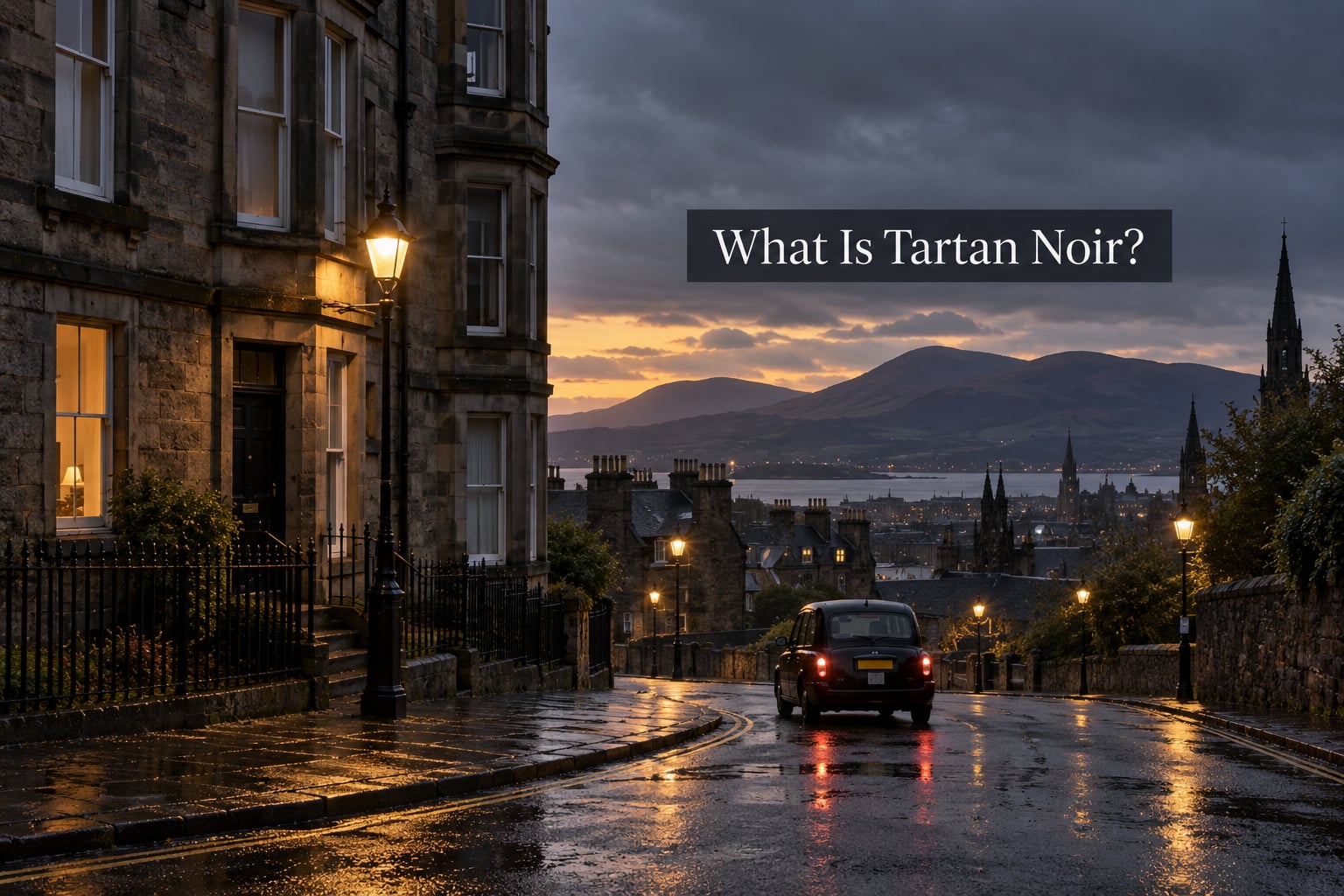
Tartan noir describes a body of Scottish crime fiction that treats the country’s cities, estates, weather and public institutions as pressure points rather than backdrop. It favours flawed investigators, unreliable narrators, bleak prose and black humour, and it usually ends in moral uncertainty instead of comfort.
It is narrower than “Scottish crime fiction”, which also covers light mysteries, procedural series and cosy village whodunnits. It is also narrower than the older, looser “Scottish noir”, which covers gothic, historical and literary fiction that has little to do with crime. A kilt on the cover proves nothing.
Here is what usually earns a book the label:
- Bleak settings, most often Glasgow or Edinburgh, sometimes an island, a fishing town or a post-industrial belt
- Working-class or institutionally trapped protagonists rather than gilded amateur detectives
- Moral ambiguity, with no clean distinction between the investigator and the guilty
- Dark humour, often gallows humour, used to keep the bleakness readable
- Social satire aimed at policing, politics, media and the legal system
- Class conflict and social inequality treated as causes of crime, not just scenery
- Psalms, hymns or rain in the prose, which is a joke, but a joke readers recognise
Where Did the Term Tartan Noir Come From?
The roots are literary. In 1977 William McIlvanney published Laidlaw, a Glasgow-set novel about a detective named Jack Laidlaw who returns from a nervous breakdown to investigate a murder. Its flat, unflinching Glasgow, its damaged hero and its refusal to treat the city as picturesque were so unlike most crime fiction of the day that it is routinely called the first tartan noir novel.
The label itself is usually credited to Iain Banks, who used the phrase in the 1980s in connection with McIlvanney’s work, and it dates from roughly that period. Banks did something else important at the same time: his novels The Chain Dish (1989) and Dead Souls proved that Scottish writers could be as weird, blackly comic and formally adventurous as anyone publishing in London.
What turned a critical description into a market category came later. Through the 1990s and 2000s, Scottish crime fiction sold better than almost anything else from these shores, publishers put “Tartan Noir” on covers, and booksellers built a shelf around it. Len Wanner’s Tartan Noir: The Definitive Guide to Scottish Crime Fiction (2015) fixed the vocabulary most readers still use, dividing the shelf into four kinds: the detective, the police, the serial killer and the noir novel.
Is “Tartan Noir” Actually a Genre?
Sometimes, and not always. Researchers at the University of Edinburgh have argued that tartan noir is “not a synonym for Scottish noir but a mystifying marketing label for a national literature” — that is, a way for publishers to sell a mood rather than a formal category. Ian Rankin has publicly pushed back on being filed under it. The honest answer is that tartan noir names a sensibility: dark, contemporary, socially aware Scottish crime writing, whether or not you call it a genre.
What Makes Tartan Noir Distinctive?
Three things separate it from ordinary crime fiction, and they work as a set. Strip any one out and you get something more familiar.
Gritty realism, not atmosphere for its own sake
The rain and the tenements are not decoration. A city’s weather, housing stock, postcodes and job prospects shape the crime, the suspects and the detective’s options. Violence in these books tends to be ugly and often domestic, which is a deliberate break from the tidy violence of mid-century detective fiction.
Class as a cause, not a mannerism
Working-class protagonists are usually trapped between institutions that do not care about them: policing, courts, social work, local government and the press. Rankin’s Mortal Causes is the clearest example, with Edinburgh’s old guard clashing with the city’s poorer districts, and the detective deliberately drawn toward the people the system is failing.
Dark humour under the bleakness
Readers describe the books as “gritty but funny” more than any other single trait. The humour is irreverent and quite sweary, and it is what makes a very dark book finishable. It is also a defence mechanism the characters use, which means the jokes are often about the same injustice the plot exposes.
Alongside those three sits moral ambiguity. Detectives here are usually damaged, bored,compromised by family, or institutionally out of step. Readers who want a hero to admire tend to bounce off the shelf; readers who want a fair fight between a flawed person and a rotten system tend to stay.
How Does Tartan Noir Use Scottish Places and Weather?
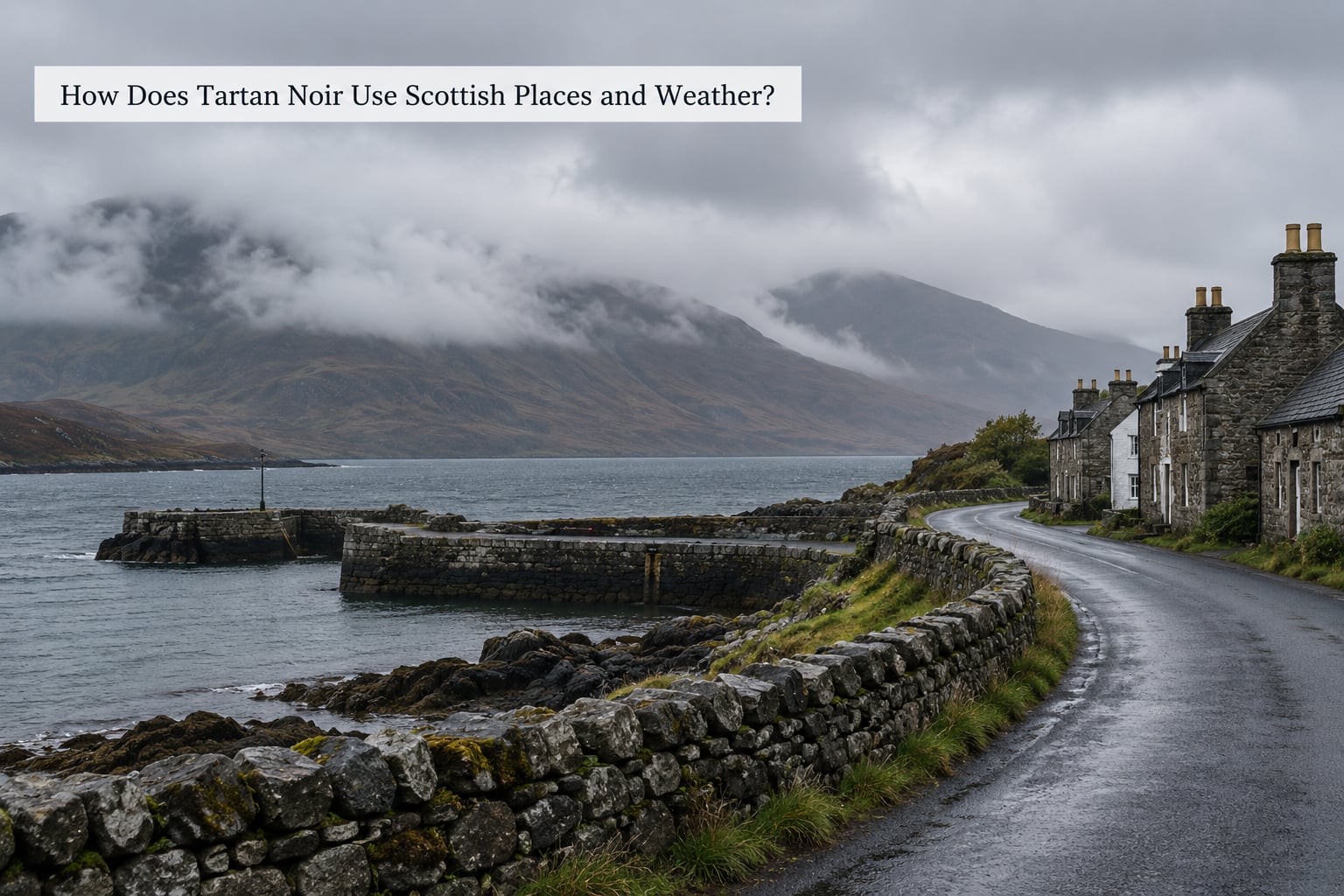
Glasgow supplies the grittiness: post-industrial decline, dense sandstone tenements, schemes, addiction and a city that has been described in the fiction far more honestly than in the tourism brochures. Edinburgh supplies the other register — wealth, private schools, old money, the Scottish legal establishment and its silences. Shetland and Orkney supply isolation, small communities and the specific pressure of an island where there is nowhere for anyone to go.
Weather does the work of plot. Darkness, rain, fog and a six-week winter afternoon are practical problems for a detective, and they are also mood. Coastal and island settings add a specific tension: tight communities where a stranger is noticed, and where solving a crime means offending everyone who has to keep living with each other afterwards.
The weather is also a contrast device. A plot that stays in the open air, on a road, on a boat or on an island, feels more exposed than the same plot in a station house. And the recurring light-dark pattern in the prose — offices lit at four in the afternoon, wet pavements, headlights — is a genre convention now, whether writers use it knowingly or not.
Which Themes and Tropes Appear in Tartan Noir?
- Institutional corruption — police, councils, courts and newspapers bending to protect the powerful
- Social inequality — poverty treated as the engine of the crime rather than as background
- Alcoholism and addiction — widespread, rarely moralised about, often comic
- Domestic abuse and violence against women — a recurring subject in both novels and the TV adaptations
- Revenge — private justice pursued outside the law, sometimes justified, sometimes not
- Compromised justice — the wrong verdict, the buried case, the cover-up that outlasts the culprit
- Outsider and returning detectives — a detective new to the city, or returning after a breakdown, or transferred in from elsewhere
- Unreliable narrators — first-person accounts that contradict the evidence around them
- Tradition against modernisation — old money, church respectability and rural convention colliding with a Scotland that has changed
- Serial killer fiction — the most commercial corner of the shelf, often explicit, often procedural
- Gothic inheritance — decaying houses, isolated estates, buried family histories, especially in the fiction around Shetland and the Highlands
- Multi-author anthologies — Scottish writers still publishing crime as a shared national project, something the Nordic and English traditions rarely attempt
Who Are the Important Tartan Noir Authors and Books?
William McIlvanney is where the shelf starts. Laidlaw (1977) gave the genre its template, and The Cone Gatherers is a hard, beautiful novel about class and complicity that most readers meet later. His prose is plain, measured and tougher than it looks.
Iain Banks brought the dark comedy and the surreal streak. The Chain Dish (1989) and Dead Souls (2012) are the two most tartan noir novels he wrote, and they are more inventive than anything else on the list.
Val McDermid is the reliable route in for newer readers. Report for Murder (1987) and The Mermaids Singing (1995) were early social-satire thrillers; her long-running pairing of reporter Carol Jordan and psychologist Tony Hill, and later DI Tony Hill and Inspector Carol Jordan, is the shelf’s steadiest series. Common Murder is the collection of essays on crime writing worth having.
Ian Rankin gave it the detective readers still argue about. The Flood (1986) and Let It Bleed (1988) are the early novels; Inspector John Rebus, gruff, argumentative and magnificently stubborn, arrived in Knots & Crosses (1987) and ran to more than twenty books. Rankin has said he dislikes the tartan noir label, and Mortal Causes is the one to read when you want class conflict to be the whole point.
Denise Mina is the modern Glasgow voice most often recommended to readers who find McIlvanney’s older prose hard. Garnethill, which won the 1999 CWA New Blood Dagger, is a bruising, claustrophobic debut, and her DCI Alexandrova books and later Gus McGuire crime capers are lighter without losing the edge.
Louise Welsh belongs to the genre’s experimental wing. Cutting Room (2002) is a tight, sour thriller; The Miracle Maker (2010) mixes crime with something closer to spirituality and is the more unusual of the two.
Newer writers keep the sensibility alive without wearing the label. The Heretic (2021) by William McIlvanney’s son Liam is the clearest recent example, and it holds a 4.2 average across roughly 1,360 Goodreads ratings. Lin Anderson’s Glasgow books, Stuart MacBride’s Shetland novels and Ann Cleeves’ Jimmy Pérez stories extend the same weather and the same cramped communities into new territory.
How Does Tartan Noir Differ From American, British, and Nordic Noir?
All three are cousins, and the boundaries are soft. A book can sit in more than one. The useful difference is what each tradition uses crime for.
| Element | Tartan noir | Nordic noir | American hardboiled noir |
|---|---|---|---|
| Typical setting | Glasgow, Edinburgh, islands, post-industrial towns | Stockholm, Oslo, Copenhagen, small northern towns | Los Angeles, New York, cities of heat and neon |
| Social target | Class inequality and British-Scottish institutions | The welfare state and its failures | Corrupt city government and capital |
| Typical detective | Damaged, local, often working-class or returning | Usually female, methodical, institutionally trusted | Private, cynical, allergic to institutions |
| Voice | Close third person, heavy dialogue, irreverent | Cool, procedural, emotionally restrained | First person, sardonic, street-level |
| Humour | Strong, gallows humour throughout | Rare, dry, sometimes black | Sardonic, aimed at the narrator’s own bad luck |
| Climate function | Endless wet, dark, claustrophobic | Cold and light, or endless winter darkness | Heat, humidity, neon and rain |
American hardboiled noir, from Chandler and Hammett onwards, is about a loner refusing to be bought. British crime writing has its own long line, from the Golden Age puzzle to Colin Dexter’s wry Oxford mysteries and the Gold Dagger tradition, and it is generally more concerned with detection than with social indictment. Nordic noir, which took the label so successfully that “noir” became a national export, treats the welfare state as the guilty party. Tartan noir’s closest relatives are the American and British kinds on craft and the Nordic kind on seriousness, but its grievance is distinctly Scottish: class, and who in the state gets to be protected.
One term to keep separate is cozy crime, or cosy crime as British readers call it. Cozy crime is the commercial opposite of this shelf: amateur sleuths, picturesque villages, low violence, a puzzle to be solved rather than a system to be indicted. Readers who find tartan noir too bleak usually land on cosy crime, and readers who bounce off cosy crime usually want tartan noir. Choosing between them is mostly a mood decision.
How Can Readers Start with Tartan Noir?
Start with the kind of book you want to read, not with the most famous series. Rebus is a fine detective series, but more than twenty novels and a dated 1980s sensibility make it a poor first door into the genre.
| If you want | Start with | Why |
|---|---|---|
| Plain, gutting detective fiction from the start | William McIlvanney, Laidlaw (1977) | The genre’s founding novel; bleak, plain and hard to beat |
| A long series to work through | Val McDermid, Carol Jordan and Tony Hill | Twenty-plus books, a consistently strong plot engine, easy entry |
| The most-read Scottish detective | Ian Rankin, Inspector Rebus | The series everyone means; start with Knots & Crosses if you can |
| Dark comedy and the strangest ideas | Iain Banks, The Chain Dish (1989) | Funny, bleak and formally odd; proves the label is wider than police stations |
| Modern, propulsive and psychologically tight | Denise Mina, Garnethill | Short, fierce and contemporary Glasgow |
| Short stories or an anthology | Scottish crime anthologies and McDermid’s Common Murder | A low-commitment way to find your author |
Many readers arrive through the television first, then go back to the books. Shetland (BBC One, from 2012) is the adaptation that carries the most tartan noir DNA, built on Ann Cleeves’ islands and moved by domestic abuse, trafficking and a small community that cannot absorb what it learns. Rebus (BBC One, 2000 to 2009) put Rankin’s detective on screen for a generation who never opened a novel. Traces (ITV, 2005 to 2007) adapted McDermid’s Wire in the Blood, and Karen Pirie has adapted McDermid’s PI since 2021.
One practical note. If you dislike being lied to, keep track of narrators. Several of the strongest books on this shelf are told by people who turn out to be wrong about the central thing, and part of the pleasure is catching the lie in the gaps.
Frequently Asked Questions
What does tartan noir mean?
Tartan noir means dark, gritty crime fiction set in Scotland, with bleak urban settings, working-class or damaged protagonists, social satire, moral ambiguity and dark humour. It grew out of William McIlvanney’s 1977 novel Laidlaw and is now used by publishers to sell Scottish crime writing as a category.
Who are the main authors of tartan noir?
The writers most associated with the label are William McIlvanney, Iain Banks, Val McDermid, Ian Rankin and Denise Mina, with Louise Welsh often included as the experimental edge. Newer names carrying the same sensibility include Liam McIlvanney, Lin Anderson, Stuart MacBride and Ann Cleeves. Several of these authors, Ian Rankin especially, have publicly resisted the label.
What are the best tartan noir books for beginners?
For beginners, William McIlvanney’s Laidlaw is the founding text, while Val McDermid’s Report for Murder is the easier modern entry point. Denise Mina’s Garnethill is short and fierce, Iain Banks’ The Chain Dish is the funniest, and Ian Rankin’s Rebus series offers the longest commitment. A Scottish crime anthology is the lowest-risk way to test the waters.
Is tartan noir actually a genre?
It is a marketing category first and a genre second. Researchers at the University of Edinburgh describe it as a label for a national literature rather than a synonym for Scottish noir, and Ian Rankin has distanced himself from it. What it reliably describes is a sensibility: dark, contemporary, socially aware Scottish crime writing rather than a fixed set of rules.
How does tartan noir differ from Nordic noir and cosy crime?
Tartan noir and Nordic noir are both serious, socially critical traditions, but tartan noir attacks class inequality and British-Scottish institutions while Nordic noir targets the welfare state. Cosy crime is the commercial opposite: amateur sleuths, low violence and puzzles rather than indictments. Choose tartan noir for atmosphere and argument, cosy crime for a lighter mood.
Is Tana French a tartan noir author?
No. Tana French writes dark, literary detective fiction set in Dublin, which is often sold alongside tartan noir because the tone and Irish setting feel similar. Her debut In the Woods (2007) is the usual starting point, and most critics treat her as Irish crime fiction rather than Scottish crime fiction. She is worth reading on her own terms.
Conclusion
Tartan noir is a sensibility rather than a rulebook: bleak Scottish settings, damaged protagonists, class as the cause of crime, and enough gallows humour to keep the whole thing readable. Start with Val McDermid’s Report for Murder if you want a propulsive plot, with William McIlvanney’s Laidlaw if you want the book the genre grew from, and with Iain Banks’ The Chain Dish if you want proof that the label covers more than police stations. Whichever you pick, follow it to the next one by the same author rather than jumping between them.