
A kidnapping plot works because it takes something away. Someone who was safe, known and busy becomes isolated, and every hour costs them more. If you want to know how to write a kidnapping plot that holds tension for 300 pages, the answer is nine decisions made in order: what the abduction changes, who wants what, who knows what, what makes delay expensive, how discovery narrows, what was planted earlier, why the kidnapper is who they are, which assumption breaks, and what the protagonist gives up at the end.
Most drafts get stuck on the abduction scene itself, which is the least important half hour in the book. Plan past it before you draft it.
Table of Contents
- What You Need
- Step-by-Step: How to Write a Kidnapping Plot
- Step 1: Decide What the Kidnapping Changes
- Step 2: Create Distinct and Conflicting Goals
- Step 3: Choose Who Knows What—and When
- Step 4: Add Pressure Without Needless Sensationalism
- Step 5: Build an Escalating Chain of Discovery
- Step 6: Plant and Pay Off Foreshadowing
- Step 7: Make the Kidnapper More Than a Plot Device
- Step 8: Design a Reversal That Earns Its Consequences
- Step 9: Resolve the Plot Through a Decisive Choice
- Common Mistakes
- Frequently Asked Questions
- How many scenes should a kidnapping plot have?
- How do you keep a kidnapped character interesting?
- What makes a kidnapping motive believable in fiction?
- How many clues or twists are too many?
- Should the kidnapped character be rescued at the end?
- How do you write a kidnapping plot without making it feel predictable?
- Conclusion
What You Need
You need six things before you write a word of prose, and none of them is a weapon or a route map. This is a character problem wearing a thriller coat.
A person worth following. Either the abducted character or the person hunting them. If you cannot describe what that person wants on an ordinary Tuesday, the abduction has nothing to interrupt.
A consequential objective. What the kidnapping is meant to achieve: money, silence, leverage, revenge, an idea enforced on a person, or something stranger. “They want money” is a starting point. “They want the signature on a document that would expose a twenty-year-old lie” is a plot.
Defined stakes. Practical, emotional and moral. What breaks if this goes wrong, and who else breaks with it.
A time-pressure device. A deadline that comes from inside the situation rather than from an arbitrary countdown. A ransom note, a court date, a wound that will not stay closed, a job offer that expires at dawn.
A setting with constraints. Where it happens, what the geography allows, what the season or the hour does to everyone’s options. A rural farmhouse, a hospital wing, a ferry, an apartment block where neighbours hear everything.
A map of discoveries. The list of things the reader learns and in what order, including the ones that turn out to be wrong. Build this before you write, or you will discover the answer halfway through and pad backwards.
If you are still stuck on an opening page rather than a structure, decide whether you want to start with the protagonist or the circumstance. That choice alone clears a lot of abandoned drafts, and it is worth resolving before you plan beats.
Step-by-Step: How to Write a Kidnapping Plot
Step 1: Decide What the Kidnapping Changes
Write one sentence in the form “Before this, X was true. After this, X is not.” If you cannot finish that sentence, you do not have a plot yet, you have an incident.
A good example: a forensic accountant who trusts paperwork now knows people can be removed from a car in eleven seconds. A weak one: “things got intense.” Specific change is what you can test each scene against. If a scene could have happened before the abduction, it is not part of this plot.
Then check that the change forces a choice. Confusion is not a plot. Your protagonist should have to decide between two bad options by the end of chapter three, and the kidnapping should be the reason that decision arrives early.
How you know it is working: you can describe the protagonist’s situation in the last chapter without mentioning the kidnapping, and the description still means something.
Step 2: Create Distinct and Conflicting Goals
Give every major character a goal, a reason for that goal, and a method they believe is justified. Four people should want four different things that cannot all happen.
Write the goals on one page in a simple list: who they are, what they want, what they will not give up, and what they believe they are entitled to. Conflicts then emerge on their own rather than being invented to keep the plot moving.
The seeker wants them back unharmed. The family wants the money gone and the police called, which is the opposite of what the seeker wants. A police handler wants a case with a defendant. The abducted person may want to be rescued or may want to be left alone, and that split can carry a book.
Make at least one goal private or misunderstood. If your antagonist is doing something the reader can see clearly from page ten, you lose the second act. The best version of this technique gives you dramatic irony: the reader knows the uncle is helping the kidnapper, and the protagonist is still defending him at dinner.
Each side needs to believe its methods are reasonable. You do not have to sympathise. You have to understand.
Step 3: Choose Who Knows What—and When
Map your characters’ knowledge at four or five key beats: what each one suspects, what each one is wrong about, what each one is concealing, and what each one discovers.
Suspension comes from the gap between what the reader has and what the protagonist has, and from the gap between what the protagonist believes and what is true. Use selective revelation. Give the reader a detail the protagonist walks past. Let them assemble it later.
The rule that keeps this honest: your mystery has to be difficult but discoverable. If the reader could only solve it by you withholding something any competent character would have noticed, the difficulty is artificial and readers feel cheated. If the clue was on page nine in plain sight, the ending is satisfying instead.
Three information tools keep this manageable. Selective revelation hands the reader a fact before the protagonist gets it. Withheld context keeps the reason for something unknown until it hurts. Competing clues let two characters interpret the same evidence differently, which is more dramatic than anyone simply being wrong.
A practical way to check the map: pick your final beat, then walk backwards through every scene asking who knows what at that point. If the answer is the same for everybody in four consecutive scenes, you have a flat stretch, and that is usually where readers fall out of a kidnapping story.
Step 4: Add Pressure Without Needless Sensationalism
Pressure comes from consequences, not from violence. Most of the best kidnapping tension is administrative: a window closing, a bank refusing an instruction, a family member lying to protect somebody, a wrong assumption about who is in charge.
Build four sources of pressure. A deadline that shortens. Consequences that worsen with every choice. Loyalty that splits, so two people who love the protagonist take opposite positions. False expectations, where someone is certain of the situation and is wrong.
Escalation means the same problem getting worse, not a new problem each chapter. Five solved obstacles in a row read as padding.
Some pressure sources are worth more than others. A deadline everyone can see is less useful than one only the protagonist knows about, because it makes silence feel expensive. A divided ally is better than an enemy, because the reader can watch the loyalty break. And false expectation is the cheapest to write: let a character confidently describe the situation and let the scene quietly contradict them.
On violence: you get more from less. Wounds that limit what someone can do next scene are more useful to the plot than a paragraph describing damage. Readers who have never been in a real hostage situation know it when you have written one for atmosphere. Keep the suffering credible by never making the abducted person stupid or passive, which is the fastest way into a plot readers reject.
Test: does every scene change what is at stake or what the protagonist must do next? If neither, cut it or merge it.
Step 5: Build an Escalating Chain of Discovery
Do not let your investigator solve the kidnapping in one conversation with a witness who volunteers everything. Chain the discoveries so each one forces a new question.
Start with the protagonist’s first explanation of what happened. It should be wrong in a specific, believable way, not stupidly. Then alternate: a clue that supports the wrong theory, a detail that knocks it down, corroboration of the new theory, a discovery that narrows the field of credible explanations.
The difference between a chain and a list is causality. Each discovery should be caused by something the characters did, and should cause something they do next. Once the reader sees the chain working, the ending stops being a surprise and starts being a payoff.
Red herrings belong here, and they only work when they are true of something real. A false lead that points at a person with a genuine connection to the case does more than a coincidence.
Step 6: Plant and Pay Off Foreshadowing
Foreshadowing in a kidnapping story is mostly motive planted as behaviour. The antagonist mentions a place with no reason to. A character reacts to a name. Someone pays cash for something that costs nothing.
Plant each clue to support two readings at once. If it only supports the true one, it is a signpost; if it only supports a false one, the payoff will feel arbitrary. When the truth lands, the earlier clue should click twice: once for the plot, once for the character, because the clue also told you something about who they were.
Five containers work reliably. Motive, dropped as a habit or an opinion. Behaviour, like someone who checks a room’s exits on entering. Setting detail, because the place the story keeps returning to is rarely neutral. Relationship history, where an old argument turns out to be load-bearing. And earlier choices, because a decision your protagonist made for the right reasons at the start becomes evidence against them at the end.
Audit the draft backwards. Take every major payoff and trace it to a preparation. Take every planted detail and ask whether the ending uses it. Details that do neither get cut or turned into texture.
Step 7: Make the Kidnapper More Than a Plot Device
An antagonist with an objective and no fear of anything is a mechanism, and readers sense it immediately. Give them five things: what they want, what they are afraid of, a contradiction in how they see themselves, a rationalisation for the act that holds together under pressure, and real leverage over somebody the protagonist cares about.
Start the contradiction somewhere ordinary. Someone who is meticulous about money has no idea what anything costs. Someone gentle with children has a reputation for being hard with employees. The gap between self-image and behaviour is what makes them frightening rather than merely unpleasant, and it is what makes their rationalisation believable.
Leverage is more frightening than malice. Someone who already knows where the money is, or what the protagonist did in a particular year, or whose child is in a school the protagonist’s family donates to.
Connect the crime to the book’s theme, but never excuse it. Empathy for a character is not approval. The distinction is where most drafts collapse: as soon as the story starts treating captivity as romance because the antagonist becomes likable, the plot stops being a kidnapping plot. A writer on a WritingForums thread put the standard writers keep pushing for neatly: a plan works “if I can have a kidnapping plot at the center of it, but still create empathy.” That is exactly right, and the order of those words is the whole craft question.
Test: can the antagonist sustain two incompatible sides of their personality for a hundred pages? If one side is a costume, the reveal collapses.
Step 8: Design a Reversal That Earns Its Consequences
A reversal should change the meaning of something already on the page. Motive, identity, loyalty, the reading of an earlier scene, or whether the evidence means what everyone assumed.
Prepare it in three layers. First, plant the true version in plain sight early, so a reader who was paying attention could argue for it. Second, make the obvious version feel complete, with supporting detail. Third, connect the reversal to the theme so it costs something beyond plot.
Then force the protagonist to act differently. A reversal that does not change behaviour is trivia. If the investigator now suspects someone they defended, they have to choose whether to report it.
Most writers reach for identity reversals because they feel clever. Loyalty reversals are stronger, because the person who betrays you was someone you had already decided about. Motive reversals work well when the reason changes but the act does not — you find out who is behind it and what they actually intended, and the threat is a different shape.
The feeling you are aiming for on the page is not “how did I not see that?” It is “that was right there.”
Step 9: Resolve the Plot Through a Decisive Choice
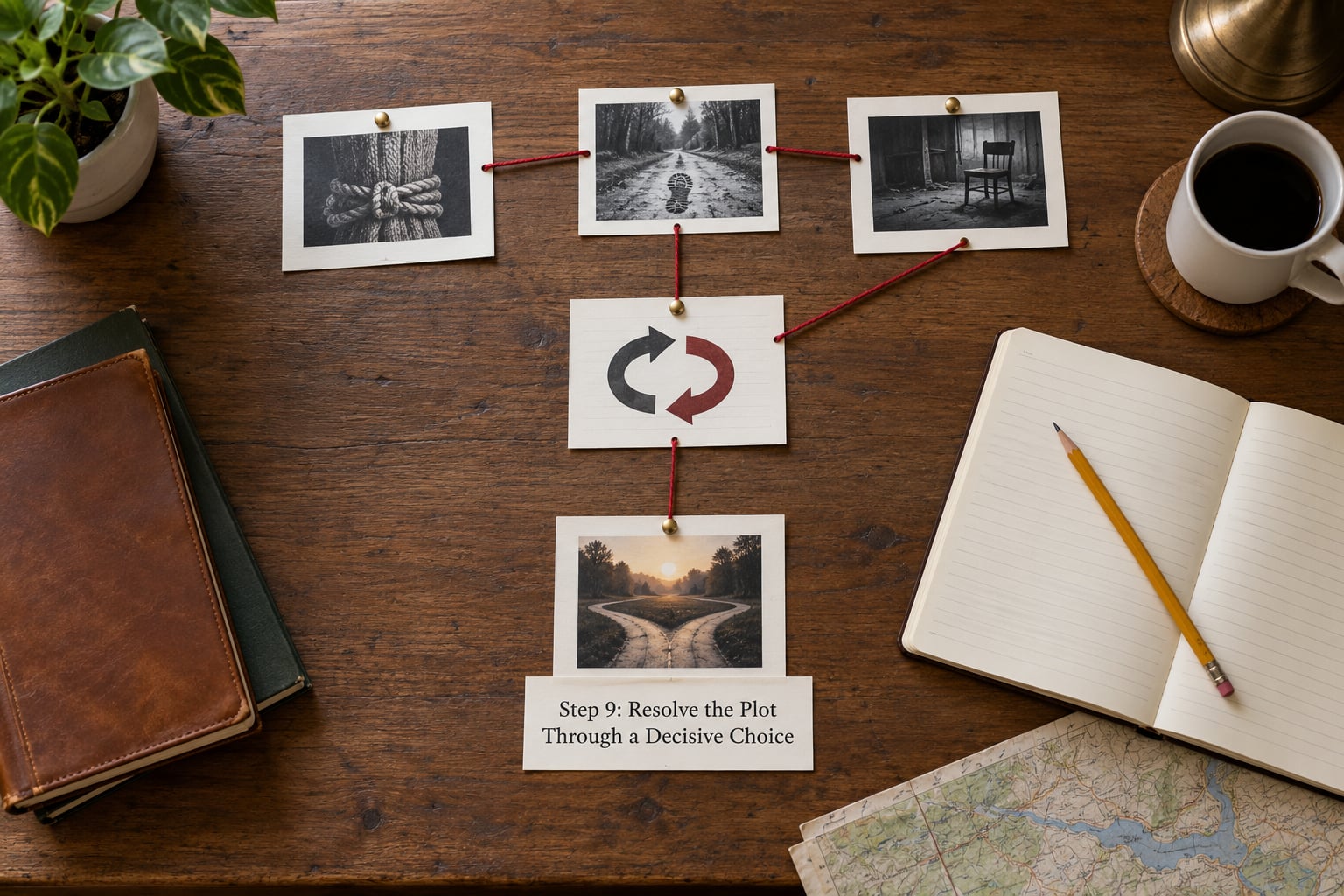
The climax brings the external crisis and the internal conflict together, and the protagonist resolves them by giving something up. Money. A relationship. A career. A version of the past they were attached to. The protagonist has to accept an unpleasant truth or choose between two values, and either way something is permanently lost.
Show the cost in the aftermath rather than describing it in the climax. Who is not in the room. What the protagonist says to somebody who will never fully believe them. Then resolve the central mystery cleanly — the reader should know exactly what happened and why.
The aftermath is where a kidnapping story earns its title. Survivors rarely feel relieved in the doorway. Practical things come back slowly and in the wrong order, and the people around them sometimes report the person they knew rather than the person who came home. Give that a chapter. It is the section most drafts skip and the one readers most often mention.
Rescue, escape, death, and unresolved are all available endings, and each is a legitimate choice if the story has earned it. What does not work is restoring every thread at no cost. Somebody who survives a kidnapping without losing anything has not been through anything.
Leave one thread deliberately unresolved if it echoes the theme. A serial case, a betrayal nobody has admitted to, a family that cannot go back to how it was.
Common Mistakes
The abduction works because of a coincidence. On the page, a stranger happens to be exactly where the victim is taken. The fix is to put the reason inside the story: a witness who spoke earlier, a route already chosen for another reason, a building they had reason to be in. Plausibility beats luck.
The victim exists to be rescued. No goal, no voice, nothing they do that matters. Give them an objective that survives the captivity and an act of agency that changes the outcome.
The kidnapper is evil without a reason. Hatred with no history and no fear. Build the objective, the fear and the rationalisation. Never excuse the act.
Captivity repeats itself. Three chapters of the same dread with no new information. Change the situation every scene: the goal, the leverage, the relationship or what the body can do.
Violence for atmosphere. Descriptive passages that could be deleted with no plot loss. Cut anything that does not affect a later choice. Convert description into consequence.
A twist from nowhere. A new character or motive appears in the final act. Plant the reversal material early and let the obvious version look complete.
No real time pressure. Chapters pass with no cost for delay. Set the deadline inside the situation and let the situation worsen when it is ignored.
A rescue nobody had to work for. The right person arrives at the right moment. Make the rescue the result of a choice made earlier, ideally one that cost something.
The kidnapping becomes a romance. Captivity framed as attraction, coercion rewritten as consent. Decide now whether the story is a thriller. If it is, the captivity is never a courtship.
The ending ignores the theme. Everyone hugs, nothing was learned. Resolve the plot and the question together. Name what the protagonist now believes.
On the coincidence debate, forum writers tend to overcorrect into rigidity. The workable rule is that the coincidence can stay if the reason it lands there is inside the realm of possibility and is explained somewhere in the book. Readers forgive chance; they do not forgive authorial convenience.
For the revision pass, read the plot as a list of causes. Mark any scene that could be moved without breaking anything and move it, merge it or cut it. Then read the last three chapters without having read the first sixty and ask whether you could still tell who is doing what. That gap is your real pacing problem.
Frequently Asked Questions
How many scenes should a kidnapping plot have?
A kidnapping plot needs roughly seven to nine major beats rather than a set scene count: the normal life, the abduction, the demand, the first captivity scene, an early discovery, the reversal, the crisis point and the decisive choice. How many scenes hang off those depends on your target length. Give yourself two or three scenes per beat in the middle stretch and keep them short, because captivity sections lose readers faster than any other kind.
How do you keep a kidnapped character interesting?
Give them a goal that survives the captivity. Someone trying to protect a sibling, delay a flight, keep a job, or work out which captor believes what has more to do in every scene than someone counting hours. Add an act of agency per chapter, however small, and let their interpretations differ from the reader’s. A passive character is the fastest route to a plot nobody finishes.
What makes a kidnapping motive believable in fiction?
A motive is believable when it grows out of something already in the story: a debt, a grudge, a job, a belief the character has stated, or a leverage they can actually hold. Give the motive a concrete shape, not an emotion, and show the character believing it is reasonable. Readers will accept almost any motive that is specific and prepared, and reject even a familiar one that arrives unexplained.
How many clues or twists are too many?
More than the cast can carry. A workable limit is one major reversal plus two or three reversals of lesser scale, and one planted clue per major beat that the reader can find again on a reread. If a twist does not change what a character does next, it is not earning its place. Count them, then cut until the last one still lands.
Should the kidnapped character be rescued at the end?
Not necessarily. Rescue is one ending among several, and escape, death, an ambiguous outcome or an unresolved case can all be stronger depending on your theme. What matters is that the resolution arrives through a choice the protagonist makes rather than an event that happens to them. If someone else saves them, the save should be the result of a decision made earlier in the book.
How do you write a kidnapping plot without making it feel predictable?
Predictability comes from convention, not from surprise. Use the beats readers expect but put pressure on a relationship or a motive nobody expects. Plant the reversal in plain sight so it feels inevitable afterwards, and be willing to change what a scene means rather than add a new character. A twist that reinterprets something already on the page beats a shock from nowhere every time.
Conclusion
To write a kidnapping plot, work outward from consequence: decide what the abduction changes, give each side a goal that cannot coexist, control who knows what, make delay expensive, chain the discoveries, plant what the ending will reinterpret, give the antagonist a fear and a contradiction, break one assumption, and end on a choice that costs something. Start now on paper: write the one sentence describing what is true before and false after, then list the three discoveries that will make your protagonist’s first assumption fail.