Southern Gothic crime fiction attaches a murder investigation to the decaying houses, swamps and small towns of the American South, so that the case being solved is never only about a body. The best books in the sub-genre treat the crime as evidence of a community’s history rather than as a puzzle with a solution: racism, class collapse, inherited violence and institutional silence all sit inside the plot machinery. If you finished True Detective and wanted the same dread with a much longer memory behind it, this is the shelf you are looking for.
This guide works through the sub-genre in the order readers actually need it. What the thing is, how place carries the plot, which themes keep recurring, how the mystery engine runs, how it differs from southern noir and gothic horror, and where to start reading without burning a week on the wrong ten titles.
Updated October 2026. Written by the Big Click Magazine fiction desk.
Table of Contents
- Southern Gothic Crime Fiction Explained
- What Is Southern Gothic Crime Fiction?
- How Does Southern Gothic Crime Fiction Use Place?
- What Themes Make Southern Gothic Crime Fiction Distinctive?
- How Do Crime and Mystery Plots Work in Southern Gothic?
- Southern Gothic Crime vs. Southern Noir and Gothic Horror
- Which Southern Gothic Crime Fiction Books Should Readers Try?
- The same material on screen
- How Can Readers Write or Analyze Southern Gothic Crime Fiction?
- Frequently Asked Questions
- What is Southern Gothic crime fiction?
- What are the three main elements of Southern Gothic literature?
- Is Southern Gothic the same as gothic horror?
- What is the difference between Southern Gothic and southern noir?
- Who invented Southern Gothic, and is the term an insult?
- Is True Detective Southern Gothic?
- Conclusion
Southern Gothic Crime Fiction Explained
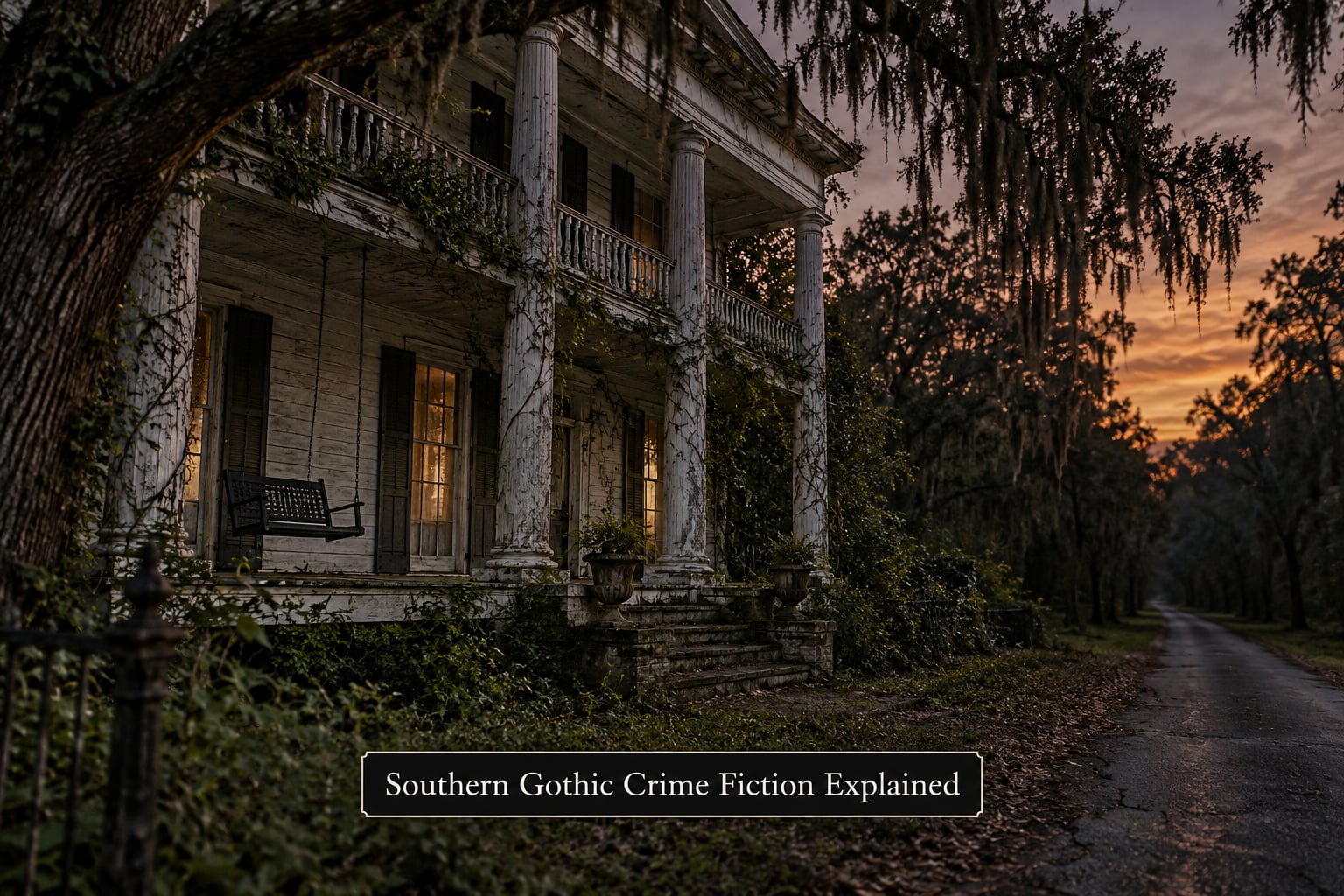
Southern Gothic crime fiction is a sub-genre that grafts an investigation plot onto the Gothic conventions of the American South, so that a murder, disappearance or cold case becomes the vehicle for exposing the region’s buried history of racism, class and violence. Its hallmark is the haunting of the past in the present, carried into a case file.
Three elements do most of the work. First, a place that carries history in its architecture: a sealed room, a missing person, an inheritance nobody will explain. Second, a crime the community would rather bury than solve, usually one that happened years before the novel opens. Third, a cast in which the victim and the villain keep trading places, so the reader is never certain who is being punished and who is being protected.
If you want the whole sub-genre in a sentence: in Southern Gothic crime fiction, the past is the crime. That is the design. The detective arrives to find a body and ends up auditing a county, a family, a church, or a version of history that the town still sells to tourists.
It helps to say what the genre is not. It is not a sub-genre of horror, even though supernatural dread is usually hovering at the edge of the frame. It is not regional flavour added to a mystery that would work anywhere. And it is not the same thing as southern noir, though the two are shelved together constantly and mixed up by readers more often than by anyone else.
What Is Southern Gothic Crime Fiction?
Southern Gothic crime fiction is crime fiction in which the setting is not a backdrop but the cause. A body turns up, an investigator starts asking questions, and every answer runs into the local past: an old arrest that was buried, a family that lost its money and its reputation in the same decade, a church that covered something up, a road project that moved the money and stranded the town. The mystery plot is real, and there is usually a solvable case inside it. But the case is a key, not the whole house.
Set that against the four genres it keeps getting confused with.
Southern literary fiction has no crime requirement at all. A novel can be about a family, a flood and a stubborn woman for 400 pages and still be squarely Southern without being Gothic or criminal. Southern Gothic crime is the narrower lane: there has to be a body, a disappearance or a cover-up for the region’s history to press against.
Southern noir shares the map but not the engine. Noir is about a lone operator working a corrupt system: a private eye, a crooked cop, a fixer. Corruption in noir is a transaction. In Southern Gothic crime, corruption is an inheritance. The detective in noir is suspicious of everyone because people are bought; the detective in Southern Gothic crime is suspicious of everyone because somebody is owed, and has been owed for a hundred and fifty years.
Gothic horror needs the threat to be uncanny or supernatural, or at least structurally impossible to explain away. Classic examples include Shirley Jackson’s The Haunting of Hill House and Victor LaValle’s The Ballad of Black Tom, where folklore and the supernatural blur. Southern Gothic crime keeps a rational investigation spine. You can solve it. What you cannot solve is why everyone involved needed the lie to keep standing.
Historical fiction reconstructs a period, usually researched in detail, with the past closed off from the present. Southern Gothic crime is usually set in the present or the recent past, with the past leaking in. That is why a 2015 novel can feel more haunted than a 1900-set one.
That gives a useful test for the books that get mislabelled. A true crime novel set in Mississippi with a killer in the woods is Southern-set crime fiction, not Southern Gothic crime fiction, unless the region explains the killing. Ask one question: does the place make the crime possible? If moving the plot to Ohio would break it, you are in the sub-genre. If nothing would break, you are reading a competent mystery with a Southern license plate.
How Does Southern Gothic Crime Fiction Use Place?
Place does the double duty of mood and motive. In most sub-genre books, the setting is not scenery that the plot passes through; it is the mechanism that produced the crime, and the reason the crime stays buried. Four kinds of place recur, and the strongest books use more than one.
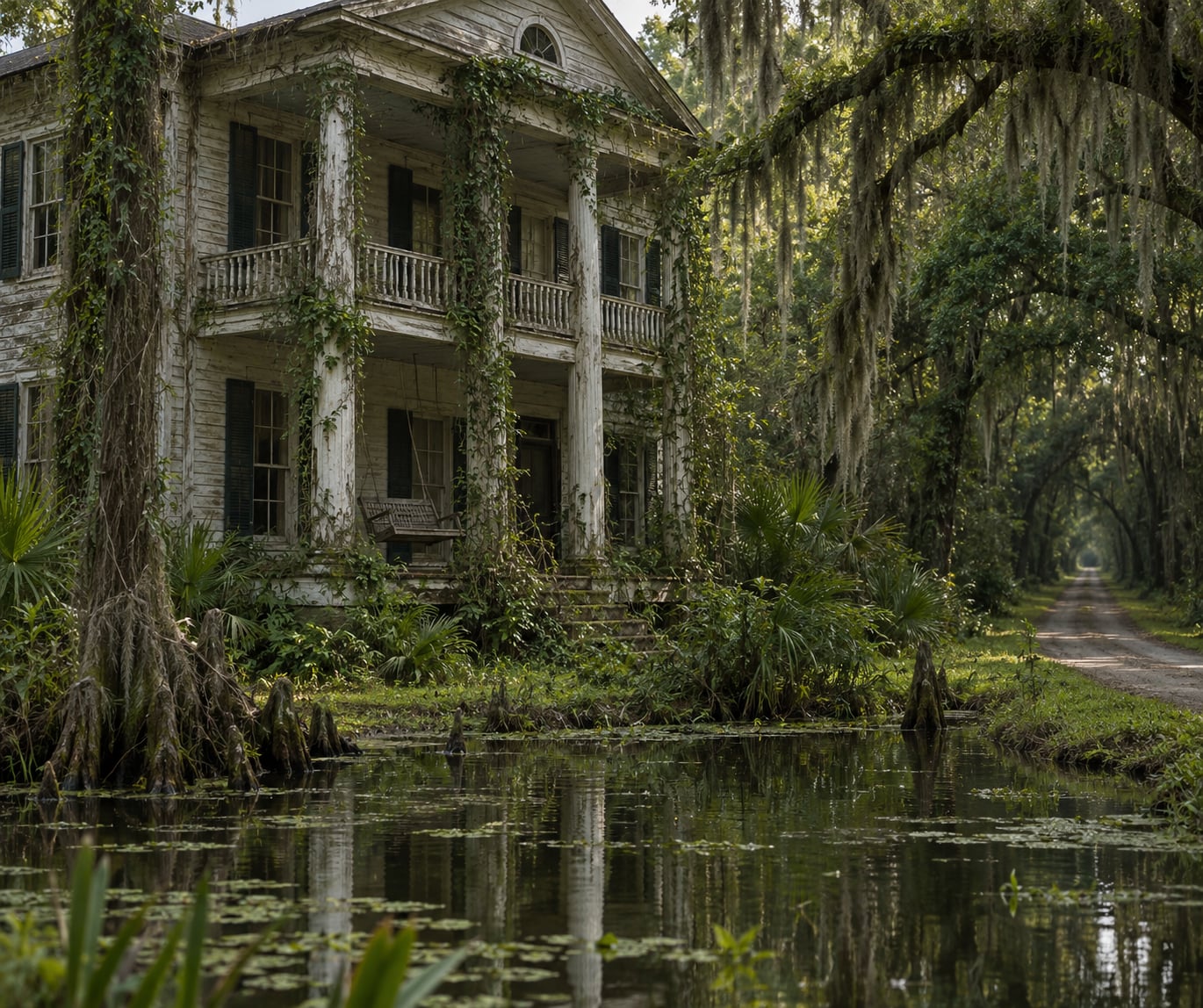
The loaded house. A derelict plantation house, an inherited Victorian that nobody can afford to fix, a family house with one wing bricked up. The house is where the region’s wealth came from, which means it is also where the region’s violence came from. Attica Locke’s The Cutting Season puts its whole investigation inside an antebellum Louisiana property for exactly this reason. Cormac McCarthy’s Child of God gives its killer a house he scavenges because nobody is watching.
The water. Bayous, blackwater rivers, flooded towns, cypress swamp, a lake with a body in it. Water in Southern writing is never neutral scenery; it carries drowning, unmarked graves, the Mississippi’s freight history and every story a county told about itself. Readers ask for it constantly, often in the bluntest possible terms: intense, dark, Southern Gothic, preferably with water. It is the most requested image in the sub-genre for good reason, because water hides as well as it surrounds.
The small town. A place where everyone is related to someone, the suspect pool is about forty people, and the sheriff has a cousin. This is where the social mechanics turn violent: not because the townsfolk are inherently evil, but because an investigation requires cooperation and cooperation costs more than silence. A person can be innocent and still refuse to talk.
The institution. The county courthouse with its burned 1963 records, the hospital, the prison, the church, the university. Institutional failure is the quietest and most reliable engine in the sub-genre. A body is rarely hidden by one villain. It is buried by a filing system, a church committee, a family that pays for silence, or a state that would rather not reopen anything.
Regional texture matters too, because the sub-genre is not one place. The Delta gives you flat land, cotton history, extreme poverty and the heaviest weight of the slave economy. Louisiana’s bayou country gives you water, Creole and Cajun communities, folk magic, and Catholic rather than Protestant guilt. Appalachia and eastern Kentucky give you hollows, extractive industry, clan structures, churches that are also social welfare systems, and a long list of outsider films that have made the region read as permanently haunted. Coastal Georgia and the Florida scrub give you tidewater, citrus and timber economies, and heat. Texas gives you land, oil money, guns and religious empire. A book that could be moved from one to another without changes is not really using its setting.
What Themes Make Southern Gothic Crime Fiction Distinctive?
Race and class are the load-bearing walls, and everything else leans on them.
Inherited violence. The sub-genre assumes that violence is not an individual aberration but a behaviour with a family tree. A killer in these books is usually also a product: raised by it, rewarded for it, or standing inside a structure that made it cheap. This is what separates a Southern Gothic killer from a generic one.
The Lost Cause myth and its dismantling. Much of the region’s self-image is a post-Civil War fiction of gentility and loss, and a great deal of Southern Gothic crime fiction exists to take that fiction apart in public. The mystery plot is what gives the critique teeth, because it forces the myth to produce an actual body.
Institutional failure. Sheriff’s offices, courthouses, hospitals, churches, schools. The question underneath most of these plots is simple and unsentimental: who was supposed to stop this, and why did they not?
Religious hypocrisy versus folk practice. Institutional religion in the South is usually shown as social management, while hoodoo, rootwork and folk practice carry a different kind of knowledge that the church has no authority over. Careful writers keep both honest instead of treating either as pure. Zora Neale Hurston did this better than almost anyone: her folk magic is neither superstition nor spectacle, and her characters use it with skill and mundane practicality.
Repression and the buried self. Desire, violence, grief, class shame, and the particular Southern habit of saying nothing in a warm voice. Add the grotesque and you get Flannery O’Connor’s particular power: characters physically, verbally and spiritually monstrous, and readers asked to look rather than to feel safe.
Blurred accountability. The victim may be monstrous. The villain may be sympathetic. The detective may be the least reliable person in the house. Toni Morrison’s Beloved is the limit case: no detective at all, and the crime is the slave trade itself, pursued across a lifetime by a ghost nobody will call a ghost.
How Do Crime and Mystery Plots Work in Southern Gothic?
Because no competitor explains the mechanics, here is the plot architecture these books actually use. It runs in roughly six moves.
- The discovery arrives late. The inciting incident is usually old news, found now: bones in a wall, a car in a creek, a photograph in an attic, a body surfaced by floodwater, a confession recorded years earlier. Starting the case in the present and the crime in the past is the genre’s single most reliable structural move.
- The investigator is an outsider or a returning insider. A state agent, a federal reviewer, a journalist, a local who left and came back for a funeral. The role exists to give the town a reason to refuse them access.
- Obstacles are social before they are legal. Stonewalling, missing files, a family with money and a reputation, a sheriff with a stake in the outcome. Legal process is the least interesting obstacle in the sub-genre; social pressure is the real antagonist.
- The clue trail runs backwards. The second timeline holds the real crime, and it belongs to someone the first timeline trusted. Reveal the old crime before the new one, or the mystery has no reason to exist.
- The reveal is institutional, not personal. The culprit is a family, a church, a county, a company, or the investigator themselves. A single monster is a thriller ending. A network is a Southern Gothic ending.
- Justice is partial and the past is not resolved. An arrest, a plea, a name read aloud at a church service. The novel usually refuses the fantasy that solving a case cleans anything.
On top of that skeleton sits a distinctive set of narrative devices. Multiple points of view split a community against itself. The unreliable narrator, often a child or a woman who has been disbelieved for the entire book, retroactively recolours everything you read. The found manuscript, the archival document and the novel within a novel let the past be read at a distance, the way a county would read it. And the double timeline, alternating present investigation with past crime, is the sub-genre’s signature rhythm: two time zones, one body.
Voice matters as much as structure here. Dialect is not decoration, and its absence is a warning sign. In this sub-genre, plain flat narration often signals a book that wants the South as a mood rather than as a place with actual people in it.
Southern Gothic Crime vs. Southern Noir and Gothic Horror
The shelf confusion is real, and the four genres get shelved together in every bookshop because no one can agree on the borders. This table is the border.
| Genre | Mood | Plot engine | Central question | Example |
|---|---|---|---|---|
| Southern Gothic crime | Dread, humidity, grief, anger | An investigation that runs into regional history | What is this place still hiding? | Child of God; The Cutting Season |
| Southern noir | Cynical, sun-bleached, hard | A lone operator against a corrupt system | Who can be bought, and what does it cost? | Charles Willeford’s Cockfights; James Lee Burke’s Black Cherry Blues |
| Gothic horror | Claustrophobic, uncanny | A haunting, a possession, a house’s secret | What is behind the door? | Shirley Jackson’s The Haunting of Hill House |
| Southern literary fiction | Warm, hard, sometimes comic | A life changing under pressure | Who does this place make people into? | Eudora Welty; Jesmyn Ward’s Sing, Unburied, Sing |
The overlap is heaviest between Southern Gothic crime and southern noir, and the honest answer is that some books earn both labels. The practical difference shows up in the antagonist. Noir’s villain is a person or a company doing business. Southern Gothic crime’s villain is usually a history with people still living inside it. If a book could be retitled Southland and lost nothing, it is noir. If the region’s past is load-bearing, it is Gothic crime.
Which Southern Gothic Crime Fiction Books Should Readers Try?
Most lists recycle the same ten canonical titles, which is exactly why readers finish one Southern Gothic novel and cannot find the next. Here is a ladder instead, grouped by what you actually want from the book.
If you want the clearest entry into the sub-genre, start with Attica Locke’s The Cutting Season (2015). A private investigator in Louisiana takes a job involving an antebellum house, and the case pulls her straight into the economics of who owns the land and who pays for silence. It is a real mystery novel with a real detective spine, which makes it the best door into the genre for people who arrive from crime rather than from literary fiction.
If you want the true-crime obsession engine, read Hester Young’s The Gates of Evangeline (2014), set in a Cajun town. The narrator is a woman who has become genuinely absorbed by a long-ago crime, and the book watches that absorption turn into something the reader has to judge rather than simply share.
If you want a cold case that opens a county, go to Donna Tartt’s The Little Friend (2018), where children in Memphis pick up a murder from the 1980s that nobody solved, and Cormac McCarthy’s Child of God (1973), where a falsely accused man in Tennessee turns into a killer who scavenges abandoned houses. McCarthy is the source text for half the modern serial-killer gothic, and no other book in this list is as tight or as brutal.
If you want the social critique at maximum volume, Toni Morrison’s Beloved (1987) is the place the sub-genre is pointing even when it has no detective in it. Read it as the statement of the theme every Southern Gothic crime novel is circling.
If you want the folk-magic strand, start with Zora Neale Hurston’s Their Eyes Were Watching God (1937) for the plain, unsentimental version, then move to Cherie Priest’s Cajun-set Devil’s Highway and Victor LaValle’s The Ballad of Black Tom, which puts Louisiana folklore inside a horror frame.
If you want the American South rather than the American rural haunted house, sample widely instead of doubling down on Kentucky. Joe R. Lansdale’s The Hatred (2015) is a Texas satire in which a murder and a social hierarchy arrive together; Dorothy Allison’s Cavedweller (1995) takes a child murder in Asheville and stays inside class and family for 300 pages; Flannery O’Connor’s stories, particularly “A Good Man Is Hard to Find” and “Good Country People,” remain the sharpest short-form examples and read faster than any novel on this list.
A note before you buy any of it: the sub-genre deals with racial violence, lynching-era history, child death, sexual violence and addiction, sometimes plainly and sometimes at a remove. None of that is decoration, and none of it is there only to shock. If you want a warning on a specific title, a library or a bookseller will give you one, and readers have made clear that knowing in advance is what lets them start.
The same material on screen
Book and screen recommendations usually live in different places, which is odd when so many readers arrive through television. True Detective season 1 (2014) is the reference point almost everyone brings to this genre, and it uses nearly every tool above: a two-timeline structure, a body found in a way that implicates ritual rather than motive, an investigator the town will not help, and a Louisiana bayou that does half the characterisation. Sharp Objects (2018) does the small-town version with a reporter returning home to a missing child. Cold in July (2014) and Justified (2010 to 2015) show the Texas and Kentucky variants, with Justified running a decade of institutional pressure in one Harlan County. Ryan Coogler’s Sinners (2025) pushes the folk-magic and racial-violence strands into a single Mississippi frame, and the Netflix adaptation of Donald Ray Pollock’s The Devil All the Time (2020) is the most direct screen version of a sub-genre novel. If a show made you want the books, the ladder above is the right order to come in.
How Can Readers Write or Analyze Southern Gothic Crime Fiction?
Almost no guide on this question covers the crime half, so here is the working method. It applies whether you are writing it or reading it closely enough to tell why a version works.
- Choose a place with a specific economy. Not “the South.” A county where the mill closed, a town the interstate bypassed, a parish whose land was consolidated after the war. The sub-genre fails whenever the setting could be swapped for another region without damage.
- Give the investigator a reason to be there that the community resents. A state agent in a county with a bad history of outside scrutiny is the classic. The resentment is the first obstacle and should appear in the first 50 pages.
- Make the old crime plausible. It worked once, and everyone involved had a reason. Then kill or silence the only witness with a stake in telling the truth.
- Separate the red herring from the false suspect. A false suspect is someone who had motive and a bad day. A red herring is a lie told for reasons other than guilt, usually to protect an institution. Weak books make them the same character.
- Give the perpetrator logic before you give them menace. The best ones explain themselves in retrospect, clearly, without excusing anything. If the logic only works to excuse the crime, the book collapses into apology.
- Let the setting refuse to co-operate. Records burned, roads gone, families gone, everyone related to the victim. The investigation should get harder because of the place, not only because the killer is clever.
- End with a partial reckoning. A conviction, a name read at a funeral, a plaque. The genre’s whole argument is that the past survives the verdict, and a neat ending gives that away.
As a reader, the same list works as an evaluation checklist. When a book disappoints, the failure is almost always one of four things: the setting was wallpaper, the old crime did not feel plausible, the reveal named one person instead of a system, or the ending resolved the history instead of the case.
Frequently Asked Questions
What is Southern Gothic crime fiction?
Southern Gothic crime fiction is crime fiction set in the American South in which the region’s history causes the crime rather than merely decorating it. An investigator begins with a body, a disappearance or a cold case, and the investigation runs into racism, class collapse, inherited violence and institutional silence. The mystery is solvable, but solving it exposes what a community has been hiding from itself for generations.
What are the three main elements of Southern Gothic literature?
Three elements recur across Southern Gothic literature. First, the haunting of the past in the present, where history presses into current life rather than sitting in the past. Second, grotesque characters and situations, usually physically or spiritually monstrous, which readers are asked to look at instead of looking away from. Third, decaying settings and blurred morality, including derelict houses, swamps, small towns, poverty, and a victim and villain who are hard to separate.
Is Southern Gothic the same as gothic horror?
No. Southern Gothic crime keeps a rational investigation spine, so the case can be solved by evidence and reasoning. Gothic horror depends on the uncanny or the supernatural, and its haunting is often structural rather than explainable. The two overlap constantly in the South, which is why books like The Ballad of Black Tom or Swamplandia! sit between them. Ask whether the mystery can be closed by a detective. If yes, it is closer to crime fiction.
What is the difference between Southern Gothic and southern noir?
Southern noir adapts hardboiled crime conventions to the South: a lone investigator, a corrupt system, and a cynical narrator. Corruption in noir is a transaction, and the question is who can be bought. Southern Gothic crime treats corruption as an inheritance, where the antagonist is a history, a family or a county rather than a single operator. Some books earn both labels, but if the region’s past is load-bearing to the plot, it is Gothic crime.
Who invented Southern Gothic, and is the term an insult?
There is no single inventor. The label was largely a put-down when it appeared, and Southern writers pushed back on it; Eudora Welty is often quoted as saying they better not call her that. The sub-genre grew out of nineteenth-century grotesque writing by figures including Henry Clay Lewis and Mark Twain, and was consolidated in the twentieth century by the Southern Renaissance, with Flannery O’Connor, William Faulkner and Toni Morrison defining it.
Is True Detective Southern Gothic?
True Detective season one is the closest popular comparison point, and it borrows most of the machinery: a two-timeline structure, a body discovered in a way that points to ritual instead of motive, an investigator the town refuses to help, and a bayou landscape carrying the region’s history. It is television rather than a Southern Gothic novel, and critics have debated its use of the setting. It is still the fastest way to explain the sub-genre to someone who has never read one.
Conclusion
Southern Gothic crime fiction is a genre with one central device: the past is the crime. A body, a disappearance or a cold case opens an investigation, and the investigation runs straight into the region’s history of racism, class collapse, inherited violence and institutional silence, which is why the case can be solved and the guilt cannot. Load-bearing elements are a setting that causes the plot, a crime old enough to have been buried, and a cast in which the victim and the villain keep trading places.
Start with one book and commit to a branch. If you come from crime, read Attica Locke’s The Cutting Season and go from there to Cormac McCarthy’s Child of God; if you want the argument the whole sub-genre is built on, read Toni Morrison’s Beloved. Tell us what you read next and which region you think the sub-genre keeps under-serving, and we will keep building the ladder.