Most literary crime short stories land between 1,500 and 3,000 words, with 3,000 a useful working target. Flash pieces run far shorter, novelettes and novellas run longer, and any submission venue will override that with its own hard limit. So the honest answer to how long should a crime short story be is: whatever the story needs to finish the job, within the range the venue allows.
Writers argue about this constantly in places like r/writing and writingforums, usually because they have a finished draft and no idea whether to trim it or let it breathe. A 1,800-word draft that resolves cleanly is fine. A 4,200-word draft where the detective spends three scenes deciding what to have for lunch is not, and no editor will tell you so.
Table of Contents
- How Long Should a Crime Short Story Be?
- Flash crime fiction: under 1,000 words
- Standard short stories: 1,500 to 7,500 words
- Novelettes and novellas: 7,500 words and up
- What Word Count Is Normal for Crime and Noir Fiction?
- How Do You Know When Your Story Is the Right Length?
- How Long Should a Crime Short Story Be for a Magazine?
- Three tiers of crime markets to know
- Should a Short Crime Story Be Faster Than a Mainstream Story?
- How Do You Cut a Crime Short Story Without Losing the Mystery?
- Can You Make a Crime Short Story Longer by Adding More Mystery?
- Frequently Asked Questions
- Is 1,000 words enough for a crime short story?
- Is a 5,000-word crime story too long for a short story?
- How do I decide whether to cut or expand a crime short story?
- What word count is best for a crime short-story contest?
- How do I make a short crime story feel faster?
- Should dialogue count toward a magazine’s short-story word limit?
- Conclusion: Choose Length by Story, Not by Rule
How Long Should a Crime Short Story Be?
The direct answer: aim for 1,500 to 3,000 words for a standard literary crime short story, and go shorter or longer only when the form demands it. A story with one suspect, one interview and one reversal can finish in 1,200 words. A story with a real investigation, a false suspect and a moral turn usually needs 2,500 to 4,000.
Length is a consequence of the story’s job, not a target you set before writing. Set a target and you will pad or truncate to hit a number, and both produce the dead prose that makes crime readers skim.
Flash crime fiction: under 1,000 words
A flash crime story fits one scene: a confession, a break-in, the moment a detective realises the body is the wrong one. Everything before and after the story happens off the page, which is what makes the form tense rather than incomplete. Many themed crime contests and commissions ask for exactly this, often with a strict 1,000 to 1,500 word ceiling.
Below roughly 500 words you are into micro-fiction or drabble territory, where the whole crime has to live inside one image and one exchange. It works, but it is a specialist craft and hard to sustain over a series of submissions.
Standard short stories: 1,500 to 7,500 words
This is the band most crime journals and literary magazines publish in, and the band most of our advice applies to. Somewhere around 3,000 words you have room for a setup, an investigation with two or three turns, and a closing scene that changes how the reader reads everything before it.
The awkward zone sits between 1,000 and 1,500 words. A lot of first drafts land there, and a lot of them feel undercooked: the suspect has no motive you can name, the clue was never planted, and the reveal arrives as information rather than as a shock.
Novelettes and novellas: 7,500 words and up
Once a crime story passes 7,500 words it is a novelette, and past roughly 17,500 it is a novella. Those are fine forms with their own discipline, but they compete with full novels for attention, and many readers who wanted a short story will not finish one. Know which one you are writing before the draft gets away from you.
What Word Count Is Normal for Crime and Noir Fiction?
The short-fiction length ladder is the fastest way to see where your draft sits. These ranges are the standard ones used by writers’ references and by submission guidelines, and they apply cleanly to crime and noir.
| Form | Typical word count | Reading time | Best crime use |
|---|---|---|---|
| Micro-fiction | Under 200 | Under 1 minute | A single image of aftermath or discovery |
| Flash fiction | 200 to 1,000 | 1 to 4 minutes | One-scene crime, confession, or twist piece |
| Short-short | 1,000 to 2,000 | 4 to 8 minutes | Compact pieces for themed contests and anthologies |
| Short story | 1,500 to 7,500 | 6 to 30 minutes | Literary crime, noir, whodunit, procedural |
| Novelette | 7,500 to 17,500 | 30 to 70 minutes | A single-case story needing room for a false suspect |
| Novella | 17,500 to 40,000 | 70 to 160 minutes | Crime with a sustained investigation or a returning detective |
| Novel | 40,000 and up | Long sitting | Crime and mystery conventionally run 80,000 to 100,000 |
For page count, most trade and self-published formatting sits at roughly 250 to 300 words per page. A 3,000-word story is about 10 to 12 pages, which is why it reads as a single sitting rather than as homework. A 12,000-word novelette is closer to 45 pages, and readers will notice when a piece they were told was a short story turns out to need an evening.
One more conversion worth knowing: at an average silent reading pace of 250 words per minute, 3,000 words is about 12 minutes. That single-sitting figure is why the 2,000 to 3,500 range keeps showing up as the practical sweet spot for crime short stories in anthologies and magazines.
How Do You Know When Your Story Is the Right Length?
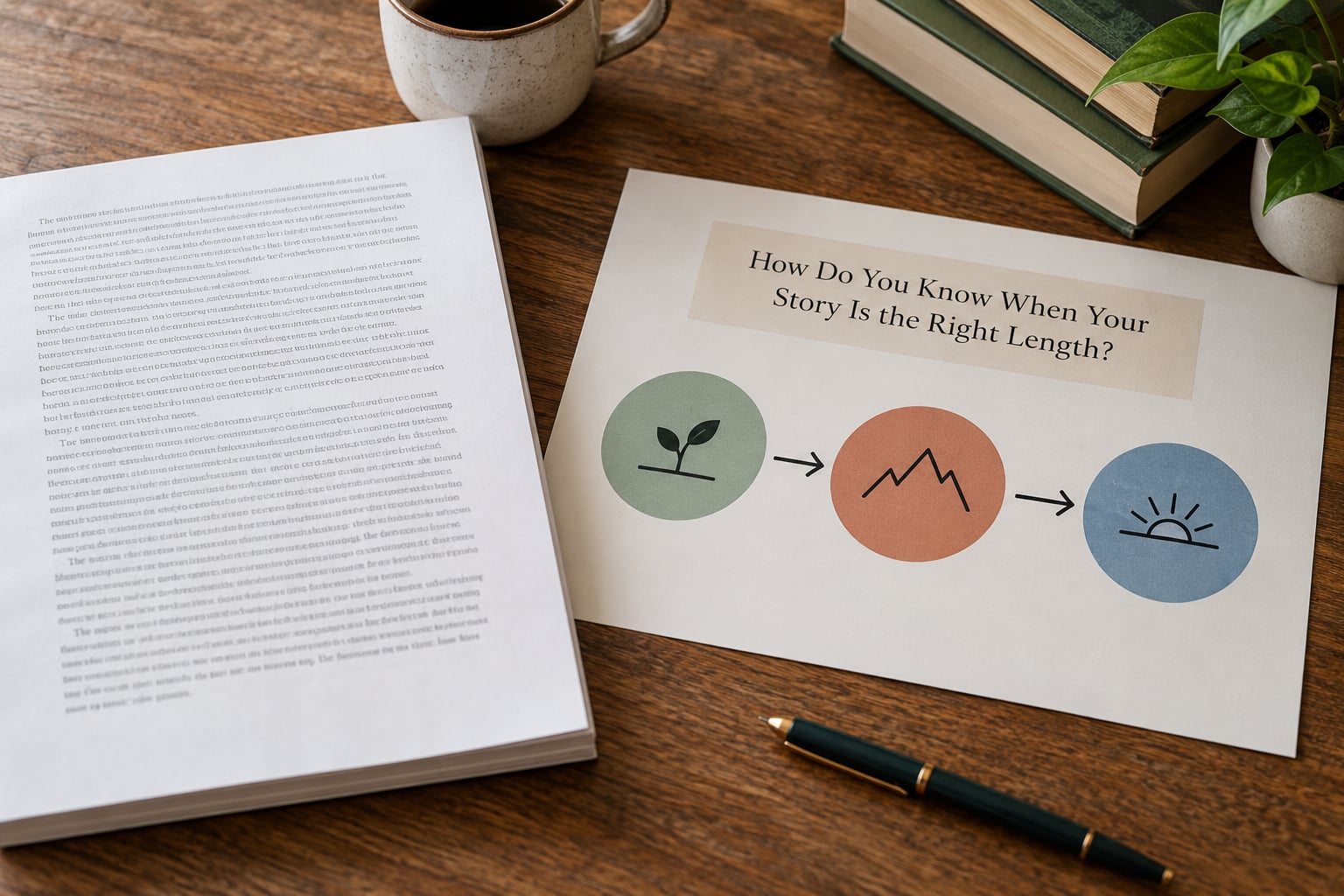
Test every scene against four jobs: does it change the situation, reveal character, deepen the mystery, or raise the stakes. A scene that does none of those is a candidate for the bin, and cutting it is the shortest path to a shorter draft.
Roughly speaking, a crime story needs three functional blocks. Setup takes about 15 to 20 percent of the total and earns the reader’s investment in the victim or the investigator. Investigation takes 50 to 60 percent and should contain at least two reversals, each one narrowing or redirecting the field of suspects. Resolution takes the remaining 20 to 25 percent and delivers the reveal plus the aftermath that gives the reveal meaning.
If your investigation block has only one reversal, you probably need more words rather than fewer, because the second turn is what makes the first one land. If you have three reversals and no resolution scene, you are not too long; you are unfinished.
Forum advice converges on the same point from a different direction. Writers in r/writingadvice tend to stress that a short story needs at least three layered threads, not more words, and contributors on writingforums often advise cutting 25 to 50 percent from a first mystery draft. The draft feels long because you know everything in it; the reader does not.
How Long Should a Crime Short Story Be for a Magazine?
Follow the venue’s stated limit exactly, because it is the one rule you cannot argue with. How long should a crime short story be when the target sets the limit? At whatever the submission guidelines say, and not one word more.
Three tiers of crime markets to know
Themed contests and commissions. These carry the tightest ceilings, usually 1,000 to 1,500 words with a strict limit and a stated theme. They are the fastest feedback a new crime writer can get, and the format forces you to build a complete arc with almost no room for description.
Crime and mystery journals. Frequently 1,500 to 7,500 words, which is the widest band you will see in fiction submissions generally. Some journals want self-contained stories, others explicitly accept novel excerpts, and those two wants imply very different structures.
Literary magazines. Broader still, often 1,000 to 7,500 words, but judged on prose rather than plot mechanics. A noir story with a strong voice can go longer here than it would in a crime journal, because the writing is the point.
Anthologies work the same way, with one addition: read the call and check whether they want original material or previously published pieces. Novel-length crime sits far outside this conversation, but if your piece keeps expanding past 8,000 words, it may be a novel chapter in disguise.
Check guidelines at the time you submit rather than trusting an old blog post. Limits change, and the market round-ups that quote them are often years out of date.
Should a Short Crime Story Be Faster Than a Mainstream Story?
No, not automatically, but the opening has to work harder. Crime readers have a short tolerance window, often measured in the first few hundred words: if a body, a threat, a missing person or a suspicious detail has not appeared by the end of page one, they stop reading. That is a pacing rule about openings, not a demand that every sentence be a gunshot.
Immediate action is one valid approach. A delayed-body opening, where the detective arrives at an apartment and works backward, is another. Noir and slow-burn mysteries can afford to start quieter because the voice and the atmosphere are carrying the tension, and readers who chose a literary journal over a pulpy one have already agreed to that trade.
What does not work in any subgenre is a preamble. Family history, a weather paragraph and a job the protagonist quit three years ago are all removable in crime fiction, and they are the first thing an editor cuts.
How Do You Cut a Crime Short Story Without Losing the Mystery?
Cutting investigative prose feels like cheating because you wrote every clue deliberately. The mystery only depends on a handful of those details being present and plantable, not on all of them being explained on the page. A six-step pass gets you from bloated to tight without losing the plot.
- Cut by percentage first. Decide your target minus current count, then aim to remove about 10 percent more than that so you do not creep back up in the final read.
- Mark every scene that changes nothing. If the reader knows the same thing at the end that they knew at the start, the scene goes.
- Compress summary. Interviews and searches narrated in the past tense can usually become a line of dialogue or two.
- Trim repeated description. Crime writers describe rooms, weather and weather-adjacent mood far more than once is needed. Keep the strongest instance.
- Cut backstory to one concrete detail. A single image carries a motive better than a paragraph explaining it.
- Protect the spine. Keep every clue needed for the reveal, the suspect’s motive, and the final scene. Everything else is negotiable.
Then read the trimmed draft aloud. Anything you stumble over is still too dense, and it is usually a cut candidate you missed.
Can You Make a Crime Short Story Longer by Adding More Mystery?
Sometimes, and the additions that earn their place are specific: a second suspect with a real motive, a deeper look at a relationship under pressure, an extra investigation beat that raises the cost of failure, or a moral complication in the resolution that changes what the detective wanted. Each of those changes the story rather than decorating it.
What does not earn its place is a twist added only to make the piece feel longer, or extra suspects who exist to be eliminated. Both produce the sensation of a padded story even after the cuts. If you find yourself adding complications that the ending does not need, the story was already finished.
Frequently Asked Questions
Is 1,000 words enough for a crime short story?
Yes, if the arc is complete. A thousand words can carry a crime, an investigation and a resolution, and plenty of themed crime commissions use exactly that limit. The risk is not the length, it is thin motive and missing clue work. Read your draft and ask whether a reader could solve it from what you planted. If the answer is no, the problem is craft, not word count.
Is a 5,000-word crime story too long for a short story?
No. Five thousand words sits comfortably inside the standard short-story range, which runs to about 7,500 words, and many crime journals accept pieces that size without blinking. Length only becomes a problem when the investigation stalls for paragraphs at a time. If every scene changes the situation or reveals something, readers will not count the words.
How do I decide whether to cut or expand a crime short story?
Check your scene endings. If scenes fail to change the situation, cut them. If the investigation has only one reversal and the ending feels unearned, expand it with a second turn rather than with description. Most first mystery drafts benefit from a 25 to 50 percent trim, and adding words is justified only when the reveal needs more setup to land.
What word count is best for a crime short-story contest?
The contest’s stated limit, exactly. Themed crime commissions and contests commonly set 1,000 to 1,500 word limits, while crime journals and literary magazines usually accept somewhere between 1,500 and 7,500 words. Check the guidelines on the day you submit, because limits change and old round-ups are frequently out of date.
How do I make a short crime story feel faster?
Front-load a crime, a threat or a suspicious detail in the first few hundred words, cut every scene that changes nothing, and replace narrated summary with dialogue. Replace past-tense recaps of interviews or searches with two lines of exchange instead. Read the draft aloud and cut whatever you stumble over, since hesitation in your voice shows up as hesitation in the reader’s.
Should dialogue count toward a magazine’s short-story word limit?
Yes. Dialogue counts the same as any other text, and scene breaks and headings do not count either, though a small number of venues trim the first page to gauge style. Word processors report total words including dialogue, so check your count that way. If a magazine publishes a limit, treat it as a hard ceiling rather than a target to reach.
Conclusion: Choose Length by Story, Not by Rule
Start with the format you are writing for, draft the smallest version of the story that contains a real crime, a legible investigation and a resolution, then revise for momentum rather than for a number. If a venue sets a word limit, that number wins every time. Until then, 1,500 to 3,000 words is the range most crime short stories serve best.
Finish the draft first. Trimming is easy, padding is not.