Learning how to write a short story with a twist comes down to one rule: the ending has to be surprising in the moment and inevitable in hindsight. A twist reframes everything the reader has already been told. If they can point back at the planted clues and say they should have seen it, you did your job. If there is nothing to point back at, you cheated them.
Most failed twists are not failures of imagination. They are failures of bookkeeping. The author knows where the story is going, then forgets to leave anything behind on the page, so the ending arrives as weather instead of consequence.
What follows is the process I use, and the one I would hand a writer six months into a novel who has stalled at the final act. It is built for a piece between about 1,000 and 2,500 words, because that is where twists live or die. Bring a pen, a single notebook, and about three sessions. The first session is thinking, the second is drafting, the third is the least pleasant and most valuable one.
Table of Contents
- What You Need
- Step-by-Step: How to Write a Short Story With a Twist
- Start With the Story’s Central Lie
- Choose a Twist That Changes Meaning
- Decide What the Reader Knows
- Plant Fair Clues in Ordinary Moments
- Build Misdirection Without Cheating
- Write the Scenes Around the Reveal
- Reveal the Twist Through Character Reaction
- Revise for Fairness, Surprise, and Emotion
- Common Mistakes
- Frequently Asked Questions
- What makes a short story twist feel satisfying?
- How do you plant clues without giving away the twist?
- Should the reader know more than the protagonist?
- Can a twist change the story’s meaning without introducing a new character?
- How long should a short story with a twist be?
- How do I revise a twist that feels too obvious?
What You Need
You do not need an outline template, a software subscription, or a genre rulebook. You need five things, and you need them before you write a single sentence.
A protagonist with one clear want. Not a personality, not a backstory, a want. She wants the inheritance, wants the neighbour to admit it, wants the last train. One want keeps a twist pointed at something.
A central lie. This is the belief the protagonist starts with that turns out to be false. A twist without a lie to overturn is just information. More on this in step one.
A setting small enough to hold in your head. A kitchen, a hotel corridor, a laundrette at 2am. Every physical detail you establish is a candidate clue, which is useful and dangerous.
A timeline. Twenty-four hours, forty years, the length of a single phone call. Write it out on paper with the times in the margin.
A final revelation, chosen before drafting. You need to know the last line of the story before you write the first. That feels backwards, and it is the single change that most improves a twist.
One honest warning before you start. Twist stories fail far more often from over-planning than from spontaneity. If you spend an hour choosing your twist and then nine drafting, you have the balance wrong.
Step-by-Step: How to Write a Short Story With a Twist
Start With the Story’s Central Lie
The central lie is the engine of a twist story, and it is usually two sentences long. Write what your protagonist believes at the start, and what they believe instead once the twist has landed.
Example: Ana believes her sister has been missing for six days. She believes instead that her sister left, and Ana has been told a comfortable story so she will stop asking. The gap between those two sentences is your story.
To find yours, finish this line: at the end, it turns out the reader was wrong about ______. The blank is the central lie. If you cannot fill it in, you have a plot but not a twist.
A useful test: the lie should be something the protagonist could reasonably have believed. Beliefs held without evidence produce twists that read as authorial trickery.
Choose a Twist That Changes Meaning
A twist works when it changes the reader’s understanding of what they have already read, not when it introduces facts that were never available. Revealing that the butler had a sister in town is new information. Revealing that the butler is the sister, introduced plainly in scene three and never remarked on again, is a twist.
That is how to write a short story with a twist without resorting to something arbitrary: change the meaning of existing material rather than adding a new fact. Run your candidate ending against four questions, and if it fails two or more, it is probably a plot development wearing a twist’s coat.
Did it change what a scene means? Did it change why a character acted? Did it change who the reader is rooting for? Did it make an earlier moment land differently? A real twist answers yes to at least three.
Good examples from fiction you can study: the point-of-view flip in The Usual Suspects, the reframing of the opening in Gone Girl, and the narrator’s unreliability throughout Gone Home. All of them reframe scenes already written. None of them import a surprise character from nowhere.
Decide What the Reader Knows
Most twist problems are really knowledge problems, so map the information before you draft. Use a table with three columns: protagonist, reader, supporting character. Fill each row with what that person knows at the start, the middle, and the end.
The most common and most powerful pattern gives the reader slightly more than the protagonist, and both less than the truth. A scene where the reader sees a coat on a hook and the protagonist walks past it does a lot of quiet work. The reader files it away without knowing why it matters.
Decide now what stays hidden, what gets hinted at, and when each piece of evidence enters. Hints go in early and casually. Proof goes in at the last possible moment.
Second pattern: the protagonist knows more than the reader. This is how twist endings that feel like ambushes get written, and it is worth using sparingly. Used twice in one story it becomes exhausting.
Plant Fair Clues in Ordinary Moments
Planting clues is a distribution problem, not a creativity problem. You are not inventing clues, you are choosing where to hide the ones you already have.
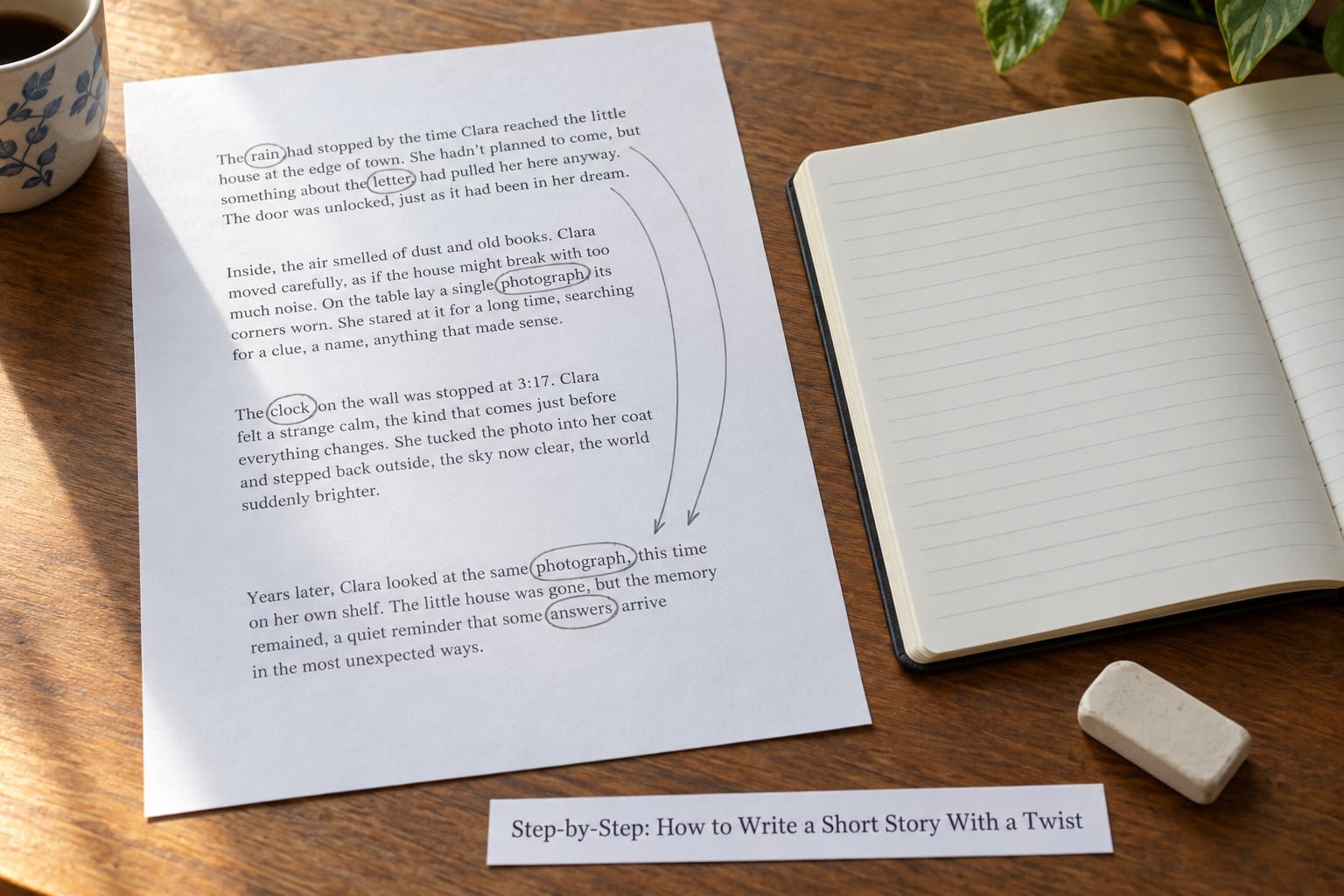
Put them in three kinds of moments. Visual details, which cost you nothing and read as set dressing: an umbrella that stays folded, a coat on a hook, a photograph turned face down. Verbal details, which come free inside dialogue a character would plausibly say: a complaint about the cold, a joke that lands too well. Behavioural details, the most useful kind: a person who checks the time twice and never mentions being late.
The discipline is camouflage. A clue hidden in a paragraph that exists only to hide it glows. The same detail inside a scene with its own purpose, a quarrel, a meal, a long drive, disappears into the texture of the story and gets remembered only afterwards.
That is the whole trick when you plant clues without giving away the twist: the clue has to be doing two jobs at once. It has to be a real part of the scene and a piece of evidence, and the reader should be able to appreciate the second job only in hindsight.
Three clues is usually plenty for a short story. Ten is a neon sign. Spread them across the first two thirds, never in one paragraph.
To see the camouflage working, take one plain fact. A character left a party alone at nine and walked home. Plant that in a scene where two friends argue about money and the host is offering a drink: the character declines, finds a coat, and says goodnight without explaining where they are going. Nobody in the story remarks on the departure. Read back two months later, the reader can point at it and say that was the moment she left, and they will be right.
Build Misdirection Without Cheating
Misdirection is a false interpretation that the story actively supports. It is not the same as withholding information, and the difference matters.
Withholding means the reader lacked something they needed and you kept it back. That is cheating. Misdirection means the reader had everything they needed and still reasoned their way to the wrong answer, because you gave them a plausible motive and you let them lean on it.
Three reliable methods. Competing motives: give two characters plausible reasons for the same act and let the reader settle on the wrong one early. Selective perception: describe a neutral action in language that colours it, so the reader sees menace in something administrative. Omitted context: include a detail that would have changed the reading, but place it somewhere the reader’s attention has already moved past.
On that last method, be careful. Burying the decisive fact in the middle of paragraph two, disguised as small talk, is fair. Burying it in the final paragraph, where the reader could not have noticed it, is not.
One red herring per story is usually the maximum. A second one doubles the pleasure for genre-savvy readers who spot it and doubles the confusion for everyone else.
Write the Scenes Around the Reveal
A twist story is four jobs in sequence, and each scene has to do a different one. Give each a sentence in your notes before you draft.
The opening scene establishes the protagonist’s want and their lie, and it plants the first clue. It should read as the beginning of something ordinary.
The escalation scene applies pressure to the want while the misdirection firms up. This is where most twist stories go wrong, because writers keep adding plot when they should be adding constraint. Fewer options, less time.
The confrontation scene forces the protagonist to act on what they believe, and that action is what makes the twist land. A twist is only felt when it invalidates something the character has already done. If your protagonist has made no choices, there is nothing to overturn.
The reveal scene reframes what came before, in as few words as possible. Do not explain. Do not summarise. One character says the thing that changes everything, or nobody says it at all.
As a rough budget for a 2,000-word story: opening 400, escalation 800, confrontation 500, reveal and aftermath 300. Adjust for your own pacing, but keep the total under your target before you start writing prose, not after.
Reveal the Twist Through Character Reaction
The twist is not the information. The twist is what the information does to a person, and this is the part writers skip.
Concrete beats beat abstract ones. A character saying they are shocked tells the reader nothing. A character setting down a cup very carefully because their hands are not steady tells them everything.
Look for changes in decision. What does this person do at 8:40am that they would not have done yesterday? What do they stop doing? What small ordinary routine breaks? Changed behaviour is the most reliable signal that a revelation has actually landed on a person rather than a page.
Use sensory detail with a specific register. Sound and temperature usually work better than sight, because sight is what writers lean on by default. The scrape of a chair. Cold air off an opened door. A phone that has been face down on a table for six years.
And keep it brief. The aftermath of a twist is the hardest material in the story and it is almost always too long. Two hundred words is generous.
Revise for Fairness, Surprise, and Emotion
Revision of a twist story happens in three passes, in order, and mixing them wastes the session.
Pass one is fairness. Sit with your ending and walk back through the draft hunting for anything that contradicts it or is simply absent from it. New information at the end is the biggest single cause of a cheap twist. If you need a fact in the last two hundred words that has never appeared, you need to plant it earlier.
Pass two is surprise. Read the draft as someone who has never seen it and has read forty twist stories. Then ask what you noticed. Anything you spotted in the middle of the draft that points at the ending is too loud. Take it out, or bury it inside a scene that has its own reason to exist.
Then check the reverse: if you could not see the twist coming at all and nothing in the draft hinted at it, you have gone too far into concealment. The honest measure is that a careful reader should look back and feel foolish, not feel cheated.
Pass three is emotion. Ask whether the reader has any reason to care about the outcome. A twist in a story where nothing was at stake changes nothing in the reader. This is the pass that turns a clever construction into a short story with a twist that people remember.
Finally, if you want to write a short story with a twist and you are stuck on whether it works, test it without telegraphing. Do not ask a reader what they thought was going to happen. Hand them the story and ask one question: which detail stayed with you? Whatever they name tells you what actually registered.
Common Mistakes
Surprise without logic. The twist arrives and nothing in the story supported it. The fix is to find the one scene where you explain, and cut the explanation instead of adding another clue. If you find yourself adding evidence late, the twist was in the wrong place.
Clues that shout. A character notices a detail and comments on it, and the reader hears a door opening. Clues should be observed, never remarked upon. If a line of dialogue exists only to signal that something matters, rewrite the scene so the signal comes from behaviour.
A twist that changes nothing. The reveal is surprising, and when it lands the story continues in exactly the direction it was already going. A twist has to alter motive, sympathy, or meaning. If the final paragraph would read the same with the twist deleted, you have written a plot development.
Irrational behaviour. The twist makes a character do something they could not plausibly do given what they know. Readers forgive odd choices; they do not forgive characters who seem to have been switched off. Before writing the twist, check what the protagonist’s options are at that moment. Usually there is a believable version of the twist that requires no stupidity at all.
Over-explanation. The last three paragraphs explain what the reader just understood. This is the most common ending failure and the easiest to fix. Delete half of it, then read it again. The silence after a twist is doing work for you.
An ending that depends on new information. A character introduced in the final scene, a document nobody has seen, a phone call to a person we have never heard of. If the reader could only have known this in the last paragraph, the ending is not earned.
Two smaller ones worth naming. Forcing the twist into a story that does not want one is why so many twist stories feel thin; a story without a twist can be better than a story with a badly placed one. And a genre-savvy reader will often guess yours. That is not a failure. In a thriller, a reader who spots the shape of the trick and still reads to the end has been given something better than a surprise, which is a reason to keep turning pages.
Frequently Asked Questions
What makes a short story twist feel satisfying?
A satisfying twist is surprising in the moment and inevitable in hindsight. That means every element needed to understand the ending was present earlier, in ordinary scene material the reader had no reason to examine. If the reader can look back and find the planted clues, they feel clever for missing them. If nothing in the story supports the ending, they feel cheated, and no amount of shock will rescue it.
How do you plant clues without giving away the twist?
Give every clue two jobs: a real part of the scene and a piece of evidence. Hide details inside dialogue, behaviour and setting rather than in paragraphs that exist only to carry them. Spread three clues across the first two thirds of the story and never comment on them. A clue the reader notices while reading has been planted badly, however fair it is in hindsight.
Should the reader know more than the protagonist?
Usually yes, slightly more. The strongest pattern gives the reader one detail the protagonist walks past, and keeps both of them short of the truth. It creates tension without obscurity. When the protagonist knows more than the reader, the twist can work but feels like an ambush, so save it for one story and make sure the withheld fact was genuinely visible somewhere.
Can a twist change the story’s meaning without introducing a new character?
Yes, and it is usually better. The best twists reframe scenes you have already written rather than importing new facts. Changing what a scene means, why a character acted, or who the reader is rooting for needs no new character at all. New characters in the final scene are one of the clearest signs that a twist has not been set up, so treat them as a warning during revision.
How long should a short story with a twist be?
Between 1,000 and 2,500 words works best for most twist stories. Under 800 there is no room to plant clues and still build character. Over 3,000 the misdirection gets heavy and readers start reading for the trick rather than the person. Draft toward roughly 2,000, and reserve the last 200 words for the aftermath of the reveal.
How do I revise a twist that feels too obvious?
Read the draft as someone who has read forty twist stories, and note everything you spotted. Each of those is a clue working too hard. Bury it deeper inside a scene with its own purpose, or cut it entirely and find another. Also check you have not stacked three separate hints on the same detail, which is the usual reason readers catch a twist early.
Start with the central lie, in two sentences, before you write anything else. Everything after that, the map of who knows what, the three clues, the misdirection, the 200 words of aftermath, follows from it. If you can finish that sentence, you already have your story.