A short story cover letter is a brief note that travels with your manuscript and tells the editor which piece they are holding, how long it is, whether it is previously unpublished, and who you are. Learning how to write a cover letter for a short story submission takes about fifteen minutes once you have a reusable template, and it is the easiest part of the whole submission to get right.
The thing that actually gets manuscripts returned unread is not a weak letter. It is a packet that breaks the venue’s submission guidelines: wrong word count, wrong file format, a name in the file name when the journal reads blind. Guidelines beat every general rule in this article, every time.
What follows is the process I would hand a writer submitting their first crime or noir story: what to gather, how to draft the letter paragraph by paragraph, two complete examples you can adapt, and the mistakes that quietly end a submission before anyone reads the prose.
Table of Contents
- What You Need
- Step-by-Step: Drafting the Cover Letter
- Identify the Submission and State Its Relevance
- Pitch the Story in Two or Three Sentences
- Show Why the Writer Is the Right Choice
- Address Requirements and Include the Correct Materials
- Proofread and Perform a Final Submission Check
- Cover Letter Examples for Short Story Writers
- Common Mistakes and How to Fix Them
- Common Mistakes
- Frequently Asked Questions
- Is a cover letter required for a short story submission?
- How long should a short story cover letter be?
- Should I include a synopsis with a short story cover letter?
- What should I write if the story is unpublished?
- How should I format a cover letter in an email submission?
- Should I name famous authors as writing influences?
- Conclusion
What You Need
Assemble these before you type a single sentence. The drafting itself goes quickly once the facts are on one page, and hunting for a missing word count halfway through a letter is where drafts fall apart.
- The story’s exact title and word count. Count it in your word processor at the end of the document, not from memory.
- The submission guidelines, read twice. Note the word limit, font and margin rules, file format, file naming convention, and whether the venue reads blind.
- The editor’s name. Check the masthead or about page. If no individual editor is listed, a “Dear Editors” salutation is fine.
- A 50 to 100 word third-person author bio. Credits first, then one line on where you write from and what you are working on.
- Your publication history, including the empty version. If you have never been published, you still write a bio. Forum writers ask about this constantly, and the answer is simple: a bio with no credits is not a rejection reason.
- The simultaneous submission status of this piece. If it is out at more than one venue, say so in one plain sentence.
- Contact details. The email address you want replies sent to, and your postal address only if the venue asks for one.
- Comp titles, only if the letter is a query. Three recent comparable books go in a query letter. They do not belong in a short story cover letter.
One term trips people up before they even start. In US usage a query letter pitches a book-length manuscript to an agent, and in UK and Canadian usage the same word often describes the note that accompanies a short story. Check what your venue means by the term, and look at their guidelines rather than guessing.
| Cover letter | Query letter |
|---|---|
| Introduces a specific short story, flash fiction packet or novelette you are submitting | Pitches an unpublished novel-length manuscript, usually to an agent |
| Under 150 words, sometimes as little as 60 | Typically one page, around 250 to 300 words |
| Title, word count, genre, publication status, short bio, journal-fit sentence | Premise, character, what the agent would do for the book, comp titles, bio snippet, contact details |
| Sent with a manuscript to an editor at a literary journal, genre magazine or anthology | Sent to an agent, sometimes with a partial or with nothing attached |
| Read, if at all, in a few seconds by a slush reader or the editor | Read carefully, because the agent is deciding whether to request pages |
Step-by-Step: Drafting the Cover Letter
Draft in this order and you will not repeat yourself. Each step answers a different question the editor is holding.
Identify the Submission and State Its Relevance
Open with three facts and one reason: the story’s title, its word count, its genre, and why this editor reads work like it. That last sentence is the only part that takes any thought, and it is the part that separates a real submission from a spray.
A journal-fit sentence does not need to flatter the publication. It needs to connect your piece to something observable: an issue theme, a stated interest in working-class protagonists, a recent special issue on cold cases, a stated preference for stories under a certain length. If you cannot name anything specific, “I think this story fits your publication” is doing the same work with none of the credibility.
Dear Helena Marsh,

Please consider "The Long Cold," a mystery novelette of 4,200 words. I read your recent issue on county coroners with interest, and the piece follows a deputy who has to identify a body in a town where everyone already knows the answer.
Check that the word count is inside their stated range before you send. If the guidelines say under 5,000 words and you are at 5,300, the letter is the least of your problems.
Pitch the Story in Two or Three Sentences
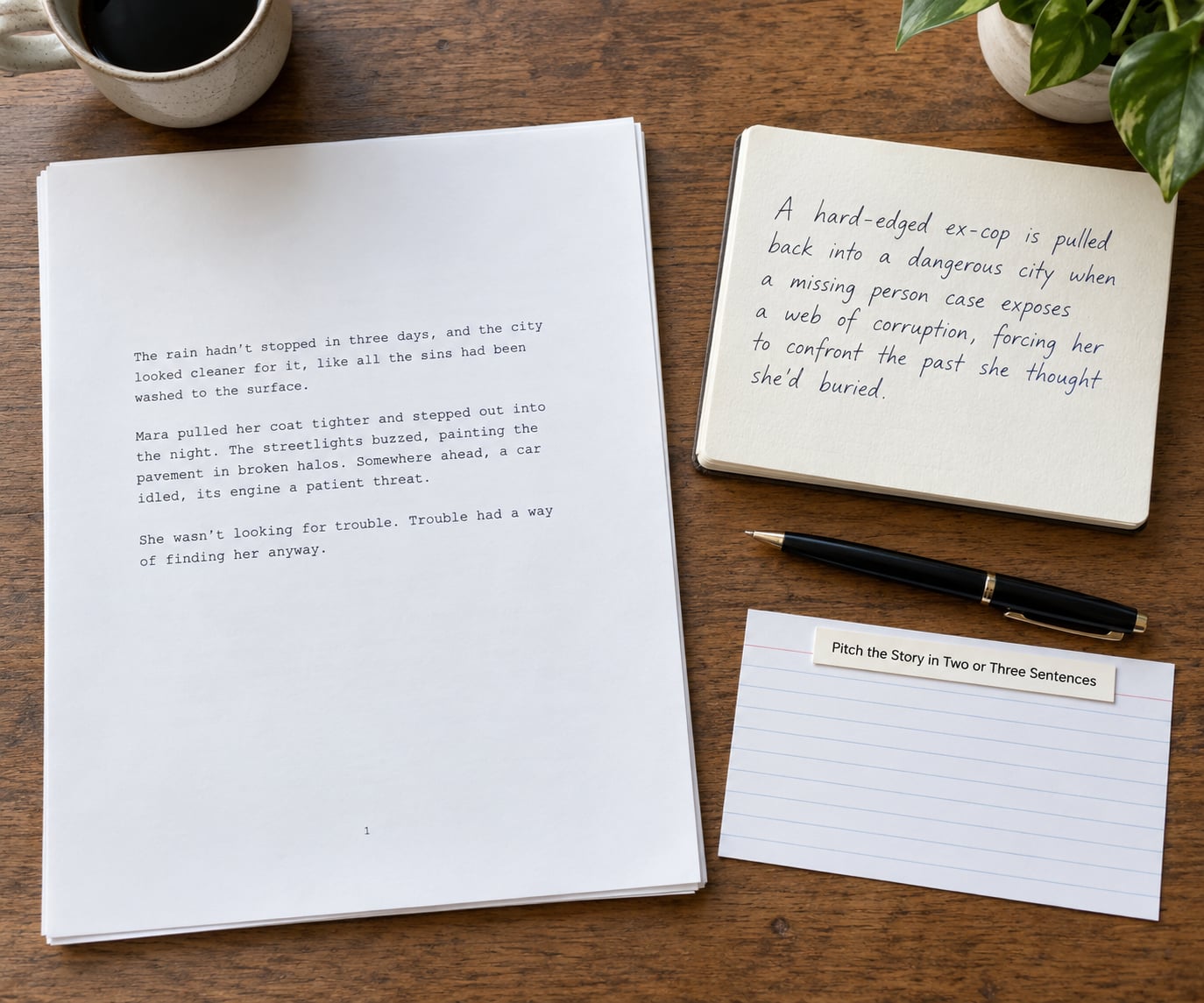
Two or three sentences on premise and central tension is plenty. Describe the situation and the pressure on it, and stop before the ending. An editor who reads your pitch first is choosing whether to read the story next, and a pitch that resolves the story robs them of that.
Weak opening lines get cut before anyone reaches your title. The ones that survive look like this.
- “Please consider the enclosed story,” says nothing. It could be attached to anything.
- “I’m a huge fan of your work since college” reads as filler and puts the writer’s feelings ahead of the editor’s job.
- “This story explores themes of isolation and redemption in modern America” is the one writers warn each other about in forum threads. It could describe half the slush pile.
Compare that with a rewrite of the same intention:
Weak: I am writing to submit my short story for publication in your magazine. It is a powerful story about betrayal in a small town and I believe your readers will really connect with it.
Strong: “The Long Cold” follows a night-shift coroner who recognizes the body on her table from a case she closed nine years ago, and who has until the 6 a.m. shift change to decide whether to reopen it.
The strong version gives an editor a character, a pressure and a clock. It says nothing about quality or legacy, which is a relief, because nobody believes the writer’s opinion of their own story anyway.
Show Why the Writer Is the Right Choice
A short bio does two jobs: it gives the editor the identifying details they need to record your submission, and it tells them whether you are the person who writes this kind of piece. Fifty to 100 words, third person, no attachments, no history of how long you have been writing.
If you have credits, lead with the most relevant ones and include at most three. “Her stories have appeared in Journal A and Journal B, and she was a finalist for the C Prize” is a complete bio at twenty-two words.
If you have none yet, do not pad and do not apologise. Point at what you are: a program, a workshop, a reading, a small paying work, or simply the fact that you write this genre. Honest versions look like this.
Elena Ruiz is a fiction writer in Tucson, Arizona. She came through the low-residency program at Workshop Name, and her work has appeared in Small Magazine and Another Magazine. She is currently writing a linked collection of desert noir stories.
Note what is missing: no “I am unpublished,” no “this is my first submission,” no apology for the state of the CV. The editor has seen a blank credits line a hundred times and never once thought less of the story.
Address Requirements and Include the Correct Materials
Finish by confirming what you are sending and what the guidelines asked for. Most short fiction cover letters close in two or three lines: this piece, these files, this contact address, and a thank-you that is not grovelling.
Three details decide whether the packet is complete:
- File name and format. Follow their convention exactly, including page numbers or a running head if asked. “Lastname_StoryTitle.docx” is a common convention; others want the title alone.
- Anonymity. If the venue reads blind, remove your name from the manuscript, the file properties and the file name, and use “Dear Editor” in the letter. If they do not read blind, your name, bio and contact details belong in the letter itself.
- Only the requested enclosures. Manuscript, synopsis, bio, and a rights or permissions note if the guidelines ask for one. A synopsis, a query and a letter all at once reads as not having read the guidelines.
If your venue uses a submission portal, most of this happens in form fields rather than a letter. Write the same sentences, but paste them into the field labelled “note to editor” and keep the bio in the field labelled “bio.”
Proofread and Perform a Final Submission Check
Read the letter once for sense and once for compliance. Two different jobs, and mixing them is how a mismatched journal name survives into the send.
Before you press send, confirm each of these:
- Journal name spelled correctly, in the subject line and the opening line.
- Editor name correct, or a neutral salutation if you could not find one.
- Story title matches the title on the manuscript’s first page, character for character.
- Word count is the real count and sits inside their range.
- Publication status is accurate, including simultaneous submissions.
- Bio word count matches what the guidelines request.
- No name appears anywhere in the file or file name if the venue reads blind.
- File format and attachments match the guidelines, with nothing extra attached.
- Reply email address is the one you actually read, checked twice.
- A clean final copy is saved in your own records, dated, before you submit.
Then send it and stop refreshing your inbox. Venues list response windows from six weeks to six months, and chasing is the one move readers describe as burning a bridge.
Cover Letter Examples for Short Story Writers
Knowing how to write a cover letter for a short story submission comes down to building one solid template and swapping the variable fields, not rewriting the letter each time. Fill in the brackets, delete the guidance, and keep a copy you can paste from.
Dear [Editor Name],

Please consider "[Story Title]," a [genre] short story of [word count] words. [One sentence on premise and central tension, no spoilers.]

[One sentence on why this story suits this publication: an issue, a stated interest, a recurring subject.]

This story is previously unpublished. [It is currently out at [Venue], and I will withdraw it within [timeframe] if you accept.] / [It is available exclusively to you.]

Bio: [50-100 words, third person, credits first.]

Thank you for your time and consideration.

[Your Name]
[Email address]
[Postal address, only if requested]
Here is the same template filled in for an unsolicited submission to a small literary magazine. Venue names here are illustrative.
Dear Mr. Adeyemi,
Please consider “Ninety Miles of Service Road,” a literary mystery of 3,800 words. A retired state trooper returns to the county where he grew up to settle his father’s estate and finds a county map with a route on it that no longer exists.
The piece appeared nowhere else, and it is not under consideration at any other venue. Your magazine’s ongoing interest in rural settings and returning narrators felt like the right home for it.
Bio: Dana Whitfield’s work has appeared in Hollow Creek Review and Bellwether. She teaches ninth-grade history outside Albany, New York.
Thank you for your time and consideration.
Dana Whitfield
[email protected]
And here is a version for a themed crime or noir open call, where naming the theme is the whole assignment.
Dear Editors,
Please consider “Cold Storage,” a noir story of 4,600 words. A repo man working the night shift takes a payment he should not have taken, and spends the following morning trying to work out which of his regular customers has been crying wolf.
“Cold Storage” was written for your open call on money and moral compromise, and the story’s central question is exactly that question: what a person will carry quietly once the money is spent.
The story is previously unpublished and not under simultaneous consideration. I can supply a synopsis or a permissions statement if either is useful.
Bio: Marcus Hale is a freelance crime reporter in Detroit. His short fiction has appeared in Two Truths and The Quarterly, and his nonfiction has been recognized by the Society of Professional Journalists.
Thank you for considering it.
Marcus Hale
[email protected]
Compare the two. Same skeleton, different emphasis: the first leans on editorial fit with a general-interest journal, the second on the stated theme of the call. That single adjustment is the whole difference, and it takes a minute.
Common Mistakes and How to Fix Them
These are the problems that show up most often in letters I see attached to story files, and each has a fast correction.
- The letter describes the story instead of identifying it. Fix: cut everything after the title, word count and genre line that a form field already asks for.
- The bio is the longest thing in the packet. Fix: cap it at the length the guidelines specify, or 100 words if they are silent.
- The writer explains why the piece is important. Fix: delete claims about relevance or power. State the premise and stop.
- Contact details are missing from an email submission. Fix: include a signature with the email address you read, in the body rather than only in the signature block.
- The letter is addressed to nobody. Fix: find the name in the masthead, and if you genuinely cannot, use “Dear Editors” rather than inventing one.
- Comp titles appear in a short story cover letter. Fix: delete them. Comp titles belong in query letters.
- The letter is longer than 150 words. Fix: cut the third paragraph. Editors read the first two sentences and the bio.
Common Mistakes
Beyond the drafting slips, some habits cost writers a read they had earned. Each of these has a direct replacement.
- A generic pitch that could go to anyone. “I believe this story will resonate with your readers” belongs in no letter. Replace it with one specific, checkable observation about the publication: a recent issue, a stated policy, a recurring subject.
- Retelling the story in the letter. A plot summary is what a synopsis is for, and most venues do not want one. Replace the summary with a single sentence of central tension.
- A list of literary influences. Naming six writers you admire shifts the conversation to you and reads as homework. If the venue asks for a note on influences, give one line. Otherwise cut it.
- Breaching anonymity. On a blind submission, your name in the file name or document properties can get the piece binned unread. Strip everything, including the metadata, before uploading.
- Ignoring individual guidelines on formatting, word count or attachments. This is the number one cause of an automatic reject. Re-read the guidelines immediately before uploading, not the day you drafted the letter.
- Leaving the journal name from your last submission in place. Forum writers have a phrase for this, and it involves your ex. Save a template per venue so the variable fields are the only things you change.
- Overselling with certainty. “This story will change the way you think about small-town justice” tells the editor you have not read your own work yet. Replace superlatives with facts: length, genre, what the character is trying to do.
Two smaller habits are worth keeping. First, never write “Dear Sir or Madam” and never joke in the salutation; editors read enough letters to find that tedious. Second, keep a submission log with the date, the venue, the word count and the response deadline, because withdrawal is much easier when you know which story is out where.
One last thing: if you receive a personalised rejection, thanking the editor briefly is welcome. A long argument about the quality of the story is not, and it travels. Small literary worlds overlap more than anyone outside them realises.
Frequently Asked Questions
Is a cover letter required for a short story submission?
Often, but not always. Many venues use a submission portal with no cover letter field at all, and some ask only for a short note in the email body. The guidelines decide. If a letter is requested, send one; if it is forbidden, do not attach one as a bonus. Either way, the story title, word count and your publication status usually have to appear somewhere, which is often all a cover letter ever contained.
How long should a short story cover letter be?
Under 150 words, and closer to 100 is better. A short story letter is an identification slip, not a pitch: title, word count, genre, publication status, one fit sentence and a short bio. Experienced readers describe the whole thing as a five-minute job. Anything that runs past a page is usually a query letter or a synopsis in the wrong place.
Should I include a synopsis with a short story cover letter?
Only if the guidelines ask for one. Some anthologies and themed calls request a short synopsis as a separate file, and there it is useful. For a standard journal submission it is redundant, since the editor will read the story itself. If you do include a synopsis, keep it to a paragraph and make sure it is listed among the enclosures the venue requested, not added as an extra.
What should I write if the story is unpublished?
Write the sentence plainly: this story is previously unpublished. Then state its status accurately, including whether it is out simultaneously elsewhere and whether you can withdraw within a stated timeframe. Unpublished work is not an apology and not a weakness. Writers with no credits at all still send a short bio describing where they write and what they are working on.
How should I format a cover letter in an email submission?
Put the letter in the body of the email, not as an attachment, unless the guidelines say otherwise. Use a short subject line naming the piece and its length. Address the editor by name if you can find one, keep the pitch to two or three sentences, and close with your name and the email address you read. Attach only the manuscript, named per their file-naming convention.
Should I name famous authors as writing influences?
Rarely, and never in a list. Influences tell an editor something about craft only when they are specific and brief. Naming six writers you admire reads as homework and shifts attention to you. If a venue asks about influences, one line naming one or two and the specific quality you took from them is plenty. Otherwise, leave them out entirely.
Conclusion
Start with the guidelines, not the template. Read them twice, pull out the word limit, the file convention, the anonymity rule and the enclosures, then write one paragraph that names your story’s strongest quality and connects it to something this editor actually publishes. Everything after that is formatting and a bio you can reuse. Polish last, send it, and go work on the next draft while you wait.
If you have been putting off a submission because the letter feels hard, the version of how to write a cover letter for a short story submission that actually works is short: read the guidelines, name the piece, give one honest sentence about why this editor, sign it. Drafting it now takes less time than the story you are avoiding.