Scandinavian noir explained for beginners usually comes down to three things: a cold, ordinary-looking Nordic setting on the surface, a tired investigator working inside institutions most readers trust, and a crime that says more about society than about the killer. Once you know that, the rest is a matter of taste and order. This guide covers the definition, how the genre differs from American and British crime fiction, where it came from, which countries and authors matter, and a sensible order to start reading and watching in.
Table of Contents
- What Is Scandinavian Noir?
- How Scandinavian Noir Differs from Other Noir
- What Makes Scandinavian Noir Feel Distinctive to Beginners?
- Scandinavian Noir Explained for Beginners
- A Brief History of Nordic Crime Fiction
- Which Countries and Authors Count as Scandinavian Noir?
- What Themes Should Beginners Notice?
- How to Read Scandinavian Noir Without Feeling Overwhelmed
- Where Should New Readers Start?
- Frequently Asked Questions
- Is Scandinavian noir the same as Nordic noir?
- What is the literal meaning of the word noir?
- Is Nordic noir depressing?
- What counts as Nordic noir versus just a Scandinavian-set thriller?
- Which Jo Nesbo book should I read first?
- The Best Way to Approach the Genre
What Is Scandinavian Noir?
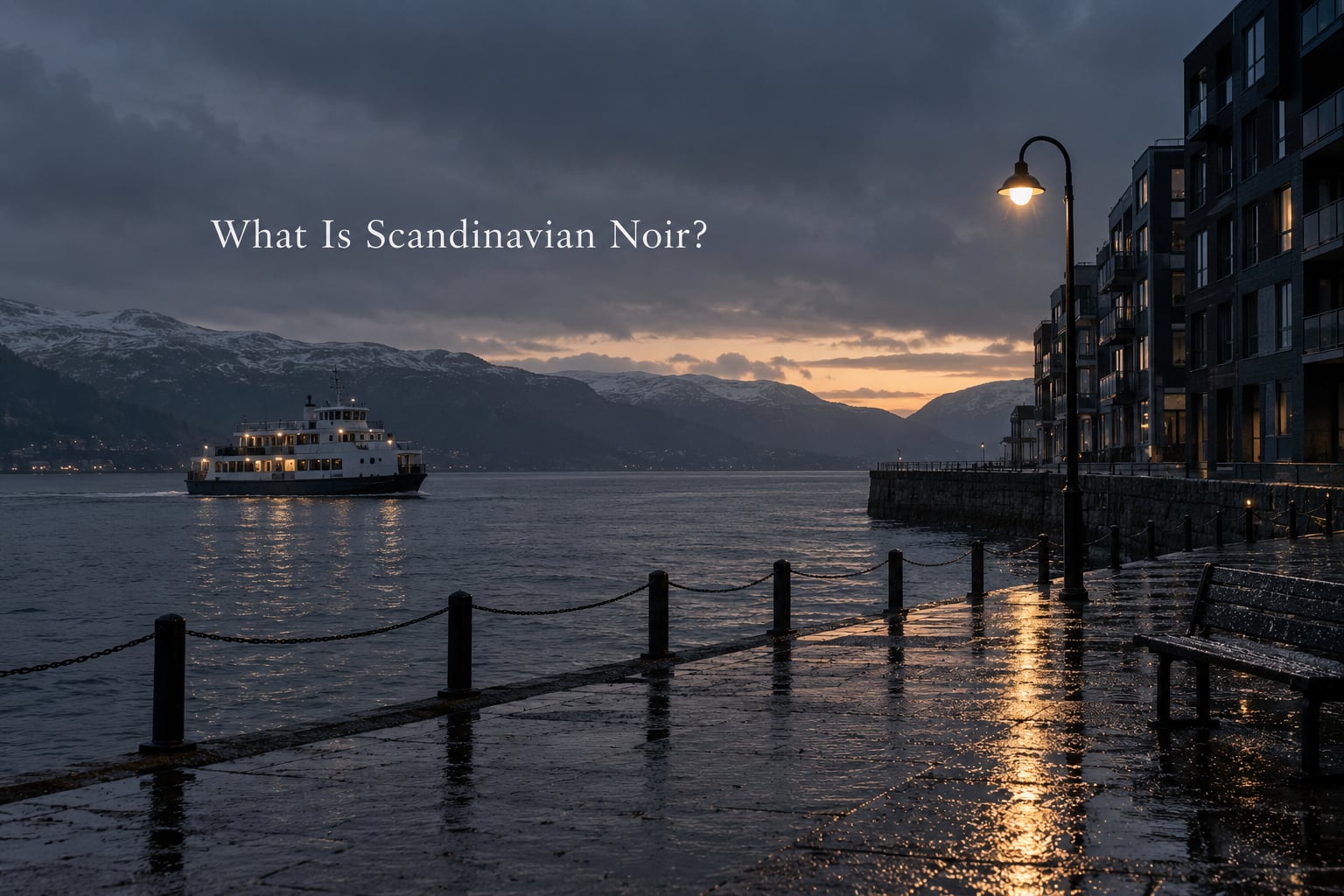
Scandinavian noir is a style of crime fiction, film and television set in a Nordic country, usually told from a police point of view. It uses plain, unadorned prose and bleak landscapes to build a dark, morally complicated mood, where violence, misogyny and inequality sit quietly just beneath a calm and apparently decent surface.
The word itself is doing less work than you would think. Noir is French for black, and in its original 1940s American use it meant a particular visual and moral style: shadowed streets, a compromised hero, fatalism. Scandinavian crime writers borrowed the surface and mostly rejected the internals. Their detectives are not private eyes living outside the law; they are public employees with pensions, paperwork and colleagues, and the corruption tends to sit inside institutions rather than in a single oily villain.
So when you see the label on a book, you can reasonably expect these things:
- A Nordic setting that does real work: weather, distance, darkness and small communities shape the plot.
- A police or investigator point of view, usually in series, usually over several books.
- Plain, stripped-down language with little metaphor and few rhetorical flourishes.
- A flawed, weary or troubled investigator rather than a clever hero.
- Social criticism running alongside the case, especially about the welfare state and inequality.
- Violence that is blunt and unsentimental rather than stylish.
- An ending that may resolve the crime and leave the social question open.
How Scandinavian Noir Differs from Other Noir
The easiest way to understand the genre is to set it against the traditions readers arrive from. American hardboiled fiction gives you a lone operator, a corrupt city and narration that never stops selling. British crime fiction gives you a puzzle, an amateur or professional investigator of a different kind, and a solution you can actually verify. Nordic crime gives you a system under strain.
| Criterion | American hardboiled | British whodunit | Scandinavian noir |
|---|---|---|---|
| Investigator | Private, outside the law | Amateur or police, often upper class | Career police, institutional, overworked |
| Main pleasure | Voice and atmosphere | The puzzle and its solution | Social pressure and slow revelation |
| Setting | Corrupt American city | Country house, village, estate | Welfare-state Nordic town, fjord or city |
| Moral tone | Cynical, self-justifying | Order restored, or neatly lost | Unresolved, systemic, uneasy |
| Protagonist | Antihero, often charming | Steady, often a bit fussy | Understated, frequently female, often burned out |
| Prose style | Flashy, first person, metaphor-heavy | Cosy, fair-play, clue-driven | Flat, precise, metaphor-free |
Two differences catch beginners out. First, the crime is often less important than the society around it, so a book can be satisfying even if you never learn precisely who did what. Second, the tone is not constant: the famous Swedish police series go from bleak to mundane on purpose, and the mundane is doing work.
What Makes Scandinavian Noir Feel Distinctive to Beginners?
Cold setting is the obvious one, and it is also the most overplayed. The interesting part is what the cold does to people. Winters are dark, towns are small, and a rumour travels the length of a fjord faster than a police unit can drive it.
Scandinavian Noir Explained for Beginners
In plain terms, the genre works by contrast. A safe, tidy, well-run community sits on top, and something rotten sits underneath. The investigation is realistic and unhurried, the detective is human rather than heroic, and the case doubles as an examination of the systems the detective works inside. That is why the interesting question in these books is rarely who did it. It is what the crime itself revealed about the town.
Beyond that, several features recur often enough to look for:
- Institutional trust under strain. The police, the courts, the social services and the press are not automatically corrupt, but they are fallible, slow and sometimes complicit by omission.
- Understated protagonists. Understatement, not monologue. Many of the best leads say very little and are exhausted.
- Everyday violence. Crimes tend to happen in ordinary homes and relationships rather than in criminal underworlds.
- Economic anxiety. Unemployment, debt, shrinking towns and a strained welfare system sit in the background of many plots.
- Gender and misogyny. Violence against women is frequently both plot engine and subject of criticism, sometimes uncomfortably so.
- Slow revelation. Information arrives through interviews, archives and small-town memory rather than through clever deduction scenes.
The prose reinforces all of this. Sentences are short, adjectives are rationed, and when a writer uses a strong image it tends to land hard because nothing else is competing for attention.
A Brief History of Nordic Crime Fiction
Nordic crime writing is much older than the phrase suggests. Detective fiction arrived in Sweden and Denmark in the early twentieth century, often in the form of puzzle-solving adventures with tidy solutions and an uncomplicated hero.
That tradition had a name: lyckligt mord, the happy murder. A crime was solved, the culprit was punished, the reader was satisfied. When Maj Sjowall and Per Wahloo published the first Martin Beck novel in 1965, they broke with it deliberately. Their ten-book series, running to 1975, used dull procedure, long shifts, strikes and budget fights, and it made the detective a tired institutional worker instead of a solver. Readers noticed, though it was not an instant commercial event.
Henning Mankell then widened the door. His Kurt Wallander books, beginning in 1991, mixed the procedural with an explicit political critique of a society Mankell believed was decaying. His essay on Sjowall and Wahloo, calling them the people who changed Swedish crime writing for good, is still routinely quoted. Mankell also wrote the novels adapted into Wallander, and he worked on the original Swedish Wallander films, which is still the adaptation most fans measure others against.
The label itself arrived later than the books. Scandinavian crime fiction was already exporting through translations, but the term Nordic noir was attached to it in the 1990s in Scandinavian studies circles, associated with work at University College London. English-language readers picked it up in the 2010s, helped by a widely circulated British television documentary series on the history of Scandinavian crime fiction, and by British and American publishers using the label as a marketing hook.
On screen the timeline is shorter and easier to track. Insomnia in 1997 put Norwegian insomnia and moral exhaustion on the map. The Killing arrived in 2007 and proved a single-city murder could hold an international audience. The Bridge in 2011 turned a real border location into a crime scene and made a rotting bridge into an image of the whole society. Borgen from 2010 added politics as a genre of its own, and Trapped from 2015 showed a small Icelandic town could carry a season. Since around 2020 the volume of Nordic crime drama on streaming has been enormous, and that is where most newcomers now meet the genre.
Which Countries and Authors Count as Scandinavian Noir?
Worth fixing early: Scandinavia strictly means Denmark, Norway and Sweden. The Nordic region adds Finland, Iceland and the far north islands, plus Greenland and the Faroes. Crime fiction from all of these gets sold as Nordic noir, loosely and often, which is why the label feels fuzzy.
| Country | Signature authors | What it is known for |
|---|---|---|
| Sweden | Henning Mankell, Stieg Larsson, Camilla Lackberg, Maj Sjowall and Per Wahloo, Viveca Sten | The template. Deep social critique, a long procedural tradition and the biggest international sales of any Nordic crime author. |
| Denmark | Jussi Adler-Olsen, Peter Hoeg, Sara Blædel, Elsebeth Egholm | Institutional comedy and satire; the Department Q books are far warmer on the page than their reputation suggests. |
| Norway | Jo Nesbo, Anne Holt, William Wisting, Samuel Bjørk, Jan Guillow | Weather, isolation and police work under pressure. A strong, often darker register than the Swedish model. |
| Iceland | Arnaldur Indridason, Yrsa Sigurdardottir, Ragnar Jónasson, Sjon | Small cast of investigators, extreme landscape, and a crime tradition that maps onto real cases, including the disappearance known as the Isdal Woman. |
| Finland | Leena Lehtolainen, Matti Rönkä, Jo Nesbo’s Finland-set later books | Exported heavily and often published under Nordic rather than Finnish branding, which confuses the category more than it helps. |
And a warning, because this trips up new readers constantly: not all Nordic crime fiction is noir. Yrsa Sigurdardottir’s thrillers, Sjon, the cozier Fjellbacka books by Camilla Lackberg, and a lot of the Arn novels by Jan Guillow are fast, plot-led and comparatively light. They are good books. They are just not the bleak institutional thing, and picking one first can lead you to conclude you dislike a genre you have not actually read.
What Themes Should Beginners Notice?
Once the plot stops being the main event, the same subjects keep surfacing. Inequality and economic precarity, especially as they affect people outside the professional middle. Immigration and the strain it puts on small communities. Gender, misogyny and violence against women, treated both as plot and as a subject in its own right. Family secrets kept across decades, usually to protect someone. Institutional failure, where the police, the state or a company behaves badly while claiming to be blameless. Mental health, handled with more directness than English-language crime fiction usually manages. Rural isolation and shrinking towns, and bureaucratic power exercised by ordinary people with paperwork.
You do not need to analyse any of this to enjoy the books. You will simply notice you start thinking about it, which is rather the point.
How to Read Scandinavian Noir Without Feeling Overwhelmed
Start anywhere, but check the commitment before you commit. Some of these series are short and closed. Anne Holt’s Hanne Wilhelmsen books are self-contained enough to sample. Jussi Adler-Olsen’s Department Q novels each stand alone even though the characters recur. Stieg Larsson’s Millennium trilogy is three books and was finished by another writer after his death. Jo Nesbo’s Harry Hole run is long and was originally ordered differently in translation, so read the first novel rather than assuming the sequence. Indridason’s Erlendur books reward patience and are traditionally read in order.
Calibrate your expectations on tone before you blame yourself. The first fifty pages of many of these books are deliberately slow, and the dialogue is terse in a way that can read as flat in translation if you are not ready for it. Nordic crime does not rely on twist surprises; the pleasure is watching a case assemble. Endings often leave the case solved and the society unreconciled.
Content warnings are worth stating plainly. There is sexual violence, violence against women and children, misogyny, child abuse, self-harm and animal cruelty across the genre, often described without the euphemisms English-language crime fiction uses. The Girl with the Dragon Tattoo contains rape described in detail. Insomnia centres on a child’s murder. The Vale Murders books include explicit sexual violence. If that is a hard boundary for you, the Danish and Swedish police series are the gentler place to start.
A short glossary helps more than you would expect, because a lot of the jargon comes from Swedish and Norwegian criticism rather than from the books:
- Facade and underbelly the respectable surface of Nordic society and the rot beneath it. The central tension of nearly every book in the genre.
- Lyckligt mord the happy murder, the solvable, tidy crime tradition that Sjowall and Wahloo deliberately broke with.
- Hygge the coziness stereotype Denmark trades on, and the foil the genre is usually defined against.
- Velfærd or welfare state, the social system the genre critiques rather than defends.
Where Should New Readers Start?
Most people arrive at The Girl with the Dragon Tattoo because it is famous, then bounce off it. Here is the order I would actually use, with a reason for each step.
One. Read Anne Holt or Jussi Adler-Olsen first. Holt’s 1222 or Adler-Olsen’s The Keeper of Lost Causes are short, self-contained, and much less bleak than the reputation suggests. You learn the tone at low risk, and you find out whether you like the voice.
Two. Then go back to the source. Maj Sjowall and Per Wahloo’s Roseanna is the book that made the modern form, it is the first Martin Beck novel, and it is the one most people have never read. Faceless Killers, the first Wallander novel, is the other candidate, and Mankell is easier to find.
Three. Add a series you can live inside. Jo Nesbo’s The Snowman is the safest famous entry point and stands on its own, or The Bat if you want the first published Harry Hole novel. Arnaldur Indridason’s The Silence of the Grave is the better-written detective fiction if you can tolerate a slower start. Camilla Lackberg’s The Ice Princess is the cosier route in, and readers who like The Missing or The Dublin Murders usually take to it immediately.
Four. Read the hard ones last. Smilla’s Sense of Snow by Peter Hoeg is dense, argumentative and about colonialism and science, not really about murder. The Millennium books are the genre’s high-water mark commercially, and The Girl with the Dragon Tattoo is the one to read knowing that the middle of it is long.
Five. Widen out. Once you know which country you like, follow it. Swedish gets you Mankell and Stieg Larsson, Norwegian gets you Nesbo and the darker register, Danish gets you satire, Icelandic gets you Indridason and the strange, archival texture of his work.
On screen, a short route works better than a ranking. Watch Trapped if you want the setting doing the work, The Killing if you want the classic police ensemble and the best-observed version of the genre, The Bridge if you want the politics sharpest, and Bordertown if you want a long, character-led investigation of a killing decades old. Headhunters and The Hunt are worth watching too, though both are thrillers with a social point rather than straightforward noir. Two warnings: Occupied and Quicksand are excellent but leave the Nordic world entirely, and the big-budget film version of The Snowman, starring an internationally known cast, is the adaptation that disappointed the most.
Frequently Asked Questions
Is Scandinavian noir the same as Nordic noir?
Yes, in practice. Nordic noir is the wider and more accurate term, since it covers Finland and Iceland as well as Denmark, Norway and Sweden, which is Scandinavia proper. Scandinavian noir is the label most bookshops and streaming services use, and both terms refer to the same body of books, series and films.
What is the literal meaning of the word noir?
Noir is French for black. The term comes from 1940s American film and fiction, where it described a visual and moral style: dark cinematography, a hard-boiled antihero and a fatalistic view of the world. Scandinavian crime writers adopted the look and the mood, but usually rejected the lone-wolf hero at its centre.
Is Nordic noir depressing?
It can be, and the first fifty pages of a book like Maj Sjowall and Per Wahloo’s Roseanna are famously slow. What it is not is hopeless: the crimes are usually solved, and the bleakness comes from social critique rather than from a bleak view of human nature. Beginners who dislike grim books often prefer the Danish and Swedish police series, which use humour to undercut the gloom.
What counts as Nordic noir versus just a Scandinavian-set thriller?
Ask three questions. Is the investigator inside a public institution rather than outside the law? Is the case carrying a social critique as well as a plot? Is the prose plain and the mood restrained? If most answers are yes, it is noir. If the book is fast, twist-driven and plot-first, it is a Nordic thriller, which is a good thing but a different thing.
Which Jo Nesbo book should I read first?
The Snowman is the safest starting point: it stands alone, translates cleanly and is the one most people know. If you want the series in its original order, start with The Bat. If you want your detective to be damaged rather than merely tired, read it anyway, because Harry Hole gets worse in interesting ways as the series goes on.
The Best Way to Approach the Genre
Start with one short book, either Anne Holt’s 1222 or Jussi Adler-Olsen’s The Keeper of Lost Causes, because they teach you the voice without costing you much. Pay attention to atmosphere and to what the institutions in the story are doing, rather than expecting a puzzle to click shut at the end. Then go back to Sjowall and Wahloo or Mankell, pick whichever country’s books you liked the sound of, and follow that thread. Nobody wastes a year of reading by starting in the wrong place; they waste it by starting with the most famous book and concluding they do not like Nordic noir.