
To write an insurance scam plot that readers believe, you need three moving parts pulling against each other: a policy worth real money, a loss that was staged or inflated, and a claim filed against that policy. Build the scheme out of a motive the reader accepts, let it develop one pressure point at a time, and have somebody competent pull it apart. This guide is about plotting fiction. It is not about committing fraud.
That distinction matters more than it sounds. Search engines read “how to write an insurance scam” literally, and whole pages of fraud-advice content compete for the same query. The page you are reading treats the con as a story engine, the way a novelist would.
Insurance fraud also makes better crime fiction than most writers realise. It needs no corpse to get moving, and it still generates enormous stakes: a family losing its home, a dying man signing papers, an entire block of small businesses finding out their coverage was never real. James M. Cain understood this in Double Indemnity and The Postman Always Rings Twice, and the engine is still underused.
Table of Contents
- What You Need to Write an Insurance Scam Plot
- A protagonist who wants something specific
- One policy, described properly
- Two documents that anchor the claim
- An investigator with a name and an employer
- A research base in public record
- The line you will not cross
- Step-by-Step: Seven Moves From Premise to Resolution
- Step 1: Choose the Central Desire Before the Money
- Step 2: Build a Scheme the Policy Can Actually Support
- Step 3: Give the Scheme a Pressure Point
- Step 4: Layer the Investigation and the Counter-Move
- Step 5: Escalate the Consequences
- Step 6: Design a Twist That Changes the Meaning
- Step 7: Resolve Through Choice, Not Coincidence
- Common Mistakes That Make an Insurance Scam Plot Fall Flat
- The interchangeable victim
- Invented policy rules
- Hiding the essential clue
- The omniscient investigator
- The same obstacle five times
- Explaining the scheme twice
- Resolving everything with a confession
- An investigator who is only an obstacle
- Frequently Asked Questions
- How do I make an insurance fraud scheme believable in fiction?
- Which types of insurance make the best plot material?
- How much research do I need before writing a crime plot?
- How do I avoid turning a fraud story into a how-to?
- How do I write a twist that is not unfair to the reader?
- Can I base the story on a real insurance fraud case?
- Conclusion
What You Need to Write an Insurance Scam Plot
Before you plot a single scene, six things need to exist on paper. Miss one and the plot will feel thin no matter how clever the twist is.
A protagonist who wants something specific
“Wants money” is not a motive. What is the money for? A medical bill, a divorce, a business that is failing publicly, a child whose school fees came due, a reputation that cannot survive another disappointment. The best fraud protagonists want a specific amount for a specific reason, and the reason is usually shame or rescue rather than greed.
One policy, described properly
You do not need a law degree, but you need a real document to point at. Decide the line of insurance, the coverage limit, the effective date, and one clause that matters later. A deductible, an exclusion, a proof-of-loss requirement, a policy that lapsed on the fourteenth of the month: these small facts are what let you build a scheme that survives contact with a plot.
Two documents that anchor the claim
Every claim has a first notice of loss, the phone call or form filed when the loss happens, and a proof of loss, the sworn statement of what happened and what it cost. Almost every good insurance-fraud plot turns on a gap between those two documents. Put them side by side on your desk. The discrepancy is your first clue.
An investigator with a name and an employer
Give the person pulling the thread a job title, a company, a manager, and a reason to care this week. An adjuster working a queue of four hundred files is a different character from a fraud specialist with a licence and a target. Give the investigator a cubicle, a difficult boss, and a named employer rather than making them a police detective or a private eye. The friction of an ordinary job is what makes an investigation slow enough to be tense.
A research base in public record
Court filings, DOJ and FTC press releases, National Association of Insurance Commissioners reports, and state insurance fraud bureau bulletins are all public and all readable. You need enough of a spine to invent around: the general shape of a case, not the personal details of living people.
The line you will not cross
Decide now how much procedural detail goes in the book. Dramatic effect is your job; instruction is not. Describe what a forged signature looks like to a fraud specialist who knows, and stop there.
Step-by-Step: Seven Moves From Premise to Resolution
Here is the framework. Seven steps, in order, and the test for each one is whether the next step becomes possible because of it.
Step 1: Choose the Central Desire Before the Money
Start with a person, not a policy. Write a paragraph about what your fraudster cannot stand about their life right now, and what would change if the money arrived. Debt is generic. Debt plus a daughter who has stopped answering the phone is a plot.
Distinguish a driving desire from a convenient one. A vague “get rich” produces a flat antagonist who acts because the plot needs him to. A driving desire produces a person who makes choices you would not have thought of, including some that damage the scheme. Greed is a weak engine because it is satisfied by success. Fear, resentment, loyalty, and grief keep generating decisions long after the money would have been enough.
Test it: can you write a sentence beginning “She could not bear to” and finish it honestly? If not, the character is not yet load-bearing.
Step 2: Build a Scheme the Policy Can Actually Support
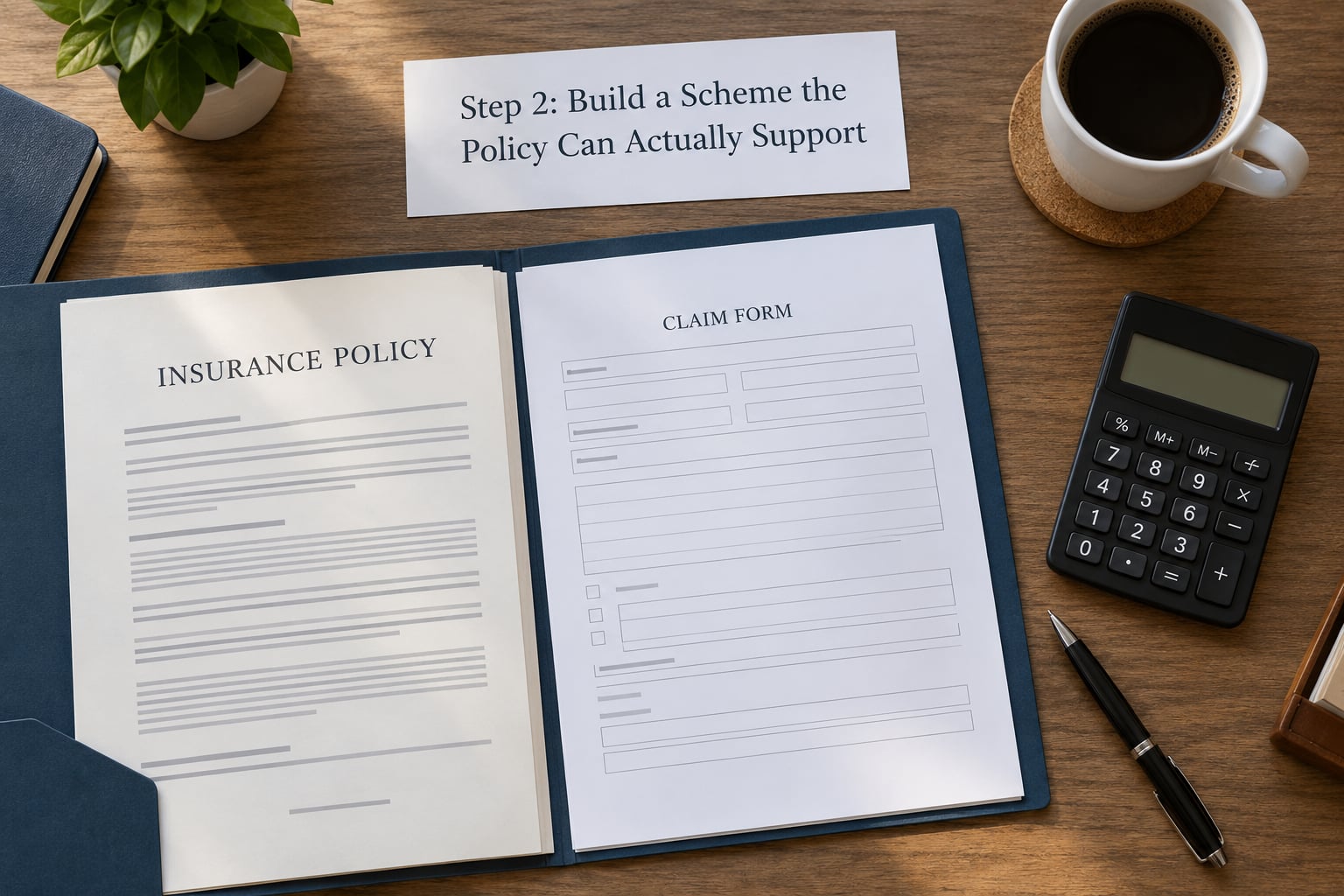
Now match the desire to a document. The scheme has to make sense against the terms of a real policy, or an alert reader will drop the book in chapter four.
Insurance fraud clusters into recognisable shapes, and each one generates a different story:
- Swoop-and-squat — take out a policy on property you have no intention of keeping covered, file a claim early, then abandon the property before the insurer can investigate. A slow build, a clean getaway, and a natural fit for a protagonist who is running.
- Staged collision — manufacture a crash that never happened. Because the loss is physical and visible, the investigator works from photographs, repair estimates, and a witness list, which gives you a suspect roster for free.
- Inflated damage claims — the loss is real, the cost is invented. A homeowner’s water damage, a smashed windscreen, a stolen tool from a van. The best of these because the underlying event gives the protagonist genuine panic about being caught.
- Undisclosed pre-existing conditions — a health policy where the diagnosis predates the application. Intimate, humiliating, and full of medical paperwork that can contradict the protagonist later.
- Ghost employees and inflated medical billing — a clinic billing for treatments that never happened, or a supervisor claiming for a worker who does not exist. Ring cases, with dozens of small lies supporting one large one.
- Viatical settlement fraud — buying a life policy on someone terminally ill and selling the policy to a settlement firm at a markup. It is a life insurance plot that requires nobody to die, which surprises readers and gives you a moral problem the characters cannot dodge.
- Arson for profit — a business burns and the owner is the one holding the torch. High stakes, obvious danger, and a real reason for the investigator to escalate.
- Fabricated ownership or nonexistent claimants — a beneficiary who was never related to the person who died, a driver who was not on the policy, a contractor who never owned the building.
- Rebundled or duplicate claims — the same loss claimed twice across two policies, or once under two names. Quiet, administrative, and surprisingly chilling.
- Fraud-as-pattern schemes — a single claim that looks ordinary and turns out to be the twelfth in a series. Useful when you want your investigator to be frightened.
Check any of these against current public sources before you rely on the details, and fictionalise deliberately so no real person is identifiable. Then write the scheme in the order the protagonist would execute it, and mark every step where something could go wrong. Those marks are your plot.
Step 3: Give the Scheme a Pressure Point
An insurance fraud plot with no obstacle is a story about waiting. The pressure should come out of the plan itself, not out of a random coincidence, because then the protagonist’s own cleverness is what traps them.
Waiting periods work well. So do exclusion clauses that catch a claim nobody thought about, an adjuster who asks a question that is slightly wrong, a co-conspirator who gets nervous, a financial deadline that forces a decision before the paperwork settles, and a piece of evidence that stops being what it was. The best version is a deadline the reader can feel ticking from the first chapter.
Give the protagonist one clean win early, so the plan looks like it is working. Without that, there is nothing to lose.
Step 4: Layer the Investigation and the Counter-Move
Put someone competent in opposition. An in-house claims adjuster has file access but no authority to search. A Special Investigations Unit investigator has authority but needs a referral from the carrier, which means a supervisor has to believe the file is worth an investigator’s week. A public adjuster works for the claimant and knows the territory. A former claims employee turned private investigator has skill and no institutional backing at all.
Those limits are the plot engine. An investigator who could do anything on page one would have nothing to do by page fifty. Write down what your investigator can legally do, what they need permission for, and what they are professionally forbidden to do, then put the required approval in the worst possible place in the timeline.
Layer the opposition. An investigator, a family member who suspects something, a lawyer who wants the claim resolved quietly, a witness who noticed one small thing, and an accomplice who may fold. Each one should notice something real and misinterpret it, and each should be wrong for a reason that makes sense at the time.
Misdirection works the same way. Give the reader a true detail that seems to point at the wrong person — a coat left at the scene, an insurance policy in the wrong name, a claim filed three weeks too eagerly — and make sure you showed it honestly on the page. Cheating readers are worse than boring them.
Step 5: Escalate the Consequences
Every exposure should cost more than the last. The claim gets flagged. The policy is referred to the fraud unit. The payment is denied on a technicality and the protagonist’s legitimate need becomes urgent. A supervisor starts asking questions. An accomplice takes a deal and gives a name. Someone who knew gets hurt.
The escalation must change the protagonist’s choices, not just the volume. At the start they wanted money. After step four they want the file to close. After step five they want the investigator to look away, or to disappear, or to die. That change in what they want is the character arc, and it is what separates an insurance scam plot from a con checklist.
Step 6: Design a Twist That Changes the Meaning
A good twist here reinterprets what the reader already has, rather than adding a new fact. It should be true in retrospect and surprising on first reading.
Options that work: the claim was flagged as suspicious from the beginning, so the investigator was never improvising. The supposed victim is in on it. The investigator’s own motivation mirrors the protagonist’s. The evidence points to an entirely different crime and the insurance fraud is the cover. The protagonist staged a loss that was genuinely damaging, to a real person who did not deserve it.
Decide what the reader learns, what they now reinterpret, and why the new direction produces stronger conflict. If it only produces a sadder ending, it is not a twist, it is a detail. Plant the support early and show it plainly: a scene can be misread by the reader without being hidden from them.
Step 7: Resolve Through Choice, Not Coincidence
The climax has to be a decision. Your protagonist chooses to file the claim, choose to torch the file, choose to walk into the interview and lie, or chooses not to run. If the case closes because of a phone call from an unrelated officer, the last forty pages were waiting.
Let the legal outcome stay ambiguous if that serves the story. A suspended sentence, a plea, a confession the reader knows is half true, an acquittal that costs the protagonist the only person who believed them. What matters is that the resolution pays off the emotional promise you made in step one: the thing they could not bear to lose, lost or kept or finally admitted.
Then give the investigator a closing beat. The file gets closed, or it does not, and either way something has changed in them. A working investigator who ends a book exactly as they began has written a procedural, not a novel.
Common Mistakes That Make an Insurance Scam Plot Fall Flat
Most of these are fixable with a revision pass, and most are visible in the first draft.
The interchangeable victim
Fix: give the person being defrauded a name, a reason to be in the story, and one specific thing they lose. An anonymous corporate entity produces no feeling. A sixty-year-old whose shop burns produces pressure on the investigator, which is plot.
Invented policy rules
Fix: anchor every plot-critical clause in something you have actually read. If a deadline matters, it should come from a real term, a real reporting requirement, or a real legal process you have verified.
Hiding the essential clue
Fix: show the clue, let the reader dismiss it for a reason that holds up. Misdirection is a matter of interpretation, not omission. If the reveal requires a fact the reader never had, you have cheated them.
The omniscient investigator
Fix: list your investigator’s limits on a separate page, then make the plot obey them. Permission, jurisdiction, and chain of custody are slow, and slowness is where tension lives.
The same obstacle five times
Fix: escalate the type of the obstacle. A phone call becomes a deadline becomes a legal letter becomes a visit. Repeating the same beat at the same volume is what makes a middle sag.
Explaining the scheme twice
Fix: let the investigator say one piece of it out loud and let the protagonist’s reaction carry the rest. A long explanation in dialogue is an info dump, and readers can tell.
Resolving everything with a confession
Fix: a confession is a decision, which is fine, but it cannot undo a plot. Build toward a choice that costs something, and let the confession arrive after it, as consequence rather than solution.
An investigator who is only an obstacle
Fix: give the investigator a private stake of their own — a case they already lost, a colleague under review, a reason to want the closure more than the truth. Then their pursuit has weight of its own.
Frequently Asked Questions
How do I make an insurance fraud scheme believable in fiction?
Make it boring. Real schemes succeed because they are administrative: forms, deadlines, exclusions, and a claim that looks ordinary on the first pass. Ground the scheme in one real policy and let the tension come from the pressure the paperwork creates, not from theatrical trickery. Readers forgive thin motives far less readily than they forgive slow procedure.
Which types of insurance make the best plot material?
Auto and property give you visible evidence and a natural suspect list. Health and workers’ compensation give you ring structures, paper trails, and medical records that can contradict a person. Life insurance raises the stakes immediately but usually requires a death, so viatical settlement fraud is the useful variant. Pick the line whose evidence matches the investigator you want to write.
How much research do I need before writing a crime plot?
Enough to invent around, not enough to transcribe. Read court filings, DOJ and FTC press releases, state insurance fraud bureau bulletins, and NAIC material for the general shape of a case. You need to know what a proof of loss is and what an investigator is permitted to do. Skip the operational details that would turn the book into a manual.
How do I avoid turning a fraud story into a how-to?
Describe detection rather than execution. Show what a trained investigator notices, what makes a claim look wrong, and what happens when a file is referred. Withhold the procedural steps a person could follow. If a passage could be lifted out of the novel and used as advice, cut the specificity and keep the emotional effect, which is the part readers remember.
How do I write a twist that is not unfair to the reader?
Plant the support early and show it plainly, then let the reader explain it away. The twist should reframe facts they already hold rather than introduce a fact they never received. A second timeline, or a phrase the reader has read three times and skipped, does the work. Fair surprises survive rereading; cheap ones only work once.
Can I base the story on a real insurance fraud case?
Yes, but compress and fictionalise deliberately. Public records and press releases give you a real scheme, and using one keeps your research honest. Combine elements from more than one case, change the setting, alter the outcome, and leave the real individuals unidentifiable. Where a case is still open, do not publish the operational detail at all.
Conclusion
Learning how to write an insurance scam plot comes down to four moves. Begin with a desire that would embarrass your protagonist to admit out loud, choose one scheme that a real policy could actually support, plant the clues that support your reversal in full view of the reader, and make the ending a decision rather than an accident.
Start now with one page. Write the motive, the scheme, the investigator, the pressure point, and the possible reversal, in that order, before you write a single scene. Most of the plotting work happens there, and it takes an hour.