
A bank robbery scene works when it is built from pressure and consequence rather than from procedure. Learning how to write a bank robbery scene comes down to six decisions: what the robber wants, what the viewpoint character can know, how the beats escalate, where the tension tightens, who breaks first, and what the outcome costs the rest of the story.
The trouble is that most drafts get stuck on the same three things, a plan nobody needs, a bank interior described like a floor plan, and a getaway that reads like a checklist. Those are the parts readers recognise from films and skip. What holds them is a teller counting something under the counter while a stranger gives an instruction they will remember for the rest of their life.
This guide walks through the six decisions in order, so you can plan the scene on a single page before you write a sentence of prose. Budget two to three hours for a full draft of a short scene, less if you are outlining rather than finishing.
Table of Contents
- What You Need
- How to Write a Bank Robbery Scene Step by Step
- Step 1: Define the Robber’s Objective
- Step 2: Decide What the Reader Can Know
- Step 3: Stage the Scene in Dramatic Beats
- Step 4: Build Pressure Through Choices
- Step 5: Reveal Character Under Stress
- Step 6: End With a Story-Changing Consequence
- Common Mistakes
- Flat action
- Too much procedural detail
- Passive viewpoint characters
- Sudden tonal shifts
- Unexplained competence
- An ending that resets the story
- Frequently Asked Questions
- How long should a bank robbery scene be in a short story?
- Should a bank robbery be written in first person or third person?
- How much detail should a crime scene include to feel realistic?
- What is the most suspenseful way to end a bank robbery scene?
- How do you write a convincing getaway without giving away robbery tactics?
What You Need
Before you draft, six things need to exist on paper. If any of them is missing, the scene will feel flat and you will not know which paragraph to fix.
- An objective. One sentence naming what the robber walks out with, or fails to walk out with.
- Meaningful stakes. Something they lose if it goes wrong, specific enough that a reader can picture it.
- A viewpoint character. One person whose eyes carry the scene, not a camera drifting around the lobby.
- Limited spatial awareness. A rough sense of where people, doors and exits sit in relation to that viewpoint.
- A timeline. How long the scene runs, so you can pace the escalation rather than describing it evenly.
- A reason the scene changes the story. A motive exposed, a trust broken, a chase set off, a new person in control.
That last one is the most commonly skipped and the most important. If the robbery ends exactly as the plot stood before it started, you have written an incident, not a scene. Ask what is different on the far side, who knows something new, and which relationship has been damaged.
The stakes item deserves a warning. Stakes written as generic dread, the plan is risky, the tension is high, produce nothing. Stakes written as a fact, a brother who needs surgery in eleven days, a parole hearing in six weeks, a daughter who watched from the back row of the queue, produce everything.
On timeline, most short stories give the robbery between 800 and 2,000 words, and that range is a floor for tension rather than a rule. What matters more is that time behaves unevenly. The first thirty seconds can occupy a paragraph. The moment of decision can occupy one line.
How to Write a Bank Robbery Scene Step by Step
Step 1: Define the Robber’s Objective
Start with want, not method. What does this character believe they are taking, and why this bank, on this day, at this hour? The answer should reveal something about them that would not otherwise be visible.
A weak objective is money. A usable one is a specific amount for a specific reason, with a deadline attached. Three hundred thousand because a surgical bill is due on Thursday. The amount itself is less important than the deadline, because a deadline turns every beat into a cost.
Next, decide what they are prepared to risk. Not what they threaten to do, which is dialogue, but what they would actually accept as a loss: a hand, a decade in prison, an accomplice they love, the version of themselves their partner still believes in. Write that down on the card and keep it in view while you draft.
Then work out the consequence in both directions. If they succeed, what new problem does the money create? If they fail, who is now in danger who was not before? A scene with two endings designed in advance rarely feels arbitrary, because the reader can feel both doors waiting.
Step 2: Decide What the Reader Can Know
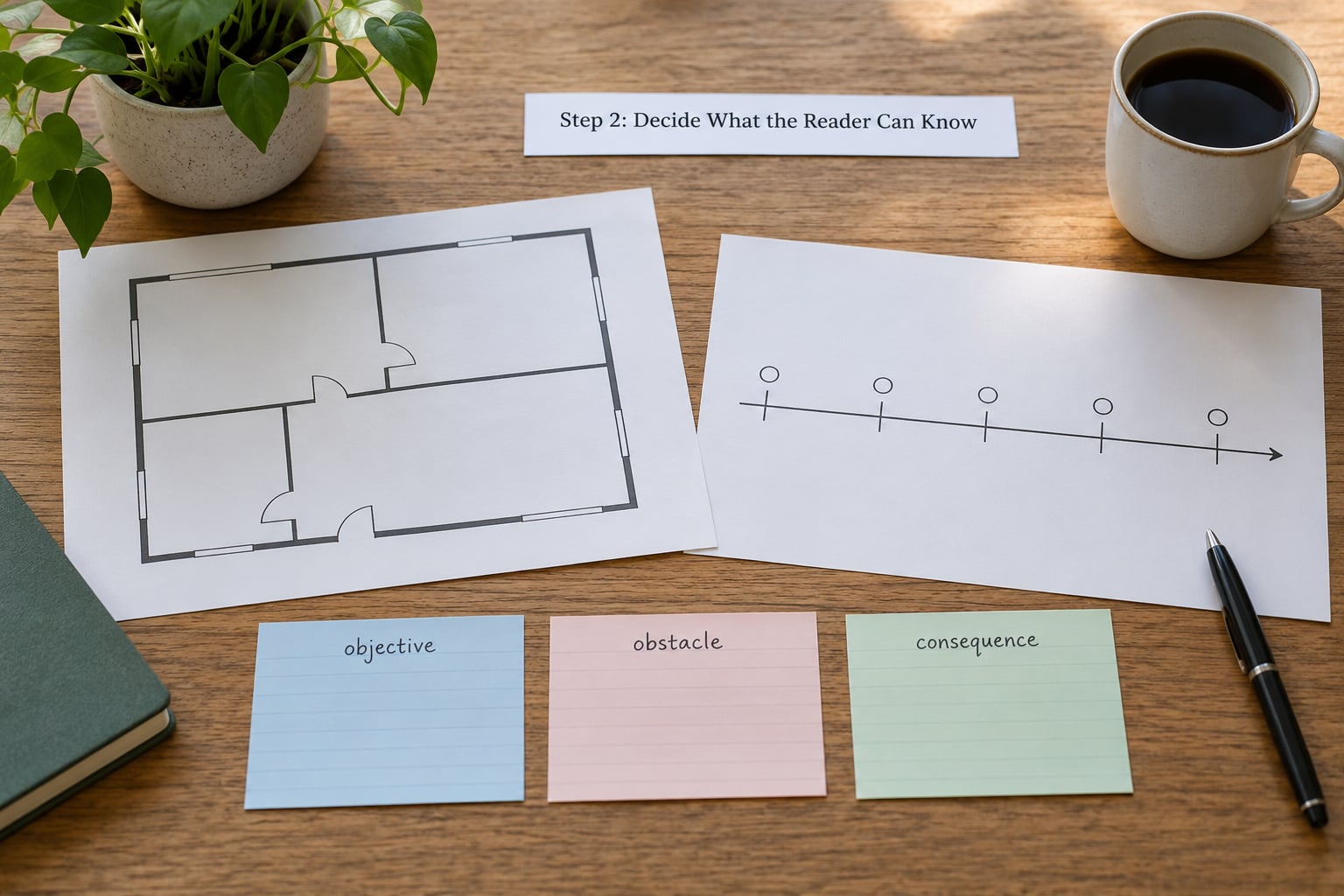
Choose one viewpoint and stay inside it. The single most useful thing you can decide before writing a word is whose eyes we are in, because that choice determines what you are allowed to describe.
There are three common positions. A close viewpoint inside the robber gives you intention and dread, and hides everything about the room that the character is not facing. A close viewpoint on the teller or a customer gives you fear, compliance and the awful ordinariness of the space, and hides the plan. A responding officer gives you consequence, distance and the aftermath of a decision you did not make.
For a first scene in a series, the teller is often the strongest of the three. Nobody suspects that person, so they can carry detail the reader would not get from the obvious angle, and the reader learns the bank through a working pair of eyes rather than a narrator’s tour.
Whichever you pick, make a small map on paper. Mark the viewpoint character, the exits they can see, the people they can see, and the one thing in the room they cannot see yet. That last mark is where your suspense lives.
Then list what the viewpoint character can observe, what they infer, what they remember from earlier, and what they get wrong. That fourth column matters most. A character who misreads a raised hand as a weapon when it is a phone creates tension that costs nothing and lands hard.
Step 3: Stage the Scene in Dramatic Beats
Break the scene into five beats and give each one a job: entrance, disruption, escalating pressure, decisive action, aftermath. Beats are not equal in length, and that inequality is the pacing.
Entrance establishes the viewpoint, the ordinary mood of the space and the time of day. Keep it short. It exists so that the disruption has something to break.
Disruption is the moment the mood changes. Someone says a sentence, or does not say one. The teller looks up and then looks down too quickly. Everything after this beat is measured against the calm of the entrance.
Escalating pressure is usually two or three turns, each one tightening the options. The first narrows what can happen, the second removes an option the character relied on, the third makes the cost of waiting higher than the cost of acting.
Decisive action is where the character chooses, and it should be the shortest beat on the page. A decision that takes four paragraphs to describe has already been made in the reader’s head.
Aftermath is one paragraph of consequence before the scene closes. What is broken, who is looking at whom, and what cannot be undone.
Write the beats as five single lines on one page before drafting. This is the fastest fix available for a scene that will not move, because you discover the missing beat while it still costs nothing to add.
Step 4: Build Pressure Through Choices
Tension is not loudness. It comes from a character who has fewer good options every thirty seconds, and from a reader who can see the shrinking set.
Use constrained options. Give the viewpoint character three courses of action and make one of them impossible for a reason that only exists in the scene, a customer who has already noticed, a device that has already been triggered, a promise made in chapter two.
Use unreliable perception next. The character reads a gesture wrong, hears a sound as something worse than it is, or fixes on the wrong detail while the important one passes. Keep it fair, though. The clues must have been on the page, or the reader will feel cheated rather than tense.
Use interrupted plans. A phone call, a cough in the queue, a colleague walking in mid-sentence. Interruptions are cheap to write and they force characters to respond rather than execute, which is what real people under pressure do.
A practical rule: at every beat, the character should be doing something other than what they planned, and doing it for a reason the reader can see. When you write how to write a bank robbery scene, this rule does more work than any amount of descriptive detail, because suspense lives in intention colliding with circumstance.
Keep the mechanics at the level the viewpoint character would actually notice. What the teller perceives is a room that has stopped being a queue and become a set of instructions. Anything the character cannot perceive should not be narrated at all.
Step 5: Reveal Character Under Stress
Stress reveals people by removing their usual options. Show it through habits, values, loyalties and fears, and let one small altered choice carry the whole reveal.
Habits surface first. The character who counts, straightens, apologises, checks a phone they are not holding. Under stress these are not tics, they are evidence, and readers read them instantly.
Values surface second. A character who keeps thinking about the person behind them in the queue is telling you what they are made of, without a line of interior monologue.
Loyalties surface third. A glance at the exit that is really a glance at somebody specific, an order given to someone else, a choice made to protect one person that endangers another.
Then choose one gesture and change it. The plan said the character would run, and instead they stop to pick up a dropped bag. The plan said they would not look back, and they do. One deviation from your own outline does more characterisation work than a page of description, because it shows a decision the character could not have made an hour ago.
For a victim viewpoint, the same principle applies in reverse. Terror shows in the small competent things, the teller who keeps counting, the customer who notices a missing shoe lace because counting is what she does.
Step 6: End With a Story-Changing Consequence
Finish on something the robbery caused, not on the robbery itself. The strongest endings answer a question the reader has been carrying, or open a worse one in the same breath.
Common moves that work: a motive becomes visible for the first time, a trust breaks in front of the reader, the viewpoint character’s account turns out to be unreliable, a pursuit starts that they cannot stop, or control of the next scene changes hands.
What to avoid is the reset. If the last line returns the story to exactly the state of the first line, with no new information and no damaged relationship, the scene was an obstacle rather than an event. Unless the reset is your joke, it reads as a wasted chapter.
End before the escape, not after, if the escape is not the point. Many writers feel obliged to write the getaway, and that obligation is where good scenes go to die. The getaway can live in a later scene, or in one line of aftermath that tells us everything.
Common Mistakes
Six failures account for most weak robbery scenes, and each has a short fix.
Flat action
The scene reports events instead of creating pressure. The fix is to cut every sentence that does not remove an option or change a relationship, and to check that each beat makes the next one harder.
Too much procedural detail
The draft becomes a set of techniques. That is where readers disengage, and it is also where the draft turns into something you do not want to publish. The fix is to keep mechanics at the level of what the viewpoint character perceives, and to trust implication over description.
Passive viewpoint characters
The narrator watches everything and chooses nothing, which drains a scene of its engine. The fix is to give your viewpoint character one decision that is genuinely theirs, and to make the scene turn on it.
Sudden tonal shifts
Four pages of grim procedural detail followed by a joke that belongs in the next chapter feels like a seam. The fix is to write the whole scene in one register, decide that register before drafting, and save tonal shifts for the break between scenes.
Unexplained competence
Characters handle an armed robbery as if they had trained for it, which readers experience as author convenience. The fix is to show one moment where competence fails or surprises the character, which makes their calm believable instead of suspicious.
An ending that resets the story
The robbery resolves cleanly and the plot resumes where it left off. The fix is to write the consequence line first, before you draft the scene, and to make sure somebody now knows something, owes something or has lost something.
A three-line self-check before you call a scene done. What does the viewpoint character want, and what do they choose? Which option is taken away, and when? What is different on the last page that was not true on the first?
Frequently Asked Questions
How long should a bank robbery scene be in a short story?
Most short stories run between 800 and 2,000 words for the robbery itself, and that range is a floor for tension rather than a target. The giveaway of a wrong length is not word count but uniformity: when every beat takes the same space, the scene drags. Give the entrance a short paragraph, the decisive moment a line or two, and spend the extra words on the aftermath, where the cost of what happened finally lands.
Should a bank robbery be written in first person or third person?
Either works, and the choice comes down to what you want the reader to feel. First person inside the robber gives you intention, dread and blind spots, but you lose the room. Third person past tense on a teller or customer gives you fear and the ordinary texture of the space, which many writers find easier to sustain. Whatever you choose, stay in one head for the whole scene and do not drift for a single paragraph.
How much detail should a crime scene include to feel realistic?
Include what your viewpoint character would notice, and nothing they could not. A teller can register the temperature of the room, the sound of a drawer, the way a stranger’s hands are held. She cannot know what is behind the counter or what a device on the wall does. Detail that stays inside one perspective reads as observation, while detail that arrives without a source reads as an author briefing the reader, and that is where scenes turn instructional.
What is the most suspenseful way to end a bank robbery scene?
End on a consequence that arrives one beat after the reader expects resolution. The money is counted, and then someone says a name that changes who they are. The doors open, and then the viewpoint character notices who was standing behind them. Suspense lives in the delay, so give the reader the outcome they wanted and then take one piece away in the last paragraph.
How do you write a convincing getaway without giving away robbery tactics?
Write the escape as experience, not instruction. Show what the character notices under stress, the street that looks wrong, the vehicle that will not start, the hands that will not work properly, and show the consequences of their choices. Avoid anything a reader could follow as a method: sequencing, timing, equipment and specific procedural steps. Suspense in an escape comes from uncertainty and cost, which is exactly what a technical description removes.
Start on a single page. Write the objective, the viewpoint, the five beats and the consequence line, then draft the prose, because how to write a bank robbery scene gets far easier once the decisions are made in order rather than discovered in the middle of a paragraph.