
The short answer is that glorification in fiction is a framing problem, not a vocabulary problem. You can write a drug trade plot without glorifying it by choosing a point of view that cannot admire the trade, putting the cost of every decision inside the same scene that shows the gain, and stripping out the language and imagery that sell the money as an escape. Depiction is not glorification. A book that shows a character shooting up and never tells you what it cost is endorsing something, even if the author personally disapproves.
That matters for practical reasons, not just moral ones. Readers who have lived near the trade spot a sanitised version instantly, and so do agents reading your query letter. The good news is that the fix is craft, and craft is learnable.
This guide walks through the whole process in eight steps, from the protagonist’s motive to the final page, plus the mistakes that trip up most drafts and a checklist you can run against your own manuscript.
Table of Contents
- What You Need
- A research method that does not require risk
- An ethical frame you can write in one sentence
- A protagonist with pressure, not ambition
- Structure that pays the cost
- Step-by-Step: How to Write a Drug Trade Plot Without Glorifying It
- 1. Define the protagonist’s pressure and motive
- 2. Build the trade around systems and incentives
- 3. Show consequences close to the story
- 4. Make the criminal world morally unstable
- 5. Avoid glamorizing language and visual treatment
- 6. Escalate through choices rather than spectacle
- 7. Give the harmed characters a point of view
- 8. End with consequences and unresolved damage
- Common Mistakes
- Frequently Asked Questions
- How can I show a character involved in the drug trade without making them seem heroic?
- What details make a drug trade plot seem glamorizing even when violence is present?
- How much research is necessary to write about the drug trade responsibly?
- Should a crime novel include information about how illegal drugs are produced or distributed?
- How can I write an antagonist connected to the drug trade without turning them into a stereotype?
- How do I end a drug trade story when the money has already been made?
What You Need

You do not need lived experience, and hunting for it will make the research worse rather than better. What you need is a research method, a moral frame you can state in one sentence, a protagonist under real pressure, and a plot structure that treats harm as structural instead of incidental.
A research method that does not require risk
Start with sources who talk about the trade rather than people inside it. Court records, indictments and sentencing transcripts are public and unusually rich: they give you real names for roles like runner, distributor and organiser, real language for how transactions get described, and real consequences spelled out in months of prison. Local newspaper coverage of drug court proceedings does the same job in more readable prose.
Add two categories of human source. One is people who have left the trade or who work with people caught up in it, such as harm reduction workers, who will talk about what the last year actually looks like from the inside. The other is people who live in the neighbourhoods affected by it and have nothing to do with it, which gives you the ambient texture that courtroom language never supplies.
One r/writers thread is titled roughly “resources for writers trying to write realistic drug use,” and the poster says they cannot find anything at all. That gap is real and the answer is mostly free: public dockets, nonprofit annual reports, published memoir, and long-form journalism that has already done the reporting so you do not have to.
An ethical frame you can write in one sentence
Write the sentence before you write the scene. Mine would be something like: this book shows why the trade is attractive to people with no other option, and it refuses to pretend that option is a choice. Yours will differ, but if you cannot write it, your book will argue for whatever your unconscious thinks the trade is worth, and that is usually where glorification creeps in.
A protagonist with pressure, not ambition
The most common failure is a protagonist who enters the trade because the money is appealing. Replace the pull of luxury with a push from below: an overdue bill, a family member in crisis, an illness in the household, a debt to someone worse than you, or an addiction they did not choose and cannot fund any other way. Wanting money is not a motive a reader forgives. Needing it is.
Structure that pays the cost
Have your plot architecture ready before drafting: an escalation curve, a point of no return, and a consequence set that lands in the reader’s last impression of the trade. If your three-act outline has no slot for damage, you will find yourself inventing a torture scene to stand in for one, and that is exactly the kind of spectacle readers are asked to consume rather than critique.
Step-by-Step: How to Write a Drug Trade Plot Without Glorifying It
1. Define the protagonist’s pressure and motive
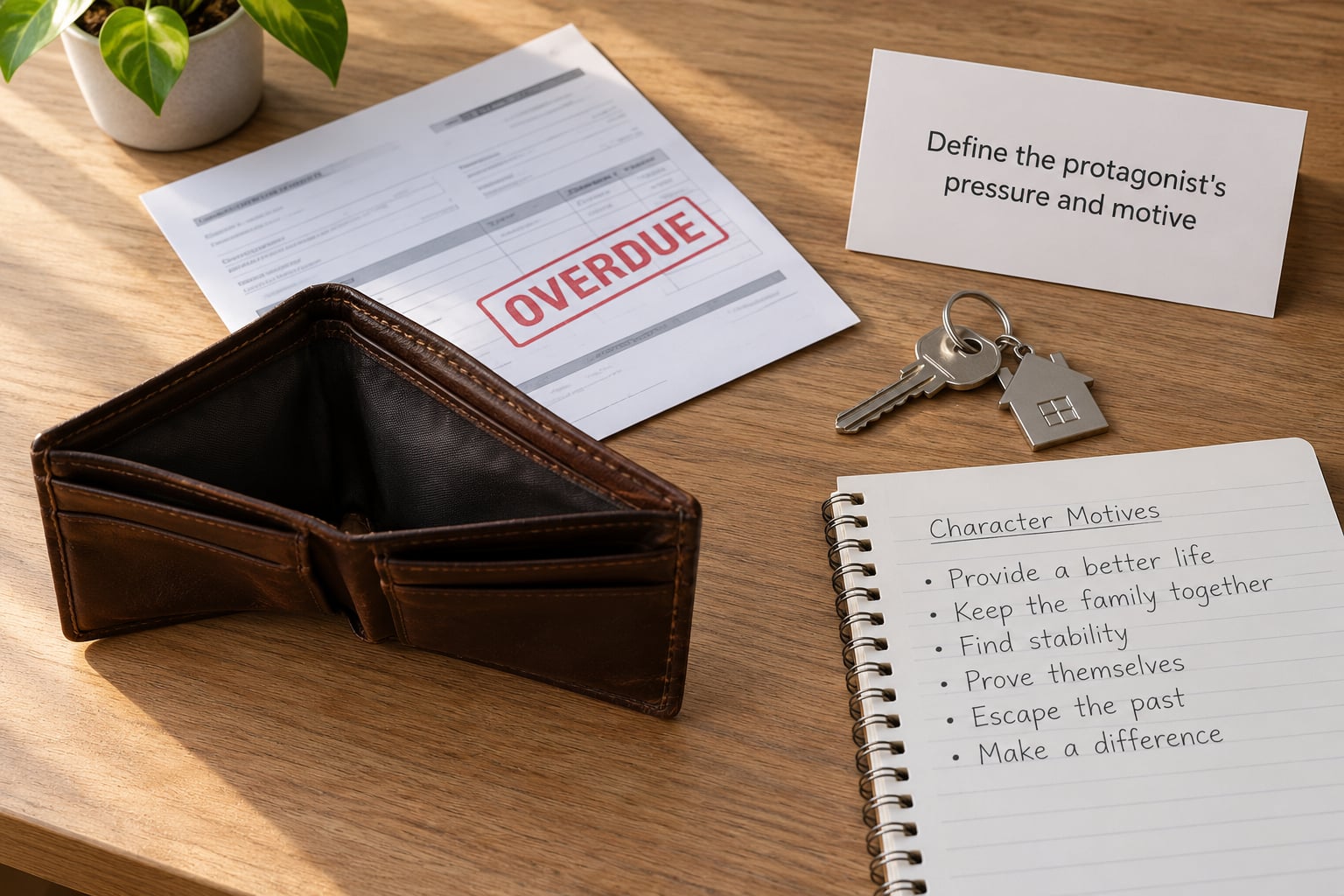
The motive should be something the reader recognises from their own life, scaled up. Rent that is three months late. A mother in hospital. A sibling’s bail. The specifics do more ethical work than any amount of narration telling the reader this is a bad situation, because the reader does the moral arithmetic themselves and arrives at the conclusion unaided.
Give the protagonist a life outside the trade before they enter it: a job they are bad at, a kid they argue with, a mother who visits unannounced and sees the fridge. The trade then reads as one decision inside a life rather than the whole identity of a character. That is also what stops the urban thug puppet, a phrase that comes up constantly in writing advice threads when someone describes a dealer who exists only to sell drugs and intimidate people. A puppet has no rent.
Write one paragraph explaining what the protagonist did not get to choose. Keep it in your notes, not in the prose. Its job is to keep you honest when the draft starts making them clever.
2. Build the trade around systems and incentives
Plots about drug rings get abandoned because they go boring, and the reason is that they are built around a sequence of events when they should be built around a set of pressures. Nobody in a trafficking story wants violence for its own sake. They want it because someone above them will not accept an excuse, and the violence is a cost of doing business that gets cheaper and more routine the deeper you go.
Write your cast as a table of competing pressures before you write a single scene. The interesting material is the gap between what each person wants and what the system will not let them have.
| Role | What they want | What it costs them |
|---|---|---|
| Runner or courier | Enough money to stop owing money | The one arrest that makes them replaceable |
| Street-level distributor | Standing, so nobody above can talk down to them | Every raise makes them a bigger target |
| Middle manager | A future that exists on paper | Living somewhere visible with a traceable life |
| Organiser | Money that outlasts the operation | Being the only person who can be charged with all of it |
| Investigator or prosecutor | A case that holds together | Building it on people she cannot protect |
| Parent, sibling or partner | Getting one person out | Choosing which losses to absorb first |
Note what this framing does for the reader. Nobody in the table is aspirational, and nobody is a monster either. They are people inside a machine that eats them at a predictable rate, and the tension comes from the machine being more reliable than any of their plans.
Keep the mechanics at the level of pressure and consequence rather than procedure. You can show what a transaction demands of a courier, what a seizure does to a distributor’s week, what a phone call at 4am means, and none of that requires explaining how anything is moved or made.
3. Show consequences close to the story
Distance is the enemy here. If a character deals for sixty pages and the harm turns up on page two hundred, the reader has already enjoyed the run. Put the consequence in the same scene or the one immediately after, before the reader has time to settle into admiration.
The most reliable technique is the controlled high. Write a short stretch where the character’s relief or euphoria is genuinely present, then let the bill arrive inside the same scene: the phone call that is not about business, the person waiting in the car, the money already spoken for. The reader gets the sensation and the price together, and neither cancels the other out.
A writer on r/writingadvice put the underlying problem plainly. To show a high you have to describe euphoria, and describing euphoria is precisely what makes it appealing. There is no technical trick that dissolves that. What resolves it is framing: the character’s own confusion about what the relief means, the flatness that follows it, the reader’s understanding that this is a debt being taken on rather than a win being banked.
Track your consequences in three registers and use all three. Physical, which is injury, illness, exhaustion and sleep deprivation. Relational, which is a partner who stops asking questions, a child who learns to lie, a friendship that cannot survive the schedule. Legal, which is the investigation, the sentence, the forfeiture, the family that now has an address associated with a case file.
4. Make the criminal world morally unstable
Nothing glamorises a milieu like making it a competent, loyal crew that functions like a healthy family. Break the trust. Make promises unreliable, make alliances conditional on the current risk level, and make the trade’s own rules punish the smallest deviation.
Useful mechanics: money that has already been promised to someone else, a drug that is cut without anyone’s knowledge, a buyer who cannot pay, a subordinate who was told to lie and remembers the lie. Each of these creates a person whose survival depends on the next decision, which is drama without spectacle.
Shame does work here too, but keep it specific. A character who is ashamed is a person with a self-image that has been contradicted by their behaviour. A character who is merely aware that what they do is unpleasant is going through motions, and readers feel the difference immediately.
5. Avoid glamorizing language and visual treatment
The seductive vocabulary of the trade is mostly the vocabulary of consumer branding. Money is clean and stacks fast, territory is something you hold, respect is something you earn, the life is a life you have made for yourself. These are all aspirations rather than descriptions, and every one of them is a sentence you can swap out.
| Glorifying signal | What it does to the reader | Replace it with |
|---|---|---|
| Dollars framed as a score | Makes wealth the reward | The specific bill that has to be paid this week |
| The outfit, the car, the phone | Turns the trade into a brand | One ordinary object with a history attached |
| Cool nicknames and street slang | Signals in-group respect | Plain, functional phrasing; let the character be specific without being charming |
| The effortless score | Rewards the trade immediately | Let the money arrive already committed to someone else |
| Addict, junkie, abuser, dependent | Reduces a person to a diagnosis | Person-first phrasing: someone with a heroin addiction, heavy use |
| Clean and dirty as moral categories | Suggests a clean verdict exists | Specific consequences rather than moral status |
The person-first convention comes out of journalism rather than fiction, but it earns its place in a novel for a craft reason. A label like addict removes everything else the character is, and what the reader then feels about them is closer to dismissal than to recognition. The AP Stylebook and National Press Foundation guidance push the same direction for reporters, and in fiction the equivalent is simply writing the person before the condition.
There is one legitimate exception worth knowing about, because getting it wrong is worse than getting it right. In-group self-identification is different from an outside label. If a character introduces himself with a term of his own choosing, in his own voice, that is characterisation rather than stigma, and it can carry real weight in the right hands.
6. Escalate through choices rather than spectacle
Escalation means the options get worse, not that the violence gets more graphic. Each step up should close a door: a debt to someone who cannot be repaid, a favour that cannot be refused, a piece of information the protagonist cannot un-know, a person who has now seen them do it.
A useful test for each escalation scene. Ask whether the protagonist chose to be there or whether they were maneuvered into it. If they chose, you have a plot. If they were maneuvered, you have a sequence, and readers will feel the difference as passivity.
On violence specifically, the rule that works is dosage. One scene that lands properly is worth five that need to be skipped. After the peak, the obligation to the reader is not a bigger event but the aftermath, which is where the cost lives.
7. Give the harmed characters a point of view
A trafficking plot with only dealers in it is structurally incapable of showing harm, because harm needs a witness. Give at least one character a full interior life who is on the receiving end: a user, a caregiver, a neighbour, a night-shift worker, a kid who has learned where the money is and what not to ask about.
This is also the fix for a trap that comes up often in craft threads. The advice to write drug use from an outsider’s point of view is sound until you notice that outsiders writing about users very often write them as strange and unstable, which is a different dehumanisation rather than a cure.
The solution is that the observer character has to be wrong sometimes. Let them misjudge someone’s motives, dismiss a warning, or assign a neat explanation to something they do not understand. A POV that gets its read on the trade consistently correct has stopped being a person and become a camera.
One commenter on r/writingadvice put the general principle better than any craft text: characters need to be relatable, not realistic, and depth is what usually gets you there regardless of the situation they are in. Apply that to your dealer and to the family of your user with the same generosity.
8. End with consequences and unresolved damage
The ending is where glorification gets its last chance to sneak in, because endings reward. Money in a duffel at the end of the book is a promise that the reader receives as a verdict. If the protagonist gets out clean, the story has told the reader that the trade was a bad investment rather than a system that destroys people, and that is a much more dangerous message than the one you meant to send.
Let the cost land in something permanent and unglamorous. A conviction that follows their family. A custody outcome they did not want. A business they built with the money that they no longer have the standing to touch. A neighbour who will not speak to them.
Some damage should simply not be resolved, because resolving it is the same trick in reverse. A character who gets sober and reconciles with everyone teaches readers that addiction is a plot obstacle with an exit, and readers who have been there know better.
The final choice is where the book states its own argument. Make it one the protagonist is responsible for, and make it cost them something they valued before the story started.
Common Mistakes
Protagonist worship. The character is clever, loyal, misunderstood and stylish, and the narrative voice keeps awarding them points for behaviour that hurts people. Fix it by cutting the narrator’s approval, not by adding a flaw. A witty drug dealer is still charming; a witty drug dealer whose jokes land at a funeral is not.
The thug puppet. Named in a r/writers thread almost exactly as you would expect: someone envisioning a stereotypical urban thug puppet rather than an actual human being, complete with drug nicknames. Fix it by writing what the character does when nobody is buying, what their rent is, and when they last spoke to their mother.
Unexplained rewards. The trade pays well and the plot treats that as a fact of nature. Fix it by showing where the money goes before it arrives, which makes the payment a transfer rather than a prize.
Voyeuristic violence. Scenes that linger on an injury in detail that serves no POV purpose. The test is whether you could cut the description without losing anything except the flinch. If so, cut it.
Operational detail. Writing about how something is produced, moved or concealed, in enough detail to be useful to someone planning the same thing. You can write difficulty, fear, logistics as pressure and consequence without writing method, and the story loses almost nothing.
Sanitization. The opposite mistake, and a real one. A book that treats every character who uses drugs as a monster with no interior life is not safer, only less true, and it reads as a lecture. The honest middle is specific about harm and generous about the person carrying it.
An ending that erases the harm. Ambush recovery with a montage. Fix it by keeping one cost unpaid and letting the protagonist’s last action take responsibility for something rather than escaping from it.
Cutting the drug scenes to be safe. The compromise most writers land on first, and forum writers correctly identify it as destroying the story rather than solving it. If removing every intoxicated scene leaves you with a thriller nobody needs, the scenes stay and the framing changes.
Frequently Asked Questions
How can I show a character involved in the drug trade without making them seem heroic?
Give them a motive the reader recognises and an interior life that extends past the trade, then stop the narrator from approving of them. Show the relief the character feels and the cost of it in the same scene. Keep the narration flat on their cleverest moments, and let someone else carry the evidence of what their work produces.
What details make a drug trade plot seem glamorizing even when violence is present?
Usually the consumption cues rather than the violence. Money framed as a score, a wardrobe, a car or a phone treated as trophies, nicknames used as a wink, and a score that arrives with nothing attached to it. Violence can sit in a chapter for pages and still leave the reader admiring the lifestyle, because the reward the book keeps returning to is the thing they end up wanting.
How much research is necessary to write about the drug trade responsibly?
Enough to get the pressure and the language right, which takes a few weeks rather than a few years. Court transcripts and sentencing documents give you real roles and real consequences. Harm reduction workers and people who have left the trade give you the interior. Interview two or three of them and reread your draft against what they told you.
Should a crime novel include information about how illegal drugs are produced or distributed?
Write what the process costs and how it changes a person, not how it is done. Method detail buys you very little and puts the book in a category you did not want to be in. Difficulty, fear, waiting and the aftermath carry the same plot weight at a fraction of the cost, and they are the parts your characters actually have to live with.
How can I write an antagonist connected to the drug trade without turning them into a stereotype?
Give them a specific want, a specific pressure and one habit that contradicts the image. Stereotypes are built from atmosphere, so remove the atmosphere: no menacing silence, no unexplained cruelty, no clothes doing the characterisation. Make them someone who is making calculations under constraints, and let the reader see the calculation go wrong.
How do I end a drug trade story when the money has already been made?
Do not let the money resolve anything. Show where it went, what it bought, and who is living with the results now. Leave one cost permanently unpaid, and have the final decision be something the protagonist chose rather than something that happened to them. If the last page reads as a reward, it will read as an endorsement.
The counter-argument is worth taking seriously, because writers raise it constantly and they are not wrong. Heavily sanitised fiction is bad fiction, and a book that treats every user as a monster tells readers with lived experience that their experience was never legible to anyone else. Sanitisation is its own artistic failure, and dodging drug scenes is dodging the story.
So the goal is not less drug writing. It is better framing. The same scene that shows a high can also show the debt, the same deal can be tense without being a trophy shot, the same dealer can be sympathetic without being aspirational. That is a craft problem, and craft problems are the ones worth solving.
If you take one thing from this guide, do this first: find the three moments in your draft where the reader feels the trade working, and put a cost next to each one. That single revision pass will teach you more about glorification than any amount of theory, because you will feel exactly where the story is asking for admiration it has not earned.
Everything else, the motive, the POV, the language, the ending, comes after that.