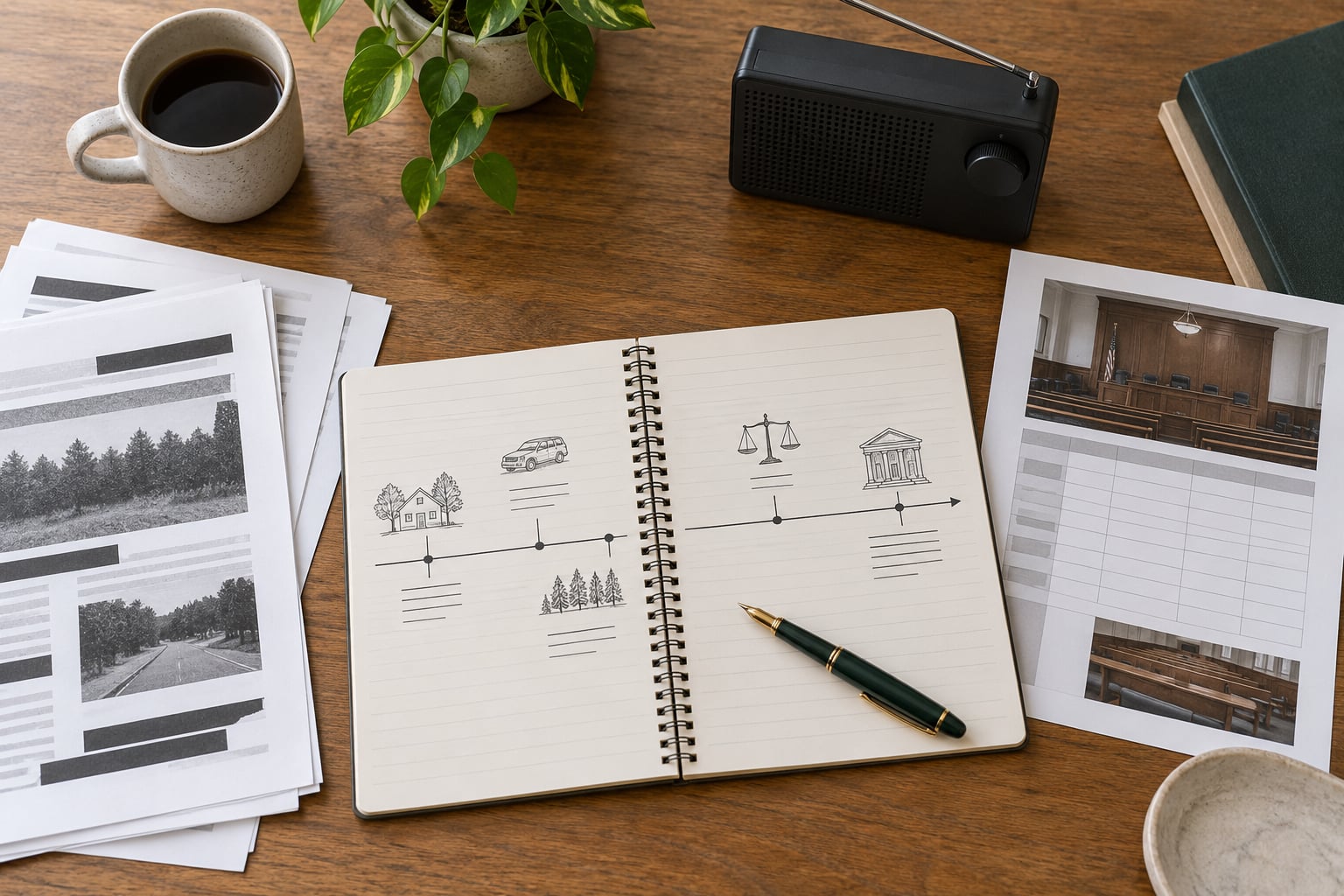
How to research police work without a badge comes down to two tracks you run in parallel: open-source research you do alone, using public records, agency policy manuals, court transcripts and reference books, and carefully cultivated contact with working or retired officers who will read your scenes and correct them. Neither track requires a uniform, a budget or an existing friend in the department.
The hard part is not finding information. It is knowing which information applies to the specific scene you are writing, and knowing what you do not know yet. A writer with a detective character and no idea how a police department is actually organised cannot identify the right questions, which is why open-ended research stalls so many manuscripts before the first draft.
So this is a process, not a book list. It takes you from a vague assignment to a verified chronology with a named human being you can email again. Most of it is free. Where it costs money, you will know exactly what the money buys.
Table of Contents
- What You Need
- Step-by-Step
- 1. Define the assignment’s police function
- 2. Build a reliable source ladder
- 3. Learn how to research police work without a badge
- 4. Interview people close to the work
- 5. Reconstruct one call or investigation chronologically
- 6. Test the scene against real constraints
- 7. Verify, anonymize, and document
- Common Mistakes
- Research Tips for Crime and Noir Writers
- Frequently Asked Questions
- Do I need law-enforcement experience to write realistic police work?
- Can I observe police work without being a police officer?
- How much police jargon should a writer use?
- Should I contact police about an active case in my novel?
- How do I verify a claim an officer told me?
- Conclusion
What You Need
Before you open a single browser tab, write down four things: the police role, the jurisdiction, the time period and the type of call. Every later decision depends on those four, and almost every piece of bad police fiction starts by skipping them.
The role. A uniformed patrol officer, a detective, a dispatcher, a crime scene technician, a K-9 handler and an internal affairs investigator have almost nothing in common day to day. A scene with a patrol officer at a domestic disturbance and a detective interviewing a suspect three hours later is a scene with two different procedures, two different sets of authority and two different documents to write.
The jurisdiction. A sheriff’s office in a rural county and a city police department in a large metro area do not work the same way, and state to state variation is real. The UK uses different ranks, different arrest terminology and a different route to interview. Australia and Canada have their own structures again. A writer who mixes a UK custody suite with a US arrest report produces a department that exists nowhere.
The period. Procedural detail has dates attached. Body-worn cameras, mobile data terminals in patrol cars, GPS tracking on vehicles, current de-escalation doctrine and in-car camera systems all arrived within a fairly recent window. Set your story in the wrong decade and a character will use technology their own agency did not have.
The call type. A warrantless search, a consent search, a custodial interrogation and a voluntary interview each have different legal thresholds and different paperwork. Decide which one your scene is before you decide what the officer says.
Then build the tools. A research notebook with no organisational system will lose you the thing an officer told you in the parking lot. Use four:
- A research notebook for anything a person told you, with the date, their role and their agency type. Add the exact phrase if they used one you did not know.
- A chronology for each scene: a single timeline with time stamps, moving from the call to the paperwork. This is the single most useful page in a police manuscript.
- A terminology log for words you have seen and are not certain about. Include where you found each one.
- A scene checklist of the details you keep meaning to check: who has authority here, what gets written down, who else is present.
Authoritative sources come first, then practical ones. Statutes and the state constitution set the legal boundaries. Court transcripts and opinions show what officers actually said under oath, which is a very different document from a press release. Agency reports, budgets and meeting minutes describe how a department spends its time and money. Policy manuals and general orders are often the most underused source a writer has, and they are frequently published online in full. Court websites, professional associations, training material, procedural books and interviews with people who do the work fill the rest.
Step-by-Step
1. Define the assignment’s police function
Decide what your character actually does before you decide what they say. Dispatch, patrol, detective work, forensics, internal affairs, corrections and specialty units are separate systems with separate rhythms, and a reader who works in one of them notices immediately when a character behaves like a character from another.
Four variables bound what an officer can do in any scene: their role, their authority, their shift and their location, plus the specific task assigned to them at that moment. An officer with probable cause may still be unable to enter a locked house without a warrant. A detective cannot lawfully take a statement at the scene of a live shooting because the person who owns that scene is a patrol supervisor and a crime scene technician, not a detective.
Write these four into the scene as constraints, not decoration. When a scene stalls, it is usually because you have not decided which constraint binds the character.
The useful output is a one-page character sheet: role, rank, authority on this specific call, shift pattern, and the two things they are not authorised to do today. If you cannot fill that in, you are not ready to write dialogue for them.
2. Build a reliable source ladder
Each source answers a different question, and each has a jurisdiction and a limit. Statutes tell you what is lawful. Transcripts tell you what was said. Policy manuals tell you what the department tells its officers to do, which is not always what officers do. News archives tell you how the public understood an event, which is a third thing again.
Read a source’s limit before you trust it. An incident report is written by the officer who attended, often under time pressure, and can be corrected later by a supervisor. A press release is written by someone whose job is framing. A training manual describes ideal practice, not shift reality. Keep that limit in your notes next to each source:
- Statutes and court opinions settle legal thresholds, definitions and the limits on an officer’s authority. They cannot settle what happened in your specific scene.
- Agency policy manuals and general orders give you official procedure, chain of command and the actual form names. They cannot tell you what officers do under pressure.
- Court transcripts and testimony show facts under oath and terminology in natural use. They say nothing about anything outside the case file.
- Public incident reports and news archives show what a typical call looks like in that city. They carry no guarantee of accuracy, and reporters paraphrase.
- Agency budgets and meeting minutes reveal unit structure, staffing, priorities and what they buy. They miss unwritten habits and culture.
- Procedural reference books give you structure, vocabulary and the shape of a department. Local variation and current practice are where they fall down.
- Interviews with practitioners supply texture, sequence and unwritten rules. They cannot speak beyond that person’s own experience.
Put the sources in order of authority and keep a note of which one you used for which fact. When two sources disagree, the disagreement is usually jurisdictional, and the fix is usually to pick a state and stay in it.
3. Learn how to research police work without a badge

Civilians can get closer to police work than most writers assume, though access is never guaranteed. Public safety agency meetings and budget hearings are open in most jurisdictions and are the most underrated source available to you, because officers speak plainly in public session and nobody is trying to brief you. Citizen police academies run in hundreds of agencies and usually cost nothing but time, sometimes with a modest fee and a background check. Some agencies offer civilian ride-alongs, and these typically need a waiver, advance scheduling and neutral clothing. Courtrooms are public in the United States, and a morning watching an arraignment or a preliminary hearing teaches custody procedure faster than any book.
Defensive and emergency-preparedness events are open to the public and worth attending. A K-9 demonstration, a bomb squad display or a forensics lab tour gives you the physical detail that reads as authentic: how the dog is cued, what a technician puts on first, how long a room stays closed. Medical examiner offices and crime laboratories often run public tours or open houses.
Paid programmes exist for writers who want structured immersion. The Writers’ Police Academy runs in-person training for writers at public safety training academies, and has added online courses. Patrick O’Donnell’s Cops and Writers project produces reference guides written for authors and screenwriters rather than for officers. Organizations such as Sisters in Crime and the resources at policewriters.org put writers near people who will answer a question.
Two rules keep this legitimate. Never obstruct, photograph or interfere with an operation, and never present yourself as anything other than a writer. If a scene interests you, ask the public information officer for a ride-along rather than parking where you can watch. And do not tail a specific unit hoping for something dramatic; that is exactly the behaviour that gets a civilian questioned.
4. Interview people close to the work
Start with the smallest ask that could work. A retired officer who reads your ten pages and sends two corrections is worth more than a chief who gives you a tour and disappears. The published account of Kate Flora’s arc is the template: one low-stakes local contact who became a mentor, then a second and third, and eventually a co-author on two nonfiction books. The relationship compounds, and it compounds because she gave something back every time.
Recruit across the chain, not just from the top. Uniformed officers, dispatchers, detectives, crime scene technicians, internal affairs investigators, prosecutors, defense attorneys, retired personnel and the civilians who deal with police daily all see different parts of the same process. Officers frequently do not know what dispatch does; dispatchers can tell you what the radio traffic actually sounds like; defense attorneys know which procedural shortcuts collapse under cross-examination.
Here is a message you can paste as-is. Keep it short, name your project honestly, and make the ask small.
Subject: Writer seeking a short police-procedure conversation
Hello, my name is [name] and I am researching a crime novel set in [city and state]. I am not looking for information about any active case, any confidential record or any private individual.
I am trying to get one thing right: the sequence of a [type of call] from the moment someone picks up the phone to the moment the report is filed. Would a 20-minute conversation with you or someone on your team be possible? I am happy to work around your schedule, and I will not record without asking first.
If anyone is not the right person, I would be grateful if you could point me to one who is. My novel is not published yet, but I will send you the finished book when it is.
Thank you for your time. [Name] [Email] [Your city]
Send it to the public information officer rather than to a personal address. Prepare neutral questions, because leading questions produce agreeable fiction. Ask what actually happens, in what order, how long it takes and what the paperwork is called. Do not ask whether a tactic is legal; ask what an officer is permitted to do in that moment and who decides.
Always ask permission before recording, and note the date and the person’s role. Test factual claims afterwards against a second source, and when two people disagree, write the disagreement into your notes rather than choosing the version that reads better. One person’s experience is not a department.
5. Reconstruct one call or investigation chronologically
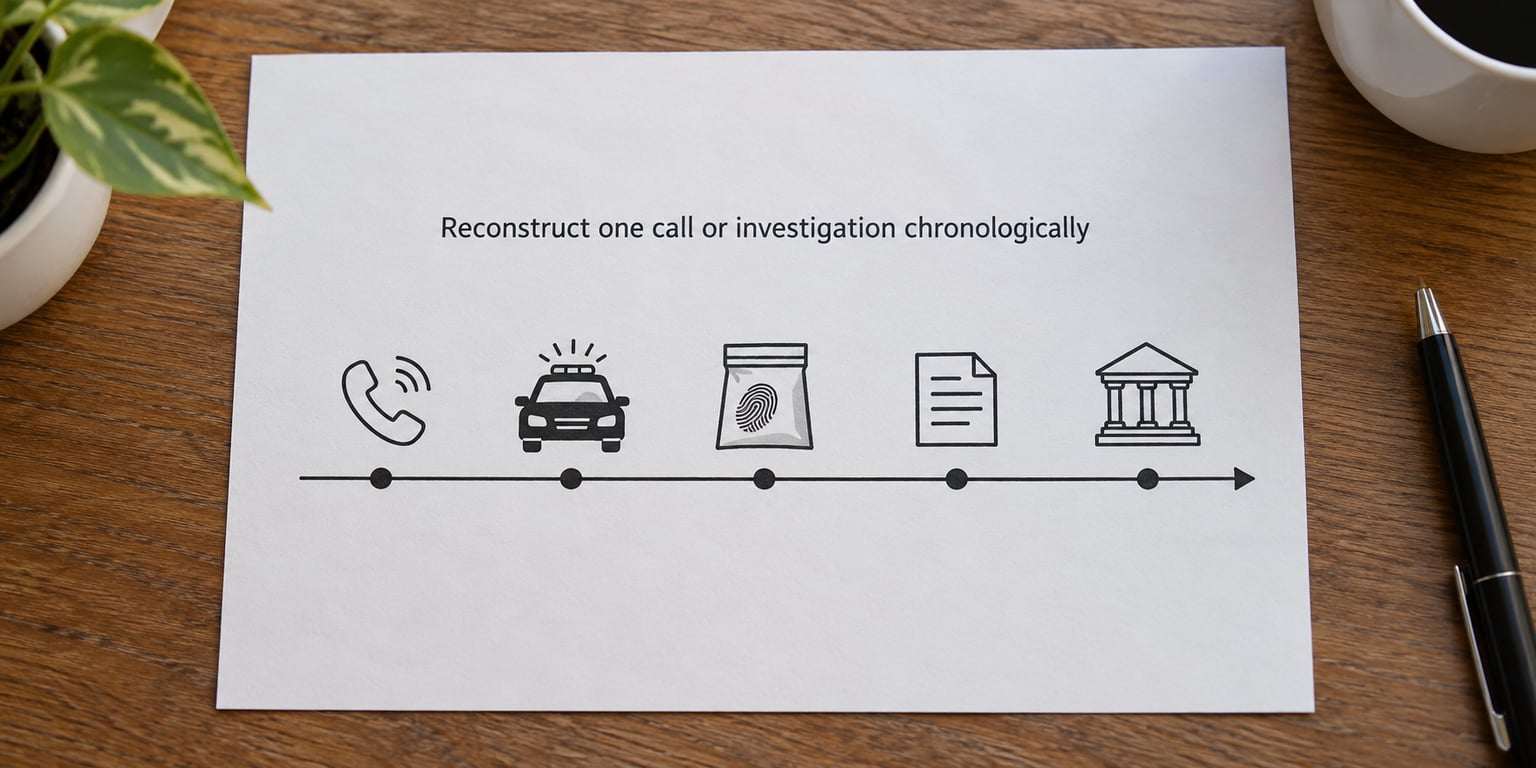
Pick one call type and walk it through in writing, minute by minute, from the first phone call to the signature on the last form. This single exercise exposes more errors than a week of reading, because a plausible scene usually fails on sequence rather than on detail.
A typical progression runs: a call is received and the caller is verified, the call is dispatched with a priority code, units respond, the scene is made safe and assessed, evidence is located and inventoried, witnesses are identified, an arrest is made if there is probable cause, the arrest report is written, a supervisor reviews it, the arrestee is transported to the custody suite for booking and a first appearance setting, and the case is presented to a prosecutor who decides what charge, if any, survives. Detectives are assigned after the initial response, not before it.
The gap between what a witness hears and what an officer observes is where good prose comes from. A witness hears a radio crackle, a door close and a voice say something they cannot make out, and later describes someone in a hurry. The radio log shows a priority response with a unit number, and the officer’s report shows twenty minutes of securing the scene before anyone searched anything. Your reader has heard the first version; your police character is acting on the second. Writing both without confusing them is what makes an interrogation scene hold up.
6. Test the scene against real constraints
Now check the finished scene against everything that limits a real officer: uniform and equipment, radios and whether the channel is working, the vehicle and its in-car computer, lighting, shift changeover, what the communications system can and cannot carry, what legal authority the officer actually has, the geography of the building, and what technology exists in the year you have set.
One verified detail is usually enough to expose an implausible scene. If you know that a department issues one patrol car per shift in the overnight hours of a small town, a scene with three cruisers arriving in ninety seconds fails on that fact alone, no matter how well it reads. Search for the same trick in reverse: a single accurate, boring detail in an otherwise ordinary scene makes readers accept everything around it.
Technical specificity cuts both ways. A paragraph on how a specific database query works is unlikely to survive first contact with a general reader, and retired officers spot lifted language within a page. Keep the mechanics to the two or three details that carry the scene, and give the rest to behaviour.
7. Verify, anonymize, and document
Apply a second-source rule to any fact that matters to the plot: the legal threshold, who has authority, what gets written down, how long something takes. If one person told you and no document confirms it, mark it in your notes as unconfirmed and treat it as invention rather than fact.
Resolve terminology and jurisdiction conflicts on paper. Write down that your story takes place in one named state and every procedure you describe follows that state. Where an interviewee used a local term, note the general term alongside it and pick one for the prose.
Anonymize living people and confidential material. Strip identifying details from any real case you have drawn on, change the outcome where needed, and keep notes on what you changed so you can check it later. Never quote an officer’s off-the-record comment. Never carry forward a detail from an active or sealed file.
Document as you go: a numbered source list, dates accessed, and a note of which scenes each source informed. Then run a final pass looking for invented authority, impossible access, privacy violations, mixed jurisdictions and any advice you took from unreliable fiction rather than a document.
Common Mistakes
Treating television as a universal authority. Fictional fix: for every television-derived assumption, mark whether it applies to a large city, a specific era or none of the above. Then replace at least half of them.
Mixing jurisdictions. A deputy from a county sheriff’s office does not work the same custody suite as a city officer, and a state trooper is different again. Fictional fix: choose one agency type and one state, and check that every procedural detail in the manuscript belongs to it.
Giving officers authority they do not have. The most common version is a character telling someone to come in for questioning as though it were an option. Fictional fix: learn the three states of a street encounter, voluntary, consensual and custodial, and write each one differently.
Forgetting dispatch and paperwork. Scenes jump from a call to an arrest with no verification, no dispatch and no report, and the officers never appear to have written anything down. Fictional fix: give the scene the documents it would generate, then let those documents drive the plot.
Overloading the dialogue with jargon. Fictional fix: keep a word only if the viewpoint character would hear it in that conversation. Explain nothing twice.
Interviewing only current officers. Current officers describe the current policy manual; retired personnel and civilians describe what actually happens. Fictional fix: get at least one perspective from each of current command, a line officer, a retired member and someone who has been arrested or has worked alongside police.
Exposing confidential information. Fictional fix: publish nothing that came from a sealed file, an ongoing investigation or an unrecorded conversation, and anonymize any real person who is not a public figure.
Treating a confident source as automatically correct. Officers are experts on their own work and unreliable on everyone else’s, including adjacent agencies. Fictional fix: two sources for consequential facts, and a note whenever they disagree.
One more deserves its own paragraph. An ex-30-year officer described the failure mode writers fear most as spotting a Googled scene within two pages. Research that produces generic, recognisable copy rather than lived texture has missed its purpose, because the point was never to collect facts. It was to collect the small true things nobody bothers to write down.
Research Tips for Crime and Noir Writers
When a source is reluctant, narrow the ask. People decline to review a whole manuscript and agree to nine questions about a single scene. Nobody wants to be studied, but plenty of officers will happily explain why a certain kind of scene is rare.
Record uncertainty openly in your notes. Writing “unconfirmed by a second source” beside a fact takes five seconds now and saves you from defending it later.
Keep the terminology log. It is dull, it is unglamorous, and it is the difference between dialogue that sounds like people and dialogue that sounds like a glossary.
Build tension from what fails. An officer who cannot get a warrant, a dispatch centre that cannot find an address, a supervisor who declines to authorise a stakeout, a detective who is told the case belongs to another unit: blocked and failed actions are procedurally accurate and dramatically stronger than a smooth success.
Consult defense attorneys and civilians. Defense counsel sees the same procedure from the other side of the table and can tell you what breaks under cross-examination. Civilians can tell you what a search feels like from the front seat.
Finally, hold the line between researched fact and deliberate invention. Decide which is which on purpose and keep a list. Fiction needs things that cannot happen exactly as they happened; it does not need things that could never happen at all.
Frequently Asked Questions
Do I need law-enforcement experience to write realistic police work?
No. Start with a narrowly defined role, jurisdiction and time period, then use public records, court materials, agency policy manuals, reputable procedural books and interviews with people who perform that work. What you need is not experience but structure: a clear picture of who does what, what gets written down and what the legal thresholds are. Most writers who read carefully and ask precise questions produce convincing police work.
Can I observe police work without being a police officer?
Sometimes. Agencies may offer approved civilian ride-alongs, citizen police academies, public meetings, defensive demonstrations and community events, but access is never guaranteed and may require a waiver, background check and advance scheduling. Courtrooms and public safety agency meetings are reliably open. Keep every request formal and routed through the public information officer, and never try to watch an operation uninvited.
How much police jargon should a writer use?
Only as much as the viewpoint character would realistically hear and understand. A detective may use informal shorthand a patrol officer does not, and neither uses laboratory or custody terminology with a civilian witness. Introduce a term once in a scene where context carries it, then use it freely. If your reader needs a glossary to follow the conversation, the jargon has outrun the character.
Should I contact police about an active case in my novel?
An agency is unlikely to discuss an active or private investigation, and pursuing confidential details creates ethical and legal problems. Research public filings, court records, released reports, published policies and completed cases instead. If you intend to fictionalise a real case, change identifying details and change the outcome where needed. Agencies that publish case summaries or media releases are the legitimate route.
How do I verify a claim an officer told me?
Match it against a document. An arrest report, a transcript, a policy manual, a statute or a court opinion will confirm or contradict what you were told, and where two people conflict you will usually find that one of them works in a different state or a different agency type. Note the date and the speaker each time, and flag anything a single source confirmed as unverified.
Conclusion
Researching police work without a badge is an escalation ladder. Start with the free authoritative material, build the structure of one department, and reconstruct one call in sequence. Then convert passive knowledge into human access with a formal request to a public information officer, a small first ask, and something given in return. Finish by sending your scenes back to whoever read them, because that is what turns a favour into an advisory relationship.
Do the first thing on Monday: pick one officer function and one call type, pull that jurisdiction’s policy manual and one court transcript, and write the chronology. Everything else gets easier once that page exists.