To write a femme fatale without stereotypes, you have to give her a goal that exists without any man in the room, a set of limits she refuses to cross, and choices that cost her something real. The archetype is not the problem. Lazy writing is the problem. This guide takes you from a two-line character sketch to a fully realized person in seven steps, with a scene-level test you can run in about twenty minutes.
The term came out of French cinema, where femme fatale literally means fatal woman. Early usages pointed at actresses like Louise Brooks and Theda Bara, but the phrase is older than film and mostly describes fiction: a woman who uses what other people assume about her as a tool.
Most drafts fail for one of three reasons. She has no motive of her own. Her power comes entirely from how men look at her. Or the plot treats her as a device that exists to hurt the protagonist and then disappears. None of those are the archetype. Those are shortcuts around it.
Below is the process I use, and it works in noir, thrillers, fantasy, science fiction, and straight literary fiction. Budget a few sessions spread across a week or two rather than trying to do it in one sitting. The hard part is not invention, it is subtraction.
Table of Contents
- What You Need
- Step-by-Step
- How to write a femme fatale without stereotypes in one scene
- Define her goal, methods, and limits
- Build contradictions that drive behavior
- Give her a narrative position beyond the male lead
- Write dialogue with subtext and power shifts
- Create consequences and independent relationships
- Audit the portrayal against common clichés
- Common Mistakes
- Frequently Asked Questions
- Do I have to write the femme fatale as a villain or murderer?
- How do I write a sexually compelling femme fatale without objectifying her?
- How can I avoid making every dangerous woman a femme fatale?
- What if my plot requires a femme-fatale character?
- How can I write dark noir fiction without relying on misogyny?
- Conclusion
What You Need
Six things, and most writers already have three of them. If you cannot answer each in a sentence, you are not ready to draft the character.
- A specific concept in one line. Not dangerous woman, but something with teeth: a probate lawyer who has quietly been buying up the deeds to every building her estranged sister owns.
- A goal that stands alone. What she wants when no one is watching her want it, and why she wants it in a year, not just tonight.
- A credible role in the conflict. How she gets access, information, or leverage. Charm is not access. Ask what she can do that the police, the protagonist, or her rivals cannot.
- Narrative context. The city, the era, the industry, the class she moves in. Much of what reads as stereotypical is a character refusing the constraints her actual setting imposes on her.
- An ethically distinct voice. A register for her dialogue that a reader could identify with the names covered up. Rhythm and vocabulary do more characterization than adjectives.
- An audit checklist. Ten yes or no questions, written before you draft, so the cliché check happens on the outline instead of after 80,000 words.
Step-by-Step
How to write a femme fatale without stereotypes in one scene
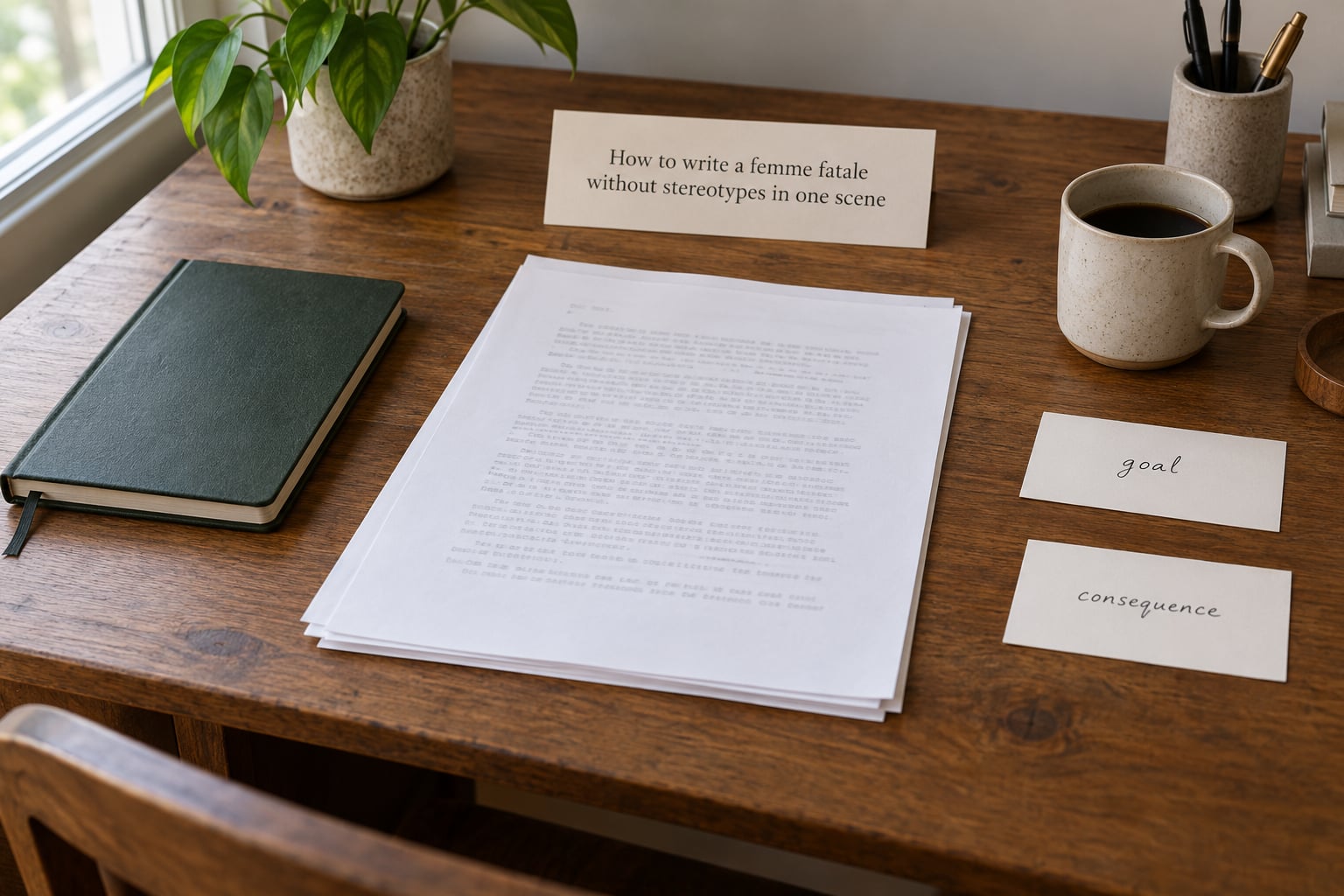
The fastest way to find out whether your character is a person is to write one scene where she makes a choice with consequences, and cut every sentence that describes her body or explains how other men feel about her.
Start in the middle of the decision. She is already holding the thing she wants, or about to do the irreversible thing. Show her reasoning in her own terms, then show the bill arriving.
Try this: instead of she glanced at him through her lashes and he felt his resolve weaken, write she signed the form at four on Friday, knowing the office would find the altered date on Monday, and she went home and made dinner for her mother anyway. That version has no seduction in it and tells you more about her in one line than a paragraph of description. The dinner is the cost. She pays it in a different currency than the one the plot charges.
When the scene works, you have a character. When it does not, you usually discover that her action was decorative, because nothing changes for anyone after she does it.
Define her goal, methods, and limits
Write down what she wants, how she gets it, and what she will not do, as three separate lists. Writers routinely blur these into one list of personality adjectives, which is why the character ends up with an attitude instead of a plan.
The goal has to survive an empty room. Ask: if you cut every male character from the draft, would she still be doing this? If the answer is no, her motive was access rather than desire, and access is a problem, not a person.
Her methods should be more than seduction. Give her three or four tools: institutional knowledge, a debt she is owed, a loyalty network, physical composure under pressure, a talent that other people keep underestimating. Then name her limits precisely. Limits create character faster than virtues, because a reader can predict what a careful person will refuse long before they can predict what a clever person will do.
One writer I know gave her character a hard line about harming children, then broke it in chapter nineteen for a reason the reader could argue with. The argument was the story. Nothing about the line itself was new.
Build contradictions that drive behavior
Complexity is not a pile of traits. Loyalty and secrecy are contradictions because they pull in opposite directions under pressure. So are caution and boldness, kindness and professional detachment, curiosity and self-preservation.
The test is simple: write the decision the contradiction forces, and see whether you like it. A character who is both loyal and secretive has to choose, in a specific scene, whether to warn someone or keep the advantage. That choice is the character. Drop one side and she becomes consistent, and consistent is boring.
Be suspicious of contradictions chosen for flavor. Playing the smoker and the health nut because it looks interesting produces a quirk. Loyalty that makes her betray a friend she loves produces an arc. One of those can be in any draft; the other carries a plot.
Give her a narrative position beyond the male lead
Ask four questions about her that have nothing to do with him. What does she know that nobody suspects she knows? What is she protecting, and who else pays if she fails? What frightens her, specifically? What will she be like in the last chapter, compared to the first?
Then check the mechanism of influence. She should be able to change the outcome of a scene from her own position in the story, not only by what the male lead thinks of her. Give her a relationship with the investigator that is professional and adversarial. Give her a source, a client, a debt. If every scene she appears in is one where she is reacting to him, she is a foil at best and a gadget at worst.
This is also where you solve a problem writers hit constantly: the complaint that she feels like a plot device rather than a person. Most often the cause is structural. She has no scene where the plot is not about her effect on him.
Write dialogue with subtext and power shifts

Dangerous characters talk well because they control what gets said, not because they say cruel things. Track the power in each exchange rather than the content.
Useful moves: answering a question with a question, giving a truthful answer that leaves the wrong inference standing, staying silent long enough that the other person fills the gap, naming the exact thing the other person is avoiding, and choosing a register that shifts mid-scene when she has decided something.
Manipulation should read as strategy with a purpose. The reader can sense the aim if the stakes are clear: she needs him in one room for eleven minutes, and she has two hours to do it. A scene where she manipulates without an objective reads as flirtation, and flirtation is what the stereotype already is.
Try rewriting one exchange so that she wins by telling the truth. If the scene improves, you have found a version of her power that is not sexual and probably will not date as well on the page.
Create consequences and independent relationships
Show what happens after. Not a moral verdict, not a punishment scene, but material results: a person who trusted her makes a different choice, a bill arrives, a friendship closes, an opportunity is gone.
Connect her to other people whose perception of her is not about men. A sister, an old colleague, a former client, a neighbor who knows her routine, a friend who has been lied to for years. Give at least two of those people a stake in what she does next, and let one of them disagree with her out loud.
Affection matters here as much as conflict. A woman who is read entirely through other characters’ desire has no interior life on the page. One scene where she is kind for no narrative advantage, at real cost, does more work than ten scenes of cool detachment.
Audit the portrayal against common clichés
Run the draft against ten yes or no questions. Any three yeses means you are still leaning on the shorthand.
- Is her power described mainly through male attention?
- Is her defining trait coldness rather than a specific decision?
- Does clothing or appearance carry characterisation the plot should carry?
- Is she defined mainly by harm done to other women?
- Is her morality described as corrupt in the abstract rather than shown?
- Does she always know everything and anticipate every move?
- Does the ending punish her specifically for her sexuality?
- Can you name her goal in a sentence, with no other character present?
- Does she lose something of her own choosing during the story?
- Would the plot break if she were removed from two scenes?
Fix the fails by replacing shorthand with a fact, a cost, or a specific line of dialogue. Questions eight through ten are the ones that catch a character who is technically well described but functionally still a prop.
Common Mistakes
Feminine equals villainous. The fix: separate her femininity from her ethics. She can be styled, soft-spoken, domestic, and still responsible for what she does. When cruelty is tied to how she performs gender rather than to her choices, the stereotype writes itself. Let her be warm with an enemy for strategic reasons, and let that read as calculation rather than as a woman being feminine.
She exists to deceive one man. The fix: give her at least one relationship she cannot get anything from. If every scene with her is a scene with him, cut the scenes where she has nothing to gain and see what breaks.
Complexity mistaken for unpredictability. The fix: her surprises should follow from her goal and her limits. A character who does random cruel things for atmosphere is not complex, she is just unaccountable. Write the reason for each odd choice, then decide whether the reader gets to see it.
He has motives, she has traits. This one shows up constantly in drafts. He wants to understand his mother, she is cold and calculating and beautiful. The fix: run both through the same worksheet. If she cannot state her want, her fear, and her reason in the same detail he can, the asymmetry is the problem, not her gender.
Social constraints written as personal villainy. If she operates outside the law because she is charming, ask what the law is protecting and who is protected by it. Give her a reason tied to the setting she actually lives in, and let some of her ruthlessness be a response to conditions rather than a personality defect.
Reward and punishment based on sexual morality. The fix: decide what the story is actually arguing, then check that her ending follows from her choices rather than from her sexual availability. She can be unforgivable, and the reasons should be the same ones you would use for any character in that position.
Three practices help more than theory. Read her scenes aloud and mark every line that a reader could have predicted from her category. Then try the same scene from another character’s point of view and see whether she changes shape or stays the same size. And get a reader who is not fond of her, with two questions: what did she want, and when did you learn it?
Frequently Asked Questions
Do I have to write the femme fatale as a villain or murderer?
No. The archetype describes how a character gets what she wants, not whether she deserves jail. She can be a con artist, a witness, a reluctant ally, or the protagonist of the book. What matters is that she pursues her own goal with methods that cost other people something. Villainy is a plot choice you can make later, once you know what she wants and what she is willing to sacrifice.
How do I write a sexually compelling femme fatale without objectifying her?
Put the appeal in competence and presence rather than appearance, and let other characters react to her while she does something purposeful. Show her reading a room, ending an argument, or wanting something she has not admitted to. A reader finds a character compelling when they can predict her decisions and still cannot predict what she will do next. Sexual charge grows out of self-possession and risk, not out of description.
How can I avoid making every dangerous woman a femme fatale?
Check where the danger comes from in each character. If it comes from her ability to make people want her, that is the archetype. If it comes from her position, access, training, ideology, or resources, you are writing someone else. You can also vary her role in the story: an antagonist who threatens, a protagonist doing the threatening, and an obstacle who simply stands in the way feel different even when all three are dangerous women.
What if my plot requires a femme-fatale character?
Keep the function and change the internals. Give her the same dramatic job she had in the outline, then rewrite her motive, her limits, and one relationship outside the male lead. The reader still gets a character who deceives and defies, but now she is doing it for a reason that belongs to her. Changing why she acts rarely breaks the plot, because plots usually depend on what she does rather than why.
How can I write dark noir fiction without relying on misogyny?
Move the darkness onto the world and the systems rather than onto women’s bodies. Noir works through corruption, institutional failure, poverty, and the cost of telling the truth, and none of those need a predatory woman at the centre. Let your femme fatale exploit a real double standard when one exists in your setting, and give her a scene in which she is on the receiving end of it. Cruelty stays in the story without settling on her as a category.
Conclusion
Write the choice, name the goal, draw the limits, let the contradictions force a decision, give her a position that holds without him, put subtext in her mouth, show what it costs, then audit the result. Seven steps, and the seventh catches what the other six miss.
Start tonight with one scene. Put her in a room, make her decide something she cannot take back, and show what she does in the hour after. If you can write that without describing how she looks or what a man feels about her, you have started the right way.