
To pace a thriller chapter by chapter, give every chapter one job: raise the cost, hand the reader one new piece of information, and end on a reason to keep going. Then audit each chapter against that job and rewrite or cut the ones that fail. It takes about a week for a full novel once you have the tools.
Pacing is not word count. It is the rate at which new information and pressure arrive in the reader’s head, and you control it at three levels: the sentence, the scene, and the chapter. Most writers only ever think about the first one, which is why their chapters read as a wall of well-written sentences that go nowhere.
The chapter is the level that matters most, because it is the unit a reader decides on. They commit to a chapter, not a scene. If a chapter arrives at its final page without changing what the reader believes about the situation, it reads as a stall no matter how sharp the prose was.
What follows is the method I use, broken into seven steps you can run on a finished draft in a single sitting.
Table of Contents
- What You Need to Pace a Thriller Chapter by Chapter
- Step-by-Step
- Define the chapter’s pressure and promise
- Map the chapter’s tension curve
- Give every scene a job
- Place reveals and reversals strategically
- Control scene length and transitions
- End with momentum, not automatic cliffhangers
- Read the chapter for pacing problems
- Common Mistakes
- Frequently Asked Questions
- How long should a thriller chapter be?
- Should every chapter end on a cliffhanger?
- How do I fix a slow middle in my thriller draft?
- How do I pace a quiet character scene without losing momentum?
- What order should I fix pacing in during revision?
- Conclusion: Make Every Chapter Change the Situation
What You Need to Pace a Thriller Chapter by Chapter
Four things. You do not need a software package, and you do not need a target word count per chapter.
- A chapter outline. One line per chapter: whose point of view it is, when it happens, and what changes. If you cannot write that line, the chapter has no job yet.
- A scene-purpose list. Every scene in the chapter named in order, with three or four words on why it exists. Exposure, pursuit, negotiation, aftermath, these are functions, not locations.
- A tension or reveal tracker. A simple column of numbers, one per scene, scored one to five. Some writers use a spreadsheet, some use index cards, some tape a strip of paper to the wall. The format does not matter.
- A draft. This method works on an outline but it only pays off on prose, because most pacing faults live at sentence level where you cannot see them from a chapter list.
One warning first. Forums like Kboards keep circling the same argument about how many words a chapter should be, and the consensus is that natural breaks matter more than hitting a number. Count if counting helps you. Stop if it becomes a way of avoiding the harder question, which is whether the chapter does anything.
Step-by-Step
Define the chapter’s pressure and promise
Before you touch the draft, write one sentence describing the chapter’s job. Most useful version includes four parts: the central question, the pressure on the protagonist, the emotional turn, and the change the chapter promises by its end.
Try: Will Mara get the child out of the city before the second checkpoint? She is exhausted and out of options. She goes from guilt to hard resolve. By the last page she has a plan and the cost of using it is clear.
If you cannot write that sentence, the chapter is not ready to be revised, and rewriting scenes will not fix it. If you can write it and the chapter does not deliver it, you have found your first fault before spending an evening inside the prose.
Map the chapter’s tension curve
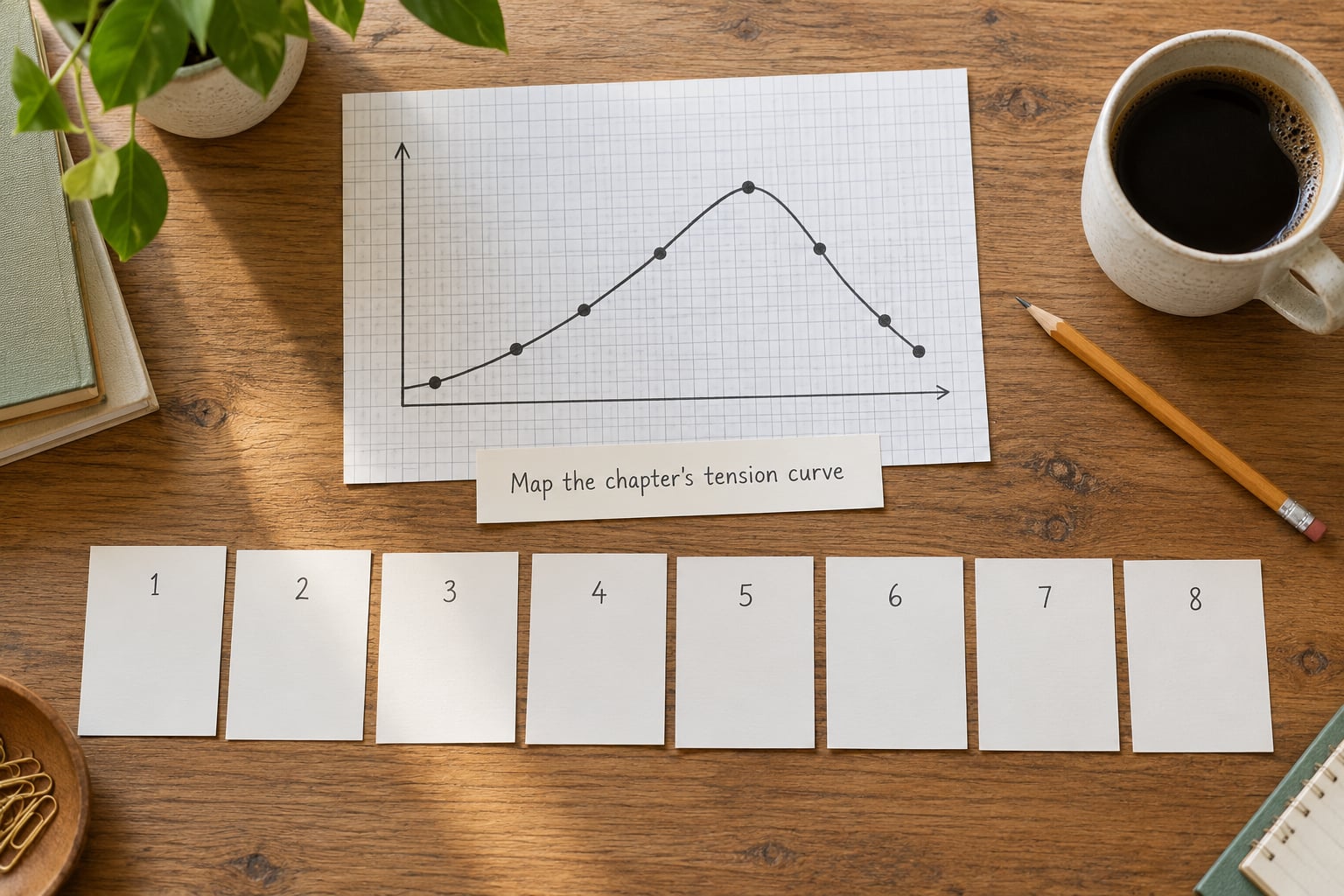
Score every scene in the chapter from one to five, where one is pure aftermath and five is the worst thing that could happen right now. Write the numbers in a row. You are looking for shape, not averages.
A thriller chapter that works usually looks something like this: it opens mid-pressure rather than at zero, rises, dips for a beat of strategy or breath, then climbs again into a complication that lands in the final pages. Two useful rules fall out of this.
First, never open a chapter at one. If the first scene is a character getting into a car, standing outside a door, or remembering something, the chapter starts on the back foot of its own curve. Second, three low scenes in a row is where readers stop caring. Barker Books put it as readers checking out after roughly three low-tension scenes, and in my experience the number holds well enough to use as a diagnostic.
A false release is useful here too. Let the pressure drop briefly because it looks like the danger has passed, then reintroduce it inside the same chapter. That dip reads as relief, and the second rise lands twice as hard because the reader lowered their guard.
Give every scene a job
A scene earns its place by doing one of five things: escalating danger, exposing motive, delivering information that changes the reader’s model of events, forcing a choice, or reversing the apparent situation. If you cannot name which, you have a candidate for cutting or merging.
The scene-sequel distinction helps here. Dwight Swain’s model separates scenes, where a character acts against resistance, from sequels, where a character reacts to what just happened and processes it. Thrillers lean heavily on scenes. A sequel in the middle of a chase is usually a stall, but a short one between two scenes is where the stakes land emotionally, and cutting it entirely leaves your protagonist strangely incurious about everything that just happened to them.
Two consecutive scenes with the same job are a merge waiting to happen. Two characters arguing in a kitchen and two characters arguing in a stairwell are one scene wearing a coat.
Place reveals and reversals strategically
A reveal is information the reader did not have. A reversal is information the reader had, newly interpreted. They need different spacing, and mixing them up is a common reason a twist lands flat.
Three placements work well. Introduce the discovery late in a scene so the chapter has something to carry forward. Withhold confirmation by letting the character notice something and then run out of room, so the question opens the next chapter instead of closing the current one. Or reinterpret earlier material by returning to a detail the reader already passed and changing its meaning, which is the strongest of the three because the payoff costs the reader nothing in setup.
The mistake to avoid is confirming a plant in the same scene you plant it. The reader has no time to feel clever. Leave at least a chapter of gap between the detail and the payoff, and keep a ledger so you know which plants are still outstanding when you reach the end.
With multiple viewpoints this gets sharper. Stagger what each character knows so that two chapters cannot deliver the same information twice, and so that a chapter carrying a reveal is followed by one from a viewpoint blind to it. The contrast does work for you.
Control scene length and transitions
Start each scene as late as you can and end it as soon as you can. Kurt Vonnegut’s advice to start as close to the end as possible is usually quoted as a joke and works exactly as written. The warm-up paragraphs where a character travels, dresses, or recalls the previous chapter are the most commonly cut material in any pacing pass.
Put the chapter break where the situation changes, not where the page fills up. If a scene ends and nothing has shifted, you have two choices: merge it into what follows, or move the break so it lands on the shift. A break on a change of location, a change of plan, or a piece of information arriving is a free acceleration.
For length, use these as bands by intensity rather than a single number. Nobody’s pacing survives a rigid target, but the bands are useful for spotting a chapter that has drifted.
| Chapter intensity | Typical range | What it should carry |
|---|---|---|
| High-intensity pursuit or action | 1,000 to 1,800 words | One continuous pressure, almost no room for reflection |
| Standard commercial thriller chapter | 2,000 to 3,000 words | Two or three scenes, ending on a turn |
| Building toward a major reveal | 3,000 to 4,000 words | A slower climb that earns a large payoff |
| Breather or aftermath | Under 1,500 words | Cost of what happened, then a hook into the next chapter |
Under 2,000 words reads fast and over 4,000 tends to read slow, mostly because a reader will put a physical book down rather than fight a long quiet stretch. If a chapter is pushing past 4,000, ask whether it is really two chapters wearing a shared heading.
End with momentum, not automatic cliffhangers
Advice to end every chapter on a cliffhanger is everywhere and it is only half right. Cliffhangers are one tool among five, and using the same one forty times turns a thriller into a treadmill where nothing registers as important.
The five endings worth rotating between are danger, decision, discovery, emotional cost, and unresolved question. Danger stops on the threat itself: the door opens and it is not who he expected. Decision stops on a choice with no good option. Discovery stops on information that rearranges the last chapter. Emotional cost stops on what the victory took. Unresolved question stops on the reader holding a gap they want filled.
The ending has to match the chapter’s rhythm too. A chapter built on rising action wants a hard stop. A chapter built on dread wants an unresolved question, because dread is slower than motion. Before you revise the final line, check which kind of chapter you actually wrote.
And test for the opposite problem. A draft that never slows down gives the reader nothing to measure against, so the danger stops registering. Two or three breather chapters across a novel is not padding, it is what makes the rest of it land.
Read the chapter for pacing problems
The final pass is diagnostic rather than creative. Read one chapter aloud at speed and flag six things.
- The opening paragraph, if nothing is happening yet.
- Any two consecutive beats making the same point.
- Any transition the reader has to work out on their own.
- Any reveal arriving after the point where it stops mattering.
- Any chapter that ends without a change of situation.
- Any stretch of explanation that could become a line of dialogue or a physical action.
Sentence-level fixes are the last thing you do, not the first. Long sentences are fine in a breather chapter and fatal in a fight scene, so tighten only where the tension curve says you should. Ninety-word sentences with stacked subordinate clauses are a symptom; the cause is usually a scene that should have ended three paragraphs earlier.
Common Mistakes
Front-loading backstory. The first chapter exists to prove the author is thorough, and by chapter two the reader has left. Fix: open with the inciting pressure already in motion and move the history into the first third of the book, where it lands as a contrast.
Counting words instead of measuring change. A 2,000-word chapter that ends exactly where it started is slower than a 3,500-word chapter that ends with the stakes doubled. Fix: score change instead of length, one line per chapter.
Every scene escalating. Constantly rising tension produces a flat line, because the reader cannot perceive an increase without a dip before it. Fix: build in real dips and real recoveries every few chapters.
Info dumps attached to new characters. The new ally arrives and gets a biography. Fix: split the information across chapters and let the character be interrupted.
Flashbacks mid-chase. A remembered childhood moment in the middle of a pursuit stops the clock the reader is tracking. Fix: move it to a quiet scene or cut it, and deliver the same information later under less pressure.
Different chapter lengths for no reason. Wild variation in chapter length reads as inconsistent effort. Fix: check that each chapter’s length follows from its intensity, and that short and long chapters alternate rather than clump.
Three habits help more than any single fix. Read chapters aloud, because the ear catches repetition the eye forgives. Track your tension scores across the whole novel in one sitting, because dead zones are invisible chapter by chapter and obvious in a row. And study two thrillers you admire and count how often something changes on a page, which is the single most useful question you can ask a comp title.
Frequently Asked Questions
How long should a thriller chapter be?
Most commercial thriller chapters run 2,000 to 3,000 words, with high-intensity pursuit chapters running shorter at 1,000 to 1,800. Length should follow intensity rather than a fixed target. A chapter under 2,000 words reads fast, and one over 4,000 tends to read slow enough that readers put the book down. If a chapter runs long, check whether it is two chapters sharing a heading.
Should every chapter end on a cliffhanger?
No. Cliffhangers are one of five useful chapter endings, alongside decisions, discoveries, emotional cost, and unresolved questions. Using the same stop every chapter makes the reader stop believing any of it, because the threat has been raised and defused forty times. Rotate endings, and match the type to the chapter’s rhythm: rising action takes a hard stop, dread takes an open question.
How do I fix a slow middle in my thriller draft?
Score every scene one to five for tension, then read the numbers in a row instead of re-reading the prose. Dead zones show up as three or more low scores in a row. Fix each one by cutting or merging scenes that do not change what the reader believes, moving backstory out of the middle, and adding a discovery or a forced choice at the midpoint of each weak cluster.
How do I pace a quiet character scene without losing momentum?
Give the quiet scene a job that is not plot. It can deliver the cost of what happened, reveal a motive the reader has misread, or hand over a detail that pays off much later. Then bound it: under 1,500 words, one emotional turn, and end on a hook into the next chapter. An unbounded quiet scene reads as filler even when the writing is excellent.
What order should I fix pacing in during revision?
Structure first, then scenes, then sentences. Confirm every chapter changes the situation before you touch a paragraph inside it, because rewriting prose in a chapter that needs restructuring wastes the work. Once the shape is right, cut scenes that have no job, merge adjacent scenes that share one, and only then adjust sentence length and paragraph breaks. Sentence-level tightening last is not optional.
Conclusion: Make Every Chapter Change the Situation
Chapter-by-chapter pacing is one question asked forty times: did anything change? If you score your tension, name each scene’s job, place your reveals with a gap, cut the warm-up, and rotate your endings, the chapter stops being a container you pour into and starts being a unit of pressure.
Here is the audit, ten checks: does every chapter change the reader’s understanding; does every scene have a nameable job; does the chapter open above one; are there no more than two low scenes in a row; is each new piece of information placed late rather than early; are plants and payoffs at least a chapter apart; does the chapter break land on a change; does the length follow the intensity; does the ending type vary; would you still read this chapter if nothing happened in the next one.
Start with the chapter you like least. Write its pressure and promise in one sentence, score its scenes from one to five, and see what the shape looks like. Most of the time the problem is visible in about four minutes.