
Short chapters keep readers up late because each chapter break hands them a finished beat and an open question at the same time. The length is a side effect of that structure, not the cause: what makes readers turn pages is a chapter that delivers one change and then stops while the next question is still unanswered. So learning how to write short chapters that keep readers up late is less about counting words and more about giving every chapter an urgent job, real pressure, and an ending that costs the reader something to set the book down.
Most drafts that read as slow are slow for a boring reason: nothing changes. A character walks into a room, talks, thinks, walks out. Cut that in half and it is still nothing. The fix is to make the chapter do one thing and then do the revision pass that finds where it stopped doing it.
Table of Contents
- What You Need
- Step-by-Step: How to Write Short Chapters That Keep Readers Up Late
- Step 1: Give the Chapter One Urgent Job
- Step 2: Put Pressure on the Character Now
- Step 3: Make Every Scene Change Something
- Step 4: Control the Information Gap
- Step 5: Build a Cause-and-Effect Chain
- Step 6: End on a Lift, Turn, or Cost
- Step 7: Test the Pull and Tighten
- Common Mistakes
- Frequently Asked Questions
- How short should a chapter be?
- How do I end a short chapter without using a cliffhanger?
- How many scenes should fit in one chapter?
- How can I make a quiet character-driven chapter more tense?
- Does every chapter need a major event or revelation?
- How do I keep atmospheric writing from slowing the pacing?
- Conclusion
What You Need
Five things make a short chapter work. If you cannot name all five for a chapter on your list, the chapter is not ready to draft.
One observable objective. Securing the evidence, escaping the tail, concealing the motive, extracting the confession. Something you could watch happen or fail.
Immediate pressure. The reason this has to happen now rather than tomorrow. A deadline, a second party, a cost that lands on somebody specific.
A sequence that escalates. Two or three discoveries or consequences, each one raising the cost of the next choice.
A change that carries into the next chapter. Information gained, power shifted, trust broken, danger raised, objective replaced.
A way to measure it. A short test you can run on the finished chapter without asking a friend whether it felt slow. The audit in Step 7 does that.
A word target is useful only after those five exist. Chasing a number without them produces the staccato chop described later, where every chapter is short and none of them goes anywhere.
Step-by-Step: How to Write Short Chapters That Keep Readers Up Late
Step 1: Give the Chapter One Urgent Job
Write one sentence in the margin before you draft: this chapter is the chapter where she gets the ledger out of the safe. Not a theme, not a mood, not a summary of a fight. A single observable job with a success state and a failure state.
The job has to alter the character’s choices by the end of the chapter. If she gets the ledger and then behaves exactly as she did before, the chapter was a delivery mechanism, not a story. Something downstream should now be possible that was not possible before, and something should now be closed off.
Test for focus by asking whether any paragraph could be lifted out and dropped without the job failing. In a 900-word chapter you should find one or two candidates at most. In a chapter where you find five, you are carrying two chapters and neither one is finished.
Step 2: Put Pressure on the Character Now
Pressure is what makes short form legible. Without it, brevity reads as thin because nothing is at stake. Four levers work almost every time: immediate stakes, narrowed options, a competing obligation, and time.
Here is the crime and noir version. A detective has a burner phone that will ring once. In it is evidence that will clear her client. In the same room is the man who sold her the client, who would be ruined by the same phone call. She cannot destroy the phone and protect the man, and she cannot keep it and protect the client. One chapter, one choice, no room to narrate her deliberation for six pages.

The diagnostic is simple: could this scene continue indefinitely without changing? If yes, there is no pressure yet. Add a clock, remove an option, or give the character someone who will be hurt by the delay, and the scene starts making decisions for itself.
Pressure also fixes exposition. The same ledger background that would stall an unpressured chapter becomes usable the moment the character has to decide whether to open it in front of the man who wrote it.
Step 3: Make Every Scene Change Something
Track one of five variables after each scene: information, power, trust, danger, objective. If none of them moved, the scene is not earning its place, no matter how good the prose is.
A flat exchange: two detectives in a car discussing what they already know about a body found Tuesday. The information is unchanged, the power is unchanged, the trust is unchanged. The scene is atmosphere with a conversation attached.
A revealing version: the junior detective mentions a detail nobody had connected, and the senior detective goes quiet because the detail points at someone inside the department. Information changed, power changed, and a loop opened. Same location, same two people, roughly the same length. One of these is a chapter and the other is a pause.
The change does not have to be physical. A character deciding to lie to someone they trust is a real change, and it is often the best one available in a quiet scene.
Step 4: Control the Information Gap
The gap between what the viewpoint character knows and what the reader knows is the engine of a short chapter. Write down three columns before drafting: what the character knows, what they suspect, and what they have got wrong. The reader gets access to the first and second, and a partial hold on the third.
Withholding works when the character cannot say the thing out loud, or does not yet know it. It fails when you are simply hiding information the viewpoint could freely mention, because the reader detects the author rearranging the furniture and stops trusting the narration.
Concrete partial evidence beats vague hints. A keycard with no label means less than a keycard logged into a building at a time the character was somewhere else. Give the reader enough to build a theory, then let them be wrong, then let the character’s next decision confirm or destroy it.
Step 5: Build a Cause-and-Effect Chain
Each action should cause a consequence, and each consequence should force the next decision. That chain is why a compact chapter accelerates instead of sagging: nothing in it exists independently of the beat before it.
She opens the safe. The safe is empty because someone beat her to it. Therefore she must lie to her partner about the time she was in the building. Therefore she has to call the man who sold her the client and find out whether he lied too. Four beats, roughly 800 words, and every sentence is pulling the next one along.
Where a chain stalls, you get a chapter that reports rather than moves. Look for paragraphs that explain a feeling the reader already has, or restate a conversation that already landed. Those are where the cut goes first. If the stalled passage contains a change, split the chapter there instead: a chapter that changes direction halfway can become two chapters, each with a clearer job.
Step 6: End on a Lift, Turn, or Cost
Three ending models do most of the work in short chapters, and only one of them is the loud cliffhanger most writers picture.
Reveal. Something true arrives and reframes what came before. The reader rereads the chapter instantly, which is a good use of their time and a strong reason to continue.
Decision. The character commits. No external threat required. A hand on a door handle, a name agreed to over the phone, a lie told to the wrong person.
Cost. The consequence lands and raises the danger. The job gets done and the bill arrives anyway.
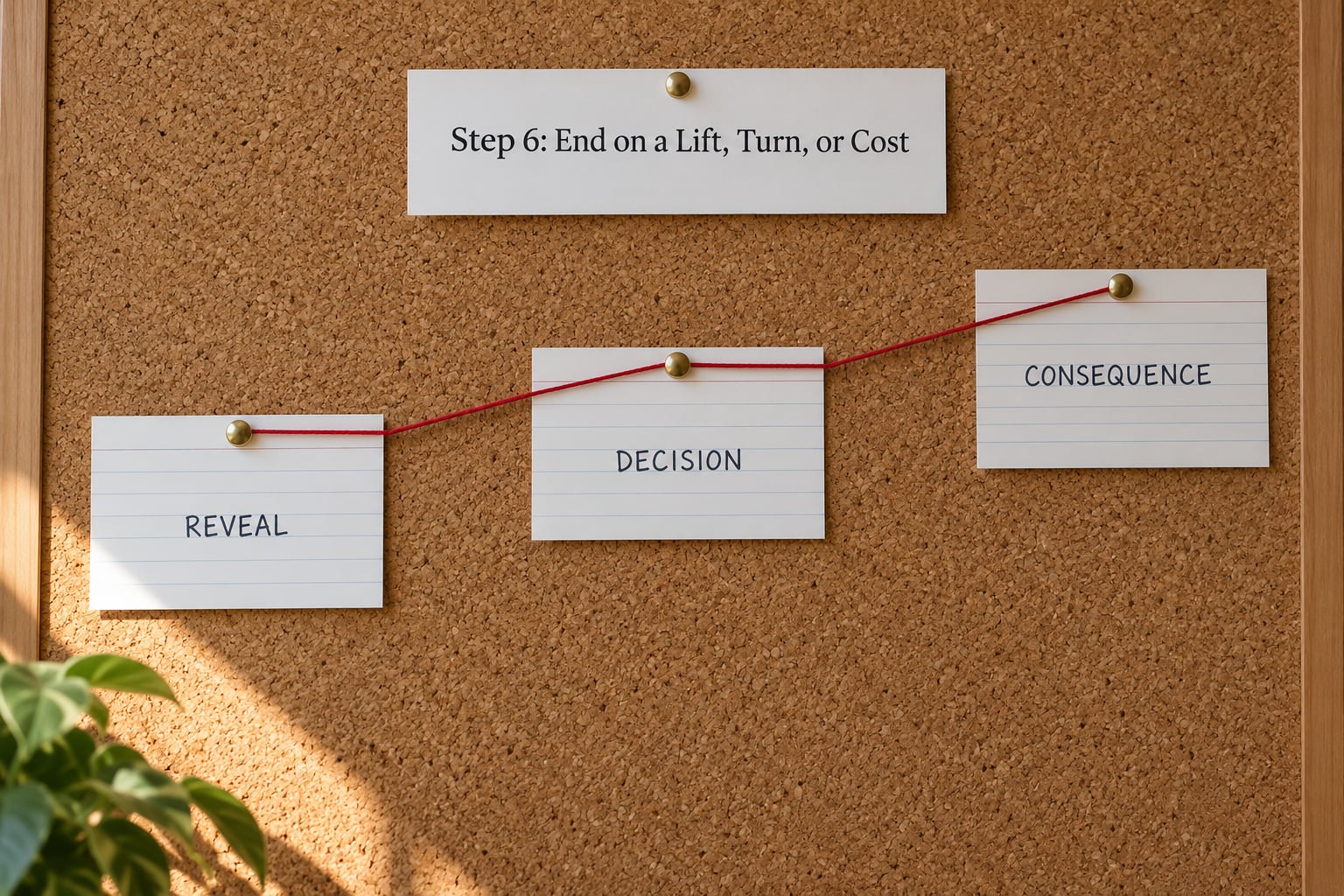
What all three share is redirection: attention moves from a settled thing to an unsettled one. Ending a chapter only to stop the clock is a gap, not a hook. Ending it so the reader must re-evaluate what they just read is a hook.
If you end every chapter at maximum alarm, the alarms flatten out and start reading as a house style rather than as danger. Mix the three models, and let the quietest ending on your list be the one that follows your loudest.
Step 7: Test the Pull and Tighten
Run six questions on each finished chapter. Objective, pressure, change, information gap, escalation, ending pull. If any answer is a shrug, that is the sentence you go fix.
Then revise for pace rather than for elegance. Cut repeated beats, especially emotional information you have already delivered once in behaviour. Sharp transitions so the chapter does not restart the reader’s attention at every scene turn. Trim the opening paragraphs where the scene gets oriented, and trim the closing ones that settle a feeling the ending has already earned. A commenter in a writing forum put it simply: get in faster and leave before a sense of completion.
For an existing draft with 3,000-word chapters, work at the chapter level first. Find the change point, which is the moment the scene’s direction reverses, and split there. Then do the same again on the resulting halves. Most bloated chapters are two finished chapters that grew into each other.
Finally, read the chapter break alone. Read only the last paragraph of one chapter and the first of the next. If that seam does not create a question or a jolt, the break is decorative and you should move it.
Common Mistakes
Short chapters that are just unfinished scenes. The fix is the change test in Step 3. Length is a symptom, not the disease.
Opening with exposition. In late, out early: start where something is happening and let the context arrive through pressure and reaction.
The same cliff point every chapter. Predictable in two chapters, dead by ten. Rotate reveal, decision and cost, and vary your chapter lengths so the rhythm is not staccato all the way through.
Repeating emotional information. Once the reader has felt it through an action, another paragraph explaining it costs words and buys nothing.
Delaying all payoff. A short chapter should still deliver one completed beat. Hooks stacked with nothing settled underneath them feel like being strung along.
Stranding the reader. Writers call it the wicker basket: hook hard, then switch scenes and leave the answer several chapters away. One reader described it as playing with them. Pay off a hook within a chapter or two.
Forcing a mystery through concealment. If the viewpoint character could plainly say the thing and does not, the gap is artificial.
Short chapters also cost you texture. When you cut a chapter from 2,500 words to 900, keep the sensory detail that is doing work and cut the description that is only decorating. One concrete detail under pressure beats five under no pressure, and it keeps voice and atmosphere without spending momentum on them.
Frequently Asked Questions
How short should a chapter be?
For crime, noir and thriller, 500 to 1,200 words works well, with a ceiling around 1,500. In literary or suspense fiction you can run 1,500 to 3,000 without losing the effect, as long as the chapter still turns once. A 1,200-word chapter is not too short, and neither is 800. What matters is that each chapter completes one beat and opens one question. Length targets only matter once the chapter has a job.
How do I end a short chapter without using a cliffhanger?
Use a decision or a cost instead of a reveal. End on the character committing to something irreversible, or on a consequence landing that raises what they are up against. A short chapter that ends on a quiet choice still gives the reader a reason to continue, because now they want to see what the choice costs. The test is whether attention moves to an unsettled question, not whether anything explodes.
How many scenes should fit in one chapter?
One scene, or two tightly joined ones. Two scenes only work if the second flips the value of the first, so a reader cannot remove the second without losing a change. Anything more than that usually belongs in separate chapters. If you find yourself adding a third scene to reach a word count, the word count is the problem, not the scene count.
How can I make a quiet character-driven chapter more tense?
Narrow the options rather than raising the volume. Give the character a competing obligation, shorten the deadline, or put the person they care about inside the decision. Tension in a quiet scene comes from cost, not volume. A character deciding whether to tell the truth they already knows is more gripping than a loud argument, because the outcome is genuinely in doubt.
Does every chapter need a major event or revelation?
No. Alternating intensity reads better than sustaining it. What every chapter needs is a change in information, power, trust, danger or objective, and a reason to turn the page. A chapter can deliver a small change, such as a character deciding not to call, as long as that decision closes off an option and opens a problem. A chapter with no change, major or minor, is the one that stalls a draft.
How do I keep atmospheric writing from slowing the pacing?
Attach the detail to pressure. Rain on a window is neutral; rain on a window while a car idles behind her is tension, because the detail now reports danger. Keep one or two concrete details per beat and cut the rest. At the polish stage, trim the paragraphs that orient the reader at the start of a chapter and the ones that settle a feeling at the end, which is where atmosphere usually collects.
Conclusion
Open your draft and take the next chapter. Give it one urgent objective, one change that carries forward, and one ending that creates a specific reason to keep reading. Then run the six-question audit and cut what does not serve any of the three. Most stalled chapters get shorter the moment someone decides what the chapter is for, and that is how learning how to write short chapters that keep readers up late becomes a habit rather than a trick.
Editors see the same pattern in every manuscript that drags: chapters that are short but inert. Length was never the disease.