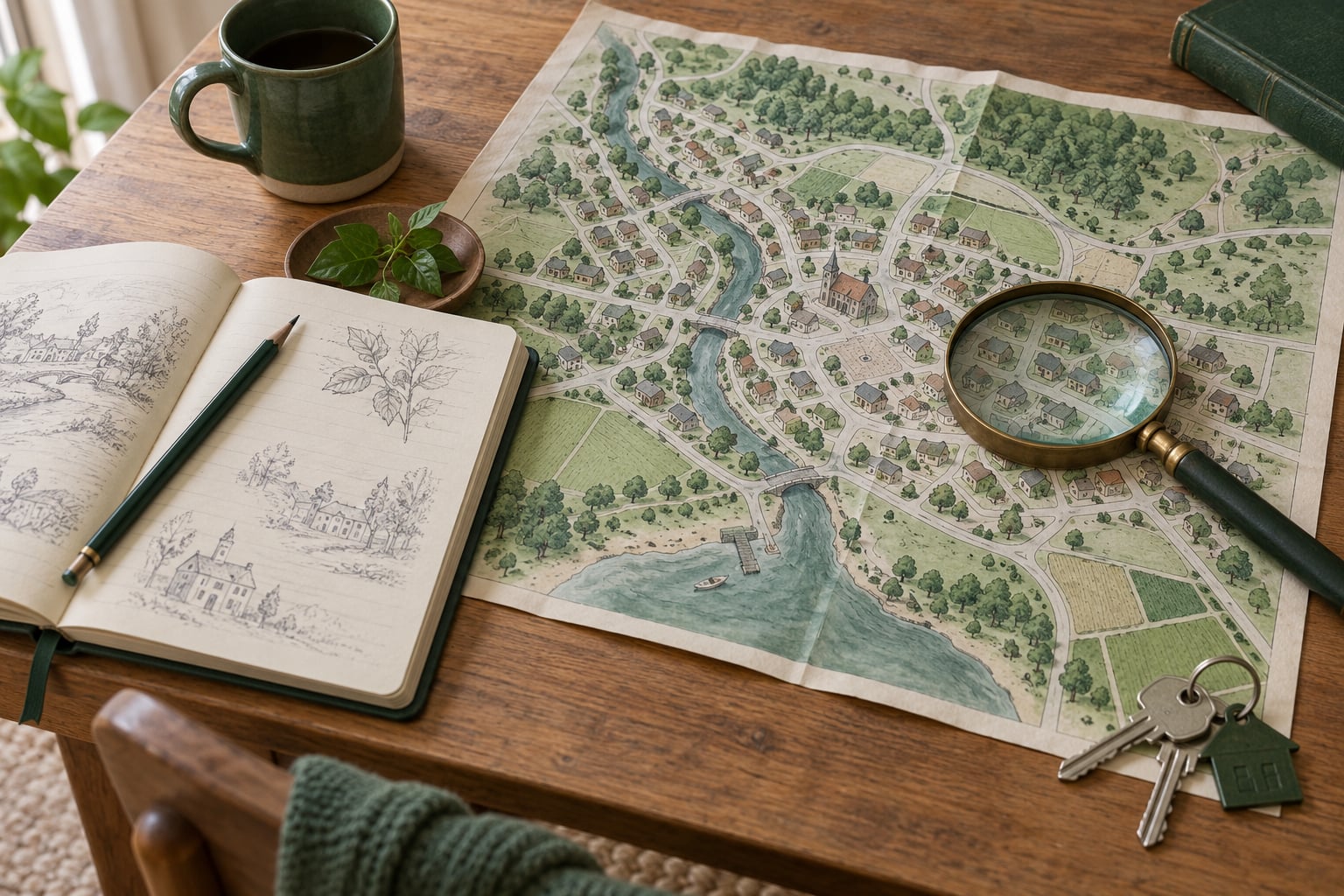
Getting the structure right is what matters most when you work out how to write a small town murder mystery, because the suspect pool is closed: nobody new walks into town, so every character you introduce is a candidate. The craft is in making that town specific enough that its residents feel like people rather than props, then hiding the solution in plain sight where a careful reader can find it. Here is the process, from premise to final page.
Most first drafts go wrong in the same place. The writer knows who killed whom, then stops knowing what the detective does next, and the middle turns into a series of interviews that change nothing. Fix that early, and the rest is manageable.
Table of Contents
- What You Need
- How to Write a Small Town Murder Mystery, Step by Step
- Step 1: Choose a Specific Small Town, Not a Postcard
- Step 2: Build the Murder Around a Motive the Town Already Tolerates
- Step 3: Create a Cast of 4 to 7 Believable Suspects
- Step 4: Map the Timeline and Locations
- Step 5: Plant Fair Clues So Readers Can Solve It Themselves
- Step 6: Choose a Detective or Narrator
- Step 7: Write the Investigation With Rising Pressure
- Step 8: Resolve the Mystery Without a Perfect Ending
- If You Plan a Series
- Common Mistakes to Avoid in Small Town Mysteries
- Frequently Asked Questions
- How many suspects should a small town murder mystery have?
- How do I make a small town feel believable without using stereotypes?
- Should all clues in a murder mystery be revealed to the reader?
- How do I keep the murderer from being obvious too early?
- Do I need to research real police procedures for a small-town mystery?
- Can I write a small-town mystery from the victim’s point of view?
What You Need

You need six decisions made before you type a word of prose. Rushing past this stage is why so many mysteries feel thin in the middle.
- A defined town. Population, geography, industry, one or two institutions, and the season the book opens in.
- A central conflict that predates the murder. Something already dividing the town before the body appears.
- A victim the town will lie for. Not a stranger with no ties, which is rare in a place this size.
- A cast of 4 to 7 suspects, each with motive, means, opportunity, and a secret unrelated to the crime.
- An evidence system. A table where every clue records who found it, who else knows, and what it really means.
- A timeline. The victim’s last 48 hours mapped to the minute, plus a point-of-view decision for the investigation.
If you cannot fill in those six in a single sitting, you are not ready to draft. Go and read a few chapters of a small-town mystery you admire, Anne Cleeves or a classic Christie, and notice how little you can actually say about the place on the first page. It is all deferred.
How to Write a Small Town Murder Mystery, Step by Step
Step 1: Choose a Specific Small Town, Not a Postcard
Generic “quaint village” fiction fails because it describes decoration instead of structure. What you actually need is a town census, and you build it the way you’d profile a real place.
Start with population and geography, because both determine your suspect pool. A town of 800 people with one bridge out for four months of the year has a closed circle the reader will believe. A town described as “sleepy” but full of seasonal workers, commuters and a passing trade route is not closed at all, and your plot will leak.
Then map the institutions. Every town has a handful of places where everyone crosses paths: a diner, a hardware store, a bar, a school, a church, a co-op, a town hall. Pick three and give each one a named owner. Those three owners become your gossip network, your scene generators, and half your recurring cast.
Then add what the place does for a living. A mill town, a fishing town, a college town, a tourist town, a farming town each generate different motives. A mill town with a plant closing generates resentment, inherited grudges, and men with nowhere to be at 4 p.m. A tourist town generates seasonal strangers, which is the one thing that can break a closed circle, so you will have to explain carefully who came in and why nobody noticed.
If you are writing about a real place, build a composite instead. Take the shape of one town, the diner from another, and invent names for everyone. A familiar layout with fictional people gives readers the recognition pleasure without putting real residents in a murder scene. This comes up constantly in writing forums, and the advice is consistent: composite first, disclaimer later, disclaimer optional.
Step 2: Build the Murder Around a Motive the Town Already Tolerates
A murder in a small town is never just a murder. It is an interruption of a working arrangement the whole community depends on, and that is what makes the story interesting rather than merely puzzling.
Work backward from the answer. Decide who dies, who kills them, and why, before you decide anything else. Then interrogate the motive until it is uncomfortable but explicable. Good motives in this genre are rarely sudden rage; they are slow pressure that finally finds an exit.
Ask three questions of your motive. Is it rooted in the conflict you already established in Step 1? Does the killer gain something they cannot get any other way? And would the town have quietly tolerated this pressure without the murder happening? That last question is the one that makes the whole plot feel earned.
Now give the murderer means and opportunity that fit the town rather than a laboratory. A hunting rifle in a rural town is unremarkable. A locked-room problem in a house with a coal chute is a fair-play puzzle because the reader was told about the chute in chapter two. Plant the tool early, then. Any clue the killer needed must have been mentioned before it mattered.
Finally, decide the emotional stakes for the killer. A murderer who feels nothing gives you a plot. A murderer who has to grieve someone they are about to destroy gives you a book.
Step 3: Create a Cast of 4 to 7 Believable Suspects
Between four and seven suspects is the workable range. Three is too few to sustain misdirection, and eight turns your suspect interviews into a roll call. Give every suspect a motive, means, opportunity, and one secret that has nothing to do with the murder.
That last item is the trick that separates a cast from a suspect list. Each person is hiding something unrelated: an affair, a debt, a lie about where they were born, a sibling nobody knows about. When the investigation opens a file on one of them, the town finds the real secret far juicier than the corpse, and the reader gets misdirected for free.
| Suspect | Motive | Means | Opportunity | Red-herring secret |
|---|---|---|---|---|
| Diner owner, 60s | Wants the deed to the building | Owns the kitchen knives | Was alone after close | Owes money she has said she does not |
| Deputy, 30s | Passed over for promotion | Service pistol, training | First on scene, altered the log | Undisclosed complaint history |
| Teacher, 40s | Victim reported her years ago | No access, no training | Coach’s alibi for the evening | Never actually lived in the state she claims |
To keep them from blurring, differentiate by voice first. Each suspect should answer the same question differently. A terse deputy, a rambling teacher, a diner owner who answers only what was asked. If you can tell who is speaking with the names removed, your cast is working.
And make sure the reader likes the killer, at least a little. In a closed circle, the murderer is somebody the reader has been rooting for across 60,000 words, and that is where the shock comes from.
Step 4: Map the Timeline and Locations
Draw the timeline before you draft a single scene, and be more specific than feels necessary. The victim’s last 48 hours, minute by minute: who saw them, when, what they were carrying, and where they went.
Then overlay everyone else’s movements. Every alibi needs a location and a person who can confirm it, and an alibi nobody can confirm is not an alibi, it is a gap with a motive attached.
Next, work out how the body was discovered, by whom, and at what hour. Discovery time is the single most useful constraint you have, because it fixes the window when the murder must have happened, and every clue after that point exists in that window or is a lie.
Keep the in-story timeline compressed. Three to seven days is the usual range for this kind of book, because a compressed clock justifies why the detective is still awake and why nobody has time to think calmly. Long timelines invite readers to ask why the sheriff did not serve a warrant on day two.
Finally, draw the locations on an actual map. Distance determines whether a character could have made the trip, and readers will quietly do this arithmetic for you whether you intend it or not.
Step 5: Plant Fair Clues So Readers Can Solve It Themselves
Fair play means every clue required to reach the solution appears before the reveal, in a form the reader could have interpreted correctly at the time. That is the contract. Break it and readers stop trusting you, and they remember longer than you would like.
Four clue types cover almost everything: physical objects, behavioural tells, testimony, and absence. An object is a key, a receipt, a boot in the wrong mud. Behaviour is a person who is calm in the wrong moment. Testimony is a contradiction nobody presses on. Absence is the chair nobody sat in, the call that was never made.
Two techniques make clues work. A two-part clue gives the reader half in the first act and the rest at the reveal, so the payoff feels like recognition rather than ambush. An anchoring clue is something the reader registers without understanding it, planted in plain sight among ordinary detail, so that later they remember seeing it even though they did not know what it meant.
How many do you need? For a 50,000 to 70,000 word novel, five to seven real clues is plenty, provided each one narrows the field and each one can be read innocently at the moment it appears. Ten real clues becomes a scavenger hunt.
| Clue | Who finds it | Who knows | Real meaning | Red-herring reading | Payoff |
|---|---|---|---|---|---|
| Boot print, wrong tread size | Sleuth, chapter 6 | Killer only | Borrowed boots, not the suspect’s own | Confirms the deputy was there | Chapter 28 |
| Receipt from the hardware store | Deputy’s report | Owner, deputy, reader | Lock was rekeyed the week before | Killer staged a break-in | Chapter 24 |
| Witness cannot place a time | Sleuth, chapter 11 | Reader, one suspect | She saw the murder and lied to protect her son | Weak witness, no value | Chapter 26 |
Plant before the murder in the timeline and recall it at the end in the narration. That is the single most reliable trick in the genre: the clue sits in plain view for sixty pages doing nothing, then the closing chapter walks back through the case and the reader sees it. Buried in a list, in a description of a room, in a bit of complaining dialogue.
And track everything in the clue tracker. One row per clue, columns for who knows and what the red-herring reading is. It takes an hour at the outline stage and saves you a rewrite.
Step 6: Choose a Detective or Narrator
The sleuth’s position decides what the reader is allowed to know, and each option buys you something different.
- Local deputy or sheriff. Full access to the scene and the people, but constrained by the law. Great for procedural realism and for the frustration of waiting on a warrant.
- State or federal investigator. An outsider with authority and an unfamiliar eye. Good for tone that treats the town as a closed system to be taken apart.
- Coroner or medical examiner. Access to the body and to a body of knowledge the reader will enjoy. Limited movement, excellent clue delivery.
- Amateur sleuth. No legal powers, unbounded time, and a private reason to care. The dominant choice in cozy fiction because it explains persistence without paperwork.
- Journalist. Access to records, sources, and lies, and a legitimate reason to lie back.
- Participant narrator. A witness who is also a suspect. Most claustrophobic, hardest to sustain, and the most rewarding payoff.
Whichever you pick, give the sleuth a blind spot. A character with no weakness is a camera, not a person, and a reader who cannot see past their assumptions has nothing to solve.
Step 7: Write the Investigation With Rising Pressure
The sagging middle has a known cause: not enough change between scenes. Here is a twelve-beat sequence that keeps pressure rising, and you can adapt it to your own plot.
- Discovery, off-page. The body is found by someone with an ordinary reason to be there.
- The town closes ranks. Officials arrive, everyone repeats the same three facts.
- First suspect interviewed. An alibi that does not quite hold.
- A red herring takes shape, sourced from a character’s unrelated secret.
- Sleuth’s first wrong assumption, stated out loud to the reader.
- Local colour: the institution scene where everyone is in one room. Nothing happens and it matters.
- The timeline narrows. A time of death with a window nobody can fill.
- Complication. A second death, a destroyed scene, or a witness who changes their story.
- Midpoint. The truth of the crime changes shape, usually about motive rather than identity.
- The town turns on someone, and the suspect pool reorganises.
- Pressure from outside: a bigger agency, a reporter, or an impatient public.
- Confrontation and reveal, using evidence planted no later than beat four.
Two rules keep this honest. Never introduce decisive evidence in the last three chapters. And let the cost rise: each beat should cost the sleuth something, even if it is only an ally who will not speak to them any more.
Step 8: Resolve the Mystery Without a Perfect Ending
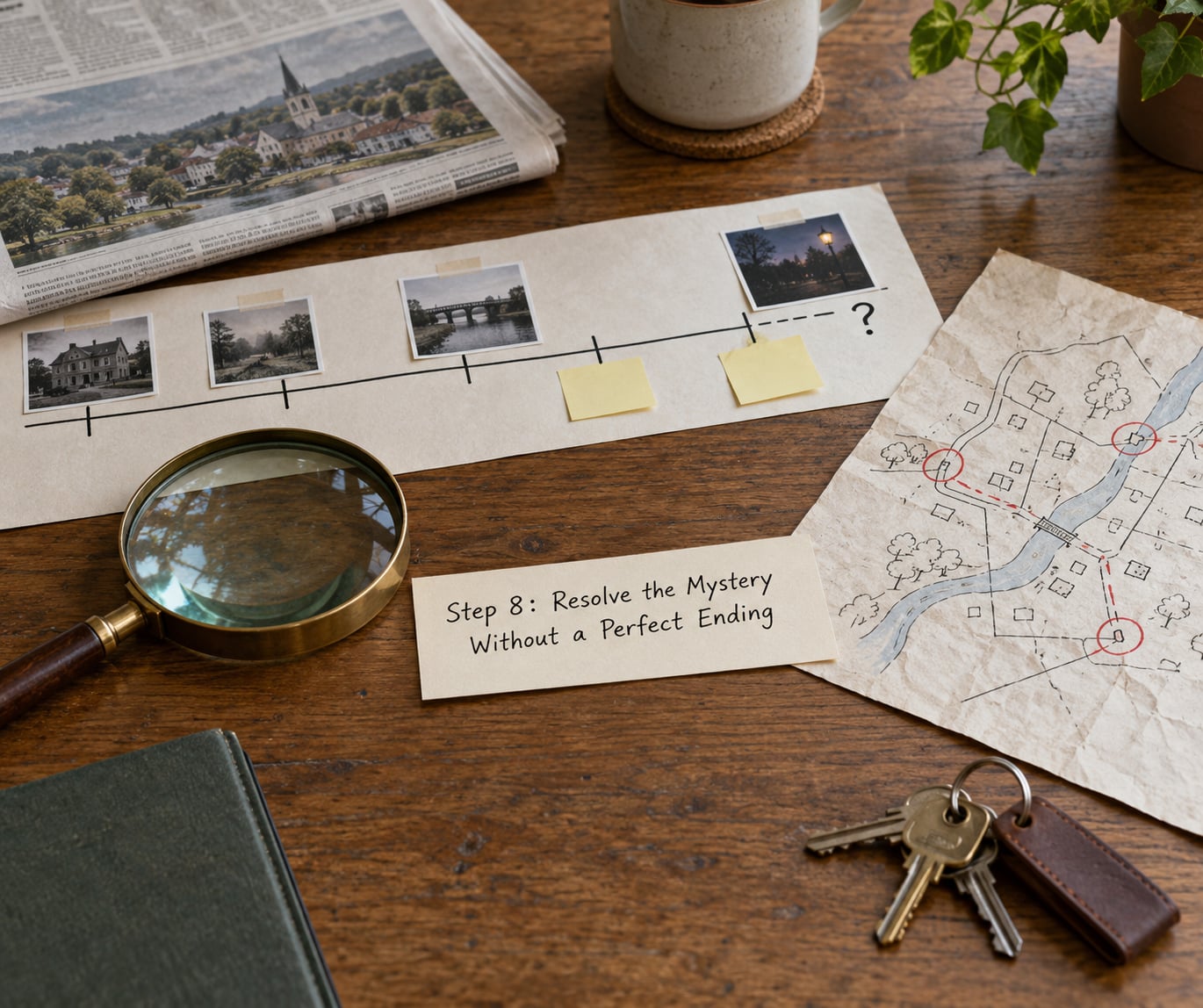
The reveal should be shock plus recognition. The reader should be startled by who did it and immediately think, of course, I saw that on page forty. That combination only happens when the evidence was in front of them the whole time and the solution reinterprets it rather than adding to it.
Deliver it in three beats. Name the culprit with the decisive clue attached, so the reader never has to accept an assertion. Then account for the timeline, minute by minute, so nothing is hand-waved. Then tell us what it cost, because that is the beat readers carry with them.
Then stop short of a tidy bow. Small towns do not convict cleanly, reputations survive, and people go back to the diner next week. A closing note where the town is intact but permanently changed does more work than a scene where justice is dispatched and everyone walks into the sunset.
If You Plan a Series
One town can host several murders, but not many. Vary the mechanism each book: a guest, a festival, a delivery that arrives from out of town, a body from a cold case. Give your amateur sleuth a job and a home so the town has a reason to keep her there. And keep the cast list stable, because readers who remember last book’s diner owner will not forgive you for replacing her in book three.
Common Mistakes to Avoid in Small Town Mysteries
Most of these are structural rather than stylistic, and each one has a fix you can apply during revision rather than inspiration.
- The town as scenery. One diner, one church, one hardware store, five interchangeable neighbours. Fix: give every recurring character a job, a want, and a reason to be in a room.
- Every suspect equally suspicious. When everyone has the same amount of darkness, nobody is. Fix: rank them. One real killer, one strong near-miss, and the rest get honest secrets rather than fake motive.
- Withholding clues for surprise. Twist does not mean withheld information. Fix: reveal everything early and let the interpretation change.
- Convenience. The car that will not start, the storm that strands everyone, the witness passing by at exactly the right minute. Fix: introduce every accident of plot in advance, in a scene where it does not matter.
- A detective with perfect instincts. Fix: give them a wrong assumption they voice early and abandon expensively around the midpoint.
- Deus ex machina. A new witness, a hidden camera, or an undiscovered lab report in the final chapter. Fix: everything that solves the case must have appeared by the midpoint.
- A tone that ignores the body. Comic relief is fine; comedy about the corpse is not. Fix: let the humour live in the investigation and the community, never in the discovery.
- Too many deaths for one town. Fix: one murder per book, with the non-murder crime widening as your series grows.
Then revise with a detective’s eye. Read the draft backward from the reveal and check that every clue was on the page first. Read it forward and ask whether any scene could be deleted without losing anything, because in this genre the answer is usually yes for one scene in five.
Before anyone else sees it, give the manuscript to three readers and ask them one question: who did it, and when did you know? If two of three guess by the midpoint, your clues are too loud. If none of them can name a single clue, they are too quiet, and you know exactly which scenes to fix.
Frequently Asked Questions
How many suspects should a small town murder mystery have?
Between four and seven. Three leaves too little room for misdirection, and past seven your interviews turn into a roll call that readers skim. Give each suspect motive, means, and opportunity, plus one secret unrelated to the crime so the town finds something juicy on its own. Aim for one real culprit, one strong near-miss, and the rest carrying honest secrets rather than manufactured motive.
How do I make a small town feel believable without using stereotypes?
Build the place structurally instead of decoratively. Fix population, geography, industry, and season, then map the three institutions where everyone crosses paths and name their owners. Characters emerge from that map because they have jobs and errands, not because they are quaint. Avoid the fiddly-lark-and-sunshine voice; specificity about how the town actually functions reads as far more convincing than accumulated local colour.
Should all clues in a murder mystery be revealed to the reader?
Every clue the solution requires should be visible before the reveal. Fair play obliges you to let the reader have the evidence, not to make them use it. Withholding a decisive detail for shock is the one cheat readers punish hardest, because it converts your book from a puzzle into an assertion. You can still surprise them by changing what a clue means rather than by keeping it back.
How do I keep the murderer from being obvious too early?
Give the killer a strong unrelated secret so early suspicion slides past them, and give another suspect a motive the reader finds more satisfying than the real one. Use two-part clues: half the reader registers in act one, the rest lands at the reveal. Most importantly, spread real clues across the whole book instead of clustering them in the first third, so a correct early guess still leaves the reader with somewhere to go.
Do I need to research real police procedures for a small-town mystery?
Enough to keep your investigator credible, and no more. Know how a body is found, who responds, what a coroner does differently from a sheriff, and roughly how long a small department takes to act. Readers forgive invented geography; they do not forgive a detective who ignores a chain of custody. A few hours with procedural accounts covers it.
Can I write a small-town mystery from the victim’s point of view?
You can, but you should know the trade. Close third person from the victim gives you the tightest, most claustrophobic voice in the genre and lets the reader watch the murder coming. The problem is structural: a dead narrator cannot investigate, so someone else has to drive the second half. The usual solution is a section break, with the victim’s last hours before the death and a named investigator after it.
Start with the town, not the corpse. Write down who lives there, what they do, and what they are already arguing about, then let the murder interrupt that arrangement. Everything after that, the suspects, the clues, the twelve beats, follows from those two pages of work. That is how to write a small town murder mystery that readers can solve and remember.