To outline a mystery so clues land fairly, work backward from the solution: settle who did it and why, list every fact that proves it, then plant each fact in an early scene with an innocent explanation attached. An engaged reader should be able to reach the culprit from the page in front of them, without guessing.
Fair play is not the same as being easy. It means the solution was never hidden, only misread. Ronald Knox and S. Van Dine both codified versions of that contract in the 1920s and 1930s, and the outline below borrows their logic rather than their exact rules.
Table of Contents
- What You Need
- Step-by-Step: From Mystery Premise to Fair Clue Trail
- 1. Define the Question and the Answer
- 2. Choose a Detective or Narrator with a Reason to Investigate
- 3. Build the Crime Timeline
- 4. Plant the Fair Clues
- 5. Distribute Fairness Across the Story
- 6. Plant Misdirection Without Cheating
- 7. Draft the Reveal by Working Backward
- 8. Test the Clue Trail as an Ideal Reader
- Make the Clue Trail Visible on the Page
- Check Fairness Before You Draft
- Common Mistakes
- Frequently Asked Questions
- How many clues does a fair mystery need?
- How do I keep clues hidden without making the mystery unfair?
- Should every suspect be equally suspicious?
- Can I use an unreliable narrator in a fair-play mystery?
- Should I outline the whole mystery before drafting the first scene?
- Conclusion
What You Need
Most outlining problems are really planning-material problems. A writer who has a premise and no ledger ends up improvising clues chapter by chapter, which is exactly how a reveal turns into a trick. Gather these six things first.
- A premise in one sentence. Who wants what, and what stops them. If it needs a semicolon, it is not finished.
- The central solution. Culprit, method, motive and opportunity, decided before chapter one.
- A cast with individual goals. Each suspect wants something that is not the truth, or hides something that is.
- A crime timeline. Minute by minute for the two hours around the crime, plus arrival and discovery times.
- A clue ledger. A table with fixed columns that every clue must occupy, from first appearance to payoff.
- A revision pass you leave open. Clues often get planted during revision, not drafting, so keep room after the first draft.
The ledger is the one writers skip and then regret. A writer on an absolutewrite.com forum thread put the standard practice plainly: work backward from the end, get the hook into place early, then fill the gaps with the twists.
Step-by-Step: From Mystery Premise to Fair Clue Trail
Eight stages, each ending in something checkable. If a stage produces nothing you can look at, it has not finished, and the next stage will be built on guesswork.
1. Define the Question and the Answer
Write the mystery as one question a reader would actually ask: who stole the cooperative’s delivery ledger on Thursday night? Then answer it in one precise sentence.
Keep the solution and the theme apart. The theme might be about grief or small-town loyalty; the answer is a name, a method and a reason. Writers who merge the two end up with a thematically satisfying ending that no clue supports.
Check: both the question and the answer fit on one line each. If the answer needs the word “somehow”, it is not solved yet.
2. Choose a Detective or Narrator with a Reason to Investigate
Pick the viewpoint character next, because the viewpoint decides what the reader gets to see. An investigator with official access sees records; an amateur sleuth sees doors left open and neighbours who will not talk.
Give them a personal objective that outlasts the case. Wanting to clear a relative, prove a rival wrong or keep a job are all stronger than wanting to find out what happened, because they keep the character moving when the official investigation stalls.
Check: the protagonist must still act if the police stop caring. Write down what they do in chapter six that no badge would authorise.
3. Build the Crime Timeline
Reconstruct the crime on paper before you write any of it. When it happened, who was where, who moved between rooms and why, and when each person discovered the body or the loss.
Most unfair-feeling plots are timeline bugs. A writer in a forum discussion of outline problems described finding her culprit’s unaccounted-for time only during revision, after the draft was finished, which cost her a rewrite. Twenty minutes on a grid before drafting is cheaper.
Check: every material clue has a plausible time and place of origin. Anything without a slot in the grid is a deus ex machina in waiting.
4. Plant the Fair Clues
Work from the answer back. List what the detective must be able to prove: means, motive, opportunity, and the link between suspect and scene. For each fact, write the clue as the reader first meets it, not as the detective later explains it.
Give every clue five attributes: source, location, viewpoint, meaning, and one plausible wrong interpretation. That last attribute is the whole game. A wet coat proves nothing until it means something the reader can reinterpret after the reveal.
Check: an attentive reader can explain the clue after the reveal, without needing a new fact to do it.
5. Distribute Fairness Across the Story
Fairness is not a single revelation in the first third. It is a spread: supporting facts early, the decisive clue in the first third of the manuscript, context in the middle, and explanation at the end.
Mix four delivery modes so the trail has texture. Physical evidence sits in description, statement contradictions sit in dialogue, opportunity gaps sit in the timeline as the sleuth reconstructs movements, and clues of omission sit in what a character declines to mention.
Check: early clues still read as memorable on a final reread, and later clues deepen what they already meant instead of replacing it.
6. Plant Misdirection Without Cheating
A red herring is a mistaken inference, not a lie from a suspect. The character saw something real and drew the wrong conclusion, and the reader drew it with them.
Give each false lead a genuine cause: a debt the suspect really has, a weapon they really own, a lie they tell for a reason unrelated to the crime. Then let the real evidence quietly contradict it.
Red herrings are cheaper to cut than to invent, so write more than you need and trim with a critique partner later.
Check: after the solution, each false lead still makes sense as something a person would have done. If the reader feels the author lied, the misdirection failed.
7. Draft the Reveal by Working Backward
Before you write the final chapters, write the detective’s explanation as an outline. Which facts get named, in what order, and what evidence is produced with each one.
Order matters. Lead with the least ambiguous fact and build to the one that reframes the reader’s earliest assumption. If a reveal introduces a fact the reader has never seen, the ending is a trick no matter how logical it sounds in the last page.
Check: every explanatory beat answers a question the reader already had. No beat merely restates the ending louder.
8. Test the Clue Trail as an Ideal Reader
Audit the outline in five passes: visibility (was it shown, not implied), necessity (would the solution survive without it), consistency (does it contradict anything earlier), interpretability (did it have at least two readings), and timing (was it early enough to be used).
Then run the ideal reader test. Walk the clue trail yourself, without your notes, and see whether the chain completes.
Check: you can reconstruct the solution using only what the story presents. If you need to remember the outline while doing it, the outline is doing work the reader cannot.
Make the Clue Trail Visible on the Page
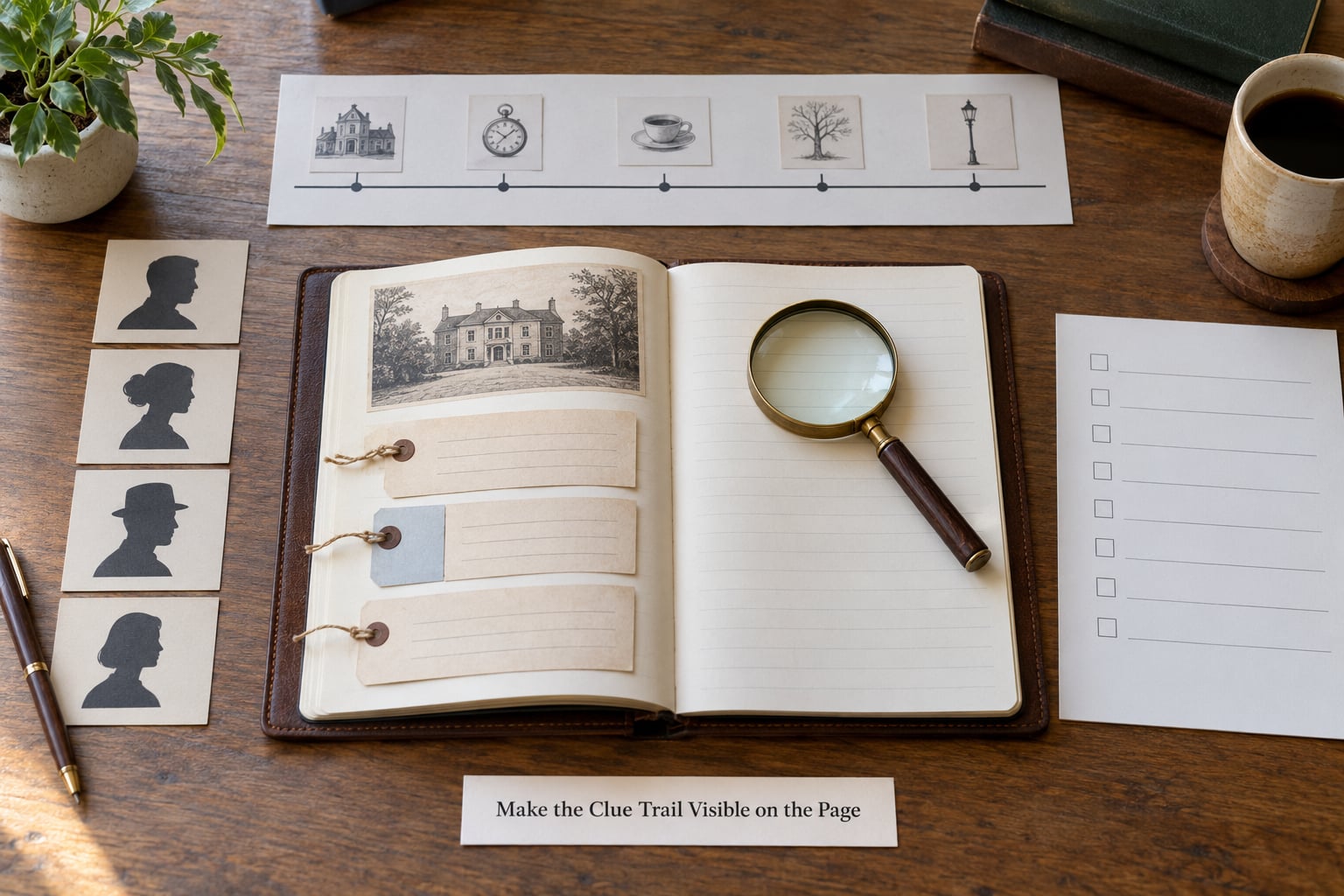
A ledger row reads like a shot list, and the prose problem is turning each row into something a character would encounter without narrating the plot.
Description. Physical and forensic clues ride along with the setting. A loading dock with one unlocked roller door is a clue if the door matters later and the text mentions it while the sleuth is looking at something else.
Dialogue. Statement contradictions come from people who answer the question asked rather than the question meant. Two witnesses who describe the same ten minutes differently have told you something real.
Documents. Ledgers, rotas, delivery notes and phone records let you plant precise, forgettable fact. A duplicated timestamp on a log page is more useful than any scream from a witness, because the reader can check it.
Viewpoint limits. Fairness does not require narration. Restricting the story to what one character can see or hear creates fair gaps rather than unfair ones, as long as the gap is a limit of perspective rather than a withheld fact.
One worked example runs through four stages. A warehouse co-op’s paper ledger goes missing on a Thursday. Plant: the treasurer mentions her ledger is “nearly finished up for the quarter” in chapter two, and the reader reads it as small talk about admin. Reassessment: the same phrase returns in chapter fourteen when the detective realises the missing week is exactly the week nobody can vouch for. Payoff: the treasurer’s partner has been copying the ledger for two months. The clue never changed. Only what it meant.
Check Fairness Before You Draft
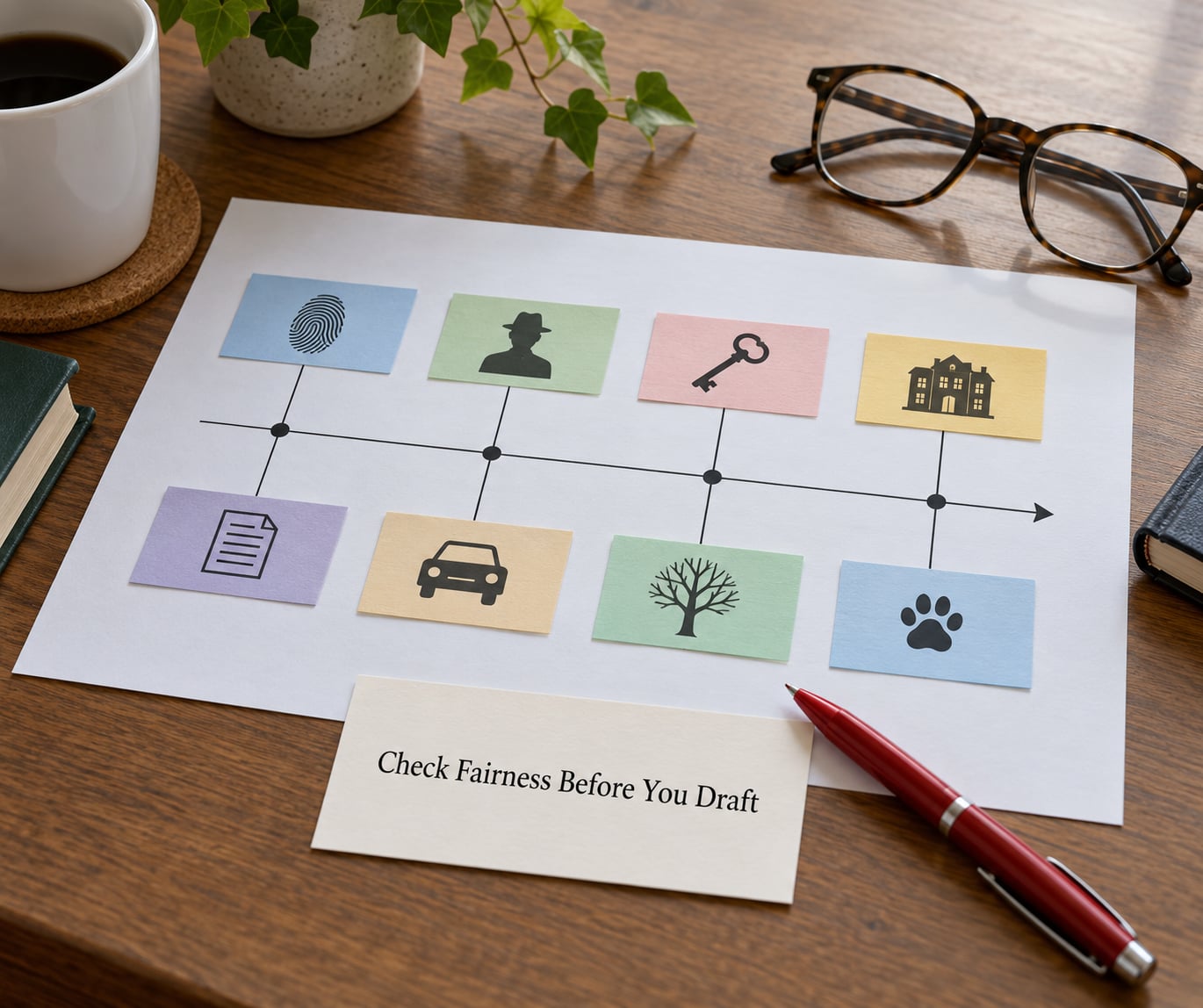
Run this audit on the outline before you write a word, and again on the finished draft. On the draft, work from memory rather than from your notes, since that is the state your reader is in.
- Reverse-outline it. In one line per chapter, note what the reader learns. Anything you cannot state is atmosphere, which is fine, but it is not a clue.
- Find the decisive evidence. The fact that convicts must appear before the midpoint. If it appears in the final chapter, move it.
- Check alibis arithmetically. Walk the crime timeline and confirm every suspect’s account leaves room for the culprit’s known actions.
- Mark private knowledge. Cross out anything a character knows but the text never gave the reader, including off-page conversations you assumed were obvious.
- Look for duplicate clues. Two facts proving the same thing means one is decorative. Cut or reassign it.
- Check for premature certainty. A suspect who cannot be excluded in chapter four will feel obvious for six hundred pages.
- Run the accusation test. Hand the outline to a reader, stop them before the reveal, and ask who did it and why. Their reasoning is your diagnostic.
Most writers find two or three fixes per pass, then repeat. Fairness is not something you confirm once; it degrades as you add scenes, so the audit belongs in every revision round.
Common Mistakes
Hiding the decisive fact. If the proof arrives with the detective in the last chapter, readers feel cheated. Move the plant into the first third and add noise elsewhere.
Planting clues with no second meaning. A detail that can only ever be read one way is not a clue, it is an announcement. Every clue needs an innocent reading, and that innocent reading has to be one a reader would actually form.
Giving the narrator private information. Omniscience is fine. Withholding a fact you already showed the reader in a different scene is not. If it was on the page, it counts as shown.
Letting the culprit behave stupidly. This is the complaint that comes up most often in writing forums. Nobody conceals evidence by leaving a trail of convenient coincidences, so the culprit’s mistakes must come from a real constraint: an assumption about what people know, a deadline, or a fear.
Suspecting everyone equally. If six people have a secret motive, no one stands out. Give each suspect one real reason to lie that is unrelated to the murder, and give the culprit the only motive that fits the timing.
Overloading the middle. Too many false leads exhaust the reader and flatten the genuine trail. Keep the ones that can be reassembled after the reveal and cut the rest.
On revision, work in rounds and change one thing at a time. First pass, fix logic and timeline. Second pass, fix clue visibility and placement. Third pass, cut red herrings. Mixing all three at once means you never learn which habit produced which problem.
Frequently Asked Questions
How many clues does a fair mystery need?
Most conventional mysteries work with three to five significant clues plus a scatter of supporting detail. The significant ones each prove a different element of the solution, such as means, motive or opportunity. Supporting clues make the world feel investigated rather than staged. If you have more than five significant clues, they are probably doing the same job twice.
How do I keep clues hidden without making the mystery unfair?
Give every clue an innocent first interpretation that a reader would plausibly form. The clue is then visible and correctly hidden at the same time, because the reader saw it and read it the wrong way. What breaks fairness is not concealment but withholding: introducing a fact at the reveal that never appeared before.
Should every suspect be equally suspicious?
No, and equal suspicion flattens the middle. Each suspect needs one real secret unrelated to the crime, so the reader can accuse them for the right reasons, but only one motive should fit the timing and opportunity established in the timeline. The least suspicious suspect with the best-timed motive is a classic and still works.
Can I use an unreliable narrator in a fair-play mystery?
Yes, as long as the unreliability is systematic and the fair clues reach the reader through some other channel. Letters, transcripts, physical evidence and second-hand testimony can carry the trail while the narrator distorts it. What will feel unfair is unreliability as a rescue, where a lie in the last chapter explains everything earlier.
Should I outline the whole mystery before drafting the first scene?
No. Outline the ending, the timeline and the clue placements, then draft the opening with some slack in it. Writers who discover while drafting usually keep a light ledger instead of a full outline, adding a row each time they learn something the reader will need later.
Conclusion
Clue fairness is an outline problem, not a rewrite problem, and it collapses into three artifacts: one sentence for the central question, one sentence for the answer, and a ledger row for every fact that connects them. Start with those today.
Write the question your reader would ask, answer it precisely, then build the timeline that makes the answer possible. Every clue you plant from there is a clue you can defend, because it was already on the page before anyone accused anyone.