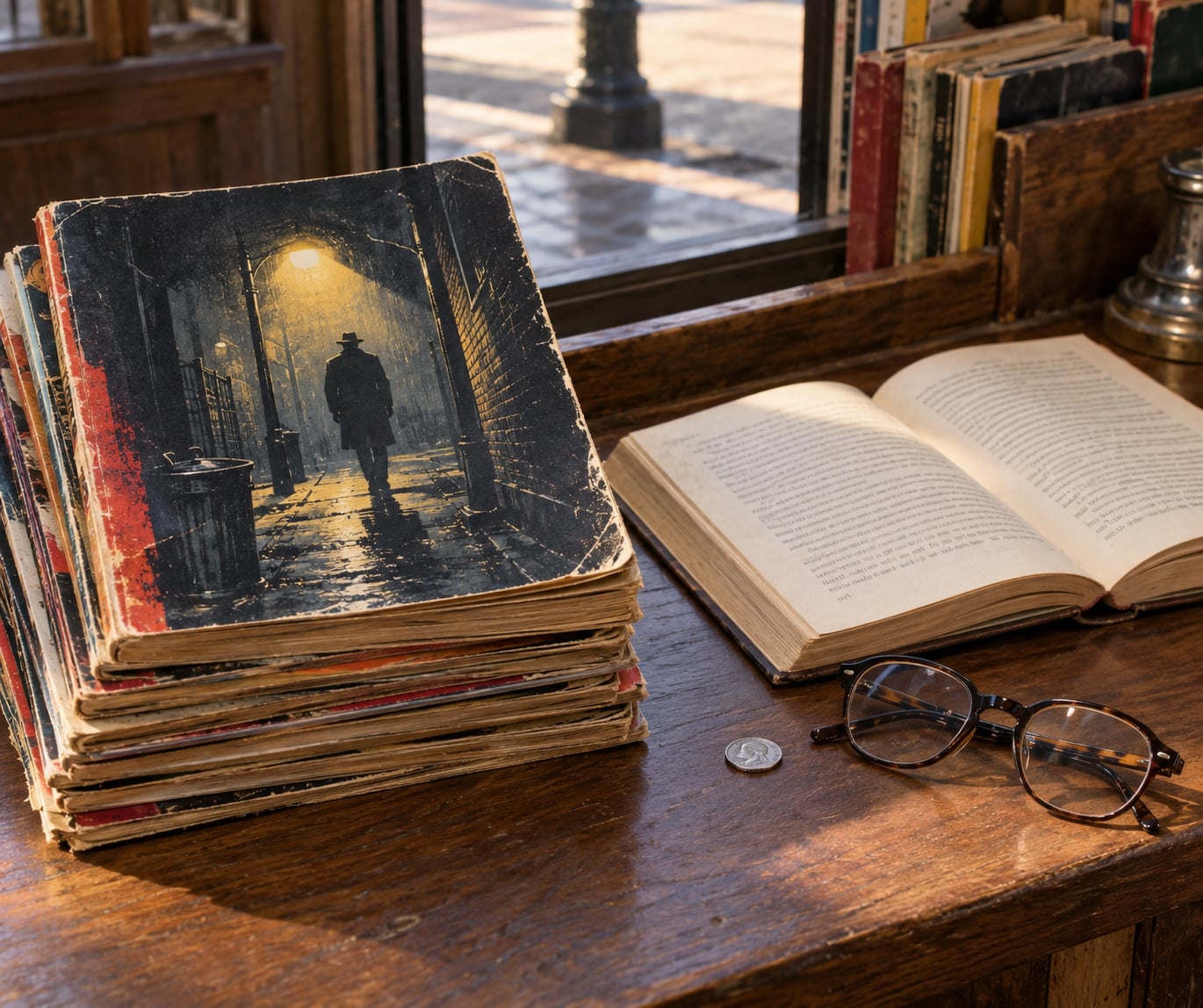
Pulp magazines shaped crime fiction by making it fast, cheap and immediate. Printed on cheap wood-pulp paper and sold at American newsstands for about ten cents from the 1890s into the 1950s, titles like Black Mask, Dime Detective Magazine and Detective Story Magazine published the detective stories that created the hard-boiled style we still read. A word here: this article is about the pulp magazines themselves, not Tarantino’s 1994 film.
That matters because the pulp is not just a chapter of publishing history. It is the place where the tough first-person narrator, the corrupt city, the femme fatale, the chapter that ends mid-scene and the paperback that carried a serialized murder into every drugstore in America were all worked out.
The best way to understand why Chandler’s prose clips and why Sam Spade sounds the way he does is to know what his editors were paying him per word.
Table of Contents
- What Were Pulp Magazines?
- How Pulp Magazines Shaped Crime Fiction: A Historical Timeline
- How Pulp Magazines Made Crime Fiction Readable
- How Pulp Magazines Shaped Crime Fiction: The Core Process
- Which Pulp Genres Mattered Most to Crime Fiction?
- How Did Black Mask Change the Crime Story?
- How Did Dime Novels and Sensation Fiction Prepare the Way?
- How Did Women, Race, and Censorship Shape Pulp Crime Stories?
- What Did Pulp Magazines Change About Detective Fiction?
- What Lasted After the Original Pulp Era Ended?
- What Can Modern Crime Writers Learn from Pulp?
- Frequently Asked Questions
- Are pulp magazines the same as paperbacks?
- Why is Black Mask considered central to hard-boiled crime fiction?
- Did pulp magazines invent the detective story?
- What is the difference between hard-boiled fiction and noir?
- Why did original pulp magazines decline?
- How is modern noir fiction different from classic pulp crime fiction?
- Conclusion
What Were Pulp Magazines?
Pulp magazines were cheap, wood-pulp-paper periodicals sold at newsstands for roughly ten cents from the 1890s to the 1950s. They carried mostly original fiction, printed on untrimmed pulpwood paper with cheap covers, and paid writers by the word at rates as low as half a cent.
The name comes from the paper, not the content. That cheap stock is why the fore-edges were left uncut and why the magazines fell apart in your hands after two reads. It is also why the price point worked: ten cents bought a full issue of short stories, and newsstands sold them the way they sold cigarettes.
Here is how the format differed from the two other ways mass-market crime stories reached readers.
| Feature | Pulp magazine | Dime novel | Paperback original |
|---|---|---|---|
| Typical price | About ten cents | Ten cents | Twenty-five cents and up |
| Paper | Cheap wood-pulp stock | Wrapped in yellow paper | Better grade paper |
| Length | Six to ten stories, roughly 100 to 150 pages | Book length | Book length |
| Payment | About half a cent to a penny a word | Varied; sometimes a share of sales | Advance plus royalties |
| Distribution | Newsstands and drugstores | Newsstands | Newsstands and drugstores |
The economics explain the style. Paid by the word at half a cent, a writer producing a six-thousand-word story in an afternoon could not afford to spend three paragraphs describing a room. Every sentence had to move the scene, and the scene had to move fast because there were four more waiting in the same issue.
How Pulp Magazines Shaped Crime Fiction: A Historical Timeline
Two eras did most of the shaping. The table below traces the major developments and why each one mattered for the crime story.
| Period | What happened | Why it mattered for crime fiction |
|---|---|---|
| 1860s to 1890s | American dime novels and British penny dreadfuls flood cheap-fiction markets with sensational crime and detection | Gave pulp writers a stock of stock situations, character types and lurid covers to recycle |
| 1896 | Argosy becomes the first magazine built around fiction for a mass audience | Proved a monthly could carry serial fiction and still sell on newsstands |
| 1910s | Frank A. Munsey and Street & Smith develop cheap general-interest fiction magazines | Created the template: lurid cover, mixed fiction contents, ten-cent price |
| 1920 to 1923 | Black Mask publishes Dashiell Hammett and Raymond Chandler, who bring an authentic American voice to the detective | Hard-boiled detective fiction emerges as a distinct voice, and Hammett’s Continental Op stories set the model |
| 1928 | Dime Detective Magazine launches | Gives Erle Stanley Gardner a place to build the Perry Mason machine and its enormous readership |
| 1930s | Golden Age and noir: roughly 200 pulp titles in circulation at the height of the Depression | Crime fiction becomes a mass habit, read by working-class and working-age men on cheap magazine paper |
| 1939 onward | Pocket Books brings ten-cent paperbacks to American drugstores | Serialized pulp stories become book-length novels and the paperback becomes crime fiction’s mass market |
| 1940s to 1950s | Original pulp fiction declines as comics, paperbacks and television compete | Crime writing moves to hardcovers and paperbacks, keeping the pulp’s voice but losing its magazine training ground |
| 1970s to today | Crime magazines and later online crime publications revive the short-form form | The compressed, immediate crime story survives in new formats |
Two numbers frame the whole story. Argosy circulated about 9,000 copies in 1894 and was selling roughly half a million by 1907. At the peak, the American market sustained more than 500 pulp titles in a month, a few hundred of them carrying crime fiction.
How Pulp Magazines Made Crime Fiction Readable
Pulp magazines made crime fiction readable by building stories for readers on a bus, not readers in an armchair. That meant entering in motion, narrating from inside the danger, and stopping at a moment of maximum pressure rather than a moment of resolution.
Chandler put it plainly in The Dime Detective, published in Black Mask in January 1938: he was aiming at readers who wanted the story to move, and he shaped his prose around the constraint of the page and the deadline.
How Pulp Magazines Shaped Crime Fiction: The Core Process
The core process turned a lurid premise into a publishable pulp story in a repeatable sequence. Writers worked through the same steps until the form became muscle memory, which is why so many of them could produce a competent mystery on demand.
- Immediate conflict. Open inside trouble, often in the middle of a scene the protagonist does not understand yet.
- Characterization under pressure. Establish the narrator through how they behave when threatened, not through description.
- Escalating complications. Each answer closes one question and opens two louder ones before the word limit arrives.
- A hard ending. Cut at maximum tension rather than at resolution.
- A hook for the next story. Close with a new threat so the reader buys the following issue.
That fifth step is the commercial engine of the form. A magazine that ends a story tidily risks losing the reader, so pulp endings tend to break off mid-problem.
Which Pulp Genres Mattered Most to Crime Fiction?
Crime was only one of several genres sharing the newsstand, and it borrowed from all of them. Each category left a specific mark on the crime story.
- Detective fiction. The formal base. Rules about clues, suspects and fair-play disclosure came from the puzzle tradition, and the pulps pushed the form toward professionals working real cases.
- Mystery. Centered on concealment rather than violence, with a domestic or provincial setting that later writers kept even as they darkened it.
- Hard-boiled detective fiction. The decisive contribution. A first-person narrator who is also the protagonist, city streets instead of drawing rooms, and violence treated as weather rather than event.
- Noir. Bleaker and more atmospheric in tone, emphasizing fatalism, shadow and unstable identity rather than the hard-boiled hero’s competence.
- Westerns. Supplied the square-jawed frontier hero and the shorthand morality of a world with fewer institutions.
- Science fiction. Contributed compression and high-concept premise, though it influenced crime writing less directly.
- Horror and weird fiction. Added the taboo, the unexplainable and a willingness to disturb the reader.
- Adventure. Moved heroes across geography at speed, which is exactly how a detective travels a city.
Readers who struggle with the shift from puzzle to hard-boiled usually find that the genre mix explains it. Noir is often less a separate tradition than a tonal adjustment made inside a form the pulps had already built.
How Did Black Mask Change the Crime Story?
Black Mask changed the crime story by proving that the detective did not have to be a gentleman amateur with a magnifying glass. It ran Hammett, Chandler, Horace McCoy and others who wrote a working man’s America in a working man’s idiom.
Five changes stand out. The narration moved to first person, so the reader learns the case through the detective’s filters, including his self-deception. The language moved to colloquial speech: short declaratives, street slang, and dialogue that argues instead of explaining.
The setting shifted to the urban and industrial, with docks, rail yards, cheap apartments and corrupt business interests rather than country estates. Violence became routine and unsentimental, described in a sentence rather than lingered over in a paragraph. And the hero’s code became the moral center of the story, since the authorities were generally shown to be worse than the private eye.
Editors shaped this as much as writers did. H.L. Mencken at Smart Set was not a pulp editor, but the pulp editors who published Chandler made decisions about cutting and pacing that changed the prose readers ended up with in book form.
The magazine also served as an apprenticeship. A writer could learn structure, pace and the discipline of the deadline by getting rejected repeatedly, and the generation that came out of that training built most of the twentieth century’s crime canon.
How Did Dime Novels and Sensation Fiction Prepare the Way?
Dime novels and sensation fiction prepared the way by supplying pulp writers with a proven kit of parts. Pulps inherited rather than invented, and knowing what came before makes the borrowings visible.
British penny dreadfuls of the 1830s and 1840s had already established the cheap, weekly, crime-centered format and the convention of ending on a cliffhanger. American dime novels from the 1860s, sold in yellow wrappers for ten cents, added urban melodrama, criminal heroes and lurid advertising.
From that stock came square-jawed heroes, damsels in distress, cognomen villains and the whole convention of the cover as promise. Nineteenth-century urban melodrama also supplied the corruption theme, since cities were portrayed as places where respectable surfaces hid organized crime long before the pulps picked it up.
The differences matter too. Dime novels were book length and serialized as reprints, while pulps were original monthly short fiction with a table of contents that functioned as branding. Pulp writers inherited the situations and largely rewrote the prose.
How Did Women, Race, and Censorship Shape Pulp Crime Stories?
Pulp crime stories were shaped by exclusions as much as by innovations. Women wrote for and read these magazines, but the fiction they were offered was overwhelmingly male, and the codes around sex and race were enforced hard.
Women wrote and edited in the pulps, and their work is now a serious subject of study rather than a footnote. The profession’s pay structure, however, kept most women in the lower-paid categories, and female characters in the crime pulps were usually written by men and written as problems to be resolved.
Racial representation was blunter. Black characters appeared mainly in roles that served the plot of white protagonists, and the stereotypes were reproduced at scale on lurid covers. That imagery is not a marginal problem; it was the sales art, which means it told a huge audience what to expect.
The Spicy titles, including Spicy Mystery Stories and the magazines billed as Saucy, pushed sexual frankness well past what the hardcover market allowed. They normalized a willingness to write about desire and violence together, though usually from a male point of view that rewarded the protagonist and punished the woman.
Censorship did its own damage. Editors cut language, softened morality and avoided subjects that invited postal action, and the result was fiction that could depict a murder graphically while treating the social causes around it as untouchable.
Later writers inherited the compressed plotting and rejected the assumptions, and that rejection is part of the history rather than a correction bolted onto it.
What Did Pulp Magazines Change About Detective Fiction?
Pulp magazines replaced the puzzle-box detective with a professional who worked in the world and got hurt doing it. That single substitution changed the narrator, the setting and the moral structure of the crime story at once.
The earlier detective was an amateur of means who solved crimes for satisfaction and rarely faced real danger. The pulp detective was often police-adjacent, privately employed, and physically vulnerable, which meant the reader could expect beatings, arrests and long stretches of a body in a doorway.
Because the narrator was inside the action, information arrived filtered and unreliable. A hard-boiled detective lies to himself as often as to other people, and the reader’s pleasure comes partly from noticing what he will not admit.
Seriality made another contribution. A detective who appeared in dozens of short stories acquired a name, a method and a set of running complications, which is the direct ancestor of the series detective and of the modern procedural with a regular cast.
What Lasted After the Original Pulp Era Ended?
Original pulp fiction declined for a plain reason: the same audience found better value elsewhere. But almost every technique survived the switch to paperbacks, film and television.
The paperbacks came first. Pocket Books and its rivals made serialized pulp stories into inexpensive book-length novels, which is how Chandler’s magazine work and Hammett’s The Glass Key reached readers as books. Chandler’s own novels were largely reworkings of Black Mask serials, and they kept the pace because the magazine had trained the prose.
Film noir arrived with the same materials. The shadowy lighting, the voice-over narration, the corrupt official and the rain-soaked street all come straight from pulp narration and its film adaptations, as do radio’s The Shadow and Doc Savage and the comic books that took pulp plotting into panels.
Later crime writing kept the shape at a slower tempo. Hardboiled writers working in the 1980s and after adopted the first-person voice and the moral ambiguity while rejecting the prose shortcuts, and the short crime story survives in crime magazines and online crime publications that still pay by the word or the story and still end on pressure rather than resolution.
Originals are also collectible, which surprises people who assume the era is common. Pulp survival rates are brutal, and high-grade copies of early crime pulps command disproportionate sums.
What Can Modern Crime Writers Learn from Pulp?
Modern crime writers can learn five things from pulp, and most of them are structural rather than stylistic.
- Open inside the problem. Start in motion, in the middle of something the protagonist cannot yet explain. Background can arrive later.
- Characterize under pressure. Show what a person does when threatened instead of describing who they are.
- Protect pace. Cut every sentence that only re-establishes what the reader knows. The half-cent-a-word discipline is brutal and effective.
- Use the chapter break honestly. Ending a section at maximum pressure is a structural tool, not a trick, and it works at novel length too.
- Know the market you are writing for. Every pulp constraint came from a specific reader with a specific budget and a limited amount of time. New markets impose their own versions.
Two cautions go with the advice. Pulp prose was often thin, and its assumptions about women and race were regressive. Take the compression and drop the stereotypes.
Frequently Asked Questions
Are pulp magazines the same as paperbacks?
No. Pulp magazines were periodicals printed on cheap wood-pulp paper and sold at newsstands for about ten cents, usually carrying six to ten original stories a month. Paperbacks are bound books, and the paperback revolution of 1939 absorbed pulp readers by reprinting serialized pulp stories in book form. The pulp came first and taught the paperback its pacing.
Why is Black Mask considered central to hard-boiled crime fiction?
Black Mask published Dashiell Hammett and Raymond Chandler at the moment the hard-boiled voice was forming, and its editors enforced the pace that made the style work. Hammett’s Continental Op stories and Chandler’s Marlowe serials set the model of a first-person narrator inside a corrupt city. Generations of crime writers learned the form from those pages.
Did pulp magazines invent the detective story?
No. Detection was already a well-established form in the nineteenth century, from British penny dreadfuls to American dime novels and the puzzle-mystery tradition. Pulp magazines took those conventions, compressed them for a word-rate deadline, and added the professional investigator who works real cases. The invention was the voice and the pace, not the premise.
What is the difference between hard-boiled fiction and noir?
Hard-boiled fiction centers a tough, competent narrator who trades in a personal moral code inside a corrupt world. Noir is a tonal category rather than a method: it emphasizes fatalism, shadow and unstable identity, and its protagonists are often passive or destroyed by what they cannot control. Noir is a mood applied to crime fiction; hard-boiled is a narrative approach.
Why did original pulp magazines decline?
Original pulp fiction faded after the 1940s because its readers found cheaper, faster alternatives. World War II paper drives drained paper supplies, comic books offered stronger visual shocks for the same dime, paperbacks sold longer books for about the same money, and television took over the same leisure hours. The techniques survived in every one of those formats.
How is modern noir fiction different from classic pulp crime fiction?
Modern noir usually writes at novel length with more interiority, psychological complexity and social observation than pulp allowed. Pulp crime fiction was written to a deadline at a half-cent-a-word rate, so it favored action, compressed prose and endings at maximum pressure. Modern writers keep the first-person voice and the moral ambiguity while discarding the shortcuts that read as dated.
Conclusion
Pulp magazines shaped crime fiction by making it immediate: first-person, compressed, violent, and turned out under a deadline that rewarded nothing slow. Black Mask gave that style its voice, the dime novels gave it its situations, and the paperbacks carried it into the modern canon.
If you want one place to start, read a Hammett or Chandler novel and notice how rarely the prose rests. Then read one of their magazine serials, if you can find one, and watch the same voice solve the same problem in a fraction of the space.