
To write a labor noir story, you build noir’s machinery — a protagonist without a moral center, a system that cannot be beaten, a downward spiral, an unhappy ending — around a workplace instead of a criminal underworld. The antagonist is structural: the schedule, the supervisor, the quarterly call, the closure memo. No detective required. Updated for 2026, this guide walks through the eight decisions that turn a workplace grievance into a story with teeth.
Forum threads on r/noir and r/writing keep circling the same complaint: every noir article is a list of character tropes, and nobody writes about a protagonist who clocks in. That is the gap this fills. If you have a setting and a grudge, you can build from here in a few weeks of evenings.
Table of Contents
- What You Need
- How to Write a Labor Noir Story: Step by Step
- 1. Choose a Workplace Where Power Is Unequal
- 2. Build the Conflict Around a Threat People Can Measure
- 3. Create Characters on Opposite Sides of the System
- 4. Show What the Company Controls
- 5. Give the Worker an Objective Beyond Revenge
- 6. Let the Investigation Expose the Cost of the Truth
- 7. Use a Voice That Balances Grit With Clarity
- 8. End With Consequences, Not a Moral Message
- Common Mistakes
- Frequently Asked Questions
- What is labor noir, and how is it different from workplace fiction?
- How long should a labor noir short story be?
- Should a labor noir story be written in first person or third person?
- How much research does a writer need about labor and workplaces?
- How can I make a labor noir story feel suspenseful without relying on violence?
- What ending works best for a labor noir story?
What You Need
Before you draft a line, you need five things, and none of them are a character archetype list.
A workplace you can describe from the inside. Not a genre idea of “a factory.” An actual place, with a layout, a shift pattern, a break room, a specific noise. If you have not worked there or visited, you owe the story some research.
A conflict with a measurable cost. Money, hours, safety, a job, a reputation inside a small community. Noir runs on pressure, and pressure needs a number attached. “His hours were cut” is weaker than “he lost nineteen hours a month and his rent was due on the first.”
Two people who want incompatible things. A worker or organizer, and someone with authority over them — supervisor, owner, staffing manager, compliance officer, or a union rep whose interests diverge. Both must be understandable. If the antagonist is a cartoon, the reader stops feeling trapped.
A decided moral temperature. Noir is not darkness for its own sake. Decide early how far your character will go and what they will not do, and let the story test that line.
A point of view and tense. Choose before the first sentence. Close third person past tense is the workhorse for labor noir; first person works when your narrator is unreliable or newly recruited and doesn’t yet know the shape of the place.
How to Write a Labor Noir Story: Step by Step
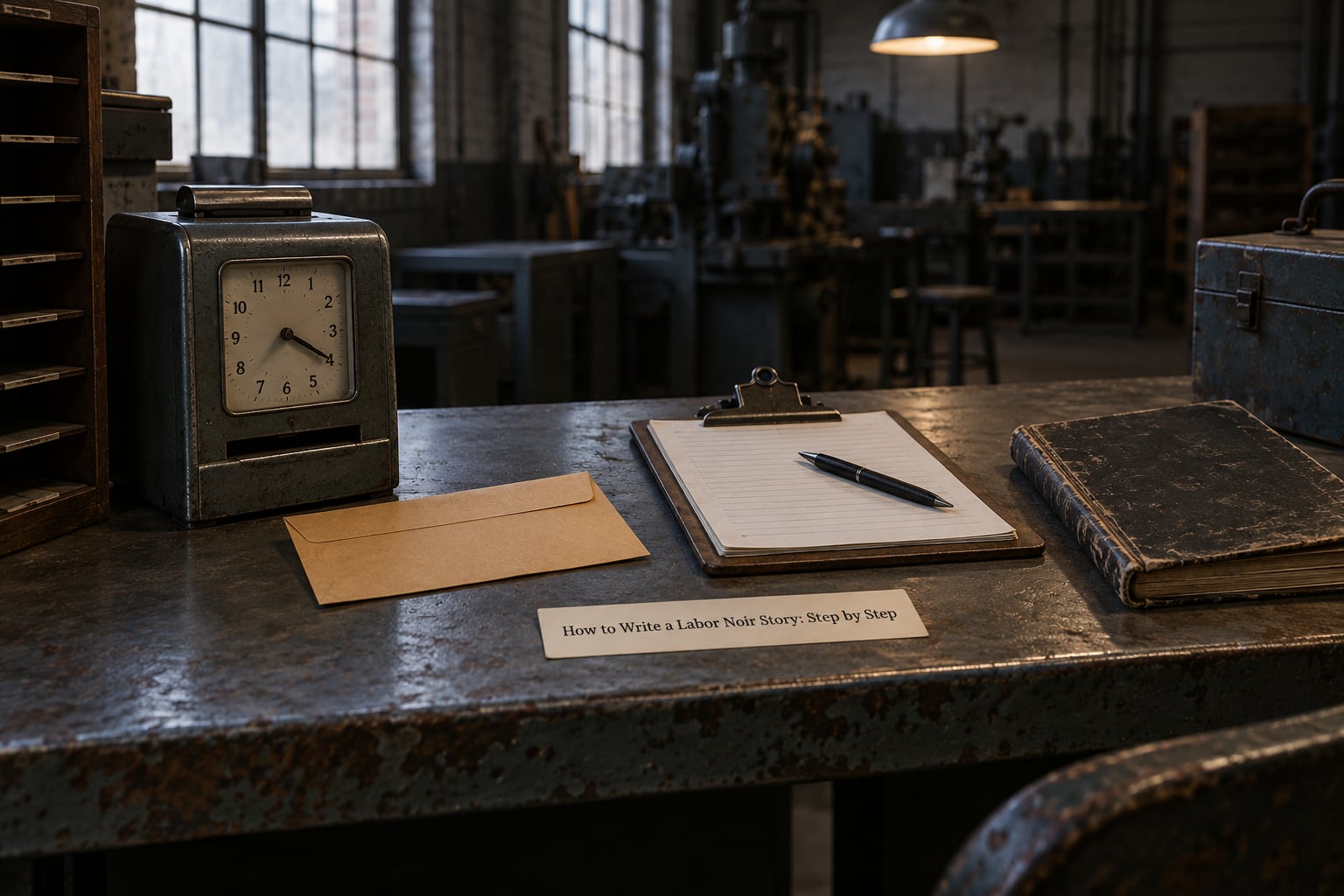
1. Choose a Workplace Where Power Is Unequal
A labor noir setting needs visible hierarchy, written rules, and a limited set of choices. A plant floor, a distribution warehouse, a hotel housekeeping department, a hospital’s night shift, a delivery app, a university custodial staff — all of them work because somebody can change your hours, your assignment, or your record of what happened.
The trap is turning the story into a catalog. Two or three details per location, used twice each, beats a paragraph of inventory every time. A time clock that eats punch cards, a ventilation system that fails in one corner, a supervisor who never walks the far aisle.
You’ll know the setting works when you can describe it in one breath and a reader can feel who has the keys.
2. Build the Conflict Around a Threat People Can Measure
Start from a concrete loss: unpaid hours, an unsafe machine, a layoff round, credit stolen for someone else’s work, retaliation after a complaint, or pressure to sign off on something. Abstract injustice has no grip. “The plant is dying” is a theme; “the plant is closing one line and the man on it has eleven weeks of notice” is a story.
Then attach the threat to an immediate objective. The character wants something by a specific time, and failing to get it costs more than the discomfort of asking. That is the whole engine of noir, and it does not care whether the gun is a handgun or a missed paycheck.
3. Create Characters on Opposite Sides of the System
Give your worker a want, a need, and a lie they believe. The lie is the noir engine — “if I keep my head down, it passes over me” is a beautiful lie, and a story should spend its whole length dismantling it.
Give the authority figure a job, not a motive cartoon. A plant manager with a production number to hit, a scheduler whose own hours were cut, a compliance officer who genuinely believes the paperwork protects the line. Their interests should be legible even when their methods are awful.
Keep the asymmetry intact in the scene. The worker can be smarter, braver, and more right than the person above them, and still lose on every move they get to make. That gap is the story.
4. Show What the Company Controls
This is the step most writers skip, and it’s the one that makes labor noir feel like labor noir rather than a workplace drama wearing a hat.
Control looks like: who sets the schedule, who edits the roster, what the record says happened, who holds the badge, who speaks first in a meeting, who gets to leave at five, whose name is on the report. Rendered well, control is atmosphere and plot at once.
You do not need the word “exploitation.” A worker explaining why they clocked in early but can’t log the extra ninety minutes is more efficient than a paragraph of theory, and the reader arrives at the conclusion themselves.
5. Give the Worker an Objective Beyond Revenge
Revenge is thin, because revenge is just a mood. Give the protagonist a goal with a deadline and a witness: protect a coworker from a charge, get an injury claim honored, keep a job long enough to qualify, retrieve a document, secure a name on a record, hold a line until a specific date.
Every good objective creates a moral choice, because the clean path and the effective path are never the same. Signing something you don’t believe keeps the lights on. Telling the truth costs you the shift you need. The story lives in that fork, repeated.
6. Let the Investigation Expose the Cost of the Truth
A labor noir plot moves on evidence: a paper trail, a schedule, a badge log, a text thread, an injury report, a conversation overheard in a break room. Each discovery should change one of three things — what the character understands, what options they have, or how exposed they now are.
Build the beats as a countdown rather than a puzzle. Something the character can no longer un-know, and a window that is closing. A stacker injured in March. A supervisor who leaves in June. A corporate audit scheduled for the fall.
The investigator here is often just a person who pays attention, which is why the form works without a professional solver.
7. Use a Voice That Balances Grit With Clarity
Noir prose is not an excuse for unreadable sentences. Controlled imagery, active verbs, and dialogue that clips on the right beats will carry grit better than a fog machine.
Anchor scenes in what the body registers: cold, vibration, fluorescent hum, the ache in a specific hand, the taste of vending machine coffee at hour eleven. Two or three senses per scene is plenty when they are chosen well.
On dialogue, let shop talk carry the politics. Workers talk sideways — about a schedule, a truck, a kid’s school — and the meaning sits in the gap between what is said and what is meant. Give your characters their own stock of phrases and recurring references, and let the same phrase change meaning across the story.
One caution: grit is not the same as caricature. A line of dialogue should carry contempt or affection or fear, not a writer’s dislike of that accent. If you would not say it in the room, cut it.
8. End With Consequences, Not a Moral Message
Labor noir endings usually land somewhere in a small win, a quiet defeat, or a broken solidarity — and the choice should be the only ending your character could have earned.
A few shapes that work: the objective is met and the person is quietly ruined by it; the group wins and the protagonist watches from outside; the evidence surfaces and the cost lands on the wrong person; nothing changes and the character makes one small, private decision that is theirs.
What to avoid is the courtroom epiphany where the system corrects itself on schedule, and the closing paragraph that tells the reader what it all meant. Let the last image carry the meaning. If your final line could be printed on a poster, it’s too tidy.
Common Mistakes
Workers written as passive victims. They suffer, and the plot happens around them. Fix: give every worker an action they take that is competent and self-serving, not just a reaction. A worker who lies to protect a relative is more alive than one who merely endures.
The corporation left faceless. “The company” cannot frown. Fix: put a person in the room. One scheduler, one staffing contractor, one manager with a name and a desk. The abstraction dissolves and the threat becomes concrete.
Labor as decoration. A union pin on a generic character. Fix: make the class position shape a decision. What the character cannot afford determines what they will agree to.
Commentary mistaken for motivation. The character explains the system instead of acting inside it. Fix: replace the explanation with a choice. Cut dialogue that only a writer would need to say.
Jargon overload. Dense legal or procedural language stalls the scene. Fix: keep the expert terms that matter, drop the rest, and trust one plain sentence to carry what a specialist would need three clauses for. If a term can be replaced with a concrete object, replace it.
The easy moral victory. A bad boss falls and the crew celebrates. Fix: ask what the machinery does next. It usually hires someone new, and that person has a name and a family.
Two revision habits do more work than any of the above. Read the story aloud and mark every sentence where you’re admiring your own prose rather than reporting the scene; those are cuts. And give each scene a test: can someone who has never worked that job describe the shift in order? If not, the research isn’t done.
On writing about struggle you haven’t lived — a question writers raise often and rarely get answered — the workable rule is to research like you intend to be checked, and to let the characters’ choices carry the weight rather than your sympathy. Give the workers wit, irritation, and ordinary appetites. Ordinary appetites are what keep a story from turning into a poster.
Frequently Asked Questions
What is labor noir, and how is it different from workplace fiction?
Labor noir is noir fiction where the protagonist is a worker rather than a detective or criminal, and workplace pressure supplies the plot: low wages, layoffs, scheduling, union politics, corporate extraction. Workplace fiction may cover any setting, including comfortable ones, and may end in resolution. Labor noir keeps noir’s spine — a flawed protagonist without a moral center, a system that cannot be beaten, a downward spiral, an unhappy ending.
How long should a labor noir short story be?
Most strong labor noir short stories land between 2,000 and 5,000 words. That range gives you room for a textured setting, one sustained conflict, and a single turn, without losing the pressure that noir depends on. Under 1,500 words you will spend more words on atmosphere than on consequence. A novella of 15,000 to 25,000 words works when you want two viewpoints and a slow reveal.
Should a labor noir story be written in first person or third person?
Both work, and the choice follows your narrator. Close third person past tense suits a character who understands the job well and is still learning the shape of the system. First person suits a narrator who is new, tired, angry, or unreliable, because the voice itself can carry suspicion. Whichever you pick, hold it steady; switching tense mid-story pulls the reader out of the pressure you built.
How much research does a writer need about labor and workplaces?
Enough that you could pass a shift interview. Learn the real terms for the job, how the schedule is built, who has authority over what, how complaints actually get filed, and what people talk about when nothing is happening. Talk to two or three people who have worked the job. Readers detect a fabricated workplace quickly, and the details you pick up are usually more interesting than the ones you would have invented.
How can I make a labor noir story feel suspenseful without relying on violence?
Narrow the options instead of raising the stakes. Show what the character loses if they move too late, then close that window: a deadline, a scheduled audit, a supervisor’s last day, a coworker who is already counting on them. Suspense also comes from social pressure — a meeting where saying the wrong thing is visible, a form that has to be signed, a record that cannot be corrected once written.
What ending works best for a labor noir story?
Whatever ending your character has earned, not whatever ending feels satisfying. Small wins, quiet defeats, and broken solidarity all serve the genre, as long as the outcome follows from the choices the character actually made. Avoid the courtroom epiphany where the system corrects itself on schedule, and avoid a final paragraph that explains the theme. Close on an image, a gesture, or a piece of information the reader assembles for themselves.
Start where the pressure is easiest to see: pick a real job, a specific loss, and one person who has to decide what to do about it this week. Write the scene where they say the thing out loud and watch what it costs them. That scene is the story’s spine, and the other seven decisions arrange themselves around it.