A caper comedy works when the reader watches the plan from the inside: how it forms, what it costs to put together, the moment it snags, and how it finally lands. The comedy is not decoration hung on a robbery story — the jokes are the mechanism of the plot. Here is how to write a caper comedy, stage by stage, from a one-sentence premise to the last joke of the twist.
This guide is for novelists, short story writers and screenwriters working in comic crime. It assumes you already know the reference shelf — Westlake, Evanovich, Wodehouse, Leonard — and what you want from those books. What follows is the scaffolding underneath.
Table of Contents
- What You Need
- The target: something worth the trouble
- A crew, not a team
- A complication that can escalate
- A comic engine
- A reason for the caper that is not money
- Step-by-Step: Build the Caper From Premise to Punchline
- 1. Start With a Compressible Big Idea
- 2. Choose the Right Comic Engine
- 3. Design the Crew, Not Just the Heist
- 4. Map the Plan Before You Map the Chaos
- 5. Add Stakes Without Killing the Playfulness
- 6. Build Escalation and Reversal
- 7. Write Dialogue That Performs the Funny
- 8. Land the Twist, Payoff, and Ending
- Common Mistakes
- The dumb decision
- Plot eating the characters
- Tone drift
- The MacGuffin with no heat
- The teleported twist
- The crew of identical voices
- Frequently Asked Questions
- What is the difference between a caper and a heist story?
- Should the heist succeed or fail in my caper?
- How long should a caper novel be?
- How do I keep the heist plan believable without being a criminal expert?
- How do I balance comedy with suspense in a caper?
- How do I write a crew of criminals readers can tell apart?
- Conclusion
What You Need

Five materials, and you cannot start without all five. A story missing one of them usually stalls at the heist sequence, which is where most first drafts die.
The target: something worth the trouble
The object of the caper has to be attractive to the reader, not only to the crew. A bearer-bond ledger is a MacGuffin until we know why one particular person on earth wants it badly enough to burn their life down for it. Give the target a private meaning for at least one crew member, and let that meaning leak into the plan.
A crew, not a team
Two people cannot fill an ensemble. Four to six is the working range, each with a job in the plan, a private want outside the plan, and a flaw that will cost them something. If everyone wants the same thing, you have a heist film and no story.
A complication that can escalate
One clean obstacle is not enough. You need an obstacle with a chain attached: someone who can be asked questions, a system with a schedule, a building with a night watch. Escalation is the engine of the last act, and it must be seeded early.
A comic engine
One relationship or friction that generates jokes indefinitely — a partnership between two incompatible people works better than any gag list. If you can describe your comic engine in a single sentence, you have something that will still be funny on page 200.
A reason for the caper that is not money
The strongest capers are about something the crew wants for reasons they would never admit out loud. Money gets the crew in the room. Ambition, shame, love, a dead brother, a debt to somebody dangerous — that keeps them interesting once the money is spent.
Step-by-Step: Build the Caper From Premise to Punchline
Eight stages. Each one has a test, and the test matters more than the stage, because most of these will send you back two steps.
1. Start With a Compressible Big Idea
Compress the whole story into one sentence containing a protagonist, an objective, a target, an obstacle, and comic pressure. If you cannot fit those five, the story is not ready to be structured.
Compare these three premises:
- A retired pickpocket is hired to steal back a necklace her late husband made, but the only person who can get her inside the museum is her ex-husband. Comic pressure lives in the partnership, and the target carries private meaning.
- Six strangers rob a bank in exchange for a helicopter. Specific, but no thread to pull on — nothing here tells you who wants anything beyond the money.
- A con artist marries a widow to steal her fortune, and falls genuinely in love with the old woman he is murdering. Strong want, strong obstacle, and the comedy can go dark or light depending on your tone.
The test: can your sentence generate complications, or does it only describe a theft? Take your sentence and ask “and then what does that cost somebody?” If nothing comes back, compress harder.
2. Choose the Right Comic Engine
Comedy in a caper comes from four sources, and you should pick one primary and let the others support it.
- Personality clash — two people who want different outcomes from the same plan. The most durable engine by a distance.
- Competing goals — every crew member secretly has an exit strategy that benefits them and screws the others.
- Social convention — the plan collides with how people actually behave: the host who will not stop talking, the bureaucrat who follows the rule literally.
- Physical limitation — the wrong tool, the wrong height, the wrong vehicle. Physical comedy in a heist is usually the panic of competence failing.
A collection of one-liners is not an engine, because it has no source and it runs dry. Every crew member should disrupt the plan in a different way, and the reader should be able to predict the disruption without predicting the specifics.
3. Design the Crew, Not Just the Heist
Fill this in for each character before you write a scene:
- Role in the plan — what they physically do on the night.
- Private want — what they want when nobody else is watching.
- Flaw — the specific weakness the plot will eventually use.
- Relationship to the protagonist — what they owe, what they resent, what they cannot say.
- Comic function — which kind of disruption they produce (delay, noise, panic, betrayal, over-competence).
The same break-in plan plays as comedy in three different ways depending on who is in it. A silent expert and a nervous chatterbox produce farce. A silent expert and a charming fraud who talks to guards produce something closer to a con. A silent expert and someone who keeps solving problems nobody asked them to solve produces escalating competence porn, which is a different book again.
Watch for the ensemble blur, the most common crew fault. If two characters share a want, split them. If two share a voice — same sentence length, same vocabulary, same habits of interrupting — give one of them a silence or a tic that the other never has.
4. Map the Plan Before You Map the Chaos
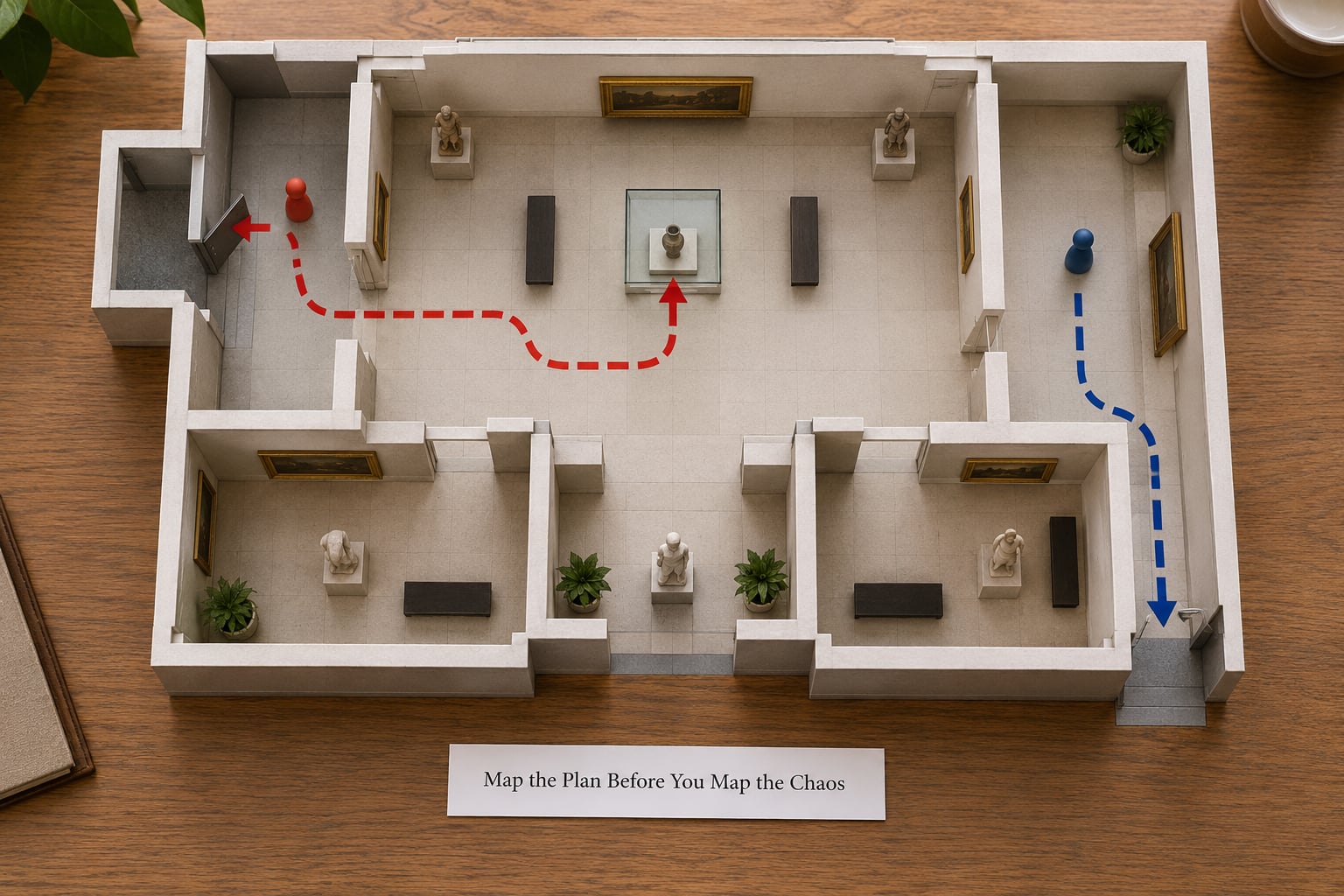
Map the plan in stages, then decide what happens to each stage. Six or seven stages is plenty.
| Stage | What the crew believes will happen | Comic opportunity |
|---|---|---|
| Recruitment | The right people agree for the right reasons | Everyone misreads the terms |
| Preparation | The plan holds together on paper | Tooling that fails in a specific, absurd way |
| Access | One entry, no fuss | A small rule nobody remembered |
| Diversion | Guards go where they were sent | The diversion is enjoyed too much |
| Execution | The target is where it was said to be | Competence failing under a clock |
| Escape | The route is clear | Everyone arrives at the exit separately |
| Payoff | They are rich and undetected | The money cannot be spent or claimed |
For each stage write three lines: what they expect, what actually happens, and why. The third line is where the story lives. If you cannot say why, you have a gap, not a twist.
5. Add Stakes Without Killing the Playfulness
Raise the cost of failure in ways the jokes can survive. Injury and death are hard to joke about; embarrassment, exposure, time, and loss of status are not. Somebody will have to tell her family. Somebody’s real name will end up in a newspaper. Somebody will be on a list they cannot get off.
Relationship stakes are the cheapest to raise and the most useful, because every one of them is a scene somebody already has to have. The fixer who cannot fix the thing that matters to her. The apprentice who copied the wrong man. Put the cost on a person rather than on an institution and the tone survives.
The warning sign is melodrama: swelling music equivalent prose, long silent looks at the thing they might lose. If a scene would still work if the jokes were removed, it is not doing the tone work you think it is.
6. Build Escalation and Reversal
Replace a chain of similar obstacles with a sequence of genuinely increasing complications. Obstacle one is an inconvenience. Obstacle two costs time. Obstacle three costs a relationship. Obstacle four costs the crew the plan entirely, and now they are improvising in public.
Four words writers constantly confuse, so let us separate them:
- Reversal — the situation inverts and the crew must change its approach. A working gate becomes a locked wing.
- Mistake — someone errs. Use sparingly. It makes a character look foolish without making them look stupid, and it should always be a mistake someone could plausibly make.
- Red herring — a false lead the reader is given. Once is plenty.
- Reveal — a fact that was always true and now becomes visible. The strongest reveals are the ones you can trace backwards to page 40.
A caper that appears to fail three times needs three escalating failures, not one failure repeated. Attempt one fails on a detail. Attempt two fails because the crew’s relationship breaks under the pressure of the first. Attempt three fails because of a fact revealed in the setup that the reader has already seen and the crew has not. That last one is the twist arriving early, which is fine if you stage it as a reveal rather than a surprise.
7. Write Dialogue That Performs the Funny
Comic dialogue in a caper does three jobs: it advances the plan, it reveals competing aims, and it lands the joke. Most bad caper dialogue only does the third.
Give every scene two people who want different outcomes, and let each of them talk the other into something. The scene’s tension is who talks first and gives ground. Once you know that, you can cut any line that does not move it.
Subtext beats statement almost every time. Somebody who says “I just want to make sure the crew gets paid” is telling; somebody who asks about the crew’s retirement plans while holding the spare keys is doing the same work with a joke attached, and the reader gets to enjoy being smarter than the speaker.
Two practical rules. First, the joke must not stop the clock — if a punch line halts the scene so the writer can collect it, cut it and let the dialogue carry the humour instead. Second, undercut on purpose: set up a line expecting a big moment and deliver a small one, and the reader will trust you enough to believe the big moment later.
Exposition is where capers die. When someone has to explain the plan, delete the explanation and let the plan go wrong instead. A reader who watches a plan fail understands the plan better than a reader who listened to it work.
8. Land the Twist, Payoff, and Ending
Connect the ending to something planted early, resolve the protagonist’s private want rather than only the job, and let the last beat be funny for a reason. Not funny because you cracked a joke — funny because of what the reader now knows that a character does not.
The most common ending error is a twist that arrives from outside. Somebody’s twin, somebody’s secret employer, an unmarked car nobody questioned. Those are surprises; surprises disappoint on the second read. A reveal changes how the reader sees page one, which is what makes them want to re-read, and re-reading is where capers are won.
On whether the job should succeed: let the heist succeed or fail on the plan, but make the outcome cost somebody something they wanted before the caper started. A perfect job with a broken relationship, or a failed job that saves the thing the protagonist actually came for, both land. A flawless win where everyone is fine is the flattest possible ending.
Common Mistakes
These are the failures readers name most often, in roughly the order they notice them.
The dumb decision
Someone does something irrational so the plot can move. The fix is to give the crew the information they need and then let the difficulty come from cost, not ignorance. If they are late, make it because someone would not leave without a person, a dog, or a ledger that belonged to them. A choice that hurts is a decision. A choice that makes no sense is a hole.
Plot eating the characters
Mechanism crowds out people until the crew become hands. Budget your scenes: if four chapters go on preparation, the crew need four chapters of relationship, and the two have to interleave rather than run in blocks.
Tone drift
Lightness of tone, as one reader in the Reactor comment thread put it, is what the genre is made of. Decide in advance how dark the book goes and hold the line. A death scene played straight in a comic caper reads as a different book, and readers notice the switch even if they cannot name it.
The MacGuffin with no heat
The reader does not care about the object, so nothing the crew does to get it registers. Fix it by binding the target to one character’s private want and letting other characters want it for the wrong reasons.
The teleported twist
The final turn arrives from nowhere. Before you write it, list every seed you planted in the first third. If the twist is not traceable to two of them, it is not a reveal — it is an author moving a piece.
The crew of identical voices
Give each character a distinct sentence length and a distinct relationship to silence. Then read a scene with the names removed and check whether you can still tell who is talking.
Three habits keep the rest tight. Cut any joke that does not connect to the plan or the character. Put the funniest material in the middle rather than the opening, so the opening stays tense. And read the whole thing aloud at speed; anything that makes you laugh alone in an empty room but dies on the page is usually a line that needed the setup to come before it.
Frequently Asked Questions
What is the difference between a caper and a heist story?
A heist story centres on the execution of a crime, often seriously. A caper is distinguished by humour, adventure, and the sheer audacity of the plan, with the crime happening in full view of the reader rather than being investigated afterwards. Caper stories lean on ensemble character, reversals, and a light tone. Heists lean on procedure and tension. The two overlap constantly, and most books readers call capers are hybrids.
Should the heist succeed or fail in my caper?
Let the job succeed or fail according to the plan you have built, then make the outcome cost somebody something they wanted before the caper began. A crew that gets everything but loses each other has paid a price the reader will feel. A crew that fails at the robbery and gets the thing they actually came for works the same way. What flattens an ending is a flawless win where nobody wanted anything except the money.
How long should a caper novel be?
Most commercial capers land between 70,000 and 90,000 words, though novellas of 45,000 words handle a single clean job very well and short stories can carry a complete caper in 6,000. The more crew members you add, the longer you need, because every new character costs 10,000 words of introduction and payoff. Budget roughly a quarter of the length to preparation, half to execution and complications, and the remainder to aftermath and fallout.
How do I keep the heist plan believable without being a criminal expert?
Research systems, not crimes. You need to understand how a building’s night routine works, how a schedule behaves, what a security shift actually does at 3am. Then give the crew a plan that is competent but human, and let the tension come from timing and cost rather than from mechanism you invented. Readers forgive improbable plans far more readily when the characters are clearly, specifically competent everywhere else.
How do I balance comedy with suspense in a caper?
Treat tension as an inflated balloon that every joke releases. Aim for two or three jokes between each moment of real peril, and make the jokes act on the tension rather than ignore it. Richard Asplin’s formulation of the problem still holds: tension and peril inflate the balloon, comedy pops it. The fix is not to cut the jokes but to earn them from characters under pressure, and to let the scene resume at a higher level of risk afterwards.
How do I write a crew of criminals readers can tell apart?
Give each member a role, a private want, a flaw, and one distinct habit of speech. Then read a scene aloud with the names removed and check whether you can still identify the speakers. Vary sentence length, because two characters with the same rhythm will blur regardless of their vocabulary. Useful models are Donald Westlake’s Dortmunder books and Elmore Leonard’s criminal ensembles, where the crew differ in appetite rather than in gimmick.
Conclusion
A caper comedy is a plan the reader watches form, snag and resolve, with the comedy doing structural work rather than decorating it. Compress your premise into one sentence holding a protagonist, a target, an obstacle and comic pressure. Give four to six crew members a private want that does not match the mission, so the plan generates friction on its own. Then map the stages, decide what breaks at each one, and plant two seeds in the first third that the ending will pay off.
Start with the sentence and the crew conflicts. The outline writes itself once the characters disagree about what the job is for.