Learning how to write a jewel heist story comes down to one thing: the reader has to feel the plan working, then watch it stop working. You build a crew of specialists with conflicting motives, choose one specific prize, map the building’s weaknesses, and set a countdown that forces decisions. Then you run the plan on the page while escalating complications that follow from your own earlier choices, and you close with a cost rather than a car driving off into traffic. Budget a week of planning on a beat sheet before you write a word of prose, then expect three to five drafts of the heist sequence itself.
One quick note before we start, since the search results for this phrase are full of it: this is about writing the story, the literary caper, not about executing a robbery. What follows is craft, not instruction.
Table of Contents
- What You Need
- Step-by-Step: How to Write a Jewel Heist Story
- Choose a Specific Prize Worth Stealing
- Design the Crew Through Contrasting Motivations
- Map the Location and Its Weaknesses
- Set a Countdown and a Cost of Failure
- Build the Plan in Clear Narrative Beats
- Complicate the Plan Without Making It Arbitrary
- Make the Set Piece Reveal Character
- End With Consequences, Not Just a Loose Escape
- Common Mistakes
- Frequently Asked Questions
- How do I make a jewel heist story feel realistic without writing a technical manual?
- What makes a jewel heist plot exciting instead of predictable?
- How many thieves should be in a jewel heist story?
- How much should I research jewelry security and criminal planning?
- How do I write a satisfying twist in a heist story?
- What should the ending of a jewel heist story accomplish?
- Conclusion
What You Need
Before you draft a single scene, you need seven things written down, each in one or two sentences. Writers stall at the assembly scene because they arrive with a target and a cast and nothing else.
- The central objective. Not “steal the jewels” but “get the Regent Blue out of the case before the charity gala starts and the building seals itself for the night.” A specific objective gives every later scene a question to answer.
- The cast of thieves. Three to six people, each with one skill, one want, and one thing they cannot do. Name them now, because a crew of unnamed specialists becomes a crew of interchangeable speakers later.
- The target jewel or collection. One stone, one parure, one cursed necklace. A single item is easier to write around than a vault of mixed goods, and it gives you something to describe.
- The setting. A specific building in a specific city on a specific night. Weather, event, staffing, and neighbors all become plot material once they are pinned down.
- The time pressure. A concrete limit with a number attached: ninety minutes, one gala speech, a shift change, a storm window.
- The competing interests. Someone else wants the same stone, or wants the crew caught, or wants a different crew member to take the fall.
- The reason the heist matters personally. Money is the weakest answer. Debt, a name, a dead sibling, a promise kept or broken — this is what turns a caper into a novel.
Add one research note. Read public accounts of real jewelry robberies and museum security writing, and take structural texture from it: how the target is displayed, how inventory is tracked, how the night unfolds. Keep your notes at the level of “what kind of system” rather than “how this system is defeated.” You want readers to feel the presence of security, not receive a method.
Step-by-Step: How to Write a Jewel Heist Story
Eight moves, in order. Each one produces something you can put on a page, and each one has a test that tells you whether it works.
Choose a Specific Prize Worth Stealing
A good target has four things: a value, a history, an owner, and a specific set of vulnerabilities. Miss any one and the heist flattens into a heist-shaped shape.
Value is easy but insufficient. Everyone steals a diamond. History is what separates yours: the stone was worn by a woman who refused to sell it, it was insured at a number that makes the crew argue, it was bought from someone who still wants it back. An owner with a face turns a score into a relationship. Vulnerabilities are the part writers skip — where the stone actually sits, what protects it, what it is worth to the person guarding it versus what it would cost them personally to lose it.
The test: can you state the prize and its complications in one sentence? If the stone only matters because it is valuable, keep going until it matters for another reason.
Design the Crew Through Contrasting Motivations
Every crew member needs one job and one fatal flaw. The flaw is what makes them dangerous to the plan.
- The mastermind plans everything and cannot let go of the plan in the moment.
- The infiltrator has been trusted and turned and is not sure which side they are on when it counts.
- The hacker reads systems beautifully and has no instinct for timing.
- The muscle solves physical problems and creates them by being seen.
- The grifter talks people into things and talks too much when nervous.
- The inside person has access and a reason to leave the crew the moment it gets expensive.
Contrast is what generates plot. If everyone wants the same thing, the crew agrees too long and the story stalls. If the muscle wants the car running at all costs and the infiltrator wants no one hurt, you already have a scene that writes itself, and you already know where the job cracks.
Map the Location and Its Weaknesses
A jewel heist lives or dies on whether the building feels like a place someone runs every night. Give yourself the pieces a working crew would care about: how people get in and out legitimately, where the cameras sit and where the blind corners are, how the alarm is partitioned and who gets paged, how the case is opened and by whom, when the staff change shift, and when the building empties.
Write these as a floor plan with people on it, not as a list of security features. A camera matters because a specific guard watches that specific hallway and takes her break at a specific time. The check: can you name the two places where your crew is most likely to make a mistake? If not, your building is a cartoon, and readers who have worked in high-traffic retail will know it.
Set a Countdown and a Cost of Failure
Time pressure is what converts a plan into decisions. Without a clock, your crew talks about the job. With one, they choose.
Pick a limit that is visible and slightly too short. Ninety minutes, because the building’s overnight audit runs at two. One gala speech, forty minutes, and the owner’s name on the invitation list. Set the cost of failure next to it: not “they get caught” but “the infiltrator’s sister works the front desk,” or “the mastermind has eleven months of someone’s money already moved.”
How to know it works: at the halfway point of the heist, does the crew have to give something up? If the answer is no, add the clock and the cost, then reread.
Build the Plan in Clear Narrative Beats
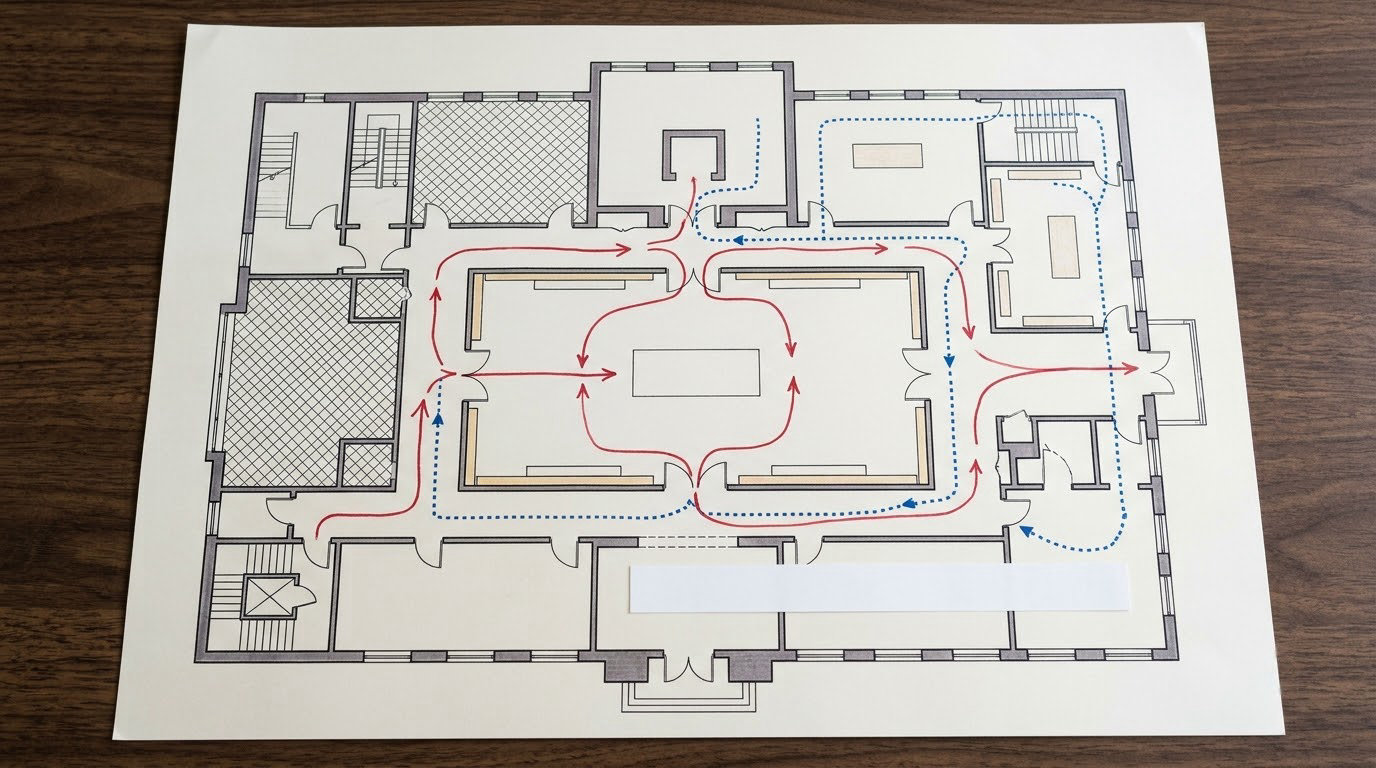
Break the job into six stages and give each one an obstacle, a choice, and a change in circumstances. That is the whole architecture.
| Beat | What happens | What the reader should know | Share of the sequence |
|---|---|---|---|
| Preparation | The crew recruits, scouts, and rehearses the weak points | The stakes and one visible risk | Short, and only if something changes in it |
| Entry | Getting in under cover of the night and the event | The route and the reason it must happen tonight | Brief |
| Deception | The disguise, the distraction, the false identity doing work | Who among the crew is least comfortable with it | Medium |
| Access | The case, the vault, the register, the safe deposit box | The obstacle’s category, not its defeat | The tense middle |
| Extraction | The stone comes free and the value of it changes hands of intention | Which person wanted it more than the others needed it | Short and decisive |
| Escape | Getting out with the clock running | What they agreed on at the start, and who is not keeping to it | Second tense peak |
On pacing the planning scene: keep it to roughly one page, and only if it changes something. The moment characters start explaining the plan to each other, the tension drops, because the reader can now predict it. If the preparation scene is dragging, ask whether one of the six beats could happen there instead. A crew member who gets cold feet during the rehearsal is a better preparation scene than a floor plan.
The test: after every beat, is the crew in a different situation than they started it in? If not, merge it with the next one.
Complicate the Plan Without Making It Arbitrary
The best complication is one the reader can trace back. Something breaks because of a choice made two scenes ago, not because the author needed tension.
The easiest fair complication is a person. Someone talks too much, someone recognizes a face, someone has a family member on the guest list, someone is not where the plan says they are. Equipment failures work if you set them up: the case was opened twice this month, the alarm panel was replaced last week, the car was a rental because the usual one was in the shop.
The genre’s central failure mode has a name writers use: the retroactive plan. When your crew produces a solution you had not thought of, and no prior scene supports it, the reader stops feeling suspense and starts waiting to be impressed. The repair is to go back and plant two specific things — a tool in an odd pocket, a name mentioned in passing, a guard described as always checking the window — so the solution reads as earned.
The check: for each complication, can you name the earlier scene that made it possible? Three you cannot trace means the plot has stopped following from its own logic.
Make the Set Piece Reveal Character
The heist is not a puzzle to be solved cleanly. It is the scene where you find out what each person will do when the plan stops working.
So give the crew a choice that is not tactical. Somebody can save a person or keep the window open. Somebody can take the stone or take the proof of what the owner did years ago. Somebody can leave the crew or leave the person they came in with. Whichever way they go, you learn something about them that the earlier chapters only implied.
Watch the tense, intimate version of this too: two people alone with the prize, one of them unable to look at it. That scene does more character work than the whole planning chapter.
How you know the scene worked: after the set piece, does any relationship between two crew members read differently than it did before?
End With Consequences, Not Just a Loose Escape
A caper earns its ending twice: once when the crew gets away, and again when the reader finds out what it cost.
Decide what happens to the jewel, to each crew member, and to the relationships between them. Some questions worth answering: who takes the blame, who gets the money and what they buy with it, who ends up in a room with the owner afterward, what the crew never says to each other, and what one of them does next. The aftermath is also where your sequel lives, because a heist that ends cleanly has nothing left to ask.
Keep it short and specific. Two pages of tense aftermath beats five pages of vague menace, and readers are usually hungry for exactly this part.
The test: can you describe what one crew member cannot go back to, in one concrete sentence? If not, the ending has not landed yet.
Common Mistakes
These are the failures that come up again and again in heist drafts, and each has a fix you can apply to an existing manuscript without starting over.
- The invisible plan. The reader learns the target and the crew, then a gap, then the escape. Fix: give the reader the shape of the job and withhold only the ending, so they understand the rules while still not knowing what happens.
- Effortless thieves. If nobody fumbles, the reader has nothing to worry about. Fix: give every crew member a flaw and let at least two of them cost the crew something.
- Unexplained expertise. A character knows exactly how to defeat a system with no basis for knowing. Fix: give them a past, a job, a relative, or a reason they are the one who belongs in that building.
- Predictable complications. The mole, the whistling customer, the car that would not start. These are conventions, not sins, and they land when you own them. Fix: use one knowingly, then subvert the other, so the reader gets the pleasure of recognition and the surprise in the same beat.
- No emotional stake. The crew is professional and the score is large, and the reader does not care who survives. Fix: put a relationship inside the crew and a reason the job matters to one of them that money cannot cover.
- An ending that erases the cost. Everyone drives off rich and the world resets. Fix: write two pages of aftermath before you write the last line of the heist, and let something stay broken.
Three tips that help more than they sound. Choose your point of view deliberately: from inside the crew the tension is improvisation, from the mark’s side it is dread, and from an investigator’s side it is a puzzle being solved — same skeleton, different book. Vary the setting’s role too, because a heist in a casino, a private collection, a museum, and a jewelry store on a high street feel like four different stories. And if you are stuck, write a smaller contained heist first, a ten-page one, because the set piece is the hardest single piece of machinery in crime fiction and practice beats are cheaper than chapters.
Frequently Asked Questions
How do I make a jewel heist story feel realistic without writing a technical manual?
Aim for category-level credibility rather than procedural accuracy. Name the kind of system in the way — a partitioned alarm, a case that logs openings, an insurance register that lists the stone by description rather than name — and let the crew’s problem be that they are out of time, not that the reader is out of information. Readers check plausibility against their own experience, which is usually retail and offices, not secure vaults.
What makes a jewel heist plot exciting instead of predictable?
Give the reader a plan good enough to predict, then make the payoff about people rather than the score. Excitement comes from watching a competent crew run out of script while the reader already knows the rules. If your tension depends on whether they can open the case, it is a puzzle. If it depends on whether the infiltrator will abandon the crew to save someone at the front desk, it is a story.
How many thieves should be in a jewel heist story?
Three to six for a novel or screenplay, and two or three for a short story. Each added thief needs a distinct job, a distinct flaw, and a scene they alone can hold; past six, readers stop tracking them and the group dialogue turns interchangeable. If you have seven and cannot cut one, give the smallest one a secret agenda so the roster reads as a pressure point instead of a list.
How much should I research jewelry security and criminal planning?
Enough to name real categories accurately: how inventory is recorded, how displays are secured after hours, what a safe deposit box changes about a job. Read public accounts of famous robberies and museum security writing for texture. Keep your notes descriptive rather than instructional, and resist the urge to be more accurate than your reader — surprising detail lands, and step-by-step method is both risky and dull.
How do I write a satisfying twist in a heist story?
Plant the twist in a scene the reader already read, then let them miss it. The double cross works when the betrayed person’s odd behaviour was on the page and read as nervousness. The swapped item works when you described the case as clearly as anything else in the book. Rule of thumb: if the reader could only see the twist coming on a second full reread, it landed. If they could not see it at all, it reads as a cheat.
What should the ending of a jewel heist story accomplish?
Four things, in this order: settle what happened to the jewel, settle who takes the blame, show the cost to at least one crew member, and leave one relationship permanently changed. Roughly two pages of aftermath does more for reader satisfaction than the entire escape sequence, and it is where your sequel starts. An ending where everyone gets away with it unchanged has not finished the story.
Conclusion
A jewel heist story holds together when every complication traces back to a choice your crew made earlier, and every beat of the job changes their situation. You can start today with three lines: name the specific prize and who wants it, list your crew’s jobs and their one flaw each, and write the single complication you already know will break the plan. Outline those, then draft the sequence beat by beat. That outline is the blueprint, and the rest is prose.