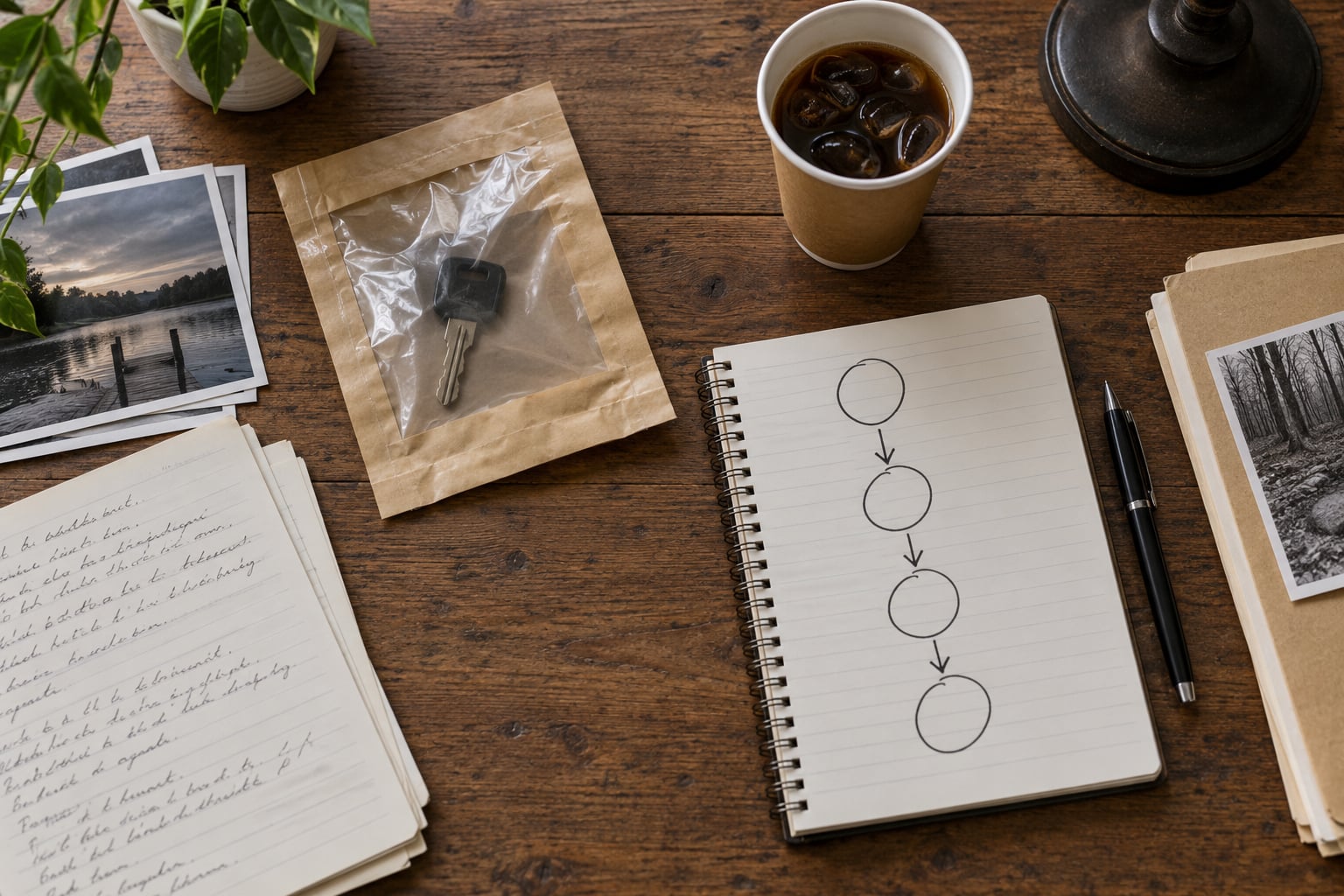
Learning how to write realistic police procedure in fiction comes down to one habit: fix the sequence before you write the scene. Real investigations run in a known order with real time limits attached, and if you know that order you can write officers who seem tired, blocked or wrong for reasons the reader can feel. Start small, pick your jurisdiction, and let the procedure do the work.
What is a police procedural? It is a crime story in which the plot is driven forward by the step-by-step work of police officers rather than by one detective’s private deduction: responding to a call, securing a scene, interviewing suspects, submitting evidence to a laboratory, then moving a suspect through custody and court.
That last clause matters. A procedural is a machine with a clock inside it, and most of what readers call unrealistic is really just a writer who forgot the machine has gears.
Table of Contents
- What You Need Before You Write Realistic Police Procedure
- Pick one country and one agency type
- Decide the time period and how much has changed
- Settle the point of view
- Build a short research list and a question list
- Know your reader’s floor
- Step-by-Step: Building Believable Police Scenes
- Step 1: Map the procedure in the right order
- Step 2: Set the agency and jurisdiction deliberately
- Step 3: Use the right level of technical detail
- Step 4: Build credible officers and witnesses
- Step 5: Let the procedure create the tension
- Common Mistakes Readers Notice
- Frequently Asked Questions
- How much police detail should I put in my crime novel?
- Do I need a police background to write a realistic police procedural?
- How do I research police procedure for a novel without getting stuck online?
- How do I write police dialogue that sounds realistic?
- Is police procedure different in the UK, the US and other countries?
- Where to Start
What You Need Before You Write Realistic Police Procedure
Most first drafts go wrong before a single officer speaks, because the writer has not decided who these people are. Five decisions fix most of it.
Pick one country and one agency type
Police authority, rank titles, arrest powers and reporting systems differ sharply by country, state and even by department within a city. A detective constable in England and Wales, a patrol officer in a US city, a sheriff’s deputy in a rural county and a state trooper do not run the same job. Choose one, and write down the rank structure so you never drift mid-book.
Decide the time period and how much has changed
Procedure is a moving target. A novel set in the 1980s has a very different reporting culture from one set now, and body-worn video, mobile data terminals and digital statement-taking all changed what officers do in the first ten minutes at a scene. Pick a year and check what did not exist yet.
Settle the point of view
Readers forgive a lot from inside a head and very little from outside one. A first-person officer can be exhausted, uncertain and wrong without the narration having to explain it. A third-person investigator who is somehow fluent in forensic science, criminal law and every witness’s motive in the same scene is asking for trouble.
Build a short research list and a question list
Two pages, not forty. Note the five sources you will actually open and the ten questions you want answered by a serving officer, a defence solicitor, a paramedic or a crime scene technician. Research without a list turns into the three-hour Google spiral that stops the novel getting written.
Know your reader’s floor
Genre readers are unusually expert. They know what a caution is, they know what a custody suite is for, and they will notice a detective solving overnight what a laboratory needs a fortnight for. Decide in advance which errors you refuse to make, and let the rest go.
Step-by-Step: Building Believable Police Scenes
Step 1: Map the procedure in the right order
Real investigations run as a sequence, roughly: the call comes in and is triaged; officers attend and secure the scene; a crime scene is processed and evidence is recovered and logged; canvassing and digital enquiries begin; a suspect is identified, arrested and interviewed under legal time limits; evidence goes to the laboratory; a charging decision is made; the case goes to court.
Write that sequence on a sticky note before you write the scene, and mark which stage your character is actually in. The story purpose of the sequence is pacing control: it tells you what your character cannot know yet. How you can check it worked: after drafting, read only the police actions in order and ask whether each one is possible from what the officers knew at that moment.
The most common fault is running the investigation faster than the law and the laboratory allow. DNA profiling, toxicology and fingerprint comparison all take time, and a case built on a result returned the same night reads as wishful thinking. Give the waiting room a job: it is where the case stalls, where a character says too much, where the second body turns up.
Step 2: Set the agency and jurisdiction deliberately
To write realistic police procedure you have to be specific about authority. Who can arrest without a warrant, who needs one, who can interview, who refuses, who records it, and what the suspect is told at the moment of arrest. The answers change with the place and the period, and they are the first thing a serving officer or a sharp reader will check.
Jurisdiction choice is a craft decision, not a logistics one. An unfamiliar country gives you distance and a fresh supply of friction for your detective, but it also means you carry every detail. If you have never set foot in the country, consider a mid-sized city in a system you have researched properly rather than a major capital you have only seen on television.
Useful named starting points: the law and procedure guidance published by the prosecution service in your chosen country, the operating procedures and public-facing pages of the force or department, and general policing manuals such as the Blackstone’s series, which get rewritten every year and can be picked up secondhand in an earlier edition. Older editions still teach you the shape of the process; only the numbers and statutes move.
There is also a named handbook written for exactly this job: Michael O’Byrne’s The Crime Writer’s Guide to Police Practice and Procedure. It is the book most working crime writers mention first, and it is worth reading before you start interviewing anyone, because it teaches you which questions are the ones worth asking.
How to check this step worked: put your rank titles, your arrest rules and your evidence rules in one list, then search the draft for any term that is not on it. Anything off the list is a decision you made by accident.
Step 3: Use the right level of technical detail
Include procedural detail only when it does one of three jobs: it reveals character, it creates pressure, or it changes the outcome. A detective who notes that the door was not forced tells you she is tired and has seen twenty burglaries this month. A detective who recites the entire forensic procedure tells you nothing at all.
The discipline is subtraction. Draft the scene with every fact you know, then cut each fact that does not work. What survives should be short, specific and slightly inconvenient. Concrete nouns beat technical nouns: a wet footprint that has already dried, a witness who keeps saying “then” instead of a time, a car that has been moved before anyone arrives.
Two habits help here. Keep margin notes while drafting instead of stopping to search, so you never lose the thread of the scene. And keep a continuity list of procedural facts as you go, because a series that says a suspect was cautioned in book one and arrested without caution in book four will be spotted by your most attentive readers.
Step 4: Build credible officers and witnesses
An officer has motives beyond the case: shift patterns, a partner they cannot stand, a promotion they want, a supervisor watching, a family dinner they are missing. Give every officer one of those and their procedural choices start to look like choices.
Keep their knowledge imperfect. Officers are not lawyers, they do not know what the laboratory will find, they mishear names, and they write down what they were told rather than what happened. Real expertise in a scene should belong to one person, a scene examiner or a forensic scientist, and the rest of the team should wait for that person rather than talking like the textbook.
Witnesses are harder. They remember badly, reconstruct rather than recall, exaggerate, conceal what makes them look foolish and contradict themselves without lying at all. Write a witness twice: once saying what they think happened, once saying what they are willing to admit. The gap between those two is where most good interrogation scenes live.
How to check: read the dialogue with the officers’ names removed. If a stranger could not tell which of your officers said a line, the voices are not doing enough work yet.
Step 5: Let the procedure create the tension
Realistic police procedure in fiction is tense not because the writer described a tense scene but because the process is pushing against the character. The clock runs: the suspect must be interviewed before the time limit expires, the crime scene will be released on Thursday whether or not you are ready, the laboratory queue is weeks long, the charge has to be justified on what you can prove rather than what you suspect.
Conflict inside a single scene comes from competing goals. The detective wants the confession, the custody sergeant wants the file closed, the pathologist wants the body moved, the family wants a name today. None of them are villains. Every one of them is doing a job that has its own pressure, and that is far more durable than a villain who resists for plot reasons.
Chase, arrest and solution should be the least interesting parts of the sequence to you. The middle is the book: the canvass that comes back empty, the statement that contradicts the evidence, the warrant that takes a day, the interview that ends because the custody clock ran out.
Common Mistakes Readers Notice
Most procedural errors fall into a handful of patterns, and each has a straightforward fix.
Omniscient procedural knowledge. Your detective knows the autopsy result before the body has been examined, because you needed the information two chapters ago. Fix: write the scene from the officer’s position and move the knowledge later.
Instant deductions. A character stares at a room for four seconds and names the culprit, the motive and the disposal site. Fix: detective work is a chain of small, boring, correct steps. Show two of them, and let the reader assemble the rest.
Uniform terminology across jurisdictions. The same word, the same rank and the same procedure used everywhere. Fix: pick one jurisdiction and hold it, as in step 2.
Dialogue nobody speaks. Characters say “let’s take a statement” in a register no tired officer uses at two in the morning. Fix: read the line aloud. If you would not say it, cut or reword it, and remember that police speech is often compressed, procedural and full of half-finished thoughts.
The paperwork dump. A chapter that recites statute books or custody rules to show the writer did research. Fix: cut it to one line that the character resents, and keep the scene moving.
Unexplained access to evidence. A detective searches a car, lifts a fingerprint from a mug and gets a result in an hour with no account of who authorised it or why. Fix: name the authorisation. Chain of custody and consent are plot, not decoration.
Arresting the wrong person for the wrong reason. Police arrest on suspicion and reasonable grounds, not on proof. Fix: give them a reason a court would recognise, even if the reason turns out to be wrong.
Two more worth naming. Television is not a reliable research base: crime dramas compress, dramatise and occasionally invent, so a scene copied from a hit series may be less accurate than the chapter of a well-researched novel. And process is slow: if your whole investigation takes three days, check what you have quietly deleted, because a realistic case rarely moves that fast.
Frequently Asked Questions
How much police detail should I put in my crime novel?
Put in the detail that changes something. Every procedural fact you include should reveal a character, create pressure or alter the outcome. Write the scene with everything you know, then cut the facts that only show you researched. Readers notice errors, not thoroughness, so a lean scene that gets the sequence right beats a long one that reads like a manual.
Do I need a police background to write a realistic police procedural?
No, but you need sources. Serving and retired officers regularly advise crime writers, and published handbooks such as Michael O’Byrne’s guide to police practice and procedure explain the sequence in detail. Combine a good reference work with a conversation with someone who did the job, and check anything that would embarrass you if an officer read it.
How do I research police procedure for a novel without getting stuck online?
Cap your research and give it a job. Keep a short list of sources and a list of questions before you start, spend a fixed amount of time on a chapter, and note answers in the margin while drafting instead of stopping mid-scene. If a scene is going to be cut anyway, research it last. The goal is finished pages, not a perfect dossier.
How do I write police dialogue that sounds realistic?
Read your lines aloud and cut anything you would not say tired at three in the morning. Police speech is short, procedural and often elliptical, and it leans on the call sign, the time and the form reference rather than on emotion. Give each officer a different cadence, and let a junior officer say less and a tired sergeant say less still.
Is police procedure different in the UK, the US and other countries?
Yes, and the differences are bigger than vocabulary. Arrest powers, cautioning, custody time limits, rank titles, court stages and the role of the prosecution service all vary by country, by state and by agency. Choose one system, read its official guidance, and hold it consistently across the book, especially if the novel is part of a series.
Where to Start
Open a document and write the investigative sequence for your case in order, then mark the stage your detective reaches in your opening scene. Everything else follows from that one page: what they know, what they are waiting for, and where your plot is going to fight them.
One last thing. Story first, accuracy second, in that order. Bend a rule when the bend serves the story, and let a character pay a small price for it, and the reader will believe you far more than if you got every step technically right and lost them in the middle of a chapter.