How to start reading crime fiction is simpler than the shelf in a bookshop suggests. Pick one subgenre you already enjoy the sound of, choose a book with a clear crime at its centre, and read it the way you would read any novel. Nothing else is required.
Most people who stall at the start are not short of interest. They are standing in front of six hundred spines, being told that noir and cosy mean opposite things, and worrying about picking wrong. So this guide takes the choice apart in six small decisions instead of one enormous one.
Table of Contents
- What You Need
- Step-by-Step: Build Your First Reading Path
- Choose the Kind of Crime Story You Want
- How to Start Reading Crime Fiction by Choosing an Accessible Book
- Read for the Story Before Solving the Puzzle
- Keep a Lightweight Reading Record
- Expand by One Book at a Time
- Let Your Taste Define the Next Step
- Common Mistakes
- Quick Tips for Making Crime Fiction Easier to Enter
- Frequently Asked Questions
- What should I read first if I have never read crime fiction?
- Is crime fiction always violent, dark, or full of disturbing themes?
- Do I need to read famous crime-fiction series in publication order?
- Should I avoid a mystery if I cannot solve every clue?
- Is it better to start with novels or short stories?
- How do I expand beyond one author without making a huge reading list?
- Start With One Book Tonight
What You Need
You need a book you can hold and about two hours, which is roughly what it takes to know whether you like something. Paper or an e-reader or an audiobook app all work; format matters far less than people think.
You also need permission to be a bad reader for a while. Crime fiction uses conventions you will not recognise on page one, and that is normal. Nobody hands you a glossary at the start of a novel, and nobody sits next to you at the cinema to explain the third-act twist either.
What you do not need is a plan for the genre. Treating reading like a syllabus is the fastest way to quit. The goal for your first book is enjoyment and completion, not solving anything.
Step-by-Step: Build Your First Reading Path
Six decisions, in this order. Skipping ahead to the last one is how people end up forty pages into a book that was never for them.
Choose the Kind of Crime Story You Want
Start by naming the kind of story you want, not the author. Six labels cover almost everything on the shelf, and you only need one of them to begin.
- Classic detective — a puzzle at the centre, a detective who out-thinks the room, suspects gathered in one place. Fair play is the rule: the answer is reachable from what you were told.
- Police procedural — the machinery of an investigation, shift by shift. Forensics, paperwork, interviews. Character and career carry as much weight as the solution.
- Noir and hard-boiled — a corrupt or tired city, a narrator who is not entirely honest, atmosphere doing most of the work. Violence on the page, usually off it.
- Thriller — momentum first. Violence is more frequent and more graphic, the stakes are larger, and the ending may leave less resolved.
- Cozy mystery — low violence, a village or small town, an amateur sleuth, a death that is rarely graphic. Crime that resolves without anyone being permanently ruined.
- Crime-comedy — the same structures, played for laughs. A very low-stakes way to sample procedural plotting without taking it seriously.
Pick one. If you genuinely cannot, start with cosy or crime-comedy, because both forgive a reader who is still learning the format. Read threads on r/suggestmeabook repeat this advice more often than anything else: name the vibe, then the book follows.
How to Start Reading Crime Fiction by Choosing an Accessible Book
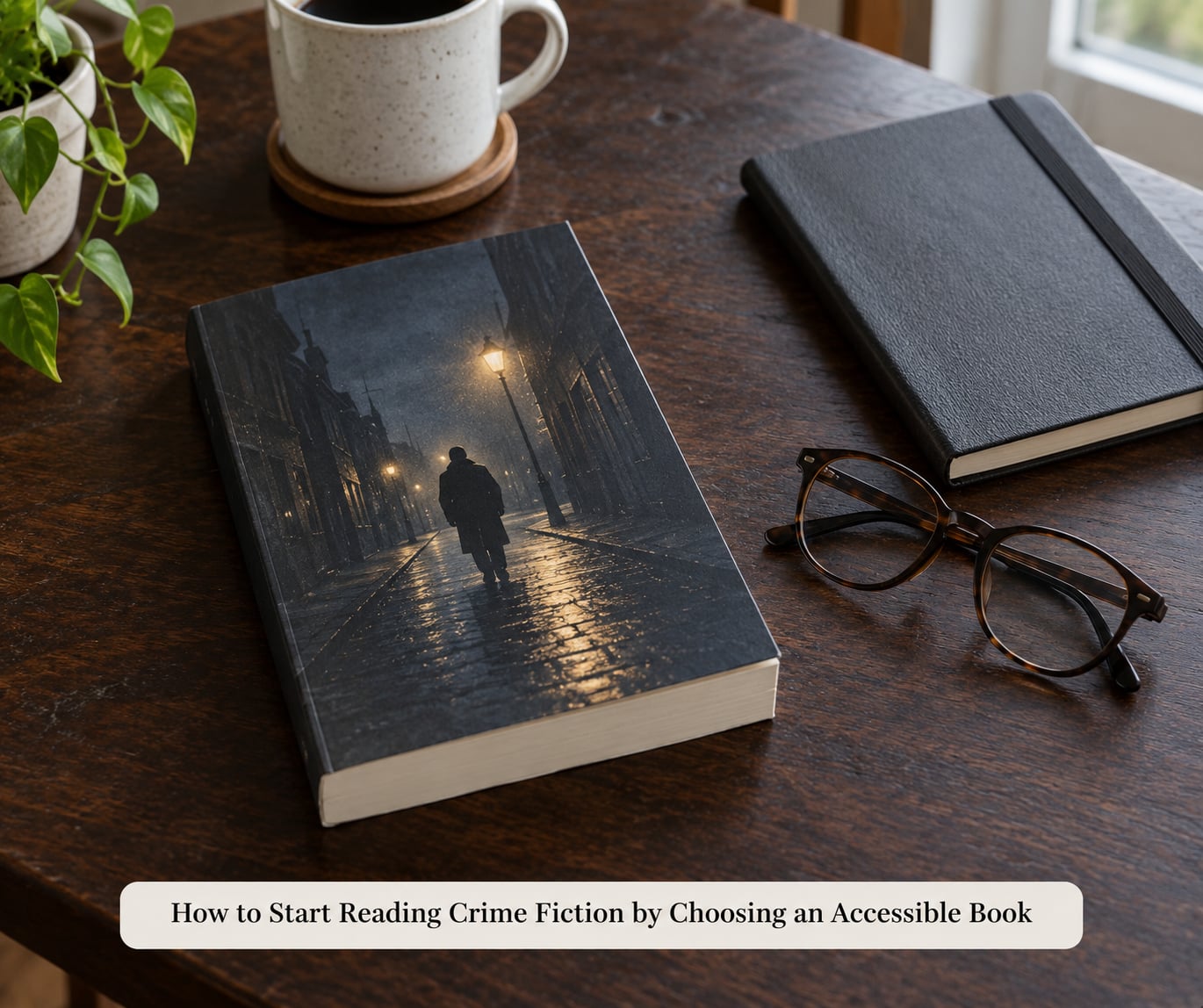
A good first choice has four qualities, and they matter more than the author being famous.
- One central crime you can state in a sentence. If you cannot summarise what happened without hedging, the premise is too dense for a first attempt.
- A protagonist you would follow anyway. Warmth beats competence as a starting point. You do not need to admire the detective, only be curious about them.
- No prior knowledge required. Nothing outside the text, no assumed geography, no running gag you must already understand.
- An edition you can actually get. In a library, on an audiobook app, or in a second-hand shop. If the only copy is a hardback with a two-year wait, choose a different book.
Concretely: an Agatha Christie or an Arthur Conan Doyle novel is the classic doorway, because the structure is so well lit that you cannot get lost. Edgar Allan Poe’s opening tales are shorter still if you want forty pages instead of three hundred.
P. D. James and Raymond Chandler are good second moves once you know which of the two moods you like, because their prose rewards attention the way Christie does not demand. Ian Rankin, Michael Connelly and Elly Griffiths are the sort of names a librarian reaches for when you ask for a series worth staying with.
Watch the page count. Anything in the 280 to 400 page band finishes in about a week of commuting or two evenings, which is short enough to keep momentum.
Read for the Story Before Solving the Puzzle
You do not have to try to solve the mystery, and plenty of regular readers never do. Suspicion is a form of participation, but it is not the only way in, and treating a missed clue as a personal failure will make the genre feel like an exam.
Four things carry a crime novel even if you never solve anything: why a character did what they did, how the city or village feels, what the narrator is trying to hide, and how the investigator changes by the end. Follow those and you are reading properly.
A simple check for whether you followed: finish, then write one sentence on why the solution fits and one on the moment it stopped surprising you. If both sentences exist, you understood the ending. That is the only test worth running.
Many readers describe the opposite habit, staying alert to every character who walks into a room. Forum threads about it are full of good-natured complaints. It fades on its own once the genre teaches you what a red herring looks like.
Keep a Lightweight Reading Record
Write down four things after each book: one line on your overall impression, the element you liked most, the question you are still holding, and any title someone recommended as similar.
That is the whole system. It takes ninety seconds and it does two useful things later: it stops you re-reading something that did not land, and it turns “I liked that one” into an actual next-book decision instead of a vague feeling.
Keep it somewhere you will see it. A notes app, the back of a notebook, a running list. Do not build a database; the moment bookkeeping becomes the hobby, most readers stop.
Expand by One Book at a Time
The next book comes from one of three places, and one is enough. Read the next in the same series, read whatever one trusted reader or bookseller names, or read a book adjacent to the one you liked.
Same detective is the strongest habit. Familiarity with a recurring cast removes the small effort of learning new people and lets you enjoy the case instead, which is exactly what the first book is teaching you to do.
Do not hold back new work until you have finished the classics. That queue is how a shelf becomes a wall, and reading in order is not a moral achievement. If a book is available in a translated edition and you want it, read it now.
Let Your Taste Define the Next Step
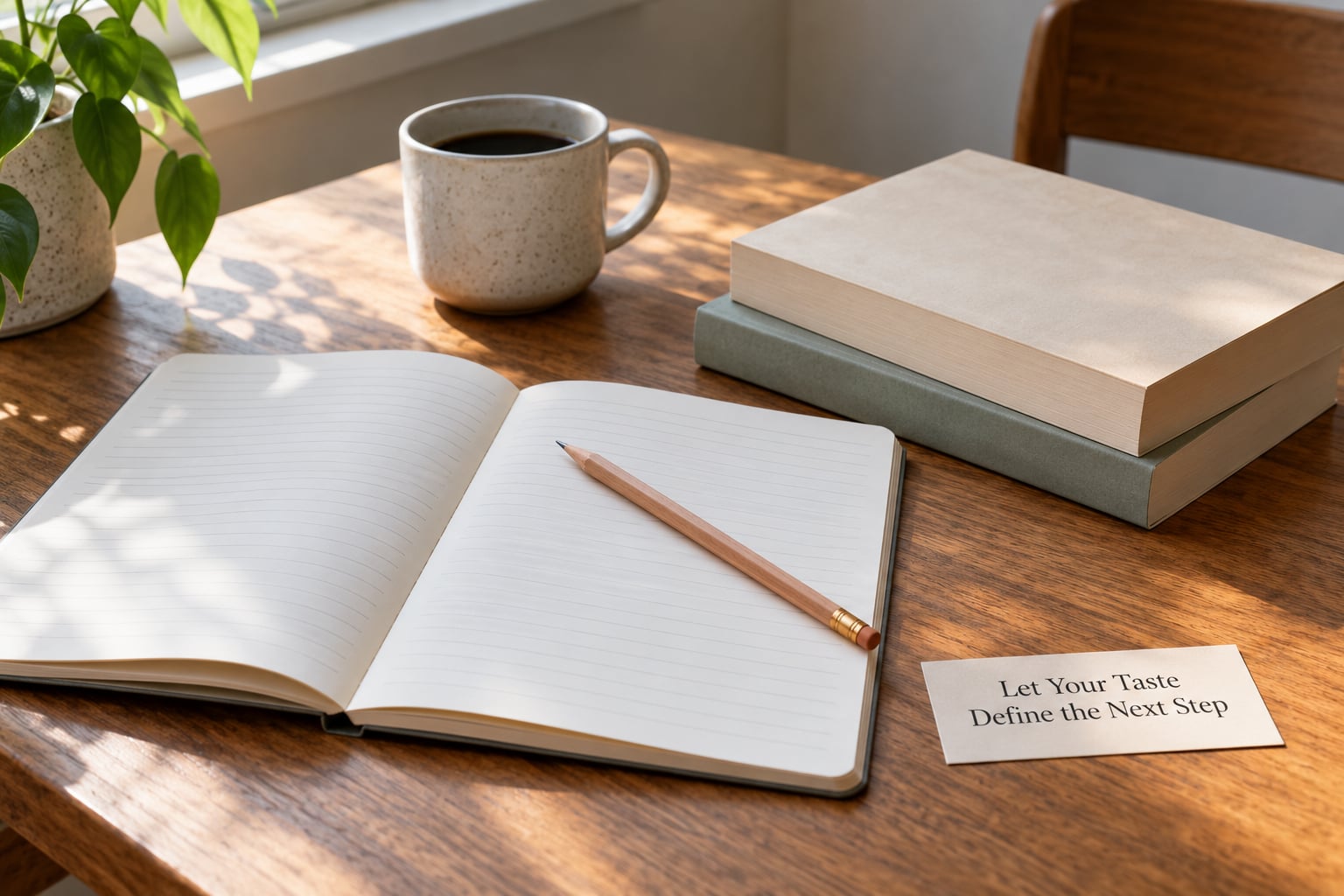
After two or three books, the useful question is not which one was best. It is what you wanted more of.
- You wanted atmosphere more than mechanism — move towards noir and hard-boiled.
- You wanted the job, the process, the shift — stay in police procedural.
- You wanted to be inside a mind you could not quite trust — psychological and noir territory.
- You wanted the trick, the closed circle, the satisfaction of the last page — classic detective and fair play.
- You wanted the page turned fast and did not mind graphic violence — thriller.
- You wanted to finish in four days without carrying the dread home — cosy.
- You kept noticing what the book was saying about policing, class or gender — that is a reason to read the criticism alongside it, starting with Martin Edwards’ The Life of Crime.
Any of those is a legitimate reading life. They are preferences, not stages, and readers happily sit in one for a decade.
Common Mistakes
Treating a to-be-read list as a syllabus. The correction: cap the list at three titles. The rest can wait without being lost.
Starting with the book everyone calls difficult. Beginning with a long, tonally cold or famously manipulative novel is how beginners conclude they do not like the genre. Start with something structurally friendly, then earn the harder stuff.
Confusing darkness with bad writing. Noir and thriller are dark by design; that is a choice the author made, not evidence of carelessness. Judge the prose and the characters, not the body count.
Refusing narrators who are unreliable or offensive. These are the most common techniques in the genre. A narrator who lies to you is giving you a second story to read underneath the first.
Quitting at the first slow chapter. Crime novels often front-load procedure and pay off in the last third. Judge at around the hundred-page mark, not the fortieth, and if it still has not engaged by then, move on without ceremony. Dropping one book is cheap; forcing yourself through five is what ends a hobby.
Holding a fixed violence tolerance. Nobody is wrong for preferring cosy to noir. Readers who know their limit enjoy the genre more over time than readers who pretend otherwise and abandon it.
Quick Tips for Making Crime Fiction Easier to Enter
Read the last few pages of the back matter first. Introductions and appendices often explain a subgenre’s conventions in a page, and knowing that fair play means the clue was in front of you removes a lot of frustration.
Sample audiobooks before committing. A narrator’s voice changes a book more than readers expect, and ten free minutes is cheap insurance for a commute you will live with daily.
Accept unresolved endings. Ambiguity is a legitimate choice in this genre, not a failure of nerve by the author.
Use a screen adaptation as a follow-up, not an entry point. Watching a series you already know the books for is a genuine pleasure; watching one cold is not a shortcut into reading.
Pick a discussion space without spoilers. A good spoiler-free forum will not spoil a reveal, and a badly chosen one will cost you the ending of anything you read next.
Frequently Asked Questions
What should I read first if I have never read crime fiction?
Pick one famous doorway — a Christie, a Conan Doyle, or Poe’s shorter tales — because the structure is simple and widely liked. Or start with a cosy mystery if you want low violence and a book under 400 pages. The most important thing is that you finish it, so choose something you can get hold of today rather than something you admire.
Is crime fiction always violent, dark, or full of disturbing themes?
No. Violence level is one of the widest axes in the genre. Cozy mysteries involve a death but rarely anything graphic, crime-comedy involves almost none, and noir and thrillers sit at the other end with frequent violence and darker themes. Nobody can tell your comfort level from the shelf label alone, so check reviews before a subgenre that sounds dark.
Do I need to read famous crime-fiction series in publication order?
Start with book one of anything you intend to follow to the end; the early books in long detective series tend to be shorter and the cast is easier to learn. If you are only curious about whether a detective appeals to you, any later book works as a taste test, though you will lose some background. Starting mid-series is not a mistake worth worrying about.
Should I avoid a mystery if I cannot solve every clue?
Not at all. Most readers do not solve fair-play mysteries, and plenty of the strongest ones stay ambiguous to the last page. What you can usefully track is why a character acted, what the setting feels like, and what changed by the end. Suspicion is a bonus, not a requirement.
Is it better to start with novels or short stories?
Short stories are the lower-commitment entry point, and the genre has an outstanding short form — Poe’s tales and the Golden Age short mystery are still read. A dozen stories can teach you conventions in an evening. Novels give you a sustained world and a recurring detective, so most readers use stories to sample and novels to get hooked.
How do I expand beyond one author without making a huge reading list?
One book at a time, drawn from three places: the next book in the same series, one recommendation from someone whose taste you trust, or one novel adjacent to what you liked. After each book write down the element you enjoyed most and let that drive the next choice. A three-title list you actually read beats a fifty-title list you maintain.
Start With One Book Tonight
Choose the one subgenre from the list above that sounds best, pick a book under 400 pages with a single clear crime in it, and start. Do not read reviews, do not plan the next three, and do not look up the author reading order tonight.
When you finish, decide the next book from what you enjoyed rather than what you should read. That is how to start reading crime fiction properly, and it keeps working long after the first one.