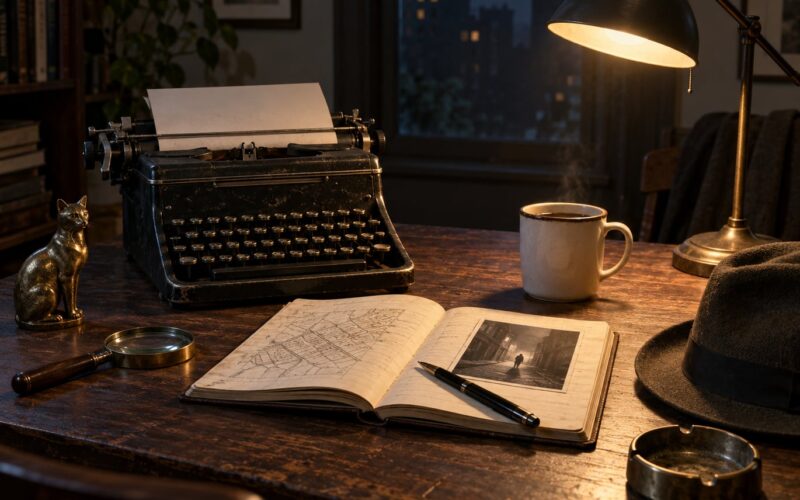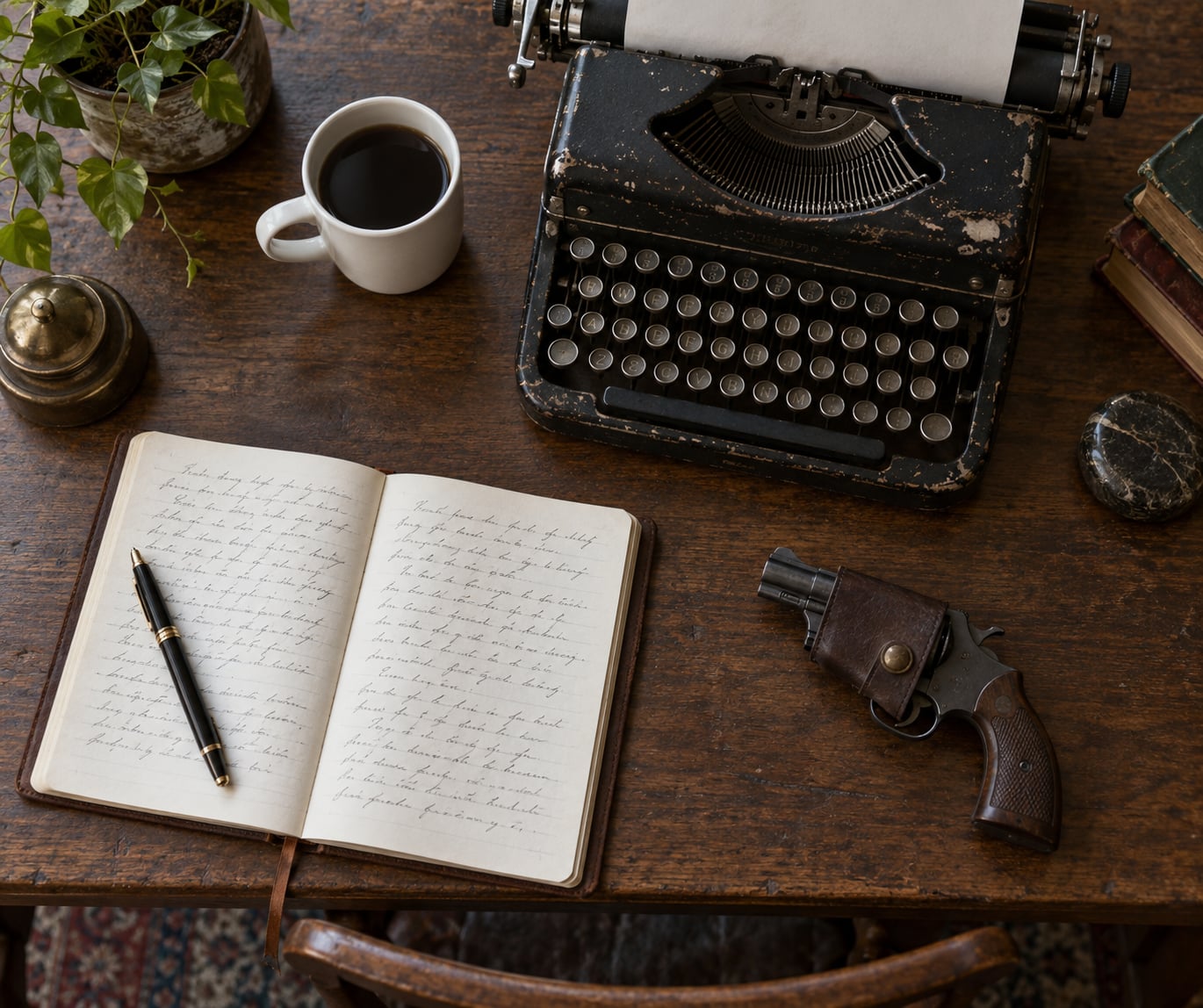
Humor in crime fiction works when it grows out of the people doing the detecting, the criminals being caught, and the ordinary world pressing in on both. The funniest crime novels are not jokes stapled onto a mystery. They are mysteries where the investigator, the witness, the coroner, and the person who found the body each have their own way of noticing the same disaster, and the reader gets to watch those perceptions collide.
This guide is a working method rather than theory. It runs from choosing a comic register, through voice, contrast, dialogue, and placement, to a revision pass that tells you whether the humor is doing any real work. Most drafts that fail do so for predictable reasons, and those get their own section with a fix for each. Budget a full revision cycle for the laugh lines, because humor that reads fine on the page can fall flat out loud, and the failure is invisible until you hear it.
One warning before you start. The single most common complaint from crime fiction writers and their editors is that humor in a serious story feels pasted on. Almost always the cause is the same: the joke was written to make the reader laugh instead of to make the character more interesting. Everything below points back to that distinction.
Table of Contents
- What You Need
- A defined comic voice
- Awareness of the genre conventions you are playing against
- A serious emotional or narrative stake
- A filter for which jokes earn their place
- How to Write Humor Into Crime Fiction Without Losing Tension
- 1. Decide What Kind of Humor Fits the Story
- 2. Establish a Distinctive Comic Voice
- 3. Let Humor Reveal Character and Relationship
- 4. Build Comic Contrast Against the Crime
- 5. Use Dialogue as Rhythm, Not Exposition
- 6. Place Jokes at Turning Points
- 7. Read the Story for Balance and Respect
- How the same tools change by subgenre
- Common Mistakes
- The punch line arrives where nothing was set up
- The joke explains the mystery
- Every character is witty
- The humor undercuts the danger
- Irony is used as a substitute for subtext
- Humor is used to dodge the emotional consequences
- The humor punches down
- Frequently Asked Questions
- How do I add humor to crime fiction without making the story feel unserious?
- What is the difference between humor and dark comedy in crime fiction?
- Should a crime victim ever be the source of a joke?
- How do I make witty dialogue sound natural between characters?
- Where should I place jokes in a tense crime scene?
- How do I know if my humor is working before I publish?
- Conclusion
What You Need
You need four things in place before a single joke goes into the draft. Miss one of them and the humor reads as authorial intrusion, which is the fastest way to lose a reader who came for the case.
A defined comic voice
Pick one character whose way of seeing is funny, and know exactly why. A detective who finds everything funny is not comic, they are just a mouthpiece. A detective who finds everything funny because they once laughed during their own autopsy, and now they flinch at the memory of it, has somewhere to go.
Write a short paragraph describing that character’s internal commentary: what they notice first in a room, what annoys them, which ordinary phrase they find unbearable. If you cannot write that paragraph in a few sentences, you are not ready to write jokes for them.
Awareness of the genre conventions you are playing against
Comedy needs a straight man, and in crime fiction the straight man is the genre itself. The reader arrives with an expectation formed by thousands of procedurals, noir novels, and crime series. A dead body in a kitchen, a detective with a stakeout, a coroner delivering bad news in a corridor. Break that expectation on purpose and you get a laugh you have earned.
Conventions shift by subgenre, and your humor has to sit inside the one you are writing. More on that below.
A serious emotional or narrative stake
Without a real stake there is nothing to relieve, and relief is where the release of tension comes from. The victim has a name. The detective has a reason to be awake. If the story’s central loss is treated as a plot device, humor attached to it will always feel cheap, because the writer already decided it did not matter.
A filter for which jokes earn their place
Decide in advance: humor in this book reveals character, sharpens conflict, or relieves pressure. Those are the three jobs. A line that does none of them is a line you cut, no matter how much you enjoyed writing it.
Writers on writing forums describe the opposite habit, adding a quip to every scene to keep the pace lively. It flattens the emotional range and readers notice, even if they cannot name what went wrong. A quieter book with three well-placed jokes beats a loud one with thirty.
How to Write Humor Into Crime Fiction Without Losing Tension
The process has seven steps. You choose a comic mode that fits the story, build a voice that can carry it, use the jokes to reveal character, set the humor against ordinary behavior so the contrast does the work, cut the dialogue for rhythm rather than information, place the jokes at the right beats, then read the whole thing aloud to check balance and respect. Each step depends on the one before it, which is why starting with a list of favorite jokes almost never works.
1. Decide What Kind of Humor Fits the Story
Comic dialogue, irony, satire, absurdism, gallows humor, and dark comedy are six different tools, and mixing them without a plan is how a book ends up tonally incoherent. Irony points at something the reader already knows and the characters do not. Satire attacks a system, a profession, or a town. Absurdism lets a scene run on logic that is internally consistent and externally insane. Gallows humor is laughter offered by people who have no comfortable way to express grief. Dark comedy finds the funny shape inside a violent or morally disturbing situation.
Match the mode to the narrator, the crime, and the emotional temperature of the book.
A hard-boiled private eye tends to run on understatement and verbal counterpunch. The jokes come from the narrator noticing how rotten the world is and refusing to be impressed by it. The prose stays flat and the observations cut.
A police procedural lives on banter and ensemble friction. With a cast of six you have six perspectives on the same evidence, and the comedy comes from them colliding in a briefing room.
A literary noir has almost no room for jokes and can still be wry. The humor is dry, infrequent, and it lands harder for being rare. A wry observation every fifteen pages in a bleak book carries more weight than a gag in every scene.
Cozy mysteries, capers, and thrillers each carry their own rules about how much levity the reader will accept, and the section on subgenres below goes into that. The decision to make first is which of the six tools you are using, because everything after that is downstream of it.
2. Establish a Distinctive Comic Voice
Voice is diction, observation, timing, syntax, and repetition used in a consistent pattern. Take those five apart and you can build a comic voice that no one else on your shelf has.
Diction is the word choice. A character who describes a dead man as deceased belongs in a different book than one who describes him as cooling off in the third drawer. Push the vocabulary until it is slightly wrong for the situation, then hold it steady across the whole manuscript so it reads as a person rather than a gimmick.
Observation is what the character notices. Everyone in a crime scene sees the body. Your detective notices the body and the single dry orange on the counter, the parking permit in the bowl, the neighbor who has already stopped cooking. Comic noticing means the detail is chosen for what it reveals about the observer, not for atmosphere.
Timing in prose is sentence length and placement. A joke that arrives after two long sentences reads slower than the same joke after two short ones. If you want a laugh, shorten the sentence before it.
Syntax is sentence shape. A mind that interrupts itself, a character who starts a sentence three times, or a formal character who never quite finishes a thought all produce comedy through structure rather than content.
Repetition is the engine of a running gag and a callback. A character who has a phrase they use when frightened, and who uses it now for the first time in a situation that should frighten them, gives you a payoff that costs two sentences and lands like a punchline.
Preserve the seriousness of the situation while you do all this. The trick is that the character is funny, not the crime. Their perspective skews, the facts stay intact, and the reader can hold both at once.
3. Let Humor Reveal Character and Relationship
A joke that only exists to be a joke can be cut and the scene still works. A joke that exposes someone’s priorities cannot, which is why the good ones are worth hunting for. This is the technique most often discussed in writing communities, and the version that works is not adding a funny line to a character but letting the character’s way of joking tell you who they are.
Take a suspect who says, in the middle of a murder interview, that he is relieved the detective came, because he had been worried about the driveway. He is not funny. He is a man with a very specific anxiety, and he just handed it over while trying to seem cooperative. That is characterization delivered through a joke, and it also gives the detective something to work with.
Relationships are where banter lives. Two partners can trade jokes, but the joke reveals who holds the power. If one character can end any exchange and the other never can, the reader learns the hierarchy without a line of exposition. If the jokes are perfectly even, you have a buddy movie rather than a partnership with friction, and friction is what generates plot.
Writers on crime fiction forums make a useful point about the same remark landing differently in different ears. A deadpan joke from a suspect might be funny to the detective and a threat to the victim’s father sitting three feet away. If the scene contains both, you get comedy and menace in one line, and you do not have to add anything else.
Three character types generate most of the useful crime humor: the self-deluded protagonist who misreads evidence because of their own assumptions, the professional who is competent and exhausted and slightly impatient with civilians, and the criminal whose self-image is more impressive than his actual operation. The last one is a gift, because the gap between the fantasy and the reality is a joke that keeps generating pages.
4. Build Comic Contrast Against the Crime
Contrast is the most reliable comic engine in the genre and it costs nothing, because the material is already in the scene. Any behavior that would be unremarkable anywhere else becomes funny when it happens next to a body.
Pair ordinary procedural language with the grim content. A detective filling out a form while describing what he found is funny because the form is designed for a fender bender. Someone offering condolences while clearly relieved it was not their house. A suspect answering questions in the specific cadence of a workplace manual, because that is how they have learned to sound when frightened.
Set domestic routine against violence. Someone is making tea while explaining where the body is. A child is asking about dinner during an interrogation. Nobody is being mocked in these moments, and that is the point. The humor comes from the situation being unable to hold both things at once.
Use social expectation as the second half of the contrast. A man who is entirely naked and completely calm has no power, and the calm is the joke. A character who says something obscene at a funeral and means it sincerely. The rule of thumb is that the serious thing stays visible. If the reader forgets for a moment that someone died, the contrast has failed and the scene has tipped into farce.
Farce has a legitimate place, mostly in caper novels and cozy mysteries, but it works by holding the stakes constant. A farcical caper with real consequences and a farcical caper where nobody is harmed read as two different books, and readers pick up on the difference quickly.
5. Use Dialogue as Rhythm, Not Exposition
Interrogation, negotiation, and suspicion scenes move faster when the information arrives sideways. If your detective asks a question and a witness answers it, the scene is doing paperwork. If the witness answers a different question, badly, and the detective has to decide what to do with the gap, the scene has started working.
Three practical moves. First, cut a joke and see what improves. A lot of comic lines exist because the author liked them, and removing them tightens the beat around them. Second, escalate a retort instead of stacking three of the same joke. Two characters trading one-liners at equal length is a stalemate; someone who finally cannot answer is a story moving forward. Third, give each speaker a different rhythm. One talks in complete sentences, one in fragments, one answers questions with questions, one apologizes constantly. Distinct cadence is what makes dialogue readable on the page without tags.
Evasion is the best comic material in a crime novel and it is free, because people under questioning are genuinely evasive. A witness who gives a beautifully detailed account of everything except the ten minutes that matter is funny and suspicious at the same time.
Hard-boiled voice has a specific trick worth naming. The jokes in that tradition almost always carry a second meaning the speaker does not intend. The narrator calls a place a den of thieves with complete sincerity, and the reader hears both the surface insult and the knowledge of what the place is. That doubling is harder to write than a gag and it does more for voice.
6. Place Jokes at Turning Points
Where a joke sits in a scene changes what it does. A joke before a revelation is a pressure release, and it makes the reader’s guard go down so the revelation hits harder. A joke during an argument interrupts and resets the temperature, which can save a scene that has stalled. A joke after a violent moment is a risk: it can look like the writer is flinching away from what just happened.
The pattern that works most reliably is release, turn, silence. Let the pressure build through the scene, give the reader one laugh roughly two-thirds of the way through, then let the discovery land in quiet. That is also why a joke placed at the very end of a chapter feels manipulative. The reader knows something is coming and the joke tells them you know too.
Know when to use silence. After a death, after a reveal that changes what a character understands about their own life, and at the end of a scene where the danger has just moved closer. Silence in those places is not a gap, it is the reader’s stomach dropping.
Build a small ladder of escalating jokes instead of one big one. Three beats that each end on a slight escalation, with the third landing on the thing the character has been avoiding, reads as a character losing their footing. One joke that tries to do all three at once reads as an author showing off.
7. Read the Story for Balance and Respect
Revision is where humor gets fixed, because the author’s ear is gone by the third draft. Read the manuscript aloud, at pace, in a room where people can hear you. Anything you stumble over, anything you have to reword on the fly, and any line where your voice goes flat is a problem the reader will feel even if they cannot name it.
Then check each joke against three questions. Does it come from this character, or would anyone say it? Does it keep the stakes visible, or does it let the reader off the hook? And does it need a victim’s pain to work? If the answer to the third is yes, cut it, no matter how clever the phrasing was.
Testing with beta readers takes a specific approach. Do not ask whether the book is funny. Ask where they laughed, and where they stopped caring. Those two questions give you a map of the comic structure without leading them. Readers who report the same joke are telling you your humor lives in one scene and needs to be distributed; readers who report no laughs at all are telling you the voice is not landing, and probably not because they lack a sense of humor.
Series writers face a different version of this problem. A comic voice has to survive repetition, so build escalation into the running gags and let the character’s humor change as their circumstances do. A joke that works in book one and reappears unaltered in book five is a tic, not a joke. Beta readers across several books are the fastest way to spot one, because the second book usually shows it first.
How the same tools change by subgenre
Cozy mysteries run on ensemble friction, pets, small towns, and an amateur sleuth who is out of their depth. The reader expects warmth, and the danger is that warmth turns the murder into a scheduling conflict. Keep the victim’s life specific and the humor goes in the community, not the crime.
Noir and hard-boiled fiction run on understatement, the narrator’s contempt for everyone around them, and a grimy setting treated with affection rather than disgust. They have the least room for jokes and get the most mileage from the ones they allow.
Police procedurals are built for banter. Multiple investigators with different methods and different histories create conflict that generates jokes for free, and the structure tolerates running gags because the same team keeps meeting new suspects.
Thrillers need the least humor and benefit most from contrast. A single wry line in an otherwise serious book is a pressure release that makes the surrounding danger feel more real, not less. Two jokes in the same scene and the tension is gone.
Caper novels and comic crime are the one place where the crime can be funny. That is not a license to make the victims funny, but it is a license to write suspects who are incompetent, pompous, or in over their heads, and to let the plan fall apart in entertaining ways.
Common Mistakes
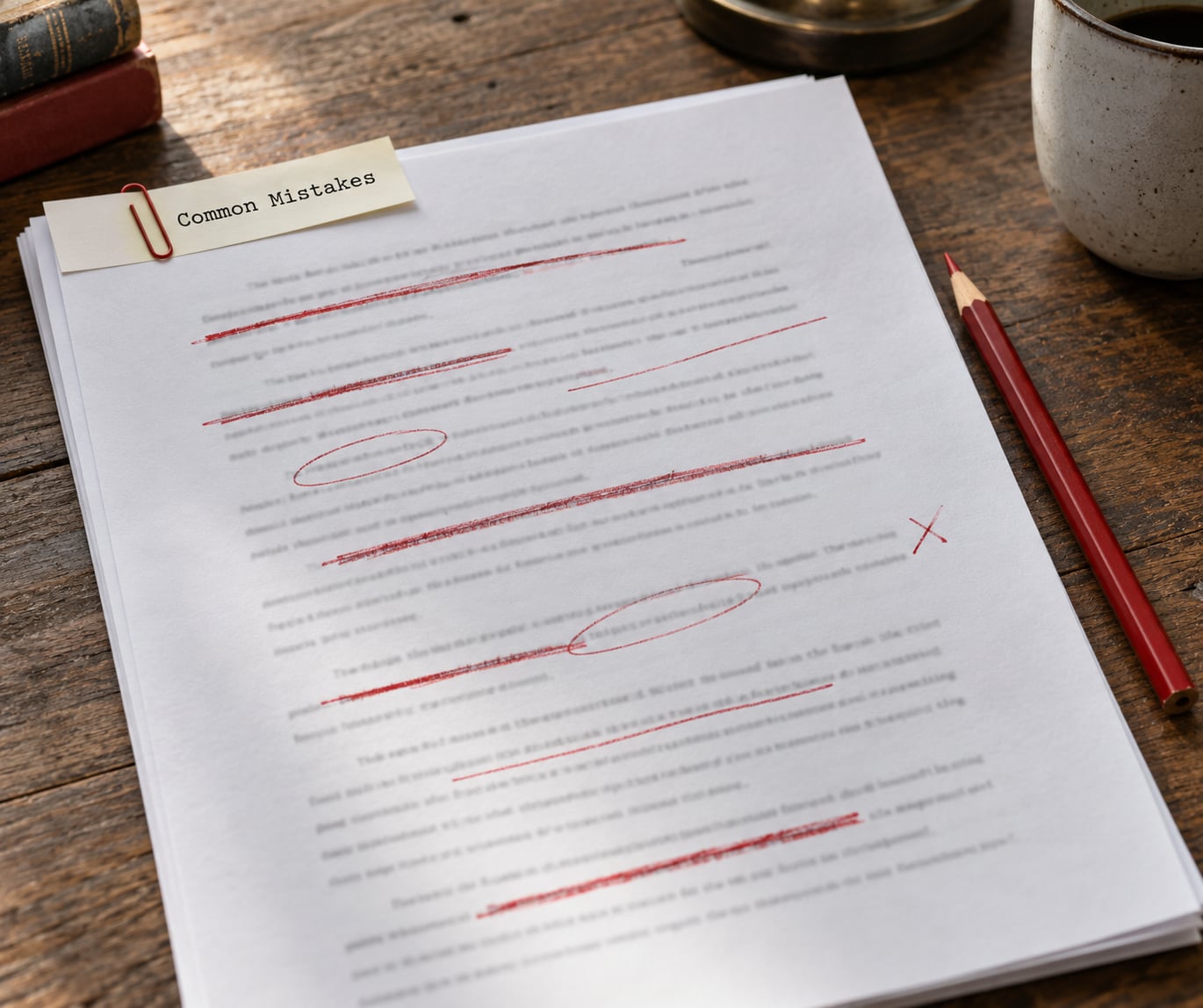
Nearly every draft that reads as unfunny fails in one of the same seven ways. Each has a direct fix, and the fixes are mechanical enough to work through in a single editing pass.
The punch line arrives where nothing was set up
Comedy needs a setup, and crime writing trains people to skip them because the plot is carrying the scene. The fix is to underline every comic line and check that something in the previous two paragraphs made it possible. If nothing did, either build the setup or cut the line.
The joke explains the mystery
A detective who jokes her way to the answer has solved the case through wit, and the reader feels cheated rather than delighted. Keep the humor in the observation and the evidence in the work. The joke can comment on the evidence; it cannot produce it.
Every character is witty
A cast of quip machines has no straight man, so nothing lands. Pick one or two people who carry the comedy and let the rest be genuinely uncomfortable, irritated, or silent. The discomfort is what makes the funny people funny.
The humor undercuts the danger
If readers are relaxed, they stop believing the threat, and a mystery that is not believed cannot be solved. Keep the body present in the reader’s mind. One practical check: cut all the comic lines from a tense scene and see if it still works as a scene. If it becomes inert, your problem is structural, not tonal.
Irony is used as a substitute for subtext
Irony that only says the opposite of what is meant produces a book that feels clever and empty. The second meaning has to be attached to something the character actually wants. When the narrator’s joke reveals fear, greed, or loneliness, irony is doing characterization. When it just sounds smart, it is decoration.
Humor is used to dodge the emotional consequences
This is the mistake writers most often defend and readers most often punish. A book that jokes its way past grief reads as a writer who could not go there. Let the character be funny before the loss, funny badly after it, and silent at the worst moment. The silence is the fix.
The humor punches down
Jokes aimed at victims, at trauma, or at a group the author does not belong to tend to be noticed immediately and forgiven never. The fix is to change the target. Aim the same comic energy at the systems, the professionals, and the perpetrators who deserve it, and check the manuscript specifically for jokes whose payoff depends on somebody being humiliated.
Two revision habits catch most of the rest. Read every comic passage aloud and mark anywhere you speed up, because speed means you are enjoying the line more than the story does. And ask a beta reader to name the funniest moment in each chapter, so you can see the distribution rather than the total.
Frequently Asked Questions
How do I add humor to crime fiction without making the story feel unserious?
Keep the crime, its consequences, and the emotional stakes clear on the page, and let humor come from how characters perceive and respond to the situation rather than from the violence itself. Jokes work as contrast and as release, and both keep the stakes visible. If a laugh line lets the reader relax about a threat, cut it. Test by reading the tense scenes with all the jokes removed and checking that the scene still works.
What is the difference between humor and dark comedy in crime fiction?
Humor is the broader category: it can be light, ironic, absurd, or observational, and it often sits in harmless situations. Dark comedy is the specific technique of finding the funny shape inside something bleak, violent, or morally disturbing. The difference is not subject matter but posture. Ordinary humor observes the absurdity around the crime, while dark comedy observes the absurdity inside it, which is why it needs more restraint and why victims are never its target.
Should a crime victim ever be the source of a joke?
A victim should not be turned into a punchline to create shock or comic relief. Humor can absolutely come from how witnesses, investigators, families, and perpetrators respond to the crime, and it can carry morally uncomfortable material without mocking the person who died. Give the victim specificity, a name, and a life, and place the comedy in the response to them. A reader who feels the victim was mishandled will not forgive it later.
How do I make witty dialogue sound natural between characters?
Give each speaker a different rhythm, vocabulary, and conversational goal, then let interruptions, evasions, and incomplete answers carry the tension. Two people trading clever one-liners at equal length sounds written; one person who cannot get the last word in sounds real. Read the exchange aloud and cut anything you stumble over, since a line you stumble reading aloud is a line your characters stumble speaking.
Where should I place jokes in a tense crime scene?
Put the joke late in the scene, after the pressure has built, and let the discovery or the reversal land in silence right after it. A joke before a revelation lowers the reader’s guard, which makes the revelation hit harder. A joke at the very end of a chapter signals that you are managing their reaction, and readers resent that. After a violent or fatal moment, silence is usually stronger than any comic relief.
How do I know if my humor is working before I publish?
Read the manuscript aloud at pace and mark anywhere your voice goes flat or you have to reword on the fly, since your ear fades after the third draft. With beta readers, do not ask whether the book is funny. Ask where they laughed and where they stopped caring, which maps your comic structure without leading them. Readers who never laugh are telling you the voice is not landing; readers who laugh at one joke in every chapter are telling you it needs redistributing.
Conclusion
The method comes down to a short list. Choose one character’s comic perspective and write a paragraph describing what that person notices, because every joke in the book will come from that filter. Let the humor live in observation, evasion, and relationship rather than in the crime itself. Place one laugh late in a tense scene and follow it with silence. Then read the whole manuscript aloud and cut anything that flatters you more than the story.
If you do one thing tonight, find the chapter where the pressure is highest, give your main character a way of looking at it that nobody else in the book has, and write exactly one joke in that scene. Read it out loud, decide whether it belongs to that person or to you, and keep it only if it does.