The easiest way to track the books you read is one log with a handful of fields, kept in a reading tracker app, a spreadsheet, or a paper journal — not three of them. Add a book the day you start it, update the page number when you sit down, and mark it finished when you close it. Ten minutes of setup covers you for years.
Most tracking habits die from friction, not from laziness. Typing page numbers into five different systems turns a hobby into admin, and people stop reading instead of stopping the tracker. A system you can update in under fifteen seconds survives; an elaborate one does not.
Table of Contents
- What You Need
- Step-by-Step
- 1. Choose How to Track the Books You Read
- 2. Create a Simple Book Log
- 3. Record Each Book as You Read It
- 4. Add Ratings Without Judging Every Page
- 5. Capture Notes Worth Keeping
- 6. Review and Use Your Reading History
- Common Mistakes
- Frequently Asked Questions
- What is the easiest way to track the books I read?
- Should I use a reading app, a spreadsheet, or a paper log?
- How often should I update my reading log?
- How do I track books I read on different devices?
- Should I rate a book before or after finishing it?
- How can I turn my reading notes into a book review?
- Conclusion
What You Need
You need somewhere to write and a rule for when you write. That is the whole kit. Everything else is optional.
- A reading tracker app. Best for: readers who want shelves, stats and progress tracking already built in. Goodreads and The StoryGraph are the two most widely used, and both let you import an existing library.
- A spreadsheet. Best for: readers who want total control over the fields and can see every past book in one sorted list. Google Sheets is the usual starting point for most people.
- A notes app. Best for: readers who read across a phone and a laptop and hate switching contexts. Searchable, private, and already on the device.
- A paper journal or planner. Best for: readers who want reflection and handwriting more than statistics. You cannot sort or count it, but writing by hand tends to make you remember more.
Decide on privacy needs too. A paper journal or a personal notes file stays on your device and nobody sees your ratings unless you show them. A social tracker puts your shelves, reviews and reading pace in front of other readers, which some people love and others find intrusive.
Step-by-Step
1. Choose How to Track the Books You Read
Pick one primary system and let it hold everything. Readers who run an app for stats and a separate spreadsheet for notes usually end up with two half-kept records and neither one complete.
Match the tool to the habit instead of the feature list. If you already keep notes somewhere daily, keep the log there. If you read at night with a paper book by the lamp, a paper log is faster than any app, and a phone screen at bedtime is its own kind of loss.
The deciding question is simple: which option would you still bother with on a tired Tuesday? That is the one to pick, even if it feels less capable than the alternatives.
2. Create a Simple Book Log
Start with seven fields and stop there: title, author, format, date started, date finished, status, and rating. Anything more is a column you will eventually stop filling in.
Format matters more than it looks. Marking a book as paperback, ebook or audiobook lets you answer questions like how many hours of listening you did this year, and it stops an audiobook from silently inflating a book count.
Make the first entry the moment you pick the book up, not the moment you finish it. A start date captured weeks later is a guess, and guesses are what make yearly numbers untrustworthy later.
3. Record Each Book as You Read It
Use four statuses and no more: want to read, reading, paused, finished. Anything beyond that is bookkeeping for its own sake.
Update progress each time you put the book down, with a single number — current page, percentage or minutes listened. One number per sitting is enough to calculate pace, and pace is what tells you a 400-page book is going to take two months.
Paused books deserve their own status rather than a deletion. Books get set aside for reasons that are not about quality, and keeping them means you can find that novel someone lent you in March without rereading everything you abandoned.
4. Add Ratings Without Judging Every Page
Rate at the finish line, not the first chapter. A rating written on page 40 is really a reaction to the setup, and it rarely survives contact with the ending.
Keep two ideas apart: how much you enjoyed the read, and how good you think the writing is. Most logs collapse these into one star rating and then produce nonsense like three stars for a book that was beautifully written and thoroughly tedious.
If you are unsure, leave the rating blank until the book is closed. A blank cell is honest; a two star written halfway through a mystery because the middle sagged is not.
5. Capture Notes Worth Keeping
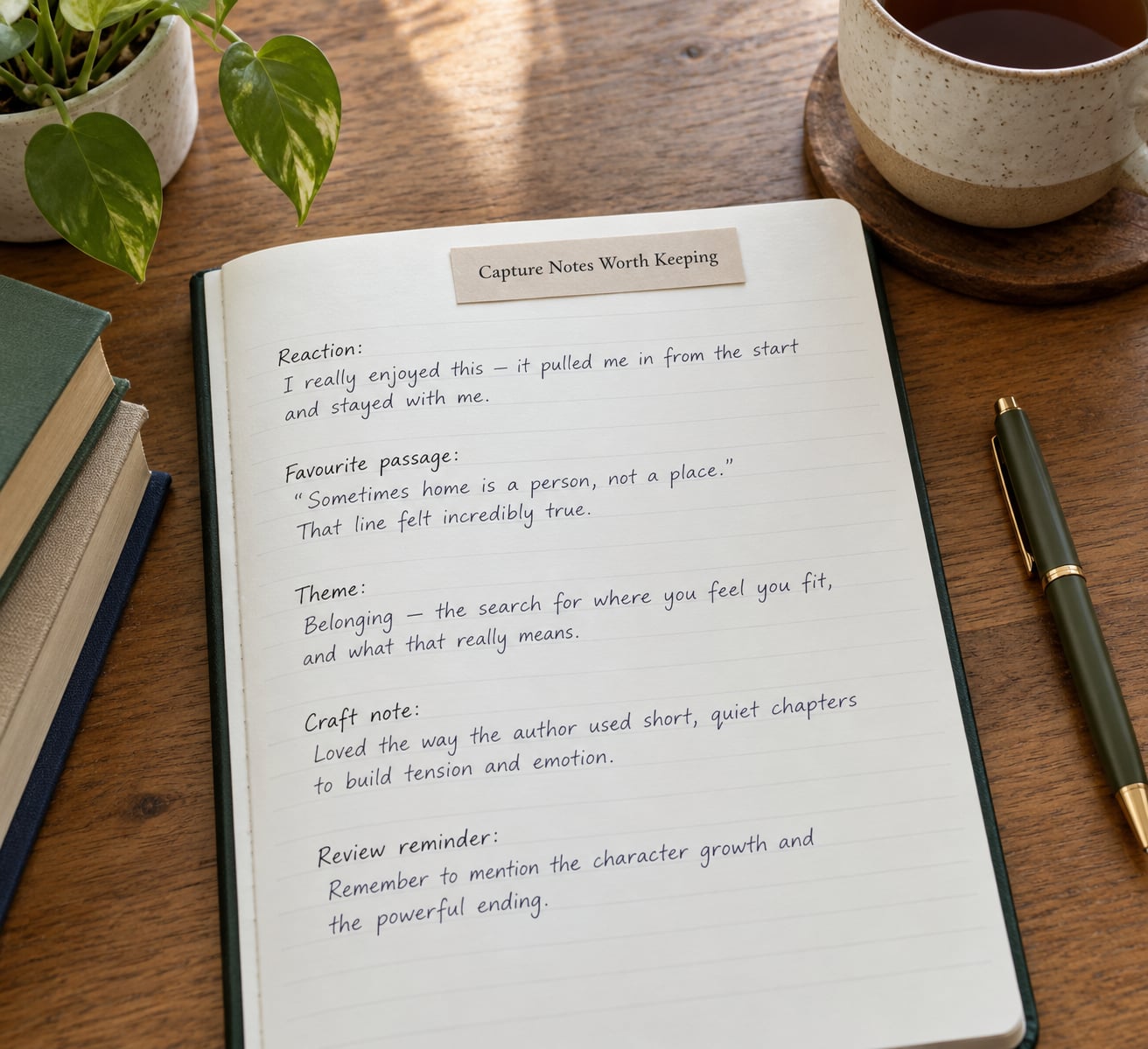
Five short lines per finished book is plenty. Write one sentence on your reaction in the moment, one passage worth keeping, the theme or question the book left you with, one observation about how it was built, and a note on whether it deserves a written review.
The reaction line matters most because it is the one you cannot reconstruct later. Two years on, “the prose was lovely and the ending was not” is far more useful than trying to remember why a book made you angry in a good way.
Keep quotes short and capture the page number with them. A quote without a page reference is a quote you will never find again, which defeats the purpose of saving it.
6. Review and Use Your Reading History
Set a recurring review — monthly for a casual reader, quarterly if you read heavily. Ten minutes is enough to sort the finished shelf by genre or author and see what you actually read rather than what you claim to read.
The pattern that matters most is the abandoned list. Three or four DNF books in one quarter usually means you picked them from a list instead of from a want, which is worth knowing before you repeat it.
Your finished shelf is also the best source for your to-read list. Filtering by an author you have enjoyed, a mood, or a pace you liked beats starting from a blank page every time. Notes become material: a book with two strong reactions and a saved passage is already half a review.
Common Mistakes
Over-recording. More fields look rigorous and get abandoned within weeks. Cut to the fields you will actually fill in for every book, not just the ones you loved.
Inconsistent statuses. If books sit on “reading” for two years, your progress numbers are wrong and any pace calculation built on them is fiction. A weekly two-minute sweep fixes it.
Rating mid-book. Half-formed ratings produce a shelf you do not trust, which quietly discourages you from looking at your own log at all.
Running three systems at once. An app for shelves, a spreadsheet for notes and a journal for quotes means three places to check and three chances to forget. Pick one.
Storing notes without context. A bare quote with no book, no page and no reason is nearly useless a year later. Attach everything to the title.
One last habit worth adding: export your data once a year as a CSV and keep it somewhere you control. Reading history you cannot download is history you have to trust someone else to keep, and that is exactly the arrangement that makes long-term readers nervous.
Start smaller than feels right. One log, seven fields, and the book currently open on your nightstand is a complete system by the end of the week.
Frequently Asked Questions
What is the easiest way to track the books I read?
The easiest method is a single log with seven fields: title, author, format, date started, date finished, status and rating. Keep it in whichever tool you already open daily, add the book the day you start, and update one progress number each time you read. That takes under fifteen seconds and is enough to build shelves, stats and a searchable history.
Should I use a reading app, a spreadsheet, or a paper log?
Use an app if you want shelves, goals and progress tracking built in. Use a spreadsheet if you want custom fields and a sortable history you own outright. Use paper if you write by hand anyway and prefer reflection to statistics. The format rarely matters as much as whether you will maintain it, so choose the one that survives a tired evening.
How often should I update my reading log?
Update progress each time you put the book down, and review the whole log once a month. Daily updating wastes time on days you do not read. A weekly status sweep catches books left on your currently-reading shelf for months, which is the most common way a reading log goes quietly wrong.
How do I track books I read on different devices?
Keep one master log and let apps sync. If you read on a phone, a tablet and a paper book, log the progress in whichever device is to hand and let the account sync. Mark the format on every entry so a paperback, an ebook and an audiobook version of the same title never get counted as three separate reads.
Should I rate a book before or after finishing it?
Rate it after you finish. A rating written partway through reflects the opening rather than the whole book, and readers who revise their ratings later end up with a shelf they cannot trust. If you are genuinely unsure, leave the field blank until the book is closed and come back to it then.
How can I turn my reading notes into a book review?
Write five short lines per book while reading: your reaction, a passage worth keeping, the central theme, one observation about how the book was written, and whether it deserves a review. When you write the review later, the reaction line gives you the honest verdict and the quotes give you evidence. Most of the work happens during the read, not afterwards.
Conclusion
Make the log today, add the book that is currently open on your nightstand, and leave the rest of the fields blank until you need them. Give the system one month before deciding whether it works, because the first fortnight always feels heavier than it will once the habit settles. Readers who protect a few minutes a week end up with a searchable history of everything they have finished in 2026 and every year after it.