A limited series suits crime novels because the genre runs on a fair-play puzzle that has to be answered, and a puzzle you have already decided to answer lets you plant clues, escalate consequences and land a real ending. Three to five books, planned in advance, give an investigation room to breathe without letting the mystery go stale.
That is the short answer. The longer version involves pacing, character arcs, reader psychology and one very practical commercial fact: crime fiction has always leaned on endings, and the modern open-ended series model quietly pushed against that tradition.
Limited series in crime fiction: a planned run of three to five novels by one author, beginning and ending on a fixed point, with the central mystery and the detective’s arc both resolved on the page. The contrast is an ongoing series, where each book is designed to sell the next one and no final book is planned.
What follows covers the structural reasons the format works, the ways it builds character faster than a long run, how to close one out cleanly, and the honest cases where it is the wrong choice.
Key takeaways
- A finite run lets the author decide the answer before writing book one, which is the only way clue planting becomes architecture rather than decoration.
- Contained cases make clues feel purposeful, because every detail has somewhere to land.
- Short runs force character change instead of letting motivation drift across a dozen installments.
- A planned ending removes the two things readers complain about most: filler books and cliffhangers that never resolve.
- Some investigations genuinely need more room than a limited run allows.
Table of Contents
- Why Limited Series Suit Crime Novels
- How a Limited Series Changes Crime-Novel Pacing
- Limited series vs ongoing series at a glance
- 1. The Clues Have a Known Destination
- 2. Escalation Has Somewhere to Go
- 3. The Detective Has a Finite Arc to Complete
- 4. Reader Trust Is Easier to Keep
- 5. Cliffs Never Dangle
- 6. It Is Easier to Adapt
- The Benefits of a Contained Mystery
- How Limited Series Create Character Depth
- How to End a Limited Crime Series Without Losing Readers
- Separate Case Closure From Character Closure
- Keep the Consequences
- Tell Readers Early That There Is an End
- Leave One Thing Deliberately Unresolved
- When a Limited Series Is the Wrong Format
- Sprawling investigations with many linked cases
- Long family histories
- World-building that is the point
- When the publisher wants more
- When cliffhangers are the product
- How Streaming Changed the Idea of a Finished Story
- Frequently Asked Questions
- What is the best length for a limited crime novel series?
- Are limited series better than standalone crime novels?
- How many episodes should a crime series have?
- Can a limited series keep the literary and noir tone of a crime novel?
- Should a limited series resolve every mystery by the finale?
- What kind of crime novel works best in a limited series?
- Conclusion: Start With the Central Crime
Why Limited Series Suit Crime Novels
Six structural reasons explain why limited series suit crime novels so well, and most of them come down to a single fact: crime fiction is a genre of promises. You promise the reader a victim, a closed circle of suspects, a trail of fair clues and an explanation. An open-ended series can honour all of that for as long as it lasts, but it can never promise an ending, and the promise is doing a lot of work in the reader’s decision to start.
How a Limited Series Changes Crime-Novel Pacing
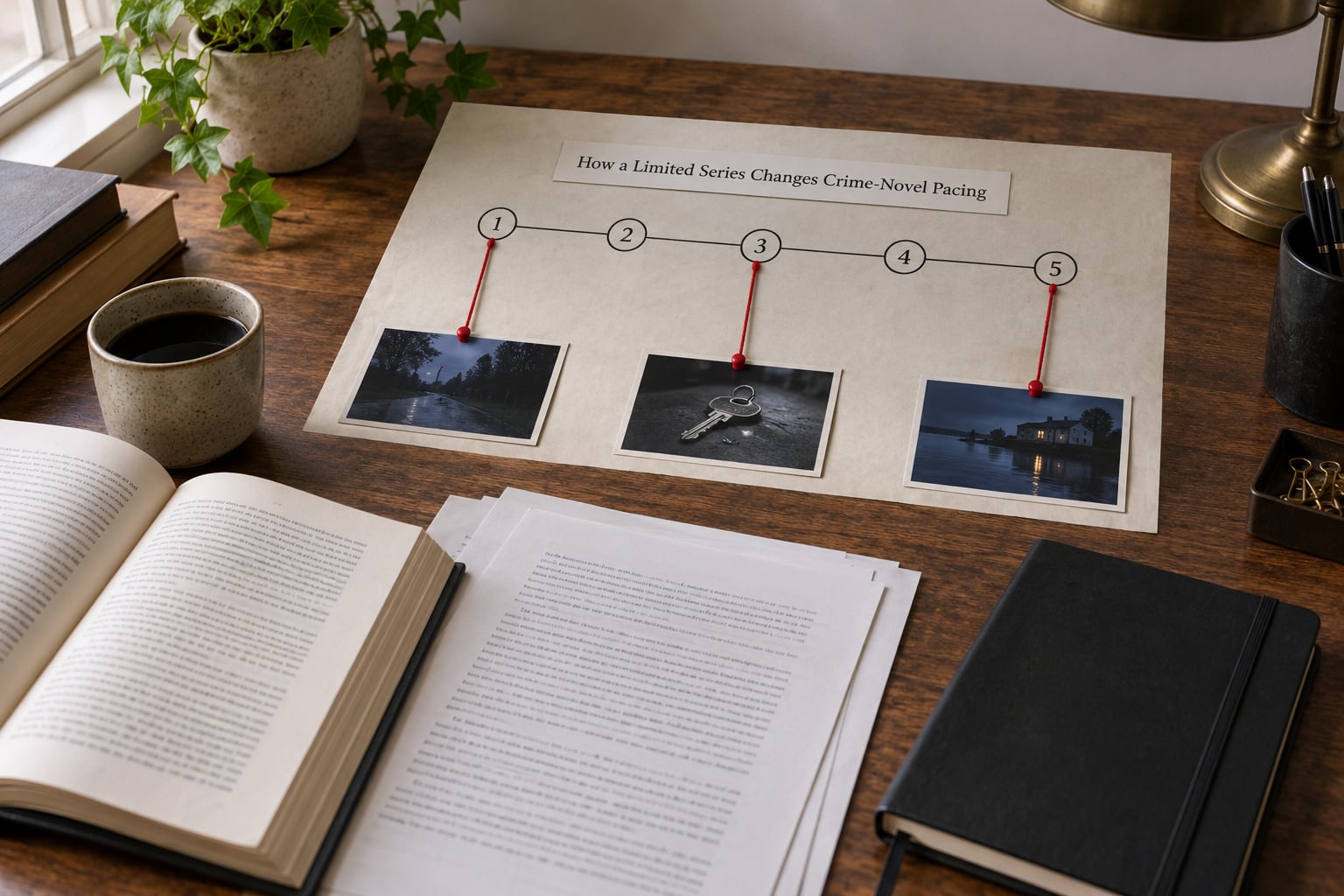
The single biggest practical difference is that a limited run converts one long investigation into a sequence of smaller discoveries. Each book can open a question, narrow the field and end on a real reversal rather than a manufactured one, because the author knows the destination and is not obliged to invent a fresh crime just to have something to write.
Compare the two structures. In an ongoing series, book four might have to deliver a twist the author has not decided on yet, so the twist tends to be a new mystery rather than a change in understanding of the same one. In a limited series, book four can do the harder and better thing: recontextualise everything the reader already knows. The suspect from book one suddenly makes sense. A throwaway detail from page twelve of the first novel turns out to have been the hinge.
That difference is why planned ending mystery novels read differently from recycled ones. The pacing is not faster, exactly. It is more purposeful, because every book arc has to move the series arc in a known direction.
You can feel the effect at the sentence level too. When the author knows how many books remain, chapter endings stop needing to be artificial cliffhangers and can be genuine turns. When the author does not know, cliffhangers become a tic.
Limited series vs ongoing series at a glance
This is the comparison that matters most, and it is the one you will rarely find laid out plainly anywhere else.
| Element | Limited series | Ongoing series |
|---|---|---|
| Planned length | Fixed, usually three to five books | Open-ended, decided book by book |
| Ending | Written and foreshadowed from book one | Absent or improvised late |
| Clue planting | Planted with a known payoff point | Often retrospective or decorative |
| Character arc | Finishes inside the run | May stall once the cast is established |
| Reader commitment | A complete package of known size | An open invitation that can sprawl |
| Book clubs | Easy to schedule and finish | Hard to assign in full |
| Adaptation | Reads as one designed whole | Risks losing momentum on the way to the screen |
| Re-reading | Rewarding, since clues pay off | Less rewarding without resolution |
1. The Clues Have a Known Destination
Mystery series arc planning is a different job in each format. With a planned ending, the author can decide in advance what the answer is and work backwards, asking of every detail whether it will matter on the final page. That reverse engineering is the real craft here, and it is only available inside a finite arc.
It also changes the ethics of the red herring. A herring in a limited series can be planted with intent, because the author knows which later book will pay it off. A herring in an ongoing series is often just a way to fill a chapter.
2. Escalation Has Somewhere to Go
Stakes need a ceiling. In a three-book run, each book can raise the cost of the failure without resetting it: a private matter in book one becomes a professional scandal in book two and a public catastrophe in book three. That is a planned escalation rather than a louder one.
Long runs have the opposite problem. So much damage accumulates that the final books tend to reset, or the consequences stop registering with the reader.
3. The Detective Has a Finite Arc to Complete
A character who changes over fifteen books changes at a rate most readers cannot track. A character given three books has to move in public, in front of an audience that has decided to watch closely.
4. Reader Trust Is Easier to Keep
Trust in crime fiction is unusual. Readers will accept a twist, but they will not accept a book that exists only to sell the next one. When the endpoint is public knowledge, nobody has to guess whether book three is essential. It is, because it is the last one.
5. Cliffs Never Dangle
The most common complaint about ongoing series is not pacing. It is the ending. A run that stops on an unresolved cliffhanger feels broken rather than open, and readers treat it as an unfinished evening rather than a book.
6. It Is Easier to Adapt
A designed whole adapts more cleanly than a sprawl, because there is an arc to follow rather than a backlog to compress. More on that below.
The Benefits of a Contained Mystery
A contained mystery is one the series actually finishes, and the benefit shows up in the reader’s experience rather than the writer’s spreadsheet. When people describe why crime fiction is popular, the usual answers are the puzzle, the escape and the restoration of justice. A limited series makes all three land, because the case is closed rather than suspended.
Suspension feels satisfying for a while and then turns into an itch. The genre was built on the idea that the detective finds out what happened, and readers take that contract seriously, sometimes with an almost legalistic attention to whether it has been honoured. A contained mystery settles the account.
There is a second, quieter benefit: clues stop feeling arbitrary. In a series that runs on indefinitely, a detail introduced early may never matter, and readers who notice start keeping score. In a planned run, the author knows which details are load-bearing, so the pattern reads as design instead of noise.
It also changes the emotional stakes of the finale. When readers know the run is finishing, the last book stops being one more entry and becomes the destination. People rearrange reading schedules around a finale. Forum readers describe binge-reading a finished series as a distinctly different experience, closer to watching a season end than to picking up the next available title.
For writers, containment removes a lot of noise. You are not servicing a backlog of unresolved threads; you are deciding which threads exist. Crime fiction series structure is mostly the discipline of deciding what not to open.
How Limited Series Create Character Depth
Short runs do not give characters more page time. They give them more decisions. A detective with three books and a stable cast has to reveal who they are through choices that cost something, because there is no room for a slow drift.
Contradiction is the main tool. A character who is loyal to procedure in one book and quietly falsifies a report in the next is more interesting than one who is simply competent. The limited run makes that kind of contradiction legible, because the reader remembers the previous book and the gap between the two versions is easy to spot.
Supporting casts compress faster too. Where an ongoing series accumulates twenty named colleagues over a decade, a limited run can afford three or four people with real functions: a partner who disagrees, a victim whose family complicates the case, an authority figure with an interest in keeping it quiet. Each one gets a defined role and a defined ending, which readers notice and appreciate.
Antagonists benefit most of all. A villain who appears in book one and is defeated in book three gets an arc across the whole run, which no mid-series series villain can honestly claim. The reader gets to watch the motive develop, and the resolution means something.
Moral choices also sharpen. With a known number of books remaining, an author can plant a moral problem early and pay it off late. The detective’s private life, which is often filler in long runs, becomes the place where the case arc and the personal arc collide at the end.
What a limited run does not leave room for is the drift. Motivation that has been quietly rewritten since book three, side characters who stop turning up, a protagonist whose job has changed twice with no comment. Those are not the complaints of restless readers; they are the complaints of readers who finished something and did not feel satisfied.
How to End a Limited Crime Series Without Losing Readers
The ending is where limited series crime fiction is won or wasted. A satisfying conclusion is not a trick. It is the visible result of decisions the author made years earlier, delivered clearly enough that readers feel the architecture instead of admiring it.
Separate Case Closure From Character Closure
Close the mystery completely. Name the culprit, explain the method, account for the timeline, and deal with the people who helped or obstructed. Then handle the character question separately, in a smaller register, because it is a different kind of answer and cramming both into one scene usually loses one of them.
Keep the Consequences
Do not reset the world for a tidy final chapter. Let the detective carry something. The best final books in the genre tend to end with the case solved and the cost still visible, which is closer to how real resolutions feel anyway.
Tell Readers Early That There Is an End
Planned ending mystery novels work better when the endpoint is public. Saying in interviews that a series will be three books and then writing forty more is the fastest way to lose the readers who cared most about the promise.
The genre has old and very good precedents here. Dorothy Sayers planned a fixed number of Lord Peter Wimsey books from the start and reached a planned finish. Ed McBain worked to a stated total for the 87th Precinct books. Mystery fiction has historically respected the reader’s expectation of an ending; the modern open-ended series is closer to the exception.
Leave One Thing Deliberately Unresolved
Not the crime. Something human. A relationship, a habit, a question about what the detective does next. That gives the last conversation between readers a reason to exist without reopening the plot.
When a Limited Series Is the Wrong Format
Limited series are not automatically the better choice. A format that suits crime novels well still fails when the material refuses to be compressed, and it is worth being specific about the cases where that happens.
Sprawling investigations with many linked cases
Some crimes are only understood as a pattern over decades. A corruption network or a multi-generational disappearance often needs the room that an ongoing run provides, and compressing it produces a mystery that feels thin rather than tight.
Long family histories
A story that spans three generations needs cumulative change. Three books can do it, but only if each generation carries a distinct case; otherwise the middle generation becomes a bridge with no crime of its own.
World-building that is the point
Series where the setting, the milieu or the professional community is the main attraction benefit from volume. Readers who come for the world rarely complain about length; readers who came for the puzzle usually do.
When the publisher wants more
This is the awkward one, and every writer in the business knows it. Publishing rewards a backlist that keeps selling, and a successful series creates pressure to continue past the point where the story is finished. The results are familiar: middling instalments, a recurring villain who stops threatening anything, and a reader base that quietly stops buying. Self-publishing removes that pressure, which is one reason more authors than ever plan a finite arc deliberately.
When cliffhangers are the product
Some formats are genuinely built for suspension rather than resolution. Serialised television does this well, and readers who only want the next case may genuinely not want an endpoint. They are a smaller audience than the forums suggest, but they exist.
The useful test is simple. If you cannot describe the final scene without revealing something about the crime, the material is probably not ready for a limited run.
How Streaming Changed the Idea of a Finished Story
Screen adaptation has made the limited series format visible in a way books rarely get to be. Television taught audiences that a story with a beginning, a middle and an end is not incomplete, it is finished, and that expectation now travels back into reading habits. Crime fiction has always had strong film and television ties, and a well-planned run of books is unusually easy to pitch because it already has a shape.
The other direction matters too. Readers who have watched a limited series arrive at books expecting the same discipline, and authors who know a run could be adapted tend to plan the arc more deliberately. That is not a bad reason to write a finite series, but it is a real influence on how many books people now expect and how quickly they expect them to end.
Frequently Asked Questions
What is the best length for a limited crime novel series?
Three to five books is the range most writers land on. Three gives each instalment enough room for a distinct crime while keeping the whole thing readable in a season or two. Five suits a slower investigation with a wider cast. Two-book duologies work for a single case retold from two sides, and anything beyond six starts to need its own internal structure to stay tight.
Are limited series better than standalone crime novels?
They serve different needs. A standalone gives you one complete case with no commitment and no recall. A limited series gives you a detective whose habits and relationships deepen across the run, which is a different kind of pleasure. Readers with limited time often prefer standalones; readers who like a recurring investigator usually want the run. Plenty of authors write both.
How many episodes should a crime series have?
Treat episodes like books. Two works when the mystery is single and tight. Three is the most flexible choice because each episode can hold a distinct crime while the series arc runs underneath. Four or five suits a long investigation with escalating consequences. Whatever the number, decide it before you write the first one and tell readers, so the endpoint shapes the clue planting from the start.
Can a limited series keep the literary and noir tone of a crime novel?
Yes, and the constraint usually improves it. Noir depends on atmosphere, moral ambiguity and voice, all of which get sharper when the story has to end on purpose rather than fade out. What noir loses in a limited run is duration: long runs can let a reader inhabit a city or a department for years. A finite series trades that drift for a resolution that hits harder.
Should a limited series resolve every mystery by the finale?
The central mystery, yes, completely. You need the culprit, the method and the timeline accounted for, or readers will read the ending as a dodge. Side threads are different: leaving one relationship or personal question open gives readers something to argue about without reopening the plot. Resolve the crime, and you can afford one human loose end.
What kind of crime novel works best in a limited series?
A novel built around one investigation, one setting and one cast of suspects. Closed-circle mysteries, cold cases with a single timeline and cases with a defined group of possible culprits compress well, because the mystery has natural edges. What works badly is anything whose interest lies mainly in how much has happened before, since that interest has nowhere to go once the run stops.
Conclusion: Start With the Central Crime
Limited series suit crime novels because the genre promises an explanation, and a planned number of books lets the author deliver one properly: clues with destinations, escalation with a ceiling, characters who finish changing and an ending that resolves instead of suspends.
If you are writing one, the first move is not outlining six chapters. It is writing one sentence describing the crime, one describing the question the detective is really trying to answer, and one describing the final scene. Fix the number of books after that, and say so publicly.
If you are reading one, look for a stated endpoint. The run that tells you how many books remain is usually the run that keeps its promises.