
The difference between a psychological thriller and a crime thriller is where the tension lives. A crime thriller is driven by a crime being committed and investigated, through suspects, evidence and procedure toward some form of justice. A psychological thriller is driven by the mental states of its characters, using unreliable narration, concealed motives and atmosphere to make you doubt what you have been told. Most of the confusion comes from how often both labels get used for the same book.
Both genres usually contain a crime. That is not what separates them. What separates them is whether the reader is waiting to solve a case or waiting to understand a mind.
Table of Contents
- Psychological Thriller vs Crime Thriller at a Glance
- What Is a Psychological Thriller?
- What psychological thrillers are built on
- What Is a Crime Thriller?
- The main crime thriller subgenres
- How Do the Central Conflicts Differ?
- How Does Each Genre Create Suspense?
- How Do Plot Structure and Resolution Differ?
- Which Genre Uses More Mystery and Revelation?
- Psychological Themes vs Crime-World Themes
- Which Should You Choose?
- Frequently Asked Questions
- Are thriller and psychological thriller the same?
- What’s the difference between crime and thriller?
- Can a book be both a crime thriller and a psychological thriller?
- Is a psychological thriller a crime thriller?
- What are the subgenres of a crime thriller?
- What is the most famous psychological thriller of all time?
- Conclusion
Psychological Thriller vs Crime Thriller at a Glance
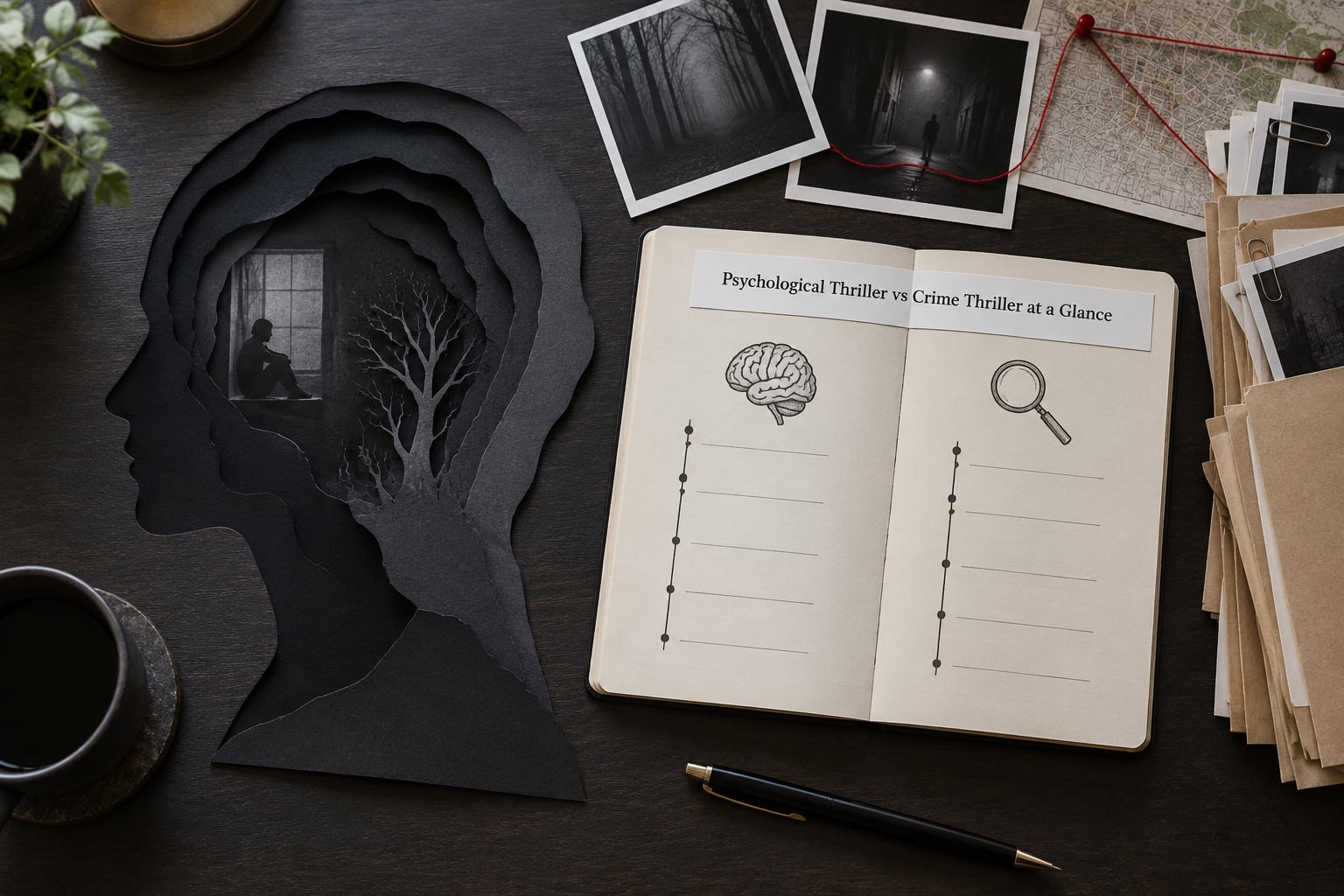
| Criterion | Psychological Thriller | Crime Thriller |
|---|---|---|
| Central question | What is really going on inside this person? | Who did it, and can it be proved? |
| Typical protagonist | An ordinary person caught in something they cannot name | A detective, officer, lawyer or investigator with a job to do |
| Source of tension | Uncertainty about perception, memory and motive | Uncertainty about facts, timelines and suspects |
| Narrator reliability | Often unreliable, limited or non-linear | Usually reliable, since evidence has to hold up |
| Reader’s position | Level with, ahead of, or inside the protagonist’s head | Level with or slightly behind the investigator |
| Plot structure | Instability revealed, then reinterpreted | Crime committed, then narrowed to a solution |
| Use of clues | Clues contradict what you were led to believe | Clues accumulate toward a provable answer |
| Resolution | Partial or ambiguous, sometimes a re-reading of events | Closure: the case is solved or the question answered |
| Dominant themes | Identity, perception, memory, trauma, existence | Justice, guilt, corruption, punishment, institutional pressure |
| Best for | Readers who want to distrust the narrator; writers building an interior dread | Readers who want procedure and puzzle satisfaction; writers building a case |
Read the table as a set of tendencies rather than rules. Plenty of good thrillers sit in the middle, and the label on the cover usually reflects which of these elements dominates.
What Is a Psychological Thriller?
A psychological thriller is a suspense novel or film in which the pressure comes from the inner life of its characters rather than from an investigation. There may be a crime, a disappearance or an accusation on the surface, but that situation exists to press on somebody. The reader’s real subject is what a character is concealing from other people and from themselves.
What psychological thrillers are built on
Five things recur. The narrator is unreliable or severely limited. An identity, a memory or a relationship is not what it appears. The setting is ordinary and domestic rather than professional, so the threat lands close to home. Morality is genuinely grey, so the reader cannot simply root for the law. The ending either confirms what you thought or reframes everything before it.
Reference definitions tend to agree on the organising principle: the genre is built around a mind, not around an offence. Critics usually define it by technique — restricted narration, withheld motive, the slow disclosure of what somebody has done — rather than by subject matter, which is why the label stretches so far across bookshops.
That is also why so many titles get described as psychological thrillers when they are really just twisty. If nothing about a character’s interior life changes, you have a plot puzzle wearing the label.
What Is a Crime Thriller?
A crime thriller is built around an offence and the machinery assembled to answer it: investigators, suspects, witnesses, evidence, forensic work and a legal process that has to survive scrutiny. The protagonist is usually defined by a role rather than a wound, and the antagonist is treated as a problem with a solution.
The main crime thriller subgenres
- Police procedural — the day-to-day work of investigators, with procedure and institutional friction doing most of the tension.
- Detective fiction — the classic whodunit, built on a closed circle of suspects and a fair clue trail.
- Noir and hardboiled — a corrupt city, a cynical investigator, and atmosphere carrying as much weight as plot.
- Legal thriller — courtroom procedure, evidence and the danger of a wrongful conviction.
- Espionage — hidden agendas, betrayal and pursuit across borders.
- Heist stories — planning, execution and the counter-plan that breaks it.
- Serial killer investigations — a pattern, a body count and a detective chasing someone who understands the hunt.
Readers in this genre usually want two things in the last twenty pages: a logical answer and the sense that justice has been administered or correctly denied. That expectation about closure is the genre’s fingerprint.
How Do the Central Conflicts Differ?
In a crime thriller the protagonist’s problem is out there in the world. She is short of evidence, out of jurisdiction, or one step behind a suspect. Every obstacle is somebody else’s behaviour: a lie, a hidden body, a bribed witness.
In a psychological thriller the protagonist’s problem is inside. The obstacle may be a person, but it works through the protagonist’s own memory, attachment or self-deception. Often the person most responsible for the crisis is also the person telling the story.
That difference decides what the reader is waiting for. One wants an answer to a question about events. The other wants an answer to a question about a person, and that answer can arrive as discomfort rather than as a solved case.
How Does Each Genre Create Suspense?
Crime thrillers withhold information and then release it in verifiable doses. Motives are hidden, timelines are reconstructed, and red herrings are planted with enough consistency to be plausible rather than random. The suspense is mechanical: the clock is running on the investigation.
Psychological thrillers withhold certainty instead of facts. A restricted point of view, a missing stretch of memory, or a narrator who reports events faithfully and still gets them wrong will do more damage than any withheld clue.
Take one premise: a woman disappears on a Monday. Handled as a crime thriller, the story follows the search, and the question is who took her and why. Handled as a psychological thriller, the story stays with her husband, and the question becomes whether the account he is giving can be trusted at all. Same incident, entirely different reading experience.
How Do Plot Structure and Resolution Differ?
A crime thriller usually moves through five beats: the crime occurs, the investigation begins, obstacles and false leads narrow the field, the truth emerges, and the case closes. Change or remove any beat and readers feel the genre’s contract broken, which is why so many of them end with a verdict.
A psychological thriller tends to run a different five. Instability is introduced quietly, details accumulate, something is revealed that reframes earlier scenes, a psychological reckoning happens, and the resolution stays deliberately incomplete. Craft guides often describe this as the reader being placed one step ahead of or inside the protagonist, rather than behind them.
Readers report the gap honestly. An ambiguous ending that feels earned lands as unease; an ambiguous ending that feels like a dodge reads as a letdown, and crime-thriller readers rarely tolerate it because closure is the point of the purchase.
Which Genre Uses More Mystery and Revelation?
Crime thrillers use mystery as a problem with one right answer. Clues accumulate, suspects are eliminated, and the revelation should be checkable against evidence planted earlier. The satisfaction is deductive: you should be able to look back and see it.
Psychological thrillers use mystery as a question about identity. Who is telling this story, what really happened years ago, and how much of it can be trusted? The revelation does not solve the case, it changes what the case meant. Patricia Highsmith’s Ripley novels and Daphne du Maurier’s Rebecca both work this way.
The named devices behind both are worth knowing. The unreliable narrator is traced back to Edgar Allan Poe, the MacGuffin to Hitchcock’s coin, and the red herring to an early nineteenth-century hunting metaphor. In crime thrillers these devices point you away from a fact. In psychological thrillers they point you away from a conclusion you had drawn about a person.
Psychological Themes vs Crime-World Themes
Psychological thrillers circle a small set of themes: death, existence and purpose, identity, the mind, perception and reality. The question underneath each one is private. Can this person trust their own account of what happened, and should the reader trust it for them?
Crime thrillers circle justice, guilt, corruption, punishment and the limits of law. These themes are social rather than private, and they get tested in public, in a courtroom or an institution rather than in a head.
Guilt and responsibility sit in both genres, and the placement is what tells them apart. In a psychological thriller guilt is something a character feels and conceals. In a crime thriller guilt is something a system has to name, apportion and punish.
Writers should also watch the traps readers complain about most: a suspect list assembled from television shorthand, and a twist that only works because two characters conveniently failed to mention something. Both belong to crime-thriller plotting, and both collapse when the story leans on psychology instead of fair clues.
Which Should You Choose?
Choose a crime thriller when you want to work something out. These suit readers who enjoy forensic detail, procedural honesty, a large suspect pool and the certainty of a final answer, and they suit writers who plan backward from the solution.
Choose a psychological thriller when you want to live inside a doubt. These suit readers who prefer a slow burn, a domestic or closed setting and an ending that keeps working after the last page, and they suit writers who start from a character’s wound rather than from the crime.
A quick signal from a blurb: if it promises a detective, a suspect list or the truth about a killing, you are looking at a crime thriller. If it promises a marriage, a missing person, a memory or a narrator you cannot quite believe, you are looking at a psychological thriller.
And if the promise covers both, that is usually the good stuff. Tana French’s In the Woods and Paula Hawkins’s The Girl on the Train both run an investigation, and both use the investigator’s own damage as the story’s engine.
Frequently Asked Questions
Are thriller and psychological thriller the same?
No. Thriller is the broad category, built around suspense and danger. Psychological thriller is a narrower type inside it where the suspense comes from a character’s mind, memory or perception rather than from an investigation. A thriller can chase a bomb across a city; a psychological thriller can sit in one room with someone whose account keeps shifting.
What’s the difference between crime and thriller?
A crime story is about an offence and its consequences, usually ending in detection or judgment. A thriller is about danger and survival, and the crime may still be ahead of the reader rather than behind them. Mystery asks who did it, thriller asks what happens next. The words get used loosely on covers, which is why so many books carry both labels.
Can a book be both a crime thriller and a psychological thriller?
Yes, and most of the best-known ones are. The distinction is one of emphasis rather than of subject matter. If the investigation drives the plot forward, the book gets shelved as crime. If the psychology of the investigator or narrator drives it, it gets shelved as psychological. Titles like The Silence of the Lambs, Gone Girl and Zodiac sit deliberately in the overlap.
Is a psychological thriller a crime thriller?
Only when the crime is what the story is about. Plenty of psychological thrillers involve no crime at all, or treat an accusation or a disappearance rather than a solved offence. Where a crime exists, the classification usually follows the dominant element. A story where the detective’s guilt and memory shape every scene reads as psychological no matter how much forensic detail it carries.
What are the subgenres of a crime thriller?
The main ones are police procedural, detective fiction or whodunit, noir and hardboiled, legal thriller, espionage, heist stories and serial killer investigations. Legal thrillers lean on courtroom procedure, espionage on hidden agendas and border crossing, and noir on a corrupt setting and a cynical investigator. Many novels sit in more than one category at once.
What is the most famous psychological thriller of all time?
Rebecca by Daphne du Maurier is the usual answer among readers, published in 1938 and still in print. Gone Girl by Gillian Flynn is the modern equivalent, and Psycho by Robert Bloch is the oldest idea the genre still runs on. If you want a starting point, Rebecca is the safest bet because it predates most of the conventions.
Conclusion
The whole argument reduces to one question: is your story’s main engine a case or a mind? If a crime is committed and the narrative exists to identify who committed it and what happens next, you have a crime thriller. If the crime, or its absence, exists to expose what a character believes, conceals or cannot remember, you have a psychological thriller.
Start there before you pick a shelf. Pick the engine first, then write or read to the conventions that engine demands, and the labels will sort themselves out.