
Domestic suspense is crime and psychological fiction in which the threat sits inside the home, inside a marriage, a family, a friendship, or a close-knit street, and the danger comes from someone the protagonist is supposed to trust. The suspense comes from plausible, ordinary pressure rather than exotic peril, which is why the subgenre reaches readers who have never been chased through a warehouse but know exactly what it feels like to lie in bed beside a person and wonder.
Domestic suspense explained properly comes down to three things: the mechanics that make the pressure build, the secrets and power shifts underneath it, and how the genre separates from the wider thriller family. Once those are clear, the labels stop being confusing marketing copy and start telling you what kind of reading experience you are signing up for.
Table of Contents
- What Is Domestic Suspense?
- How Does Domestic Suspense Create Tension?
- What Secrets and Power Struggles Drive the Story?
- How Is Domestic Suspense Different From Psychological Suspense?
- How Do Writers Build Suspense Without Revealing Everything?
- What Makes a Domestic Suspense Story Believable?
- Frequently Asked Questions
- Does domestic suspense have to involve a crime?
- What makes a story suspenseful when the setting is a home?
- Is domestic suspense the same as a domestic thriller?
- Can domestic suspense include humor or hopeful endings?
- How many secrets should a domestic suspense story have?
- What should readers look for in a strong domestic suspense novel?
- The Key Takeaway
What Is Domestic Suspense?
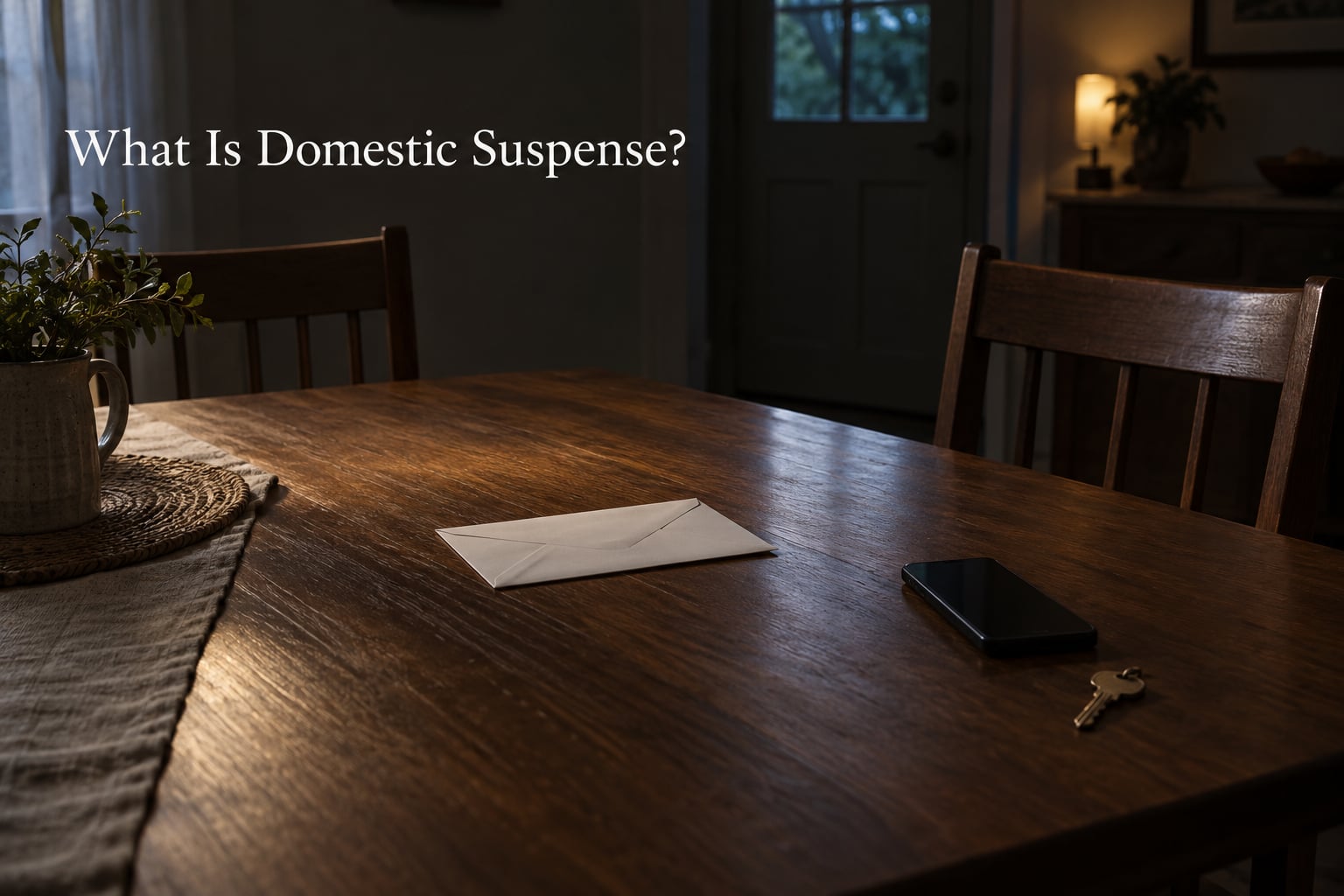
Suspense in a story means the reader knows something is going to happen and is held back from knowing what, when, or how bad it will be. Thriller adds a clock. Domestic points at the setting: the kitchen, the marital bed, the school gate, the neighbor’s driveway.
Put those together and you get the genre most readers meet under a different name, the domestic thriller, and the two labels describe almost the same shelf. The difference is one of temperature rather than plot. Suspense tends to be slower, stickier and darker, holding on to a situation well past the point where a thriller would have delivered its shock and moved on.
The defining traits show up consistently:
- The threat is inside the relationship. It comes from a spouse, partner, parent, child, sibling, friend or close neighbor, not from a stranger passing through.
- The setting is the engine. A house, an apartment block, a gated community, a suburb. The place that should feel safe is what makes the reader uneasy.
- Stakes are private and financial. Custody, reputation, a mortgage, a job, a parent’s care, a name that has to stay clean in a small town.
- Information is unreliable. Gaslighting, coercive control, an unreliable narrator, or a witness who is certain and wrong.
- Motive is withheld longer than comfort allows. The reader learns why late, and the why reframes everything read earlier.
- The reveal lands on an ordinary detail. The shock is not an explosion. It is a text message, a locked door, a gap in a story told at dinner.
- The facade holds. Someone is performing a version of themselves in public, and the tension lives in the gap between the performance and the private truth.
Labels get mixed up on shelves and in blurbs, so a quick glossary helps:
| Label | What it actually points at |
|---|---|
| Domestic suspense | Threat inside intimate relationships, built on pressure and delay rather than pace. |
| Domestic thriller | Broadly the same shelf, usually used interchangeably, often faster and more plot-driven. |
| Family thriller | A household-wide version where siblings, parents and children are implicated together. |
| Domestic noir | The same setting with a colder, more unsentimental voice and an investigator outside looking in. |
| Coercive control | A pattern of domination used inside these stories to make leaving feel impossible. |
How Does Domestic Suspense Create Tension?
Most tension in this genre comes from six pressures stacking on top of each other.
Confinement. The protagonist rarely has anywhere to go. A house in a cul-de-sac, a rural property with one road out, a building where everyone knows everyone. Escape routes disappear, so the only way out is through the conversation.
Private stakes. A public scandal can be survived. Losing your children, your home, or the only income in the household cannot be waved away, which raises the cost of every wrong move.
Unreliable information. Someone in the room is lying, or has convinced themselves their version is the truth. The reader is stuck inside a narrator’s account with no clean way to verify it.
Withheld motive. The story gives you actions before reasons. Why did the envelope get delivered? Why was the door locked from the inside? Why does the story about last Tuesday keep changing?
Shifting power. The person with the most control at the start rarely holds it at the end, and the reader is usually a step ahead of whoever has the least.
Pressure to conceal. Someone has to keep the secret in plain sight across a dinner party, a school run, a wedding. That performance takes effort, and effort is visible.
Here is how ordinary detail turns threatening. A husband mentions he was at the office late. His wife is packing a bag and does not want to be touched. There is a key on the hall table that has been there for years and belongs to no current resident. A neighbor offers to take the children for the evening, which is kindness and also access to the house. Nothing has happened yet. The whole weight rests on domestic logistics, and that restraint is what makes the genre work.
What Secrets and Power Struggles Drive the Story?
The usual engines are betrayal, financial dependence, abuse, hidden identities, family loyalty, revenge, and a past crime somebody buried. Readers can spot each one early because it shows up as behavior rather than exposition.
Betrayal starts as small concessions. Someone works late repeatedly. Someone stops mentioning a friend’s name. A phone turns face down in a way it never used to.
Financial dependence is quieter and often crueler. One income, one home, one surname. Leaving is not a decision, it is a logistics problem with a date attached.
Abuse in this genre usually arrives dressed as care. Control over money, friends, clothing, or where the car is parked. Coercive control is not one violent act, it is a hundred small permissions withdrawn.
Hidden identities work because ordinary life contradicts them. A partner has a phone number nobody has seen before. A father knows a detail about his own child that he should not know.
Family loyalty is what stops the truth coming out. Someone will protect a violent relative from a courtroom, and the reader spends the book waiting for the cost of that protection.
Revenge and buried crimes give the story a past, which lets a later scene change meaning. A phrase in chapter two suddenly reads differently at the end.
Not every secret is suspense-driving, and the test is simple. Ask what each character wants, then ask what they fear happens the moment the truth comes out. If the answer is that nothing changes for them, the secret is interesting flavor. If the answer is a house, a child, a job or a liberty, that secret will hold the tension open as long as you keep it covered.
How Is Domestic Suspense Different From Psychological Suspense?
One is about the how, the other is about the where. Psychological suspense describes the technique: a mind under pressure, perception bent, an unreliable narrator you cannot fully trust. Domestic suspense describes the location: the threat lives in the home and in the relationships that are supposed to be safest.
The categories overlap constantly. Coercive control is the usual bridge, since it is both a psychological mechanism and a domestic situation. Nobody needs a prize for reading the overlap correctly, so identify the dominant source of tension instead of arguing the labels.
| Element | Domestic suspense | Psychological suspense | Crime thriller |
|---|---|---|---|
| Where the threat sits | The home and its relationships | The protagonist’s mind, wherever that mind is | Often outside the home: institutions, workplaces, wider communities |
| Primary threat | Someone trusted acting on motive | Perception, memory, guilt, madness | A crime to explain and a culprit to catch |
| Mystery focus | What is happening behind closed doors | What actually happened, and whether the telling can be believed | Who did it and why |
| Typical narrator | Close third or first person, often compromised | Unreliable by design | Wider cast, more external viewpoints |
| Emotional payoff | Recognition and dread that lands close to home | Unease about your own judgment | Resolution, justice, explanation |
| Hallmark technique | Restriction and delayed disclosure | Interiority and ambiguity | Investigation and pacing |
| Expected ending | Escape, exposure or a costly silence | Ambiguity, or a reframe | Identification and consequence |
If you want the popular shorthand, domestic suspense usually ends with the truth out in the open, and psychological suspense usually ends with you unsure what you believe. A book can do both, which is why so many get marketed with both words.
How Do Writers Build Suspense Without Revealing Everything?
Holding information back is easy. Making the withheld information feel dangerous is the craft.
Control what the reader notices. A detail mentioned once, without emphasis, in a room full of noise is worth more than the same detail repeated over three chapters.
Raise the consequence rather than the volume. If a secret is already huge, add something the character stands to lose and the scene gets tense for free.
Change the setting when the pressure needs to build. Move from the kitchen to the car to a stairwell. Same conflict, less room, and the reader feels the walls moving in.
Delay the explanation but not the symptom. Readers will forgive not knowing why for a page. They will not forgive a character behaving strangely for twenty pages with no visible effect.
Make each reveal change a previous moment. The strongest version of this genre re-reads the last chapter in your head, because now you know which line was the lie.
A worked example. A book spends forty pages on a woman insisting she remembers nothing about the night her husband disappeared. Chapter forty-one reveals she does remember, and what she remembers is not the crime but a phone number he saved under a nickname. The mystery is not solved, obviously. But the question changes from what happened that night to who this person is and what they have been protecting. That is a partial reveal working correctly: it does not close anything, it reopens the scene in front of you.
Readers can use the same logic in reverse. If a book reveals a motive in chapter two and the tension keeps climbing anyway, the tension is coming from something else, usually a second character whose account does not match.
What Makes a Domestic Suspense Story Believable?
Believability comes from ordinary specificity. People do not react to danger in a composed way. They lie badly, they check their phone too often, they say the right thing at the wrong moment, and they care far more about how a decision looks than anyone expects.
Domestic realism means the small costs are real. A separation means a solicitor, a deposit, a school run change. Fear of exposure in a small town means the neighbor who knows, the school that asks, the job that might go.
Characters need believable reasons to stay, not just believable reasons to leave. The practical trap of coercive control is well documented in how these stories are read: leaving is not one decision, it is a sequence that requires money, a place, documents and a moment the other person is not watching.
Clues should be fair. The objects and routines that matter later usually appear early, in plain sight, and the payoff feels earned rather than sprung.
Consequences should outlast the twist. A reveal that resets everything by the final chapter has not really changed the story.
One honest note about reading it. This subgenre runs on coercive control, gaslighting, domestic abuse and the grooming of children, and some books handle it without restraint. Readers looking for a specific emotional weight should check content notes before a book club picks one, and pick a different evening for it if the material lands too close to home.
For orientation, the genre’s formative names are worth knowing. Daphne du Maurier’s Rebecca supplied the template of danger inside a marriage. Ruth Rendell and Mary Higgins Clark built the domestic mystery long before the current boom. Gillian Flynn’s Gone Girl made the unreliable marriage the center of gravity, Paula Hawkins’s The Girl on the Train moved it into a poisoned suburb, and B.A. Paris, Shari Lapena, Freida McFadden and Lisa Jewell have kept the shelf crowded since.
Frequently Asked Questions
Does domestic suspense have to involve a crime?
No. A crime is common but not required. Domestic suspense needs a threat, a concealed motive and pressure that builds inside an intimate relationship. Coercive control, gaslighting, a hidden identity or a disappearance will carry a book just as well as a murder, and many readers find the slow version harder to put down for exactly that reason.
What makes a story suspenseful when the setting is a home?
A home is not automatically suspenseful. What creates tension is the collision between ordinary detail and private stakes: a key that should not exist, a locked door nobody can explain, a partner who suddenly wants the evening alone. Because the reader recognizes every object in the room, one wrong element goes a long way.
Is domestic suspense the same as a domestic thriller?
On most bookshelves, yes, the two labels describe the same shelf and are used interchangeably. The distinction is one of temperature. Domestic thriller usually implies a faster plot with a payoff arriving sooner, while domestic suspense tends to sit in the pressure longer and lean darker. Readers rarely find a book filed under one label and not the other.
Can domestic suspense include humor or hopeful endings?
It can. Irony and dark comedy are common in this genre, usually deployed by a character who controls a room by performing it, which makes the performance another tool of control. Hopeful endings happen too, though they tend to be partial: someone gets out, something is exposed, a family stays intact and permanently altered.
How many secrets should a domestic suspense story have?
Fewer than most writers start with. One central secret, layered under two or three smaller ones that each carry real consequences, produces more tension than a stack of five, because the reader can hold the shape of the story. A secret also only works if the character losing it changes something concrete, such as a home, a child, a job or a liberty.
What should readers look for in a strong domestic suspense novel?
Look for a setting you recognize, a narrator you cannot fully trust and a motive explained later than feels comfortable. Check whether the stakes are specific and financial rather than vague. Read the first twenty pages for the tightness of the prose, since this genre lives or dies on pace, and note any content warnings before committing to a book club choice.
The Key Takeaway
Domestic suspense explained comes down to four things in order: the relationship, the secret, the threat and the unanswered question. Once those are placed, the rest is escalation, and escalation means raising personal and narrative cost rather than adding volume.
When choosing a book, read for the setting and the narrator. When writing one, decide what the secret costs to reveal before deciding what the secret is. Readers will forgive a slow plot and even an ugly ending, but they will not forgive a reveal that arrives without groundwork.