Cutting word count means compressing your prose — removing redundancy, filler and staging slack — while keeping the beats that make readers care what happens next. Cut the space between the pressure points, never the pressure points themselves. Tension should rise as the word count falls, because a leaner scene puts the reader closer to the threat with fewer words spent on logistics.
That last part is where most self-editors go wrong. They read “tighten” as “shorten”, shave every sentence to the same length, and end up with a manuscript that is shorter and somehow flatter, like a room with the furniture taken out. The fix is not more discipline at the sentence level. It is knowing which sentences are carrying load.
So this is a process, not a tip list. You will label what each scene is for, mark the slack without judging your first draft, cut in a fixed order, and verify at the end that the tension is still there. Budget two to four focused hours for one scene. A full novel takes several sessions, and that is normal.
Table of Contents
- What You Need
- Step-by-Step: How to Cut Word Count Without Losing Tension
- Identify the Essential Story Beats
- Mark Redundancy Without Judging the First Draft
- Compress Exposition Into Selective Detail
- Tighten Dialogue and Increase Subtext
- Shorten Sentences Around Moments of Tension
- Cut Low-Value Staging and Camera Movement
- Measure Cuts and Recheck the Story
- Common Mistakes
- Frequently Asked Questions
- How do I reduce word count without making my writing feel rushed?
- Should I cut descriptions when tightening a crime or noir scene?
- Is dialogue the first thing I should shorten?
- How much should I cut during one revision session?
- Can I cut words without changing the plot?
- How do I know whether a scene is too long?
- What to Cut First
What You Need
You need five things, and none of them are expensive.
- The scene itself. Work on one scene at a time, not the whole manuscript. A 1,500-word scene finished properly teaches you more than a 90,000-word novel half-revised.
- A beat note. One line per scene: what the character wants, what stops them, what changes by the end. Five minutes to write, and it is what you cut against.
- The actual length requirement. Not a vague feeling that it is long. Write the real number down — an agent’s stated ceiling, a publisher’s submission range, a competition limit.
- A clean comparison copy. Keep the original scene in a separate document so you can check that nothing broke. Revising in the same file means you cannot see what moved.
- A way to track cuts. The word count figure at the bottom of your word processor is enough. Per-scene counts are better, and a one-line table beats a spreadsheet you abandon in week two.
Keep your voice out of scope. Cutting prose and cutting your style are different jobs, and mixing them in one pass is how writers end up resenting their own books.
Step-by-Step: How to Cut Word Count Without Losing Tension
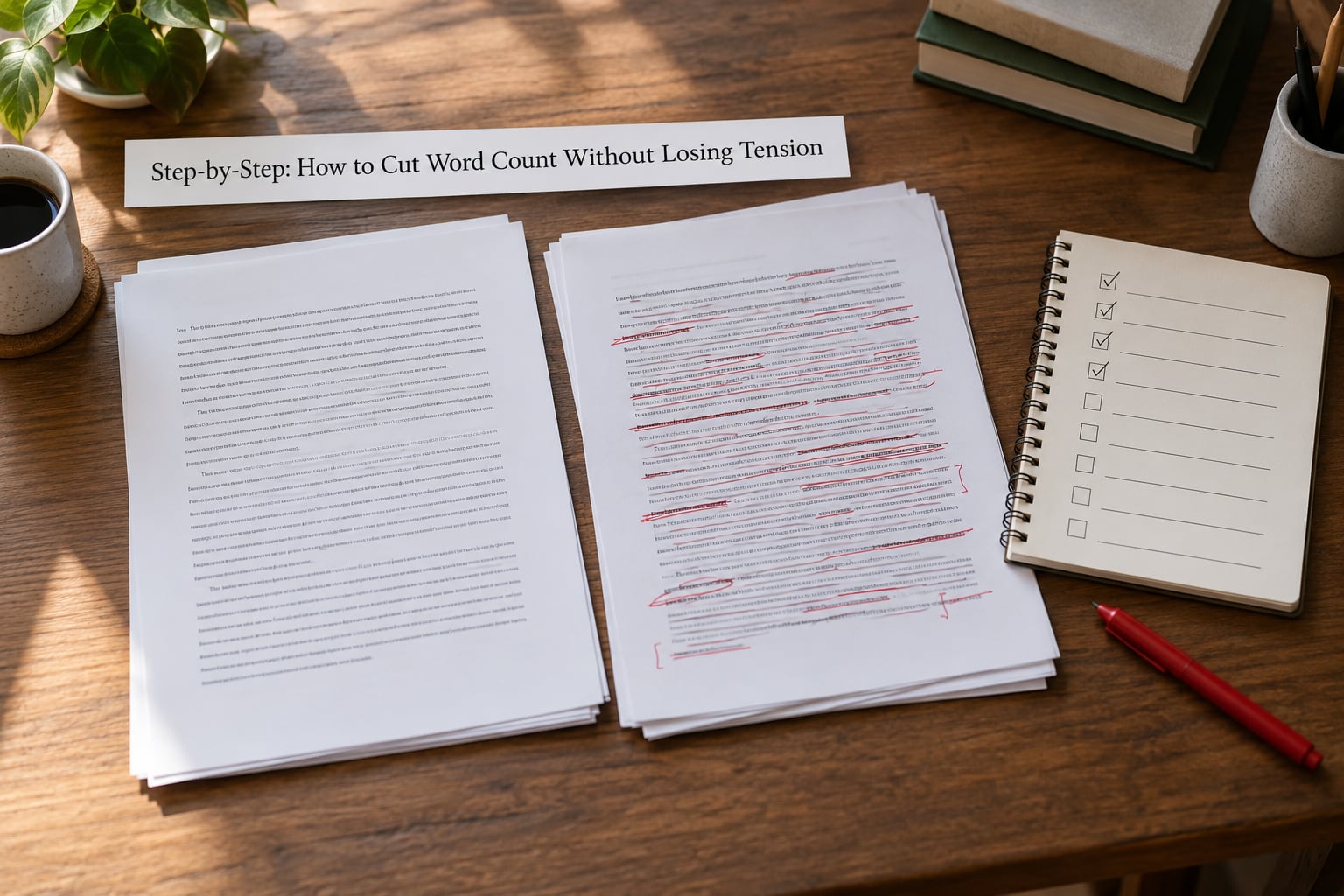
The order matters more than the technique. Structural cuts come before line cuts, line cuts come before proofreading, and proofreading comes before anything gets read aloud. Polish a paragraph you are about to delete and you have wasted an evening twice.
Here is the full sequence. Eight stages, each one feeding the next.
Identify the Essential Story Beats
Before cutting a word, name the five beats that have to survive. A scene needs a goal, a conflict working against it, a turn that reverses or deepens the situation, a consequence the character now lives with, and an emotional change in whoever’s point of view it runs through. Write all five in one sentence each.
Everything after this is a question with a real answer: does this paragraph carry one of the five beats, or is it travelling with them? A detective who lies to his partner about the file is carrying conflict and emotional change at once. The paragraph before it, explaining what the file contains, is travelling.
For a crime novel the beats are usually heavier than in other genres. A clue introduced, a lead narrowed, an alibi breaking, a suspect flipping, a body discovered — these are the load-bearing walls. Once you have them listed, the cuts stop being a matter of taste.
Mark Redundancy Without Judging the First Draft
This stage makes no deletions at all. You read through flagging four things: information the scene already told you, emotion it has now shown twice, setup the scene never pays off, and clues you explained after showing.
First drafts repeat because the writer was not sure the reader was listening. That instinct is correct the first time and wrong every time after. If your detective notices the wet coat on the body in paragraph two and thinks about the coat again in paragraph nine, one of those is going.
Flag, do not fix. Readers who write over the same paragraph three times collapse to the strongest version. Deleting on first read is how a good line gets lost to a better instinct six paragraphs later.
Compress Exposition Into Selective Detail
Exposition is the biggest word-count culprit in most manuscripts, and the easiest to compress badly. A paragraph of background delivered as statement can usually become a detail the character handles badly in the moment.
Before:
Detective Ruiz had been with the county force for eleven years, mostly in burglary, and had worked her way up to homicide in the spring. Her ex-husband had left three years earlier and she had custody of her daughter on weekends.
After, the same information, carrying more weight:
Eleven years on the job and Ruiz still reached for the burglary board when she walked past it. Her daughter texted on Fridays, birthdays, and once in a while for no reason at all.
Nothing the reader needs has gone missing, and they now know Ruiz is still orienting herself by the wrong job. The second version is shorter, but more importantly it is doing two jobs at once — world-building and characterisation.
The rule I use: pick the one detail the character would notice in this room, in this mood, at this moment. If she is frightened, she is counting exits, not furniture.
Tighten Dialogue and Increase Subtext
Yes, dialogue is usually where the fat sits. But cut dialogue in the right order: greetings, throat-clearing, repeated information, then polite exchange. Do not start with the strange or threatening lines.
Before:
“Good evening, I’m sorry to bother you at this hour, but I wondered if you might have a few minutes to answer a couple of questions about your neighbour.”
“The neighbour?”
“Yes, the man in the flat below me. I don’t suppose you know him?”
“Well, I mean, everyone knows him, in a manner of speaking.”
After:
“Your neighbour.”
“The one below me.”
“I know which one.” She did not move away from the door.
About sixty words became thirty-one, and the scene is more threatening because the refusal to invite her in is now an action instead of an explanation. Subtext is the cheapest tension available to you — it costs words and buys dread.
Watch one habit: the weak tag. “He said quietly”, “she remarked with a sigh” — the adverbs in the tags are usually borrowed pressure from a line that does not have any.
Shorten Sentences Around Moments of Tension
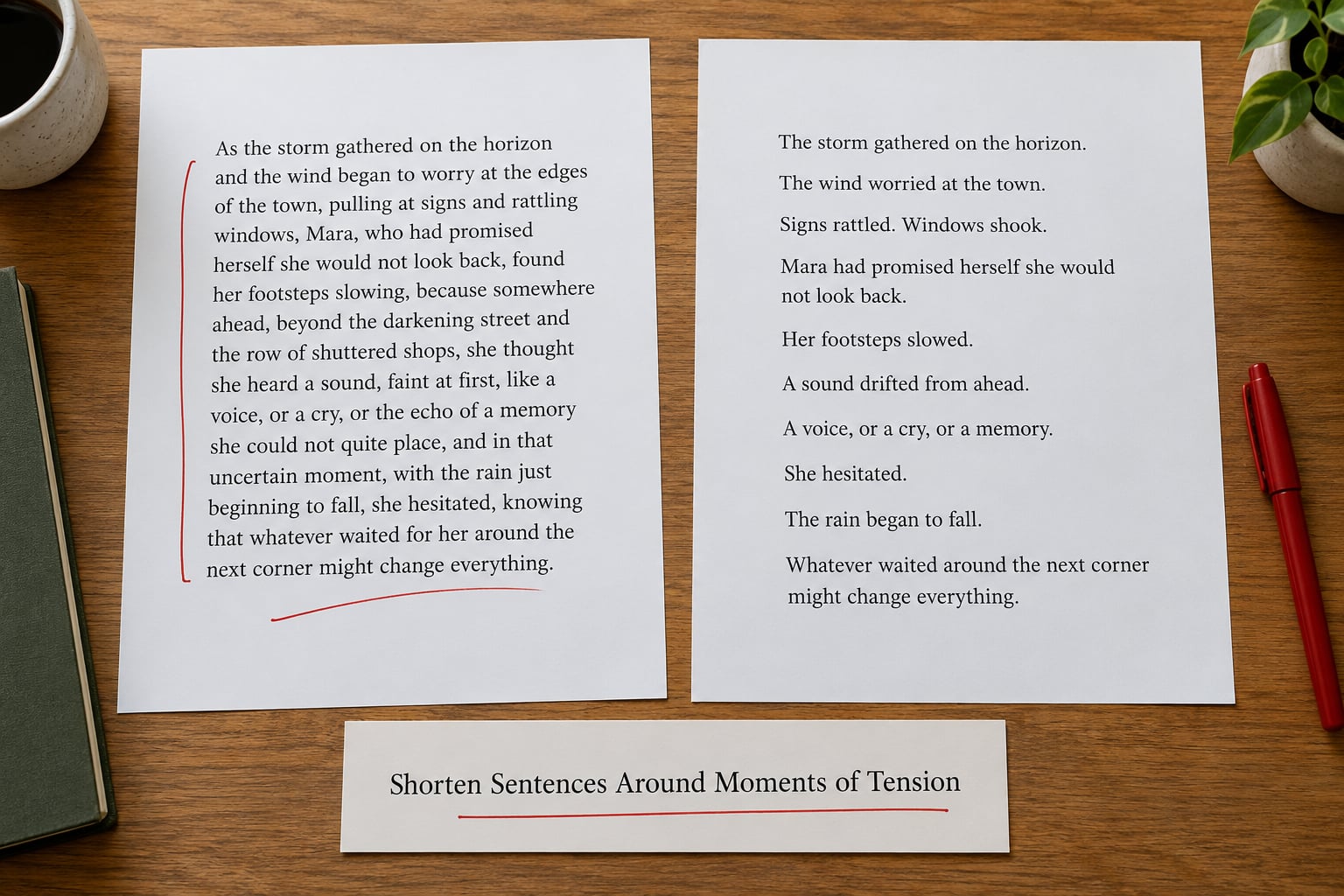
Short sentences accelerate. That is the whole mechanic, and it is why a scene can lose words and gain speed at the same time. Danger, suspicion, a decision being made under pressure — these reward compression.
Before: “She heard the door open somewhere below her and then, after what felt like a length of time that she was later unable to estimate with any accuracy, she heard footsteps on the landing, and then nothing at all.”
After: “The door opened below her. Footsteps on the landing. Then nothing.”
Fragments work when the character is short of breath, distracted or unwilling to finish a thought. Do not run a scene on fragments, though — the pattern stops registering as alarm and starts reading as a style.
The other half matters just as much. Keep the long, slow sentence for the moment dread needs room to build, for the confusion of a body being described, or for a reveal that the character is not yet able to think through. When the long sentence arrives after a run of short ones, it reads as weight. A uniform choppiness reads as panic.
Cut Low-Value Staging and Camera Movement
Staging is everything that shows you where people are standing. It is necessary and it is over-supplied. Cut the entrance throat-clear (“he shuffled in, crossing to the window, where he stood for a moment”), the second description of a room you already described from the door, and the small movements between characters that buy no pressure.
The test: if you removed the staging, would anyone understand who is where and what they just did? If yes, cut it. Most scenes need about a third of the movement they have.
The classic exception is a first entry into a location. The reader has no map yet, so the walk from the door genuinely establishes space and can carry character. That paragraph earns its words. The third paragraph of the same room does not.
Measure Cuts and Recheck the Story
Compare the original and revised counts. A first pass that removes ten percent is almost always the right first target; another twenty to thirty percent is usually available after the next read. Cutting thirty percent in one go means you are making decisions you have not tested yet.
Here is the same moment at three lengths, and it is the clearest evidence there is that tension tracks compression rather than volume.
About 110 words:
The rain had been going on since about four in the afternoon, and by the time she got to the corner of Larkin and Ninth the streets were shining in that way they do when nobody has walked on them for a while. She was thinking about the man she had seen on the bridge the week before, the one who had been watching the water, and about the letter that had come in the mail on Tuesday with no return address on the envelope, and about how she had not told anyone about either of those things. It had started to rain harder. She turned up the collar of her coat and walked faster toward the corner where the streetlight was out.
About 57 words:
She reached Larkin and Ninth at four, and the streets had that washed look nobody leaves behind. She thought about the man on the bridge. She thought about the letter, no return address, no sender. She had told no one about either. The rain thickened. She turned up her collar and walked faster toward the dead streetlight.
23 words:
The letter had no sender. She had told no one. Rain. The dead streetlight ahead, and the man on the bridge behind her.
Half the words went and the danger roughly doubled. The first version makes us wait through weather. The second lists her worries and then points at the darkness. The third keeps only what is unresolved.
For the whole manuscript, pull per-chapter counts and look for outliers rather than averages. A chapter two-thirds the length of its neighbours is either the tightest writing in the book or the one place you are stalling, and the layout usually tells you which before you read a word of it. Print it and look at the page shape from a distance — a wall of unbroken grey is a scene that has stopped moving.
Then read the edited scene aloud. The stumble test catches what the eye forgives: a sentence you cannot breathe through, a pronoun with no clear antecedent, a beat you no longer have the context for.
Common Mistakes
Cutting indiscriminately. Fix: work from the beat list only. If a paragraph does not carry a beat, cut it; if it does, it is not available in this pass no matter how much it annoys you.
Cutting atmosphere. In noir the weather, the room and the light are the threat. Fix: cut the inventory, not the atmosphere. Replace a list of observed details with the one detail the character reacts to.
Flattening subtext. Cutting every evasion turns a threat into a briefing. Fix: keep the sentences where a character says less than they mean, and remove the sentences where they explain what they meant.
Shrinking every sentence. Fix: vary length deliberately. Short for pressure, long for dread, confusion and revelation.
Deleting a clue because it felt thin. Fix: any clue the reader needs to solve the case is load-bearing, however flat it sounds. Compress its setup instead of the clue.
Getting shorter without getting better. Word count is a result, not a goal. Fix: stop when the scene reads clean aloud, not when the number hits the target. Filling the remaining gap with the next good sentence is how a manuscript lands at length with nothing left to cut.
Two rules cover most of it. Cut by story function, never by sentence appearance — a plain sentence may be carrying the whole scene. And cut one thing, read it, then cut the next.
Frequently Asked Questions
How do I reduce word count without making my writing feel rushed?
Reduce word count by cutting function, not length. Remove sentences that repeat, explain, or stage position, and keep every beat that carries a goal, a turn or a consequence. Shorten sentences only around moments of pressure, and leave long sentences in place for dread, confusion and revelation. Uniformly short prose is what feels rushed. If a mixed-length scene reads tense aloud, the cuts were clean.
Should I cut descriptions when tightening a crime or noir scene?
Yes, but cut the inventory rather than the atmosphere. In crime and noir, setting carries threat, so removing weather, light and location strips the tension you came for. Instead, drop the second and third description of a room and keep the one detail your character reacts to, usually out of fear or distraction. Four sharp details of a bar at three in the morning will beat nine used to establish it.
Is dialogue the first thing I should shorten?
Dialogue is usually where the fat sits, but do not start with the strange lines. Cut in this order: greetings, throat-clearing, information repeated from earlier, then polite exchange. Save anything where a character says less than they mean, because that gap is subtext and subtext is tension. Cutting every evasion turns a confrontation into a briefing, which is shorter and much less dangerous.
How much should I cut during one revision session?
How to cut word count without losing tension works in passes, not stints. Aim for about ten percent in a first pass, then close the document and read the scene again. A second pass usually finds another twenty to thirty percent once you have seen what the first revealed. Cutting thirty percent in one sitting means making calls you have not tested.
Can I cut words without changing the plot?
Yes, if you cut sentences rather than events. Removing redundancy, exposition, staging and repeated explanation leaves the sequence of cause and effect untouched, because nothing structural was carrying the plot. You are only changing the space between the beats. If your plot genuinely changes, you have cut a scene or a beat, which is a structural revision and belongs in an earlier pass.
How do I know whether a scene is too long?
Test the scene against its beats. If removing a paragraph leaves the goal, conflict, turn, consequence and emotional change intact, that paragraph is slack. You can also pull per-chapter word counts and look for outliers: a chapter far shorter or longer than its neighbours is usually the one that is off. If you cannot name what a scene is for, that is the strongest sign it needs cutting.
What to Cut First
Work in this order: name the beats, mark the redundancy, compress the exposition, sharpen the dialogue, adjust the sentence rhythm, then read it aloud. The first four do most of the work, and the last one tells you whether they did it.
Make one precise cut, read the scene, then make the next. That pace feels slow on the first pass and it is the difference between a manuscript that got shorter and one that got better.