
To write a novel in a year you need roughly 250 to 500 finished words a day, five days a week, which gets you to an 80,000-word first draft in about twelve months. Work to a fixed weekly word count, protect the sessions, and leave the last four months for revision. That is the whole trick.
The maths is not glamorous, but it is the part most advice skips. People fixate on whether they can find enough inspiration, when the real question is how many hours they can defend each week. A year is 52 weeks. If you write 1,500 words in five of them and use the rest for planning and revising, an 80,000-word book is finished in a calendar year with time to spare.
This plan assumes you are writing crime or noir, because that is the hardest kind to get right structurally. A mystery has to hold a secret for 300 pages while still moving. The timeline below works for any genre, but the outline and clue sections lean toward the sort of book with a body count and a detective who does not trust anyone.
Table of Contents
- What You Need Before You Start the Year
- How to Write a Novel in a Year: The 12-Month Plan Step by Step
- 1. Set the Scope and Promise of Your Novel
- 2. Build a Research and Story Bible
- 3. Build the Schedule: How to Write a Novel in a Year Without Missing Days
- 4. Outline the Story Before You Draft
- 5. Draft With a Sustainable Weekly Process
- 6. Finish the First Draft by Month Eight
- 7. Reserve Months Nine and Ten for Structural Revision
- 8. Line Edit, Proofread and Prepare the Book in Months Eleven and Twelve
- Common Mistakes That End the Year Early
- Frequently Asked Questions
- How many words a day do you need to write a novel in a year?
- Can I write a novel in a year while working full time?
- Do I need an outline before I start a novel?
- What if I miss writing days – can I still catch up?
- Is it legal to use ChatGPT to help write a book?
- Should I write every day or take rest days?
- Conclusion
What You Need Before You Start the Year
Five things, and none of them cost money.
- A manuscript brief. One page holding the premise, the protagonist’s want and need, the central conflict, the ending you already know, and your target word count.
- A wall calendar. Physical if you can stand up at it. Twelve months of hand-marked blocks, with revision weeks drawn in before you start drafting.
- A weekly schedule. Specific sessions, not an intention to write more. Put them in the same calendar as the dentist.
- A research system. One folder for sources, one for character and location notes, one for clipped dialogue and overheard phrases.
- A support plan. One person who knows your deadline and will ask you about it. A writing partner, a group, or a public progress post.
If you cannot fill in the brief in a single sitting, you are not ready to start drafting yet. That is normal. The brief is allowed to change; the deadline is not.
How to Write a Novel in a Year: The 12-Month Plan Step by Step
The year divides into four phases: four months of planning and outlining, four months of drafting to a hard finish, two months of structural revision, and two months of line editing, proofreading and preparing the book. Drafting is the part everyone plans. The other eight months are what decide whether you end 2026 with a novel or a folder of abandoned chapters.
1. Set the Scope and Promise of Your Novel
Write the premise in one sentence with a because in it: A burned detective takes the case because the department wants it closed. If you cannot, the idea is not ready for a year of your life.
Then decide three limits and write them down. Length, in words, with a floor and a ceiling. Point of view, in first person past tense or third limited, and whether you allow chapter breaks with another character. Ending. You need to know roughly how the book finishes, even if you do not know how the middle works.
Genre promises count as limits too. If you are writing noir, you owe the reader a compromised narrator, an ending without clean redemption, and atmosphere doing narrative work. If you are writing a procedural, the clues have to be there and the solution has to follow from them. Promise specifics, and the draft gets easier to evaluate at the end of every month.
2. Build a Research and Story Bible
For crime and noir, research is not a detour from the writing. It is the plot. Build the system in month two and maintain it as you draft.
Keep a file per category: procedural detail, the city or town and its geography, the period and its technology, and the profession you are borrowing. For each scene you plan to write, note one concrete fact you need to get right, and one detail you can safely invent because nobody will check.
Then build the story bible. A page per character with age, want, wound, and what they would never admit. A page per location with what the room looks like at night, since most of your book happens at night. A continuity log for details that will matter later: a wound on the left hand, a car that broke down in chapter four, a name you have spelled two ways.
Add a running list of unanswered questions. When you hit one mid-draft, you either answer it in a note and move on, or you leave it as a deliberate mystery for the reader. What you cannot do is stop drafting to go and look it up.
3. Build the Schedule: How to Write a Novel in a Year Without Missing Days
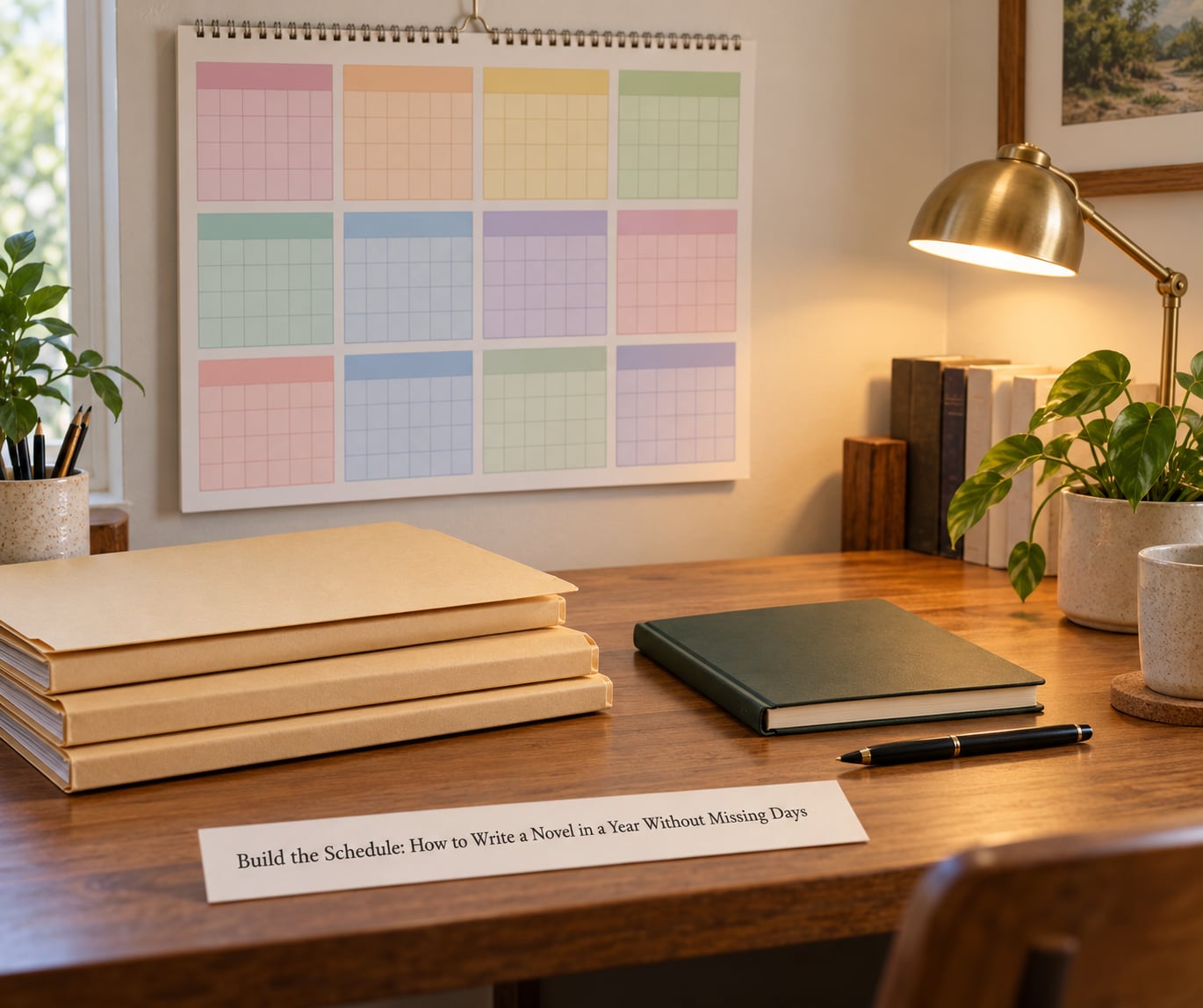
Here is the daily maths. It assumes five writing days a week and 250 working weeks across the year, which is generous once you subtract holidays, illness and the weeks you will deliberately take off.
| Target first draft | Five days a week | Seven days a week | Realistic for a first novel? |
|---|---|---|---|
| 50,000 words | 200 words a day | 140 words a day | Only if you already outline well |
| 70,000 words | 280 words a day | 200 words a day | Yes, with steady structure |
| 80,000 words | 320 words a day | 230 words a day | The standard adult target |
| 100,000 words | 400 words a day | 290 words a day | Only at full-time pace |
Now the month-by-month shape, with cumulative draft words. Months one to four are planning, so their word count is small and separate from the draft total.
| Month | Focus | Weekly target | Draft words so far |
|---|---|---|---|
| 1 | Premise, scope, manuscript brief | Outline work | 0 |
| 2 | Research and story bible | 2,000 words of notes and scenes | 0 |
| 3 | Plot beats and clue plan | Outline work | 0 |
| 4 | Scene-level outline | Outline work | 0 |
| 5 | Drafting opens, chapters 1 to 10 | 2,000 | 8,000 |
| 6 | Chapters 11 to 22 | 2,000 | 24,000 |
| 7 | Chapters 23 to 34, midpoint | 2,000 | 40,000 |
| 8 | Chapters 35 to 45, ending | 2,000 | 56,000 |
| 9 | Structural revision, scenes | Revision | Final draft |
| 10 | Structural revision, plot and clues | Revision | Final draft |
| 11 | Line edit and beta readers | Editing | Final draft |
| 12 | Proofread, format, submit | Polish | Final draft |
Note that month eight ends at 56,000 draft words, not 80,000. The remainder arrives in revision, which is where a plot-driven book usually gains a quarter of its length. If you are planning ahead, budget for that.
Give yourself two buffer weeks inside the drafting phase, marked on the calendar before you start. Life happens. Those weeks are not slack; they are the difference between a missed fortnight and a missed year.
A sample week for someone with a day job looks like this: 6am to 7:15am four mornings for one hour each, 1,000 words a session, and Sunday from 9am to noon for 3,000. That is 7,000 a week, which clears the 2,000 target with room for a bad day. Adjust the clock to your own life; the number of sessions matters more than the hour.
4. Outline the Story Before You Draft
Skip the full plotter-versus-pantser argument. The working answer is a hybrid: know the beginning, the middle and the end, and leave the connective scenes loose.
Write a scene list rather than a chapter summary. One line per scene with a verb, a location and a decision the protagonist makes. If a scene contains no decision, it is a scene you can cut or merge later.
For crime and noir, plot a second document alongside: the clue ledger. Every fact the reader needs for the solution goes in a column, with the chapter it appears in, and the chapter where it pays off. Rule one is that every clue must appear before the reveal, or be reachable from something that does. Rule two is that the solution must be verifiable by a careful reader, not merely declared in the last chapter.
Then plan the confrontation at the end. Who is in the room, what each of them wants, and what the protagonist gives up to win. If you cannot write that scene in five lines, the book is not ready to draft.
5. Draft With a Sustainable Weekly Process
The drafting rule that matters: leave the prose alone. You are not allowed to fix a sentence while you write the paragraph, and you are certainly not allowed to go back and improve chapter one while you are on chapter twelve. Put fixes in a list and keep writing.
Measure by weekly words, not by session quality. A session that produces 200 decent words beats a session that produces 1,000 words you will spend September rewriting.
When the manuscript turns out to be a different book than planned, adjust rather than panic. If it is 15,000 words longer, either extend your end date by three weeks and cut elsewhere in the year, or decide which subplot to remove on the spot. Reducing scope is a decision; letting the book grow unmanaged is a drift.
6. Finish the First Draft by Month Eight
Eight months, about 2,000 words a week, and one rule: the draft is finished when the last scene exists, not when it satisfies you. Aim to write the ending as the second-to-last thing you do, then write the final scene so you know what you were aiming at.
Every Sunday, spend twenty minutes checking the cumulative count against your target. That is the only progress meeting you need. Structural problems found at 30,000 words can be fixed in an hour. The same problem found at 70,000 words costs you a fortnight.
If you hit the midpoint and lose momentum, that is the sagging middle, and it is a scheduling problem rather than a talent problem. Cut your target for the next two weeks by a quarter and keep the streak alive.
7. Reserve Months Nine and Ten for Structural Revision
Read the whole thing in one sitting per weekend, twice, without a pen. Then diagnose on paper: what the book is actually about, where the real inciting incident sits, and which chapters do no work. Most drafts have a middle third that can lose 8,000 words with no damage.
Revise at scene level next. For each scene, check that the protagonist wants something, tries, and either gets it or changes because of the attempt. Scenes that are pure exposition become summary or dialogue. Then run the clue ledger against the text and check that nothing in the solution was withheld unfairly.
Budget these two months as separate passes. Four weeks of structural work, then four weeks of character and sequence work. Mixing them means you revise structure and sentence in the same sitting, and neither gets done.
8. Line Edit, Proofread and Prepare the Book in Months Eleven and Twelve
Line editing is where you fix how it reads, not what it is. Work on rhythm, dialogue, and the narrator’s voice in noir, where the prose is doing characterisation work. Read dialogue aloud; if you run out of breath, the speech is too long.
Then check continuity against your story bible. Left hand or right hand. Whose car. What time it was. These small errors are what beta readers notice first, and they quietly damage trust in everything else.
Send the manuscript to three readers with a short brief: what you wanted them to look at, and what you do not want changed. Give them three weeks. Read the notes, sort them into must-fix, consider, and ignore, and defend your own choices where you have a reason.
Final month: permissions for anything borrowed, formatting, a copyright notice, and the publishing decision. Decide early whether you are querying agents, pursuing a small press, or self-publishing, because each path has its own preparation list and its own lead time. Write the synopsis and query letter while the manuscript is fresh.
Common Mistakes That End the Year Early
- Perfecting the opening. Spending four months on chapter one is the single most common way a year-long novel dies. Chapter one gets rewritten in revision; that is what it is for. Write it in a sitting and move on.
- Over-researching. Research has a stopping rule. If you have enough to make the scene plausible, stop. Set a cap of two hours per research task and write while the questions are still open.
- Waiting for the right words. Daily targets assume ordinary sentences. The good sentences come later, when you already have something to fix.
- A goal that grows every time you slip. This is how writers end 2026 at 12,000 words. Keep the target flat and treat missed days as already absorbed.
On catching up, do the arithmetic rather than the feelings. If you have fallen 4,000 words behind over a fortnight, split it across the next ten sessions: 400 extra words per session. Do not try to make it up in one weekend, because that produces a 6,000-word sprint followed by two days of nothing.
On burnout, the warning signs are boring and easy to ignore: dread before the session, resentment toward the book, checking the count only to feel bad. Fix it by reducing your target for two weeks to something you find easy, not by pushing harder. A year is long enough that a slow fortnight costs almost nothing. A collapsed habit costs the year.
Frequently Asked Questions
How many words a day do you need to write a novel in a year?
About 250 to 500 words a day, five days a week. At 320 words a day you reach an 80,000-word first draft in roughly twelve months, leaving room for planning and revision inside the same year. Fewer than 200 words a day usually means the draft will overrun the calendar unless you cut scope.
Can I write a novel in a year while working full time?
Yes, and most people who finish do. Around 700 to 1,000 words before work plus one long weekend session covers the target comfortably. The key is scheduling sessions as appointments rather than opportunities, and treating the weekend block as the one you protect first when work gets busy.
Do I need an outline before I start a novel?
You need the beginning, the middle and the end. The hybrid approach works well for a year-long project: write a scene list with a decision in each scene, keep the connective scenes loose, and revise them later. A full chapter-by-chapter outline is optional, and a blank page is not a good place to spend month four.
What if I miss writing days – can I still catch up?
Yes. Divide the shortfall by the sessions remaining before your draft deadline. Four thousand words over ten sessions means 400 extra words per session, which is manageable. Do not attempt a single catch-up marathon, and keep the weekly target flat rather than raising it every time you slip.
Is it legal to use ChatGPT to help write a book?
Rules vary by platform and publisher. Most rights agreements require you to disclose AI-generated material, and some imprints refuse it outright. Using it for research summaries or brainstorming is broadly accepted; generating prose you submit as your own is the risky part. Read your contract before you use it for anything.
Should I write every day or take rest days?
Take the rest days in advance. Five sessions a week with two fixed days off is more reliable over twelve months than daily attempts, because the failures cluster into weeks. Writers who lose momentum usually kept an open-ended daily goal; writers who finish had a schedule with built-in slack.
Conclusion
Knowing how to write a novel in a year comes down to three decisions, and you can make all three this week.
First, write the premise in one sentence and set three limits: length, point of view, and how it ends. Second, put twelve months on a wall calendar with drafting weeks, two buffer weeks, and four months of revision already marked. Third, open the research file and start building the story bible, beginning with the clue ledger if you are writing crime or noir.
The draft will be rough. Plan for that now, and the rough part stops being a problem. What finishes novels is the deadline and the revision time you protected before you needed it.