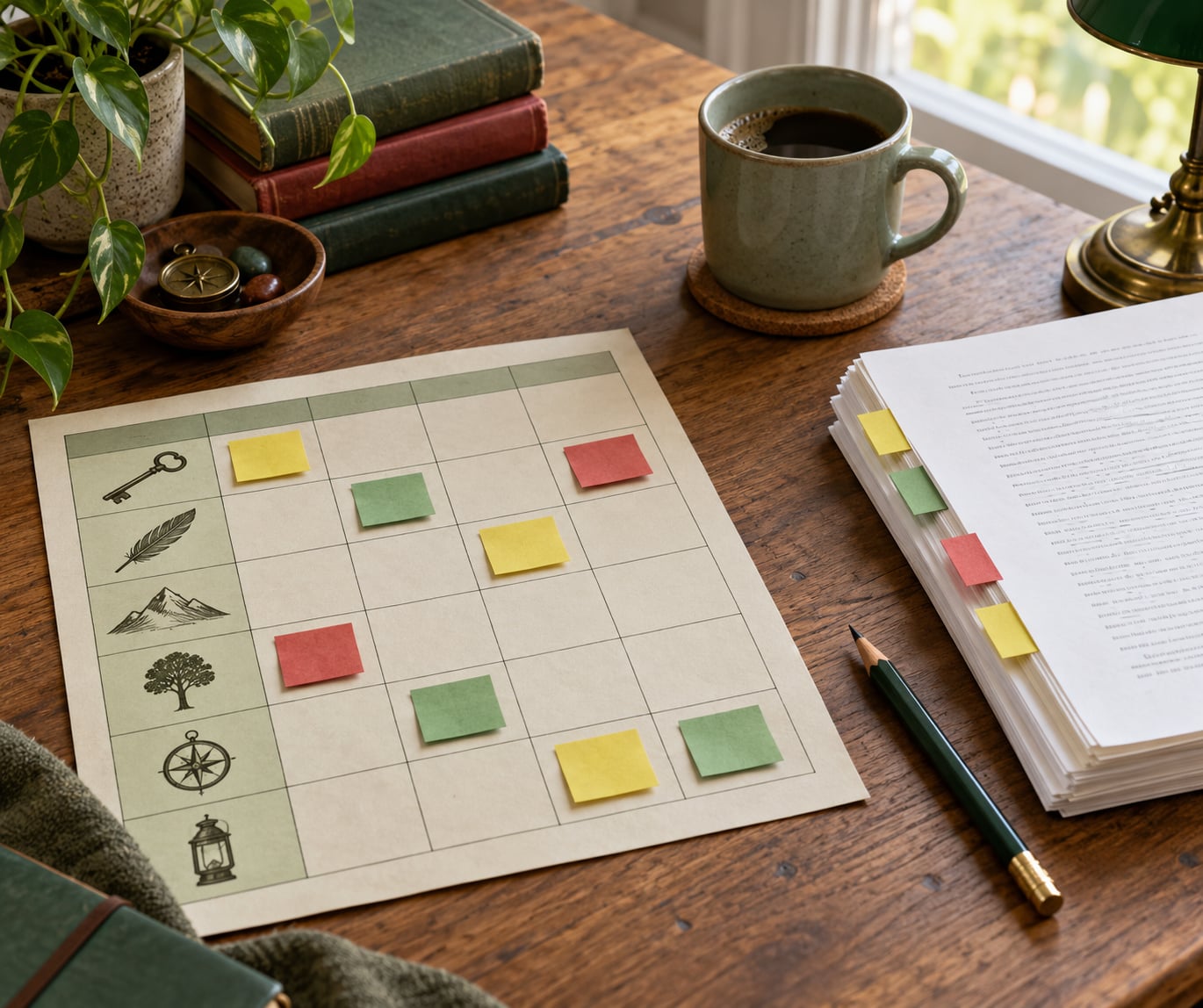
How to keep track of clues while drafting comes down to two documents: a clue tracker with one row per clue, and a separate timeline table of who was where and when. Log every clue the moment you write it, then sweep both documents at the end of each session. Twenty minutes a session keeps a 90,000-word draft honest.
Here, clues means narrative clues — the evidence, details and misdirection that carry a mystery plot. Nothing to do with the board game.
Most drafters don’t lose clues because they are careless. They lose them because they are working from memory, and memory is exactly what a 300-page draft is designed to overwhelm. The clue planted in chapter four matters because of the reveal in chapter twenty-eight, and by chapter nineteen nobody remembers chapter four — least of all a character who wasn’t in it.
Writers describe clue planning as the hardest part of the job. Some have never written a mystery because of it. The fix isn’t more talent or better software. It’s a written record you update in fifteen minutes at the end of every session.
Table of Contents
- What You Need
- Step-by-Step: Build a Reliable Clue-Tracking System
- Step 1: Map the major questions and revelations
- Step 2: Give every important clue a tracking card
- Step 3: Link each clue to a character and a scene
- Step 4: Use this method to keep track of clues while drafting
- Step 5: Track planted, discovered, and unresolved clues
- Step 6: Audit the clue chain after every major scene
- Step 7: Run a final clue-and-payoff audit
- Common Mistakes
- Quick Tips for Ongoing Use
- Frequently Asked Questions
- How many clues should I track while drafting a mystery?
- Do I need to track every small detail, or only the important clues?
- How do I keep track of red herrings without confusing them with real clues?
- Should I update my clue list during drafting or wait until revision?
- What should I do if I change the solution halfway through the manuscript?
- How do I make sure clues do not feel unfair or appear only at the ending?
- Conclusion
What You Need
Four things, and you can assemble them this afternoon. Keep the list short on purpose — the most common failure is building an elaborate system that takes longer to maintain than it takes to write.
- A manuscript draft in whatever program you already use. Don’t switch software to solve a tracking problem.
- A scene list — chapter by chapter, one line each, saying what actually happens.
- A clue ledger — a single table, one row per clue, tracking where it was planted, what the reader concludes from it, and where it pays off.
- One tracking method for the manuscript itself: comments or highlight colours applied while you write.
The clue ledger is the piece people skip, and it’s the one that matters. A spreadsheet does the job well because it filters. Excel and Google Sheets both handle a hundred rows of clue data without breaking, and you can sort by character, by chapter or by status in a second.
OneNote works too: one notebook per novel, one tab per category, one line per clue. Obsidian or Notion suit writers who like linking and backlinks, and Airtable suits writers who want views instead of columns. Scrivener’s corkboard is genuinely useful for seeing clues beside the scenes they sit in.
Paper works too. An index card per clue, a rubber band around the ones still unresolved. It’s slower to search and faster to look at, which is not nothing when you’re four chapters from a reveal and trying to remember what you’ve planted.
Whichever you pick, decide the labels now and never change them. Inconsistent labels are the reason trackers get abandoned by chapter ten.
Step-by-Step: Build a Reliable Clue-Tracking System
Seven steps, in order. The system should stay light enough to use mid-scene — if maintaining it takes longer than drafting, you’ve built a second manuscript.
Step 1: Map the major questions and revelations
Start at the end and work backwards. Before any prose, write down the central mystery in one sentence, the three or four major revelations in the order the reader will learn them, and the final solution.
Then list the questions you want the reader holding at each stage. What do they suspect after chapter five? After twelve? After twenty? A mystery is a sequence of reader questions answered in a deliberate order, and the tracker is where that order lives.
Doing this first is what separates a mystery with a fair-play clue trail from one that solves itself in the last chapter. If you can’t list the major revelations, you don’t have a plot yet, whatever you have got on the page.
Step 2: Give every important clue a tracking card
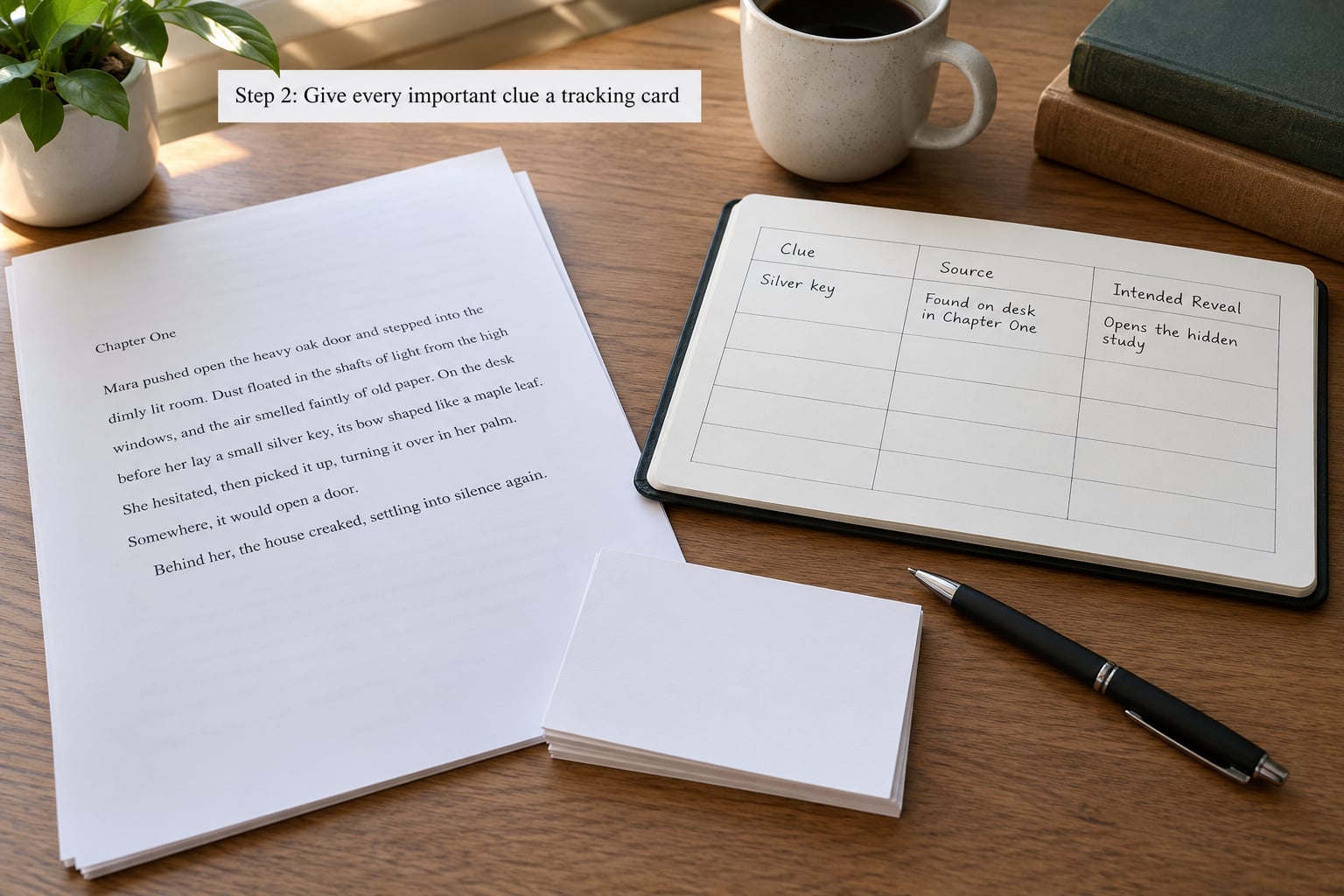
One row per clue. Not one row per detail — the ledger records clues that carry plot weight, and you decide which ones qualify. A muddy footprint matters if the culprit’s boots are muddy. A description of the kitchen wallpaper does not.
Here is the column set to copy into a spreadsheet. Eight columns covers plant location, reader conclusion, truth and payoff in one view:
| Column | What goes in it | Why it matters |
|---|---|---|
| Clue # | Number or short label | Lets you reference a clue in the manuscript without describing it |
| Scene / chapter | Where the clue is planted, by number | Tells you when the reader first meets it |
| Clue on the page | A few words or a short quote | Finds the physical line during revision |
| Reader concludes | What you expect the reader to take from it | Reveals clues that give the game away too early |
| True meaning | What it actually means to the culprit or the plot | Keeps author knowledge separate from reader knowledge |
| Payoff | Chapter and scene where it lands | The column that stops dangling clues |
| Red herring? | Yes or no | Misdirection needs tracking too, or it drifts |
| Status | Planted, noticed, resolved or deferred | Shows at a glance what is still outstanding |
Freeze the header row so the labels stay visible while you scroll. It is a small setting and it saves you re-reading column names at chapter twenty.
Add a colour convention while you’re here. Green for a real clue, red for a red herring, yellow for a detail that serves character or atmosphere only. Three colours is enough; a rainbow means you’ll forget what the fourth one meant.
Step 3: Link each clue to a character and a scene
A clue nobody interacts with is decoration. For each row, name who sees it, who reacts to it, and what it costs them to stay quiet about it.
That third part is where mysteries get interesting. If a suspect has no reason to hide a detail, the detail is a signpost, not a clue. Asking “why would this person lie about this?” moves you from plotting objects to plotting behaviour.
Attach the scene number in your manuscript as well. On paper, a sticky note with the clue number; in a word processor, a comment carrying the number. Both beat hunting for a phrase you no longer remember.
Step 4: Use this method to keep track of clues while drafting
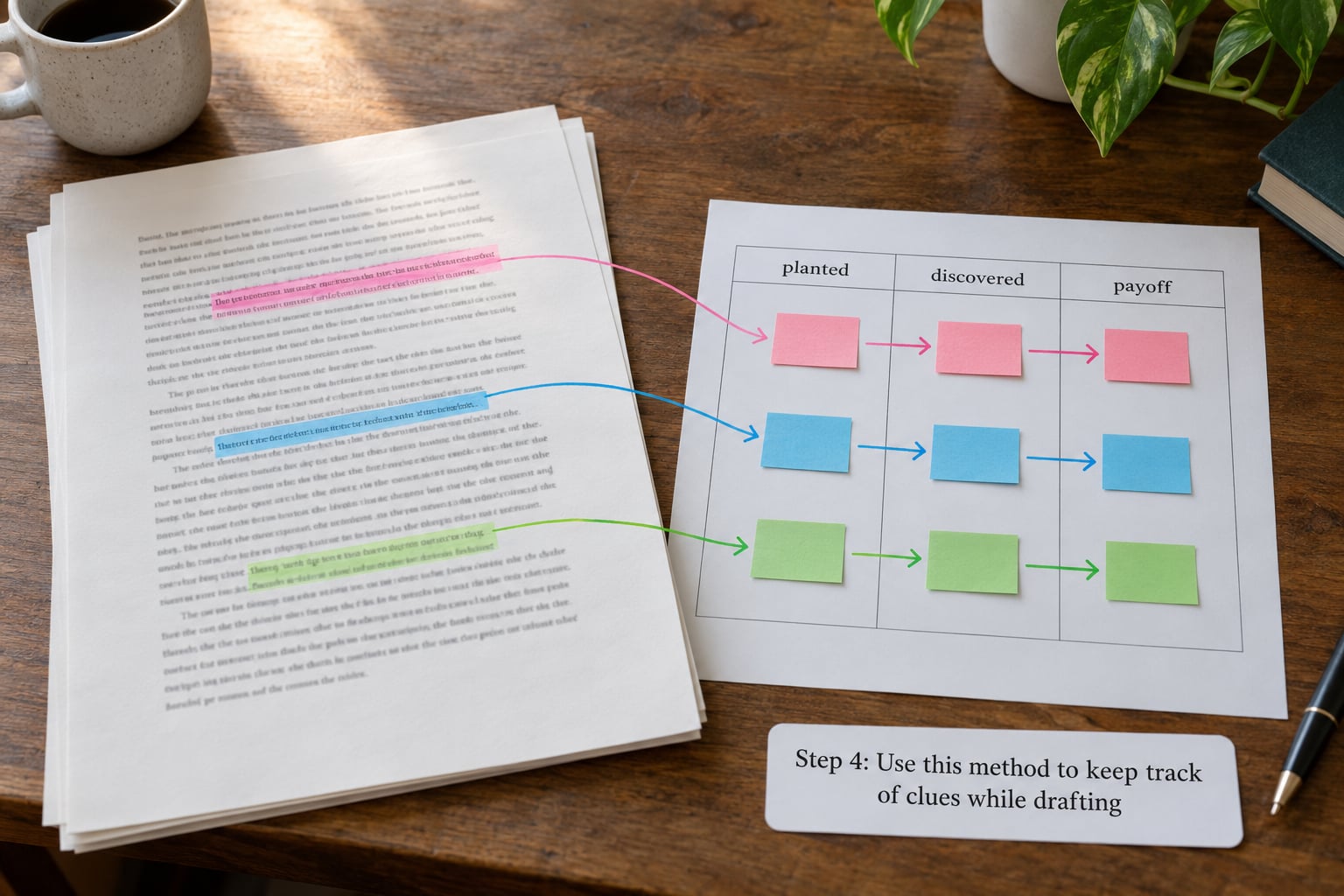
Here is the routine that keeps the ledger alive. Four moves, ten minutes, done at the end of every session rather than the end of every chapter.
- Before you write, check the ledger for the clues due in this scene. Know what you are supposed to be doing before the scene exists.
- As you draft, mark every new clue as you write it. Not at the end of the chapter — at the moment you write it, while the reasoning is still in your head.
- Log discoveries the characters make, not just clues you plant. The difference is where most trackers fail.
- Flag anything that changes the solution. If a scene forces a rethink, the ledger is now wrong in three or four rows and you want to know that on the spot.
That fourth point is the one people skip. A clue that was a coincidence in chapter six is a motive in chapter twenty, and if you don’t flag the change the ledger will confidently carry a stale meaning for the rest of the draft.
Keep a running note of clues you planted on purpose by accident. Writers report that emergent clues often land better than planned ones, and they’re right — but only if you notice them and give them a payoff.
Step 5: Track planted, discovered, and unresolved clues
Sort the ledger by status once a week. Three groups should be visible: clues planted but not yet noticed, clues the characters have discovered but not understood, and clues with no payoff scheduled yet.
The third group is your list of trouble. A clue with no payoff is either a seed for a later instalment or a mistake, and now you know which chapters it sits in.
Also separate what the reader knows from what the characters know. Authors know the meaning of every detail; readers only know what you’ve shown them. Recording both columns — reader conclusion and true meaning — is what catches the detective who deduces something they had no way of knowing.
For a locked-room or impossible crime, add a column for physical evidence and add rows for anything introduced in passing: a window, a clock, a key. Those are the details readers hold you to in chapter thirty.
Step 6: Audit the clue chain after every major scene
After any scene that changes what the reader believes, do a two-minute check. Does this new detail support characterization, misdirection, atmosphere or plot? Anything outside those four is either cuttable or underused.
Then ask the harder question: has the reader’s understanding of the central mystery actually changed? If a scene adds texture but shifts nothing, it may belong to a different book.
This is also where you check alibis. One timeline table, one row per scene, one column per suspect, and you can see immediately who could have been at the scene of the crime at the time it happened. Readers check these gaps too, carefully, and they enjoy it.
Step 7: Run a final clue-and-payoff audit
When the draft is finished, work through the ledger line by line and sort it into three bins: every clue was noticed, interpreted or deliberately withheld for a reason; every clue pays off somewhere; every clue is planted before it matters.
Then read the manuscript backward from the last page. Reading in reverse exposes the order you actually planted things in, and it’s the fastest way to find the clue that arrives one chapter after its payoff.
Give the finished draft to a reader who doesn’t write. Non-writers are better clue detectors than writer friends, who tend to skim past gaps they know are coming. Ask them two questions: where did you first suspect the culprit, and where did you feel the ending was unfair?
The first question tells you whether your misdirection worked. The second tells you where to plant more.
Common Mistakes
Overtracking. Every passing detail gets a row, and the ledger becomes longer than the novel. Fix: one row per clue that carries plot weight. If removing it changes nothing in the solution, it isn’t a clue yet.
Undertracking. You log big reveals and skip the quiet setups that make them fair. Fix: check the clue planted longest ago but resolved most recently. That gap is where unfair twists live.
Treating clues as facts. A fact is true and tells the reader nothing new. A clue is a fact plus an implication. Fix: if you can’t fill the reader-conclusion column, you’re recording setting, not evidence.
Planting without consequence. A detail appears in chapter two, matters to nobody, and reappears in chapter twenty as if the reader remembered it. Fix: make sure each planted clue either changes a character’s behaviour or narrows the suspect list at the moment it appears.
Revealing too early. The reader works out the culprit at forty percent and spends the rest of the book waiting for you to catch up. Fix: introduce early, misdirect mid-book, land it in the climax. If suspicion locks onto one suspect too soon, add a second true detail pointing elsewhere.
Changing the solution without updating the ledger. You switched the killer in chapter nineteen and now four clues mean nothing. Fix: go back through every row tied to the old culprit, and either repurpose the clue or cut the scene that planted it. Also re-check every alibi in the timeline table, because the new culprit needs a window where nobody can vouch for them.
Quick Tips for Ongoing Use
Update the ledger at the end of each session, not the end of the chapter. Fifteen minutes while you still remember the reasoning beats an hour of archaeology six weeks later.
Use the same label wording everywhere, including in manuscript comments. If chapter four says “C12” and chapter nine says “clue twelve”, you’ll waste time on both.
Review the clue list during revision as a separate pass, with fresh eyes and the suspicion lens on — reading backward from the end, as if you were the reader arriving at the solution for the first time.
For a series, add a column for the book where each clue pays off. Seeds meant for book four get filed now, not reconstructed from memory three novels later.
And keep the reader’s knowledge separate from your own. It’s the single habit that makes mysteries feel fair.
Frequently Asked Questions
How many clues should I track while drafting a mystery?
Track only the clues that narrow the suspect list, establish motive or opportunity, or pay off in the reveal. A domestic cozy rarely needs more than fifteen tracked rows; a multi-suspect police procedural can run fifty or more. If you are logging every passing detail, the ledger becomes noise and you will stop maintaining it.
Do I need to track every small detail, or only the important clues?
Only the important ones. Use the test: if the reader removed the detail, would the solution still work? If yes, it belongs in the manuscript as texture, not in the ledger. Keep a separate, looser list for continuity items such as injuries, clothing and physical descriptions that could contradict a later scene.
How do I keep track of red herrings without confusing them with real clues?
Use a dedicated column rather than a separate document. A red herring row records the false conclusion you want the reader to draw, the suspect it points at, and the moment you undercut it. Colour them red in the same table. Keeping both types in one ledger means you can see at a glance whether your misdirection has enough real clues behind it to hold.
Should I update my clue list during drafting or wait until revision?
During drafting, every session. The ledger is only useful if it reflects the draft as it currently stands, and a ten-minute end-of-session sweep is far cheaper than rebuilding forty pages of planted clues from memory during revision. Waiting until revision means reconstructing the plan, which is the work you were trying to avoid.
What should I do if I change the solution halfway through the manuscript?
Go through the ledger and mark every row tied to the old culprit, then decide for each one whether it can be repurposed or has to go. Re-check the timeline table afterwards, because the new culprit needs an unaccounted window and the old alibi structure will not support them. Expect two or three scenes to need rewriting, not twenty.
How do I make sure clues do not feel unfair or appear only at the ending?
Read the manuscript backward from the final page so you see the order you actually planted things in. Every clue that matters should pay off at least two chapters after it is planted, and the strongest clues should be visible from the first third of the book. Then ask a non-writer where they first suspected the culprit and whether the ending felt earned.
Conclusion
Start tonight, before you write another scene. Write the central mystery in one sentence, list the revelations in the order you want the reader to learn them, then open a spreadsheet and give every important clue one row: where it’s planted, what the reader concludes, what it really means, and where it pays off.
Keep the timeline table beside it. Update both for fifteen minutes at the end of every session, and how to keep track of clues while drafting stops being something you hope your memory can carry.