
To self publish a crime novel, you take on the publisher’s job: revise the manuscript, hire or source editing and cover design, format the interior for ebook and print, register an ISBN, choose a distribution platform, set your own prices, and then market the book yourself. Most first releases take three to six months from finished draft to launch day, and a professional-quality debut usually runs into the low thousands of dollars to do properly.
This guide is written for a writer with a completed crime manuscript who wants a plan rather than encouragement. If your book is a procedural, a noir piece, a psychological thriller or a cold case story, some of the steps below carry extra weight, because that readership reads closely and forgives a slow plot far less readily than it forgives bad forensics.
The order of spending matters more than the amount. Cover first, editing second, formatting third, and only then marketing spend. A cheap cover with a strong title and blurb has been reported by more than one indie crime author as the thing that moved their sales most, and none of the money matters if the first fifty pages contain typos a copyedit should have caught.
One reassurance before you start: publishing is not a single shot. Cover, blurb, categories and keywords can all be changed after release, and most self-published crime novels that stall in their first six months stall on those four elements rather than on the plot. Treat launch as the first version, not the final verdict.
Table of Contents
- What You Need
- How to Self Publish a Crime Novel, Step by Step
- Define Your Novel’s Publishing Goals
- Revise and Copyedit the Manuscript
- Prepare the Book Files and Metadata
- Choose a Publishing Platform
- Set Pricing, Release Timing, and Distribution
- Launch and Promote the Crime Novel
- Common Mistakes
- Frequently Asked Questions
- How much does it cost to self-publish a crime novel?
- How many books do you have to sell to earn a full-time income?
- Do I need an ISBN to self-publish a crime novel?
- Should I publish in ebook or print first?
- How long should a crime novel be?
- Do I need an agent or publisher to publish a crime novel?
- Conclusion: Start With Your Manuscript
What You Need
Gather these before you open a platform’s upload page. Having them assembled means the upload is a data-entry job rather than a research project.
- A finished manuscript in a word processor file you can still edit. If the last three chapters are still being rewritten, that is where the delay lives.
- Editing support, at minimum a developmental read and a proper copyedit, plus a proofread on the print file once it exists.
- Beta readers from the crime and thriller side of your own network, plus one or two sensitivity readers if the book involves victims, violence or sexual assault.
- A cover in full wrap resolution plus a thumbnail that still reads at the size of a search result on a phone.
- Interior files: an EPUB for digital and a print-ready PDF with embedded fonts for paperback or hardcover.
- Metadata written in advance: title, subtitle, book description, categories, keywords, series name and series number, author bio.
- An ISBN decision and a copyright page with your name, the year and any rights language you want on record.
- A distribution account and, if you want preorder or countdown pricing, an understanding of what each platform allows.
- A marketing kit: a simple author page, an email list, a cover with the title typeable so you can paste it into posts, and a review outreach list.
Budget for it in tiers rather than as one number, because the tiers differ mainly in who does the work and how long it takes.
| Line item | Lean (you do the work) | Standard (freelance help) | Premium (full service) |
|---|---|---|---|
| Developmental edit | Beta readers only | Freelance developmental editor | Editor plus a second reader |
| Copyedit and proofread | Self-edit, second pair of eyes | Copyeditor plus separate proof | Full line edit, copyedit, proofread |
| Cover design | Template or stock composite | Hired genre cover designer | Hired designer plus series branding |
| Interior formatting | Built-in converter | Formatter or production service | Formatter with print proofs |
| Metadata and blurb | You write it | You write it, editor polishes | Ghostwriter or marketing partner |
| Marketing | Organic only | Newsletter features, a few ads | Full campaign plus a publicist |
The practical difference between lean and standard is almost always editing and cover. Everything else can be done badly and fixed later; a book with typos on page three earns a one-star review that follows the title forever.
How to Self Publish a Crime Novel, Step by Step
Define Your Novel’s Publishing Goals
Before anything else, decide why you are self-publishing. The honest answers are different, and they lead to different decisions about control, money and timeline.
That question, should you self-publish a crime novel, is really a question about your material rather than about the industry. Crime fiction is unusually well suited to independent release, because the readership is habitual, buys series backlist, and is reachable through a handful of newsletters and communities that respond to a specific subgenre rather than to a marketing budget. It is also unusually unforgiving: this is a readership that reads three books in the same subgenre in a row and can tell within a page whether you know how a search warrant works.
| Route | Control | Timeline | Money | Best fit |
|---|---|---|---|---|
| Traditional submission | Lowest | One to three years | Advance plus royalties, often single-digit royalties | Writers with a strong platform or a breakout concept chasing wider review attention |
| Independent release | Total | Three to six months | Keeps the large majority of each ebook sale | Crime writers with a completed manuscript, a series plan, or a story too dark or too commercial for the traditional list |
| Hybrid | Partial | Slow start, faster after | Advance first, then higher royalties | Writers who want one book read widely before committing to a series |
A trade deal usually means an advance, and the advance is money you have already earned before a single copy moves, which matters when a crime debut lands in a crowded week. Independent publishing means your name on the cover, your categories, your price and your release date, and it means nobody filters your story for marketability.
Then be honest about the three audience questions that decide your metadata: who reads this book, and which shelf does it sit on. Procedural, noir, psychological, cold case and true-crime-adjacent all sell to overlapping but not identical readers, and a blurb that tries to sell all five reads as none of them. Also decide whether this is a standalone or book one of a series, because a series changes pricing, cover design and how you write the back matter.
Revise and Copyedit the Manuscript
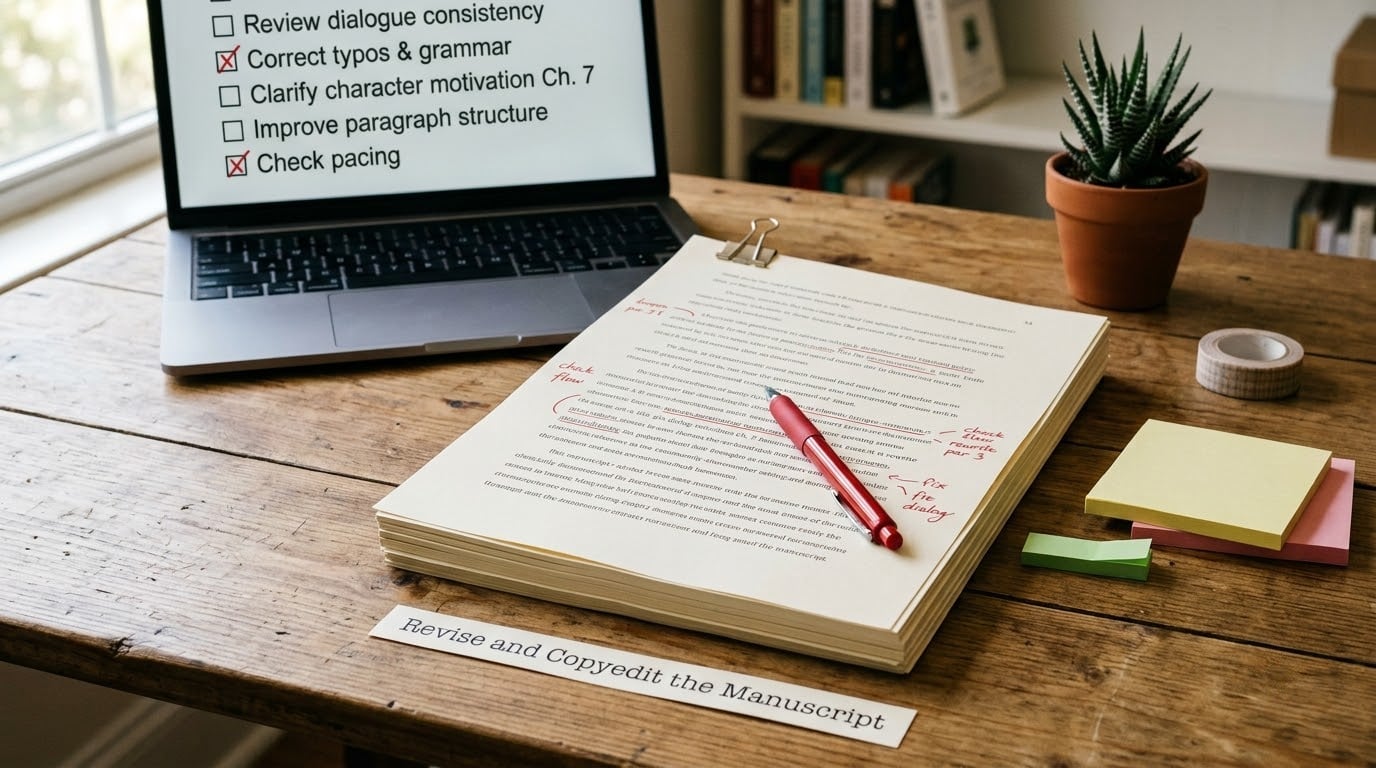
Editing is four separate passes, and knowing which one you are doing is most of the battle. Developmental editing is structure: whether the story works. Line editing is voice and sentence craft. Copyediting is grammar, consistency and factual internal accuracy. Proofreading is the final pass on the formatted file, catching only what earlier stages introduced.
Run them in that order and never skip ahead. A copyeditor cannot fix a mystery whose clues were never planted, and a developmental editor working on a manuscript with three different time zones in it will burn your budget on symptoms.
For a crime novel, the developmental pass needs a genre-specific checklist, because the ordinary questions do not cover the things crime readers notice.
- Is the procedure plausible? Chain of custody, warrant language, who is allowed to be in the room, what happens between the call-out and the interview.
- Does the forensic detail survive a sceptic? Time of death, decomposition stages, blood spatter logic, what a lab can and cannot determine from a sample.
- Are the clues planted in time? Every deduction the detective makes must trace back to something the reader saw, ideally more than once.
- Does the suspect have a motive that exists in the text? Motives announced in the last chapter read as invention.
- Is the geography consistent? Drive times, distances and landmarks, especially if your detective travels between scenes.
- Does the timeline hold? Day and night cycles, weather, phone battery levels, newspaper dates, injury progression.
- Is the dialogue doing work? Interrogation scenes fail when characters answer instead of deflect.
Two genre checks that catch a lot of trouble. First, the true-crime boundary: if your book draws on a real case, real victims or a real agency, check your exposure, avoid invented quotes attributed to real people, and consider a disclaimer and a sensitivity read. Publishing claims about a living person or an unsolved real case can produce a legal problem that a marketing budget will not fix.
Second, the 90/90 rule borrowed from the thriller world: most readers finish the first 90 percent of a book they have finished, and most abandon between the 10 and 20 percent mark. Your crime novel has to earn the first ten pages. If your opening is a prologue about a character you have not met yet, consider starting at the crime.
On AI writing tools, the short answer to a question readers ask constantly: using them to help you outline or brainstorm is not illegal anywhere you are likely to publish, but almost every platform’s terms prohibit uploading copyrighted manuscript material to a third-party service, and most retail policies expect disclosure of substantial generated text. Keep your own voice in the prose and check your distribution agreement before you upload anything.
Prepare the Book Files and Metadata
You need two interiors from the same manuscript. The EPUB is reflowable, so your styles carry the formatting: a clean serif or a well-set sans, sensible line spacing, real chapter breaks and no orphan lines. The print-ready PDF needs embedded fonts, a trim size with the correct bleed and margins on all four edges, and a gutter wide enough that nothing disappears into the binding.
Check the platform’s current specifications before you build the file rather than after. Trim sizes, margin minimums and bleed requirements are set by the printer and they change, and a file rejected for margins is a reprint’s delay rather than a small fix.
Front matter is where a lot of indie books lose points. Include a half-title or title page, a copyright page with your name, the publication year, the ISBN and a rights line, a table of contents with live links, and an about-the-author page. Back matter can hold a series list and a note about your next book, which quietly sells book two.
Now write the book description, which does more work than any other piece of metadata. A crime blurb is not a plot summary. It is a situation plus a question, kept deliberately vague about the solution. Forum threads about crime blurbs ask the same thing repeatedly: is mine too long, too short, does it spoil the twist. A useful working range is 150 to 300 words for print, with a first sentence you could print on the back of the book, and no reveal of the answer. Readers forgive a slow opening; they do not forgive a blurb that told them who did it.
For metadata, choose the two categories that genuinely fit before you choose the popular ones. Genre categories, subgenres, and the seven keyword slots you get on most platforms should carry real terms a reader would type: the subgenre, the setting type, the profession, the crime type, the tone. Skip anything on Amazon’s restricted-term list, which covers trademarked and promotional language. If the book is one of a series, set up the series page and number the books before release; readers who buy book three through a series page will also buy book one.
Choose a Publishing Platform
Almost everyone ends up on more than one. The question is which platform owns which format and what rights you hand over.
| Platform | Best fit | What to know |
|---|---|---|
| Amazon KDP | First-time crime authors who want volume and speed | Free ISBN for ebooks, print options, wide reach; a subscription program can add monthly page income but takes ebook exclusivity for 90 days |
| IngramSpark | Authors who need real bookstore and library distribution | Broader print availability, no exclusivity, a smaller royalty on print than some rivals, a distribution fee |
| Barnes and Noble Press | Authors whose readership shops that store | Strong presence in its own ecosystem, print and digital under one account |
| Apple Books for Authors | Authors who want a subscription-program audience for free | No print, and the royalty is tied to time spent reading rather than to a per-sale rate in most arrangements |
| Draft2Digital | Authors who want many stores without exclusivity | Set your own price, no exclusivity, subscription-funding options, smaller catalogue control on some stores |
| Lulu | Authors who want print-first or unusual trim sizes | Direct control, low print runs, weak automatic discovery in online stores |
Two rules of thumb. Print-on-demand through KDP or IngramSpark beats offset printing for a debut, because offset only makes sense once you have proven demand in a specific format and are ready to place a large print run of your own. And an exclusivity trade is worth it only if you know which program you are opting into, for how long, and what the realistic page-read income is for a crime novel, which is usually modest compared with steady per-sale earnings.
Authors often ask whether they can list a book on Amazon without using KDP. You can, through a distributor. The trade-off is that you give up the direct relationship, and often some control over updates and pricing speed.
Set Pricing, Release Timing, and Distribution
For ebooks, the going rate for commercial crime fiction sits in a narrow mid-range band, and pricing near the bottom of it rarely helps. The old tactic of undercutting the market to climb a ranking ladder does not work the way it did in 2010, and readers have learned that a permanently discounted crime novel is a sign of trouble. If you are publishing book one of a series, price it lower than the rest of the series, because the goal on book one is the read-through, not the margin.
Publish both formats on the same day and price them close together, because readers resent being made to wait for the format they prefer.
On timing, back-plan from the launch date rather than forward-planning from today. Six to twelve months out is where a developmental editor, a cover and a series decision belong. Three to six months out covers the copyedit, the formatter and metadata. One to three months out is for proofs, preorder setup and the prelaunch campaign. The final two weeks are for the launch itself and for fixing what breaks.
Pick a release date that is a Tuesday or Thursday, avoids a major competing release in crime, and gives you a finished book at least two weeks ahead. Print proofs take longer than people expect, and a proof that arrives after launch is a proof you cannot act on.
Before you press publish: order a print proof and read it, check the copyright page and ISBN match the metadata exactly, confirm the categories and keywords saved correctly, verify territorial rights and whether any territory is excluded, and check that your author bio and series page are live on every store rather than just one.
Launch and Promote the Crime Novel
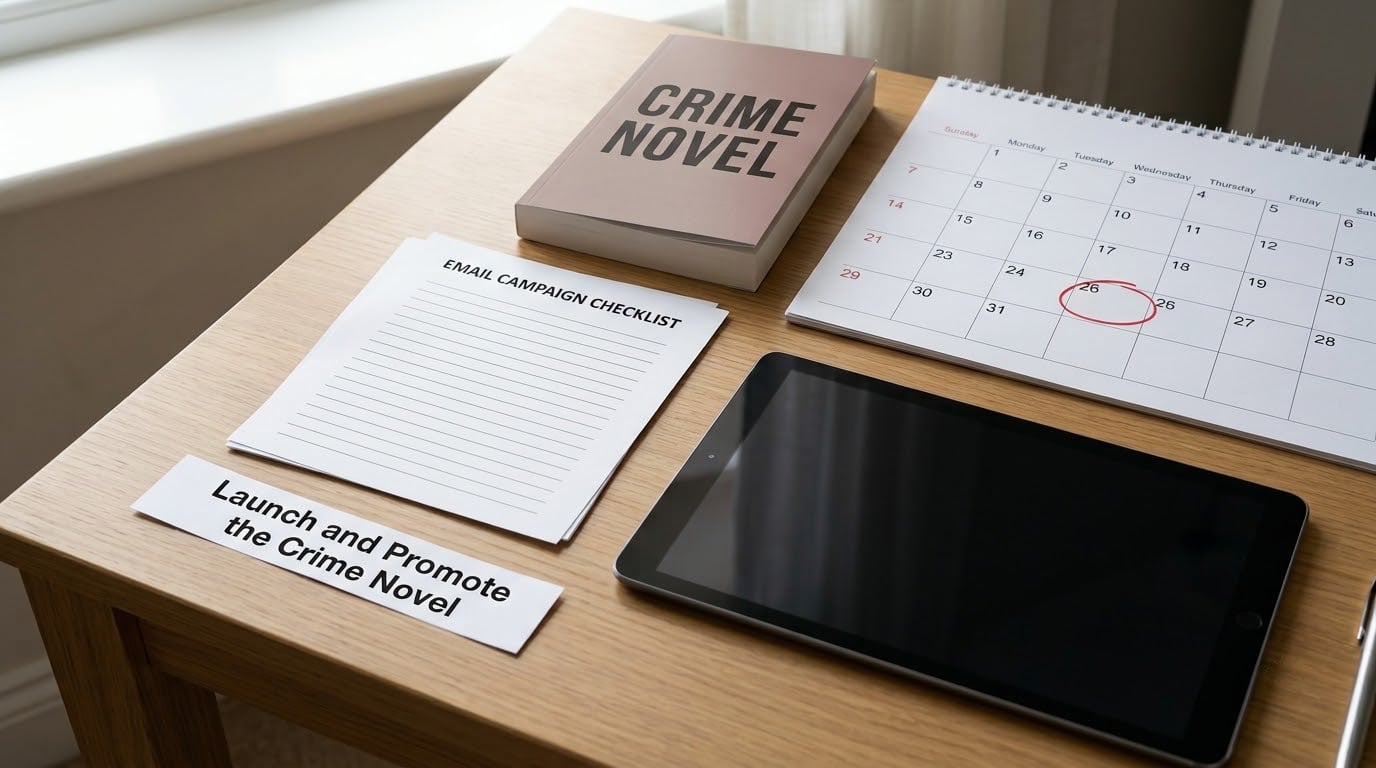
A launch is a sequence, not a day. Six to eight weeks before release, send advance review copies to reviewers who read that subgenre and say so on their pages; ask for an honest review, not a good one. Four weeks out, schedule any newsletter promotions you can get, and put the cover with the title in a typeable font into your social templates.
Two weeks out, open the preorder if the platform offers one, since a preorder shows up in the system’s algorithm differently from a same-day release. One week out, run your email sequence: one message about the book, one about who you are, one on launch day.
Launch week itself is short. Announce it, keep posting, answer every review even the hostile ones with courtesy, and monitor your sales dashboard daily so you know which day your audience actually buys.
Then do the part most authors skip: fix the machine after launch. Check where readers are dropping off using your platform’s read-through data, rewrite the blurb if the click-through is poor, and change the cover if the category page numbers look bad. Legitimate cover, blurb and keyword changes are allowed at any time and cost nothing.
Reviews deserve their own rule set, because this is where self-published crime authors most often get into trouble. Never pay for reviews, never trade reviews with other authors, never ask family to post, and never offer anything in exchange for a review. Use advance review copies, reviewer databases, and your own email list. Communities like r/selfpublish and r/KDP repeat this advice constantly, and it is correct.
Two more trust signals that cost nothing. If your book contains graphic violence, sexual assault or self-harm, say so plainly in the description or on a content notes page; readers in this genre specifically reward honest disclosure. And be careful with award entries and contest fees: legitimate awards charge a modest entry, while any scheme promising guaranteed placement in return for a large upfront fee is a scam.
After launch, consider the audiobook edition, which is where a lot of indie crime readership now sits, and think about foreign rights once the series has traction rather than at release.
Common Mistakes
Every one of these shows up repeatedly in self-publishing communities, and most of them are cheap to avoid.
Spending on the cover last. The cover is the first thing a browsing reader sees. Fix: commission it before the formatter, and check the thumbnail test on a phone before you approve it.
Treating editing as optional. Typos and grammar errors in the opening pages generate the one-star reviews that follow a book for years. Fix: at minimum a copyedit and a proofread on the print file.
Pricing book one at a cent. It trains readers to wait for a discount and devalues the series. Fix: price book one modestly below the rest of the series, not below cost.
Incentivised or fabricated reviews. This breaks platform policies and, in crime circles specifically, costs you the reader trust you need most. Fix: advance review copies and genuine outreach only.
Naming famous authors in the title. It reads as desperate borrowing, and readers notice. Fix: let your own title signal the subgenre.
A blurb that gives away the twist. Fix: situation plus question, no reveal.
Treating launch day as the finish line. Publishing a book and publishing it well are different projects. Fix: budget three months of post-launch work on metadata, outreach and the next book.
Hiding violent content. Undisclosed graphic content reads as a warning label to readers who were not warned. Fix: disclose plainly.
Four things to carry out of all this. Spend in the order of cover, editing, formatting. Decide whether the book is procedural, noir or psychological, and say so in the metadata. Change your cover and blurb when the numbers disappoint, because that is a normal part of publishing. And keep writing the next one; the second book is where most self-published crime authors actually find their audience.
Frequently Asked Questions
How much does it cost to self-publish a crime novel?
Most first releases fall into three tiers: a lean launch where you do the work yourself, a standard launch using freelance editing, cover and formatting help, and a premium launch that includes a marketing campaign. Editing and the cover dominate the cost in every tier. A tight-budget version can be done with beta readers and a template cover, but skipping the copyedit is the one saving worth avoiding.
How many books do you have to sell to earn a full-time income?
Work it out from your per-sale royalty, not from a headline figure. Most independent crime authors sell their first novel in the low hundreds of copies in the first year, and that is a normal result rather than a failure. Income becomes meaningful when a series compounds, when a newsletter grows, or when one title breaks out of its first month and keeps selling.
Do I need an ISBN to self-publish a crime novel?
Yes for print editions, and for ebooks if you want to sell outside a single platform’s ecosystem. Amazon offers a free ISBN for Kindle ebooks, which is fine for an Amazon-only launch but restrictive later if you expand distribution. Registering your own ISBN through Bowker is inexpensive compared with what freelancers charge to do it for you.
Should I publish in ebook or print first?
Publish both at the same time and price them close together, because readers resent being made to wait for the format they prefer. Print-on-demand removes the inventory risk that used to make this a hard decision for first books. The practical difference is only that print needs a proof and a few extra days of lead time.
How long should a crime novel be?
Most commercial crime fiction lands between 70,000 and 100,000 words, with police procedurals and series books often running shorter and literary or noir titles sometimes running longer. Length matters far less than pacing. If your first ten pages do not earn the read-through, adding another 20,000 words will not fix it, and cutting 15,000 will not hurt you.
Do I need an agent or publisher to publish a crime novel?
No. Self-publishing gives you total control over the cover, price, categories, release date and the large majority of each ebook sale, and it can happen in three to six months. The trade is that nobody filters the story, funds the marketing, or puts your book in front of a review desk. Many crime writers self-publish book one deliberately and query book two with the sales data behind them.
Conclusion: Start With Your Manuscript
Three things to do next, in this order. Finish the revision, with a developmental read focused on procedure, forensics and planted clues rather than on sentence polish. Choose your distribution platform, because that decision determines your ISBN, your file specs and your exclusivity obligations. Then prepare the metadata and the cover, which are the two things you can still improve for as long as the book is in print.
Everything after that is promotion and iteration, and that part is a lot less frightening once you accept that publishing is a process you keep tuning rather than a verdict you receive once. Updated for 2026.