
How to write about victims with respect comes down to four choices: show the person before the crime happened, keep them in the active seat, spend your detail on consequence rather than shock, and let them control their own story. Do those four things consistently and suffering stops being scenery and starts being a life that changed.
That gets harder the closer the story sits to real suffering, and harder still in crime fiction, where readers expect a body to explain why a plot is happening. A novel can invent a victim. It cannot invent the obligation to treat them like a person.
The method below takes an afternoon for a chapter and a full revision pass for a manuscript. It works for novelists, memoirists, screenwriters, true crime writers and reporters, and it is refreshed for 2026 with the standards bodies that publish guidance on this subject: the Dart Center for Journalism and Trauma, RTDNA, the Society of Professional Journalists and Poynter.
Table of Contents
- What You Need
- Step-by-Step
- 1. Start With the Person, Not the Crime
- 2. Define What the Harm Changes
- 3. Give the Victim Agency
- 4. Build Context Without Excusing the Crime
- 5. Control the Camera and Point of View
- 6. Use Specific, Controlled Detail
- 7. Test the Portrayal From More Than One Angle
- Common Mistakes When You Write About Victims With Respect
- Frequently Asked Questions
- Should I use the word victim or survivor?
- How do I write graphic violence without retraumatizing readers?
- What is trauma-informed journalism?
- Can I build a character from several real people’s experiences?
- How do I write about grief without overexplaining it?
- When should I bring in a sensitivity reader?
- Conclusion
What You Need

Most drafts go wrong before the first sentence, because the writer never did the preparation that lets them write about a person instead of a plot device. Five things help.
A file on the person, not the event. Before you write a word, one page of ordinary life: where they lived, what they did on a Tuesday, who they argued with, what they were looking forward to. Fiction writers get this from invented biography, which is fine and necessary. It still does the work, because specificity is what stops a character collapsing into a function.
A clear account of the harm. What actually happened, in what order, with the facts you can stand behind. Confusion here leaks into the prose as vagueness or as invented detail, and both read as disrespect.
A plan for their agency. Decide what this person does after the harm. Not much is required, only something: they leave, they lie to a friend, they keep going to work, they change their routine, they refuse to explain themselves.
Rules for yourself about detail. Decide now, in advance, how much violence you will describe. A limit set before you are emotionally inside the scene is far more reliable than one set afterwards.
Outside eyes. For nonfiction, a source on the Dart Center resource list or a local victim services organisation. For fiction, a first reader who has never seen the outline and an editor willing to argue with you. For both, the published codes: the SPJ Code of Ethics, RTDNA’s Code of Ethics, and Poynter’s ethics guidance are short, readable and worth keeping open while you draft.
Step-by-Step
1. Start With the Person, Not the Crime
Put two pages of ordinary life in front of the crime scene. Not backstory in the traditional sense, but texture: the coffee order, the neighbour who borrowed a ladder, the argument about a borrowed car, the job they hated.
This does something structural. A reader who knows the person is harder to reach, which means the violence lands as a subtraction rather than a spectacle. You will also find out early whether you actually have a character, because ordinary people are much harder to invent than corpses.
How to tell it worked: delete the crime from your draft for a day and reread the section. If the person still reads as someone specific, the characterisation is carrying weight on its own.
2. Define What the Harm Changes
Write a list of what the event alters, in four columns: emotional, social, physical, practical. Not what it felt like, which is where writers drift into prose-as-therapy, but what it changed. She stopped answering her brother’s calls. He moved to a town where nobody knew his name. The neighbours started locking their bins differently.
Then run the detail test on each item you wrote: does this reveal character, create conflict, or show consequence? If it does none of those three, it is decoration and it goes.
How to tell it worked: you can describe the aftermath without describing the injury, and the reader understands exactly how bad this was.
3. Give the Victim Agency
Most thin victim portrayals are missing one thing, and it is not more sympathy. It is choice. A person who acts is a person; a person who only receives is a prop.
Give them resistance, knowledge and priority. They knew something the investigator did not. They wanted something other than justice. They lied, partly. They chose who to tell and who not to tell, and that choice had consequences they lived with. This is how to write about victims with respect in practice: the scene stops asking what they felt and starts asking what they did about it.
The test that catches the most flabbiness: if you removed every other character from the chapter, would your victim still make three decisions that shape the outcome? If not, they are a motivation device, and the chapter needs another pass.
4. Build Context Without Excusing the Crime
Context is useful and dangerous in equal measure. A perpetrator’s history, a neighbourhood’s disinvestment, a broken system, a culture that protected someone: all of it is true and none of it cancels the harm.
Keep the verdict in the grammar. Let the context explain how it happened, and let the sentence structure show what it was. A chapter can spend forty pages on why a killing was preventable and never once suggest it was forgivable, and readers will feel the difference in how the last page lands.
One warning worth stating plainly: motive is not mitigation. The moment you write a paragraph whose job is to make the perpetrator easier to forgive, you have stopped writing about the victim and started arguing for the person who hurt them.
5. Control the Camera and Point of View
Where you put the reader changes whose experience the scene centres, and no amount of careful diction fixes a badly placed camera.
- Witnessing it: immediate and visceral, hardest to write well. It tends to freeze the victim into passivity, because a witness has no time to process.
- Discovering the aftermath: the strongest option for showing loss, since the story is about what is left behind and who has to clean it up.
- Investigating it: useful for showing how institutions treat people, and risky, because procedure is where victim-blaming hides in plain sight.
- Hearing it indirectly: secondhand, through a relative, a voicemail or a statement read aloud. Cheapest way to convey long aftermath without narrating trauma.
Pick the viewpoint that matches what the chapter is about, then check that the camera stays in a place the person would actually be able to stand. Do not narrate a mother’s interior life from outside the room.
6. Use Specific, Controlled Detail
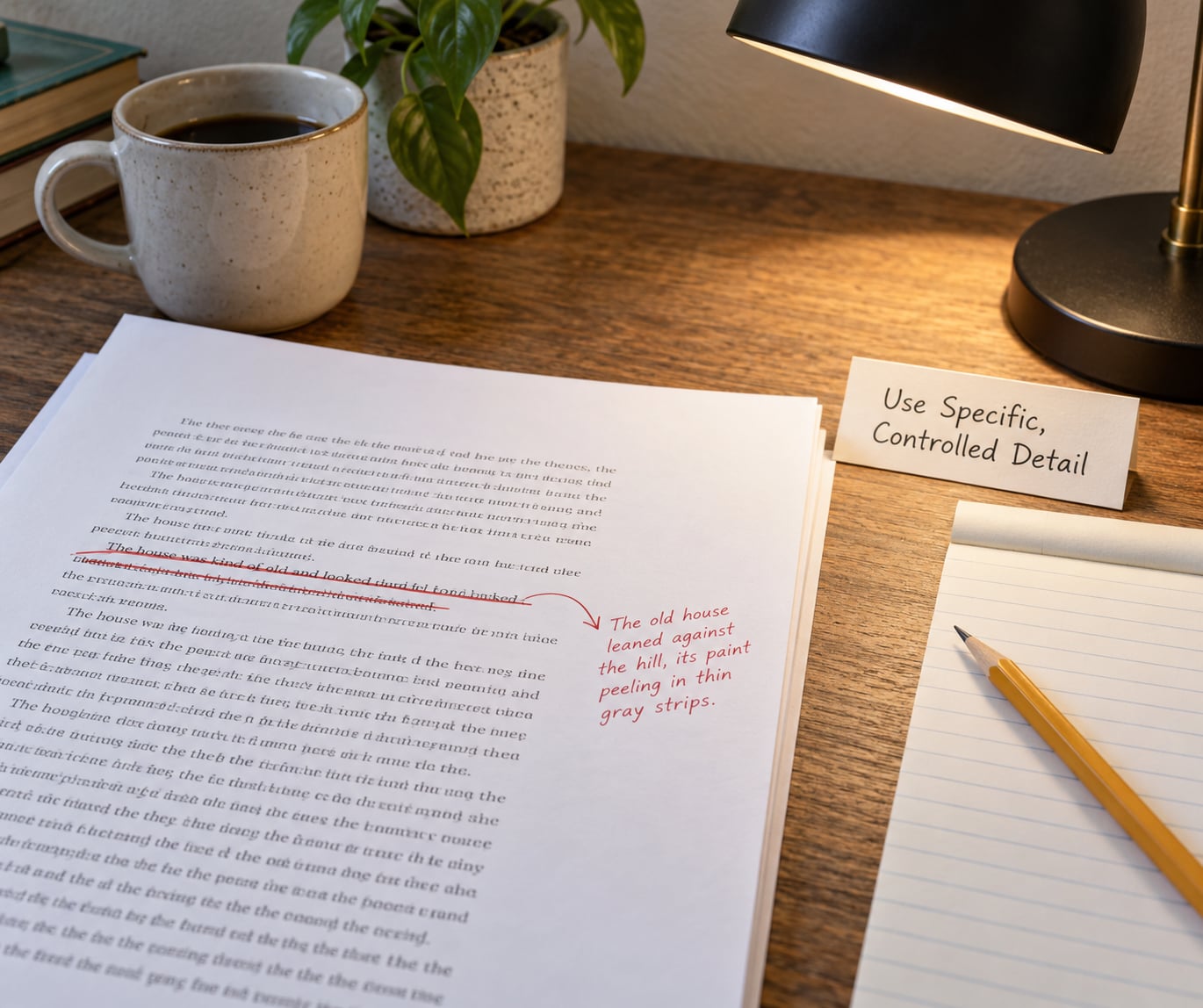
Specificity and shock are opposites. Graphic detail tries to force a feeling; specific detail lets the reader arrive at one. A sentence about what is missing from a flat after someone dies lands harder than three paragraphs of injury description.
Practical swaps that work in any mode:
- Cut intensifiers. Brutal, horrific, sickening, shocking: each one tells the reader what to feel and usually undercuts what they already feel.
- Prefer the concrete noun. Not weapon, but kitchen knife. Not a beating, but what the hand did to the side of the face.
- Give the body a life, not a wound report. Glass eye. Hearing aid. A name for the dog that is now nobody’s.
- Let aftermath do the work. Neighbours who bring food and cannot meet her eyes. A form someone signs in the wrong box.
And watch the passive frame. A sentence built so the victim disappears into the grammar leaves the reader with no one to hold on to, which is the opposite of respectful.
7. Test the Portrayal From More Than One Angle
You cannot see your own blind spot from inside the chapter, so read it with questions attached. Run these in order and note the page number next to anything that snags.
- Could a reader describe this person without mentioning the crime? If not, you have written a victim, not a character.
- Does the emotional payoff depend on repeated pain? If the chapter needs three hard scenes to work, it usually needs one hard scene and two other kinds of scenes.
- Is anyone functioning as a type? Check especially for the young professional, the single mother, the sex worker, the addict: useful as a situation, damaging as a characterisation.
- Whose grief gets screen time, and whose grief gets summarised? A pattern there usually means something.
- Does the perpetrator get an interior life while the victim gets observed behaviour? Very common, and easy to miss after three hundred pages.
- What does the last paragraph ask the reader to feel about the victim? That is usually where your real position shows.
Common Mistakes When You Write About Victims With Respect
Most of these are invisible while drafting and obvious in a later read. Each has a fix.
Writing a voiceless victim. The person exists to be discovered, mourned or saved. Fix: give them three decisions before you give them a single emotion, and let at least one decision cost them something.
Using trauma as atmosphere. Rain, a shaking hand and a pause where someone sobs can carry a whole mood. That is fine as texture and lazy as a substitute for meaning. Fix: ask what the detail is doing. If it is only making the room sad, cut it.
Overexplaining grief. Five paragraphs on how a character feels about a death, all of them restating the same thing. Fix: choose one behaviour and let it carry the weight. Grief shows up in what people do with their hands.
Equating suffering with goodness. The quiet idea that what happened to someone made them wise or pure. Survivors are not improved by harm, and a story that treats them as such is flattering itself. Fix: let them be ordinary, awkward, funny and wrong.
Making victimization the only source of worth. The character exists, in the writer’s mind, only in relation to what was done to her. Fix: write a scene set before the harm with no crime in it. If she is not interesting before, she will feel like a device after.
Sensationalising the aftermath. Piling on details of discovery, description of the body, speculation about the scene. Fix: treat the body and the immediate aftermath as off-limits except where the story cannot work without them, and check each inclusion against a single question: is this here for the reader’s shock, or for the characters?
One last check that catches more than any other: read the chapter and ask who it would be pleasant to be. If the answer is the detective, the perpetrator, or the reader, the balance is off.
Frequently Asked Questions
Should I use the word victim or survivor?
Use the word your subject uses about themselves, and if you cannot ask, ask an editor, a lawyer or a victim services organisation rather than guessing. Survivor is widely preferred by people who have been sexually assaulted because it describes a process rather than a condition. Victim remains accurate and normal in legal and procedural contexts. The worst option is imposing a term the person never chose, including survivor as a supposedly kinder upgrade.
How do I write graphic violence without retraumatizing readers?
Spend your words on consequence instead of injury. Readers do not need another accurate description of a wound; they need to know what the loss does to the people left in the room. Keep the physical detail to what a character could actually perceive, cut intensifiers like brutal and shocking, and end the scene before it becomes a spectacle. In nonfiction, warn readers and offer a way to skip the section.
What is trauma-informed journalism?
Trauma-informed journalism means reporting in a way that recognises violence changes people and treats that change as something to work with rather than a barrier to overcome. In practice it means consent that can be withdrawn at any stage, open-ended and non-leading questions, source control over identifying details, and transparency about how quotes will be used. The Dart Center for Journalism and Trauma publishes extensive practice guidance on it.
Can I build a character from several real people’s experiences?
Yes, and most published true crime does it, but the ethics change. Change the identifying detail set rather than the events, so no real person can be matched to the composite. Tell your sources their story may feed a composite and get their agreement before you begin, not after. Avoid merging two people from the same small community or workplace, where the details that survive your edits will identify them to anyone who knows the case.
How do I write about grief without overexplaining it?
Pick one concrete action and stay with it: a sibling who cannot finish a sentence, a father who keeps setting a place, someone who sorts a cupboard that does not need sorting. One behaviour carries grief more convincingly than five paragraphs naming it. Cut every sentence that tells the reader what the behaviour means, since the reader almost always gets it, and cut any second grief scene doing the same work in a different register.
When should I bring in a sensitivity reader?
Bring one in whenever the story draws on real trauma, and treat the reader as a consultant rather than a veto. Give them the draft early enough that changes are still possible, tell them which parts are invented, and ask what felt like exploitation rather than what they liked. For fiction, an editor who works in the genre often catches more than a general reader. Pay people for the work.
Conclusion
Start tonight, not with the crime scene: open the file on the person and write the two pages you owe them before you write a line of the act itself. Then find the one human truth that scene has to preserve, and cut every detail that only makes it hurt harder.
Respect in crime fiction is not softening. It is putting the damage in the story rather than beside it, where readers can look away from the person and enjoy the wound. That version takes more work, and it is the one that gets read as honest.