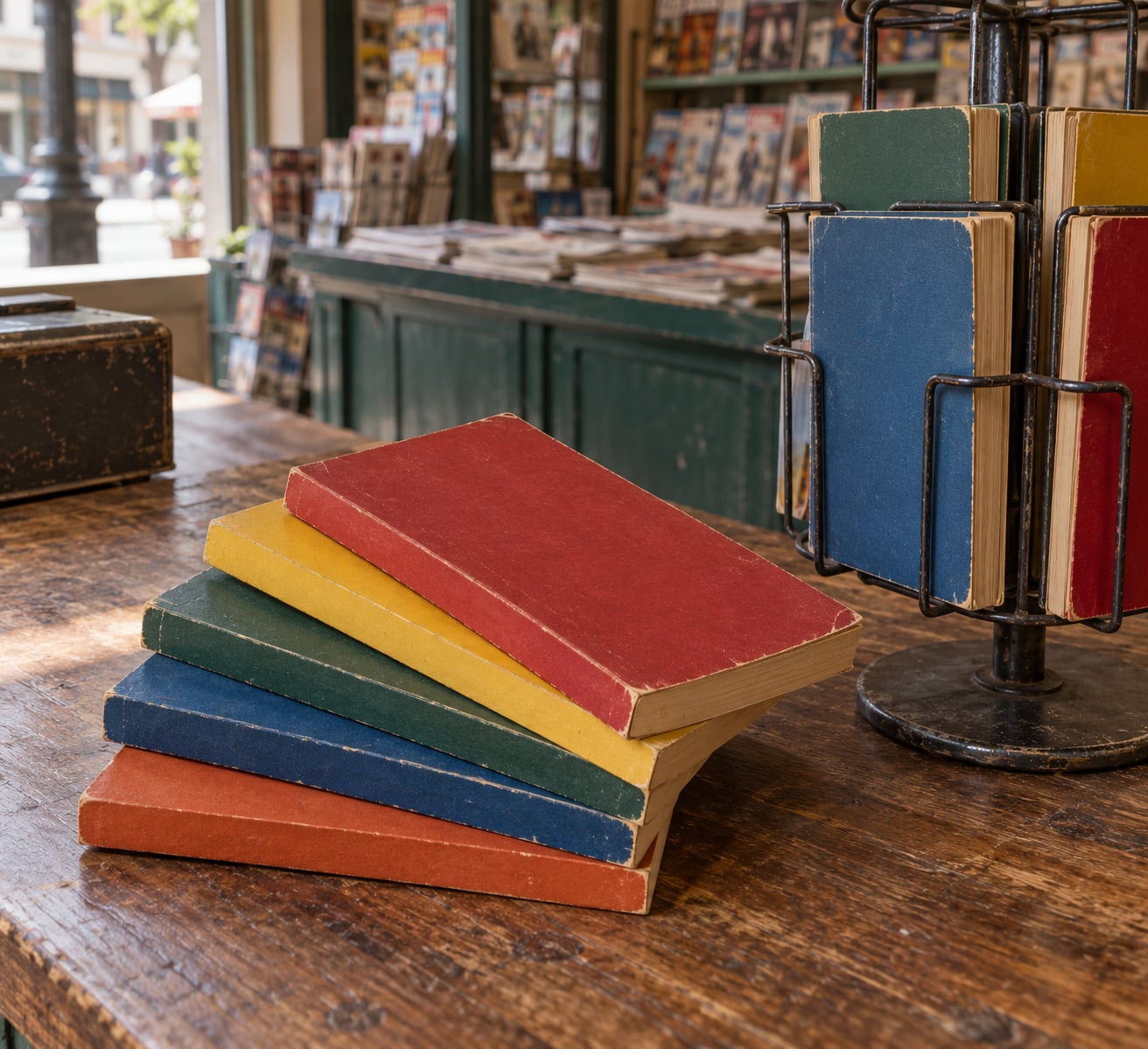
A paperback original is a novel first published in softcover at roughly pocket-book size, printed on cheap paper and sold through newsstands, drugstores and wire spinner racks rather than bookshops. That distinction matters because it means the book had no hardcover life at all. For crime fiction, this format changed everything: it put debut detectives on a rack in weeks, not years, and it built the shape of the genre we read now.
The paperback original is the reason the modern crime novel looks the way it does. One standalone first novel, fast, cheap, sold on a promise made by its cover, designed to be finished in an evening, and almost always followed by sequels from the same author.
I have gone back to these books as a reader and as someone who cares about how a genre gets made, and the standard publishing history leaves out the part that matters most. It talks about paperbacks as a distribution win. The interesting story is what happened to the writing itself.
Here is the short version of how paperback originals changed crime writing: before 1950, a crime novel had to earn its way into print through hardcovers, magazines or serial rights, and that gatekeeping shaped who got published and how. Once paperback originals arrived, the gate moved from the hardcover list to the rack, and the writing changed with it.
Table of Contents
- What Were Paperback Originals?
- How Paperback Originals Changed Crime Writing
- Why Publishers Took a Chance on Crime Fiction
- How the Format Expanded the Crime-Reading Audience
- How Paperback Originals Changed Crime Writing Style
- The Paperback Boom’s Major Publishing Effects
- The Authors and Books That Made the Format Matter
- Why Paperback Originals Helped Darker Stories Reach Readers
- What the Paperback Original Left Behind for Crime Fiction
- Frequently Asked Questions
- What is a paperback original in crime fiction?
- Were all crime paperbacks originally published as books?
- How did paperback publishing affect crime writers’ careers?
- Why did publishers use lurid covers for crime novels?
- What is the lasting influence of paperback originals on noir fiction?
- What to Read First
What Were Paperback Originals?
Three terms get mixed up constantly, so it is worth pinning them down before going further. A mass-market paperback is the small format itself, usually around four and a quarter by seven inches, printed on wood-pulp paper with a glued binding, cheap enough to be bought on impulse and designed to be disposed of. A trade paperback is larger, usually about six by nine inches, printed on better paper, sold at a higher price and usually through bookshops. A reprint is a new edition of a book that already existed in another format.
A paperback original is not a reprint. It is a book whose first edition of any kind was that softcover. Nothing came before it, so nobody gets a hardcover launch, and the publisher finds out how the book is doing only after it is already in the shops.
Collectors chasing first editions in crime series spend a lot of their time telling these apart, because a later mass-market printing looks almost identical to the first on the shelf. The signals are the spine logo, whether the original carried a price blurb or an author biography on the back, the paper, and any printing code the publisher put on the copyright page. Most catalogues skip mass-market titles entirely, so collectors lean on collector blogs and forums to make those calls.
That confusion is worth naming because it shaped how the format was talked about at the time too. A lot of crime paperbacks readers remember as originals were actually cheap reprints of books that had already been out in hardcover for a year, sometimes by an entirely different publisher with a different cover and a different backlist position.
| Format | Size | Paper | Where it sold | What it was |
|---|---|---|---|---|
| Paperback original | Pocket size | Cheap, acidic | Newsstands, drugstores, spinner racks | A novel published in softcover first, with no hardcover edition |
| Mass-market reprint | Pocket size | Cheap, acidic | Same racks and outlets | A cheaper softcover edition of a book first printed elsewhere |
| Trade paperback | Larger, roughly 6 by 9 inches | Better quality | Bookshops, online | A durable softcover edition, usually following hardcover |
| Hardcover reprint | Larger | Durable | Bookshops | A cloth-bound edition issued after the book was already a proven seller |
| Hardback-first novel | Larger | Durable | Bookshops | The traditional route: hardcover, then softcover later |
One more piece of vocabulary matters for crime specifically. Straight-to-paperback describes a writer whose career started in the softcover racks rather than in a hardcover list. In the trade paperback era that phrase has largely lost its bite, since almost everything arrives in softcover. In the mass-market era it was a career description, and an enormous amount of crime fiction was written by people who had never seen their names on a hardback spine.
How Paperback Originals Changed Crime Writing
Four things shifted at once, and it is hard to separate them. Access expanded, because cheap books moved outside the book trade. Debut authors became viable, because a modest first print run carried much less risk than a hardcover. Publishing got faster and looser, because the schedule pressure was lower and the cover-driven market was more forgiving of experiments. And the route to the reader changed, because a rack in a drugstore is a different relationship between publisher, book and buyer than a shelf in a bookshop.
The first of these is the one that gets overstated. Cheap paperbacks did not single-handedly invent a mass readership for crime fiction. Readers had been buying pulp magazines, dime novels and newspaper serial fiction for decades, and the hardboiled tradition that fed crime paperbacks came out of magazine fiction. What the paperback did was take an audience that already existed and give it a length, a spine and a place in a bag.
The second is the more durable change. In the hardcover system, a debut novel competed against a list of names an editor had already decided were safe. In the paperback-original system, the first book itself was the audition, and a strong first print run could carry an unknown writer into a series without anybody having signed them to a multi-book contract first. That is where the standalone-that-becomes-a-series pattern comes from, and it shows up everywhere in crime fiction from that period onward.
The third change is about craft. A book that has to sell on a rack, in an afternoon, at a glance, gets a harder opening and a faster first chapter than a book trying to earn a reader’s patience through atmosphere. Nobody in publishing said this out loud as a rule, but the effect on the prose is easy to see once you read a 1950s Mike Hammer next to a Chandler novel published a few years earlier.
The fourth change is structural and mostly invisible to readers. A paperback original gave publishers a cheap testing ground for market appetite. If a book about a district attorney in a mid-sized city sold well in softcover, an imprint could fund six more like it. That feedback loop is part of why crime fiction narrowed into subgenres with recognisable conventions: each successful experiment produced a category, and each category produced a shelf.
Why Publishers Took a Chance on Crime Fiction
Cheap printing made it possible. Before mechanised paperback production, making thousands of identical softcover copies was slow and wasteful. Stereotype plates, held in racks and locked into a press, let a publisher print a large run from one setting, which dropped the unit cost until a softcover could be sold for a fraction of the hardcover equivalent. Once the cost collapsed, publishers started looking for material worth setting in softcover that nobody had published, and crime fiction was the obvious place to look.
The distribution channel was the other half. Hardbacks live in bookshops, which meant the audience for crime fiction was, for practical purposes, the audience that already shopped in bookshops. Paperback originals went to newsstands, drugstores, supermarket checkouts, bus terminals and airports. A crime writer who wanted to reach a mail clerk in Ohio did not need a bookshop in Ohio. They needed a rack in a store the clerk already walked into.
Timeline of the format, with the crime-relevant part noted:
| Year | Publisher or imprint | What happened | Why it mattered for crime |
|---|---|---|---|
| 1932 | Albatross Books | First modern pocket-sized paperback in the US | Established that a book could be physically pocket-sized and cheap |
| 1935 | Penguin Books, Allen Lane | Penguin began publishing cheap paperbacks in Britain | Proved high-quality fiction could be sold cheaply; the Crime Book Society line followed |
| 1939 | Pocket Books | Robert Fair de Graff launched the format in the US with a twenty-five-cent list | Created the American mass-market paperback market |
| 1941 onward | Armed Services Editions | Cheap editions distributed to troops during the war | Put noir and hardboiled fiction into the hands of millions of readers at once |
| 1946 | Various, post-war surge | Post-war paperback boom and the spread of imprint fiction lines | Crime and noir became the fastest-growing category on racks |
| 1947 | Gold Medal Books | Originated the first American paperback-original crime series with Mickey Spillane’s I, the Jury | The moment the crime paperback became a planned series rather than a reprint programme |
| 1950 | Gold Medal Books | The imprint made paperback originals a deliberate policy across categories | Proved first-published-in-softcover fiction could sustain whole imprints |
| 1950s | Lion Books, Signet, Dell, New American Library, Ace | Crime and noir lines proliferated across imprints | Made the crime rack a colour-coded, browsable section in ordinary shops |
Censorship is the counterintuitive part. Paperback originals were, in one specific sense, the riskier place to publish a hard-edged story. Hardback publishers had legal departments, prestige to protect and relationships with distributors. A softcover imprint could take a chance on a book with a corrupt sheriff in it, and if the title drew complaints, the reputational damage was smaller. That willingness is the clearest reason darker crime stories got written at all.
The retail reality pushed the same way. A title that sat on a rack and did not move was simply returned, and a mid-sized print run at cheap unit costs meant the loss was bounded. Nobody had to bet a year of prestige on one book.
How the Format Expanded the Crime-Reading Audience
Readership grew because the books were portable, cheap and impossible to avoid. A paperback fits in a pocket. It survives a bus ride, a waiting room, a lunch break. Nobody has to decide to spend an afternoon in a bookshop to read one, which means the first book someone reads by an author is far more likely to be that author’s second or third, and the backlist does more work.
Colour coding did quiet work too. British and American imprints organised their crime lines by cover and spine colour, so a reader learned to reach for green covers at the newsstand the way later readers learned to look for a spine or a name. In the Gold Medal and Lion crime lines the device was straightforward: a consistent scheme that let a browser identify a favourite series in two seconds. Collectors still target those colour conventions when hunting specific printings.
A.F. Carter described the retail world of the format plainly in a CrimeReads roundtable: every little store contained a revolving wire rack holding mass-market paperbacks. That memory is the honest version of the paperback’s reach. It was not prestige distribution. It was a rack by the till, turning slowly, in a place people went every week whether they intended to buy a book or not.
How Paperback Originals Changed Crime Writing Style
Six effects show up in the books themselves, and they are worth separating because they are the difference between a distribution story and a writing story.
Faster publication cycles changed pacing. A novel that goes from manuscript to rack in a few months cannot afford a slow setup, and the first chapter tends to open inside the problem rather than in the weather. Series launched from the first novel changed structure. With no hardcover launch to promote, the first book had to carry the series identity on its own, so authors wrote the premise early and clearly.
Sharper voice came next. First-person narration and a strong narrating character sell a cover promise faster than third-person past ever will, which is why so many paperback-era private eyes talk in the first person and narrate almost continuously.
Regional and working-class perspectives widened the map. A format built for drugstore racks did not care about prestige geography, and the detective novels it published moved freely between city precincts, small towns and the suburbs. Stronger author control followed from all of it. With less editorial filtering between the manuscript and the rack, the voice that reached the reader was closer to the voice on the page, which is a large part of why paperback-era writers sound different from their hardcover contemporaries.
What none of this produced is automatically better writing. The format rewarded pace and accessibility, and it also rewarded repetition, because a series that worked was a series that continued. Readers who bought the first book in a rack on a Friday were buying a promise of more, and that bargain shaped the books as much as the writing did.
The Paperback Boom’s Major Publishing Effects
Here is the same set of effects, compared directly, because the differences are easier to see in a table than in prose.
| Effect | Before paperback originals | After paperback originals |
|---|---|---|
| Debut opportunities | Hardcover list, editor-driven, slow | Rack-driven, testable, fast |
| Editorial risk | Prestige exposure, high cost of failure | Bounded loss on a modest first print run |
| Reprint economics | Softcover only after hardcover success | Large softcover first runs on original manuscripts |
| Author advances | Larger, more selective, fewer debut deals | Smaller, more numerous, wider gate |
| Distribution | Bookshops | Newsstands, drugstores, supermarkets, spinner racks |
| Genre marketing | Reviews, lists, author reputation | Cover art, colour coding, eye-level positioning |
| Series economics | Contract renewal after a hit | Sequel by sequel on a proven template |
The trade-off nobody planned was prestige. A novel with no hardcover never gets a launch party, a review-page slot or a place on a serious list, and many paperback originals were never reprinted in any other format. Writers got a market they could sell into and lost the hardcover afterlife at the same time. Several of the most influential crime books of the era exist in the cheap format and little else, which is a reminder that the mass market can build a canon and then refuse to archive it.
The Authors and Books That Made the Format Matter
Mickey Spillane is where the crime paperback becomes a business. I, the Jury was published by Gold Medal in 1947 as a paperback original, with no hardcover edition behind it, and it was the first book of a planned Mike Hammer series. Nobody in publishing had set out to build a crime line that way. It sold so hard that the imprint built its whole paperback crime list on the model, and Gold Medal became the imprint most associated with the paperback original in crime fiction.
Chester Himes did something different with the same format. The Harlem Detectives, published in book form in 1951, put Black detectives on the rack at a time when almost nothing in mass-market crime did. It sold into an audience the format had actually reached, which is the clearest case for the paperback’s reach doing more than any publisher’s marketing.
Ed McBain’s 87th Precinct series went the other way and exploited the format’s appetite for volume, writing straight to a schedule, roughly one book a year, in a fixed community with fixed characters. He was, in effect, publishing a serial in book form, which the rack made possible. John D. MacDonald’s Travis McGee books used the same slot to move between a hard genre and a softer one, mixing a Florida salvage yard with a romantic subplot that gave the line a wider audience than pure noir.
Donald Westlake and Lawrence Block worked the format’s appetite for series from the other direction, with books that were faster, funnier and more deliberately plotted than the average paperback crime novel. Lawrence Block’s Bernie Rhodenbarr books are a good example of a rack novel that never lost sight of the reading pleasure that got someone to buy it.
In Britain, the parallel lines ran through Penguin’s Crime Book Society, later the Crime Club from Michael Joseph, and Collins’ Crime Club, which had earlier published Hammett and Chandler under the Black Label banner. Those were largely reprint programmes rather than originals, but they built the colour-coded, spine-driven crime shelf that American readers then copied.
Outside English-language publishing, cheap softcover made crime writing travel in a way it never had before. European readers who could not get an American hardcover at a sensible cost got a softcover instead, and the paperback original model spread into markets where hardback crime fiction barely existed.
Why Paperback Originals Helped Darker Stories Reach Readers
The moral argument is simple. Hardback fiction is reviewed and shelved in a bookshop, and a bookshop has a public personality that customers partly shop by. A softcover rack in a drugstore has no reputation to defend, so a novel about police corruption, sexual predation, drug trade or poverty had somewhere to go even when the hardcover market would not take it.
Censorship worked the same way. Publishers with a hardcover list to protect are cautious, and caution reads as taste. At an imprint whose identity is built on what it puts on the rack, a controversial title is a normal business outcome rather than a scandal. Noir in particular is built on institutions that readers are not supposed to trust, and the format gave it a home outside the cultural conversation about literature.
There was a real cost. A cheap rack will accept lurid promises faster than a review page will, and a decade of covers promising sex and violence taught some readers that crime fiction was only ever that. That stigma outlived the racks by a long way and took work to dislodge, which is part of why the paperback era is now treated as both a triumph and a rough patch.
The other cost is physical. These books were printed to be discarded. Acidic paper means most surviving mass-market paperbacks are yellowed, brittle and foxed, often with a smell that comes off the page when you open it. Collectors describe this as the central condition problem in the field, and it is a genuine one for anyone who wants to read rather than just own.
What the Paperback Original Left Behind for Crime Fiction
The mass-market paperback is smaller than it was, and drugstore racks largely disappeared from American life, replaced by supermarket checkouts, online retail and eventually streaming-adjacent discovery. Yet the format never fully died in crime. Imprints still publish affordable softcover lines, still sell on cover promises, and still take the first bet on new crime writers.
What replaced the rack is discovery through digital storefronts and social recommendation, and for crime that is mostly a change in the funnel rather than a change in the product. A debut still has to be cheap, fast, legible on a screen and backed by a name readers recognise. That is still the paperback bargain.
The institutional memory is the Edgar Awards’ Best Paperback Original category, which is a marker of genre health rather than a consolation prize. Crime writers still discuss it as a slot worth having, and it keeps the format visible in a business that has otherwise moved on from it.
The option-rights pipeline is worth noting too. A paperback original that sold had rights value for television, and the same economics that put a book on a rack in 1950 are what made a mid-list crime novel worth adapting. Cheap to publish, quick to test, easy to option. Plenty of what looks like the modern crime publishing machine is that machine with a different display.
Self-publishing repeated the bargain too, and in a more literal way than anyone planned. An author can put a crime novel straight into an e-book store with no gatekeeper, test the response, and self-publish a sequel the same week. It is the paperback-original model with the printing press removed.
Frequently Asked Questions
What is a paperback original in crime fiction?
A paperback original in crime fiction is a novel first published in softcover at pocket size on cheap paper, sold through newsstands, drugstores and wire racks, with no hardcover edition anywhere in its history. That is the difference from a mass-market reprint, which is the same small format but a cheaper edition of a book that already appeared in hardcover or elsewhere first.
Were all crime paperbacks originally published as books?
No. Thousands of mass-market crime paperbacks are reprints of books first issued in hardcover, sometimes by another publisher years earlier with a different cover. Only titles whose first edition was the softcover count as originals. Spillane’s I, the Jury was one of those originals in 1947, and collectors use the spine logo, cover blurb and printing code to sort the rest.
How did paperback publishing affect crime writers’ careers?
It opened the gate. Before 1950 a debut crime novel usually had to win a place on a hardcover list; a paperback-original slot let a first book be its own audition on a modest first print run. A strong first title could carry an unknown writer straight into a series without a multi-book contract, which is where the standalone-that-becomes-a-series pattern comes from.
Why did publishers use lurid covers for crime novels?
Because the cover had to work at arm’s length on a spinning rack, and because the format took fewer risks with tone than the hardcover market did. Consistent genre colour coding let browsers find a favourite series in seconds, and a title promising sex or violence moved off a drugstore rack faster than almost anything else. The stigma that promise created is still being cleaned up.
What is the lasting influence of paperback originals on noir fiction?
It set the shape of the form: faster publication cycles, harder openings, first-person narrators, series built from the first novel, and a cover that makes a promise before a word is read. Noir also got a home outside the book trade, which is how darker stories about corruption, drugs and poverty reached readers who never shopped in a bookshop. Those conventions outlived the racks almost entirely.
What to Read First
Start with a landmark paperback original and read it against its own history rather than against the best of crime fiction. Take Gold Medal’s first Mike Hammer and note how hard the first chapter opens, then set it beside a Chandler novel and see the difference in patience. Then do the same with Himes, and ask whether anything else on the rack in 1951 gave two armed Black detectives the lead.
Look at the physical book while you do it. Size, paper, spine logo, the presence or absence of a back-cover biography. Those details tell you what the publisher expected the buyer to be, and the expectation is half the story of how paperback originals changed crime writing.
Updated for October 2026.