To write a coroner character that readers believe, you have to fix three things before you write a single line of dialogue: which system your coroner works in, what that job actually lets them do, and what the character wants from the work. Get those right and the procedure writes itself. Get them wrong and readers bounce within a chapter, usually without telling you why.
A coroner in this article means two different jobs, so state one up front. In the United Kingdom the coroner is a judicial officer who investigates certain deaths and conducts inquests under the Coroners and Justice Act 2009. In the United States the title belongs to an elected county office with wildly varying powers, and much of the actual medical work sits with an appointed chief medical examiner. Pick a country, say so in your first chapter, and stay inside its rules for the whole book.
What follows is the process I use whenever I have to write a coroner character, revised with notes from crime writers who complained their coroner read like a Wikipedia article with a clipboard.
Table of Contents
- What You Need
- Step-by-Step: Building a Believable Coroner Character
- 1. Decide the Coroner’s Jurisdiction and Role
- 2. Give the Character a Precise Professional Purpose
- 3. Build a Believable Case Workflow
- 4. Use the Right Kind of Forensic Detail
- 5. Create a Distinct Voice and Point of View
- 6. Add Ethical and Emotional Stakes
- 7. Put the Coroner Inside the Story’s Conflict
- 8. Research the Right Details for the Scene
- 9. Revise for Accuracy, Restraint, and Impact
- Common Mistakes
- Confusing the job titles
- Making the coroner an all-purpose forensic expert
- Revealing findings too early
- Writing grief as the whole personality
- Using vague or invented terminology
- Treating DNA as instant
- Turning procedure into exposition
- Letting the coroner solve the mystery
- Frequently Asked Questions
- What is the difference between a coroner and a medical examiner?
- How much forensic knowledge should a fiction writer include?
- How do I make my coroner character feel credible?
- Can a coroner character be the main detective in a crime novel?
- How do I write a coroner without making them too cold?
- What research should I do before writing a coroner scene?
- Start With the Job Title, Not the Character
What You Need
Before drafting, you need a working answer in five areas. Each one is research, and none of it is glamorous.
- Jurisdiction. Country, state or county, and which office actually holds the authority in the place your book is set.
- Medical grounding. Enough to understand cause of death, manner of death, and the difference between what the body shows and what a test confirms.
- Procedure. How a body reaches the office, what happens at the table, what paperwork follows, and how long each stage takes.
- Ethics and law. Who may be told what, when a body can be released, and how next of kin are handled.
- Character. The private thing the job costs them, which is the part no amount of research supplies.
Fictional practice varies by location and by office, and real systems change. Check anything load-bearing against a coroner statute, a professional body, or a practising professional before you build a plot on it.
Step-by-Step: Building a Believable Coroner Character
Each step feeds the next. Skip one and the character flattens into a device that exists only to hand the detective information.
1. Decide the Coroner’s Jurisdiction and Role
The first question to answer when you write a coroner character is not what they look like. It is what title goes on their door, because the title decides what they are allowed to do.
Four job titles get mixed up constantly, and each one hands your plot different levers:
- Coroner, UK. A judicial officer, often a barrister, solicitor, senior police officer or independent, who investigates deaths that must not be certified by a doctor. In your plot this character controls whether an inquest happens, what evidence is gathered, and what is said publicly about a death.
- Coroner, US county. An elected county office whose powers vary enormously by state and by county. Pick a county with real, specific powers before you write anything about an investigation.
- Medical examiner. An appointed physician, usually a forensic pathologist, who performs autopsies and certifies death. This character controls the autopsy findings, the death certificate and the release of remains.
- Forensic pathologist. A doctor trained in pathology who examines bodies in a medical examiner’s office or a hospital. This character controls the interpretation of injuries and disease, and the cause of death line.
Jurisdiction also sets the workplace, the hours and the access. An elected small-county coroner might run the office out of a converted store with one part-time assistant. A city medical examiner’s office has a body fridge, a security desk and a toxicology liaison. That difference is characterisation for free.
2. Give the Character a Precise Professional Purpose
Give them one sentence that says what they are professionally for. For most coroners and medical examiners, that sentence is: establish cause and manner of death, and tell the family the truth of it in words they can carry home.
Cause is the injury or disease that killed. Manner is the category the death falls into, such as natural, accident, suicide, homicide or undetermined. A gunshot wound of the chest is a cause. Homicide is a manner. Keep the two apart in your prose and your characters will sound like people who have read a report.
One correction worth making early: your coroner does not run the laboratory. Toxicology, histology and DNA analysis happen elsewhere, over days or weeks. What the character does is interpret them, decide what they mean, and refuse to overstate what nobody can yet prove.
3. Build a Believable Case Workflow
Knowing the order of events stops your character from knowing things too early, which is the single most common procedural error in this genre.
- Notification, usually from police or a paramedic crew.
- Attendance at the scene or at the mortuary, sometimes both.
- Identification of the decedent, including dental records when identity is in doubt.
- The examination, external first, internal only if the case requires it.
- Photography, samples and the chain of custody for anything removed.
- Records review, including medical history and prescription records.
- Toxicology and any specialist pathology referral.
- Certification, or a decision to hold the case as undetermined.
- Communication with investigators, and with next of kin when the law requires it.
Write that list onto a card and keep it beside you while drafting. Every time your character states a conclusion, check which step has actually happened.
4. Use the Right Kind of Forensic Detail
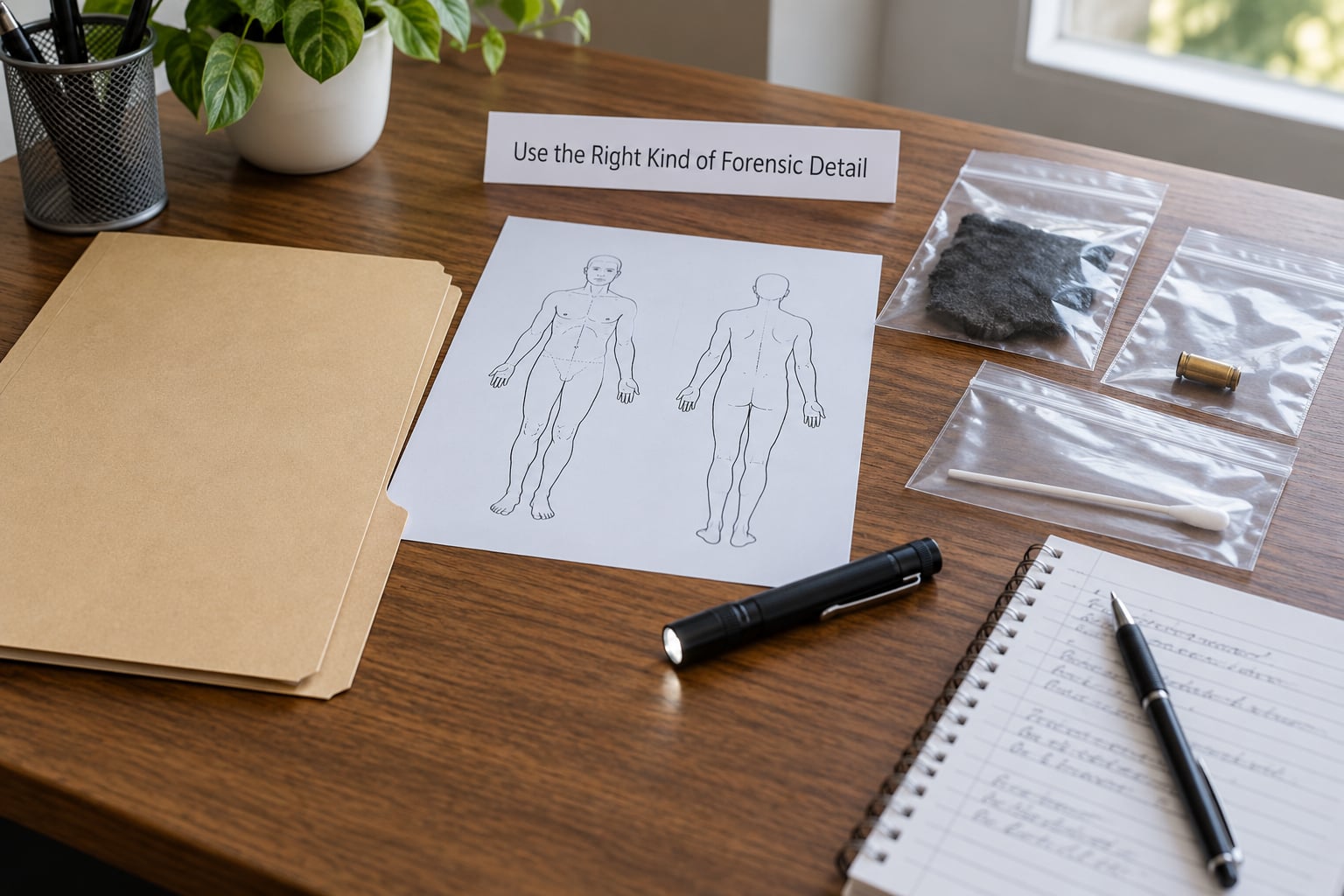
Good detail shows the character noticing things other people walk past. Bad detail explains the subject to the reader.
Prefer the observable to the theoretical. Rigor mortis and lividity are visible and time their own way into the scene. Lividity settles in the dependent parts, which is exactly why a body moved after death looks wrong on a table. That single detail does more work than a paragraph about electrolyte balance.
Use jargon once, then earn your keep with plain language. If the pathologist says petechial haemorrhages, follow it with what the reader needs to see on the page, not with a footnote.
Lean on uncertainty. Real findings come with qualifiers: consistent with, cannot be excluded, pending, no significant trauma. A character who hedges is a character who has done this for years. A character who delivers a verdict in one line reads as a narrator.
5. Create a Distinct Voice and Point of View
A coroner should not sound like a detective with better manners. Detectives speculate, interrupt, bluff and accuse. Coroners qualify. They talk in sequences and negatives, because that is what the paperwork looks like: no injury to exclude, no history to account for, nothing that would account for it.
Build the voice from three things. First, diction: the specific word their training supplies, plus the one personal tic they bring. Second, rhythm: short observational sentences broken by long careful ones when they are describing a body. Third, habits of attention, which are the cheapest characterisation in crime fiction. Your coroner counts exits. Notices who has not eaten. Reaches for the second drawer, not the top one.
Humour helps, provided it is dry and aimed sideways. Nobody tells a joke over a body, but a dry aside to a colleague in the corridor is free characterisation and very cheap.
6. Add Ethical and Emotional Stakes
The job’s real pressure is not gore. It is other people’s worst day, arriving at your desk several times a week, forever.
Build stakes from four sources. Confidentiality, which means your character carries information they may not share even with the person they like. Next of kin, who need clarity as much as comfort and are frequently told nothing for weeks. Institutional pressure, where a supervisor wants a clean certificate to close an insurance file or bury a political problem. And the slow cost, the version of compassion fatigue that shows up as cynicism rather than tears.
Resist the traumatized-cliché version. A coroner who drinks heavily and cannot look at the work is a shorthand for damage. A coroner who is very good at their job and finds it difficult to be in the room when the family arrives is a person.
7. Put the Coroner Inside the Story’s Conflict
A coroner outside the mystery is a walking glossary. Connect them and the profession starts generating plot.
Options that work: a finding the investigator would rather not have, a body whose medical history has been quietly altered, a supervisor who wants an undetermined case left open to protect a department, a family that wants a manner of suicide ruled instead of accident. Cold case work gives you the same tension across a series, because the character is the only person who remembers every file they ever signed.
The strongest version gives the coroner authority and a reason to be wrong about it. Procedural authority is a flaw with a job attached.
8. Research the Right Details for the Scene
Turn research into questions, not browsing. What office exists in this county, and who appoints to it. What does a body transport look like at this hour. What can the character know at this point in the timeline, and what is still pending. Which terminology does this office use, and would this character say it out loud.
Good sources: the coroner statute or the medical examiner’s office page for your jurisdiction, professional body guidance, published court reporting on contested inquests, and the odd medical journal review written for a general reader rather than a specialist. Blogs by working forensic specialists beat textbooks for tone. Textbooks beat blogs for accuracy.
Forum threads are useful for one thing only: finding out which detail readers complain about most. That complaint list is your revision checklist.
9. Revise for Accuracy, Restraint, and Impact
Put the draft down for a day, then read it as a reader who works in the field.
Check four things. Plausibility: could this sequence of steps actually happen, in this order, in this timeframe. Timing: results that need laboratory analysis are not available the same afternoon. Restraint: every term of art earns its place, and the ones that do not get cut. Impact: does the scene change something, or is it a lecture in a mortuary corridor.
Then read it again for character. Does the coroner sound like a person or a profession? Do they want anything in this scene that is not in the report?
Common Mistakes
These are the errors that get flagged, usually in reviews, usually without explanation.
Confusing the job titles
An elected coroner certifying deaths with autopsy findings they personally gathered is a common slip. Choose one system and use its vocabulary consistently. If you need a doctor doing the autopsy, the character is a medical examiner and you have to say so.
Making the coroner an all-purpose forensic expert
The fix is narrow. Let them read bodies and interpret findings, and route fingerprints, firearms, digital and toxicology to specialists. A character who knows everything has no colleagues, and no colleagues means no drama.
Revealing findings too early
Nothing useful comes back the same day the body is recovered. Track the clock honestly and the tension arrives for free. If your coroner solves the case in chapter four, there is no book.
Writing grief as the whole personality
Sadness is not a character. Give your coroner a competence, an opinion and an appetite before you give them a wound, or they will read as a mood piece in a scrubs top.
Using vague or invented terminology
If you are not sure of the term, describe the finding instead. Your character can say the body is colder than the room without anyone checking a glossary. Invented jargon is the one thing a knowledgeable reader will catch.
Treating DNA as instant
Cold case plots have changed since forensic genetic genealogy entered the field. Matches are not instant, results arrive with supporting documentation rather than on their own, and the ethical layer, consent and the family who never knew their relative’s DNA was tested, is where the real drama lives.
Turning procedure into exposition
If two consecutive paragraphs could be lifted into a textbook, cut one. Let the character discover the procedure through an interruption, a mistake, or an argument with someone who wants the body released.
Letting the coroner solve the mystery
This is a choice, and it can work, but be deliberate about it. If the coroner fronts the series, the case comes through a body and a family rather than a chase. That is a different engine, and it needs a different pace.
Frequently Asked Questions
What is the difference between a coroner and a medical examiner?
In the United Kingdom the coroner is a judicial officer who investigates violent, unnatural or unexplained deaths and conducts inquests under the Coroners and Justice Act 2009. In the United States a medical examiner is an appointed physician, usually a forensic pathologist, who performs autopsies and certifies death, while the county coroner is an elected office with powers that vary by state. Fiction should name one system and stay inside it.
How much forensic knowledge should a fiction writer include?
Enough to be accurate about the things the character is doing in the scene, and no more. Readers will forgive an invented small town. They will not forgive a cause of death that contradicts the injury described two pages earlier. Keep two to four correct details per scene, let your character qualify rather than conclude, and cut any term that does not change what happens next.
How do I make my coroner character feel credible?
Give them a precise professional purpose, a specific jurisdiction, and one flaw the plot can keep testing. Credibility comes from procedure the reader recognises: knowing what is still pending, declining to overstate a finding, and treating the decedent as a person with a family. A character with an appetite, a habit of attention and a professional disagreement reads as alive in a way that technical expertise alone never does.
Can a coroner character be the main detective in a crime novel?
Yes, though it changes the shape of the book. The case arrives as a body rather than a crime scene report, and the clues are medical, circumstantial and often weeks old. Families, not suspects, drive the early interviews. It works well when the mystery is about how a person died rather than who walked away with the money, and it needs patience in the first third that a police procedural can skip.
How do I write a coroner without making them too cold?
Do not reach for detachment as shorthand. Real practitioners are warm with families and unsentimental about bodies, and that split is more interesting than ice. Show the character remembering the person’s name, rescheduling a meeting so a relative can come, or noticing a gap in a history. Then let the exhaustion show in small ways, such as the pause before they answer, rather than in a bottle or a flinch.
What research should I do before writing a coroner scene?
Establish your jurisdiction first, then answer who holds the office and what powers it has. Look up how a body is transported and released, what happens at the examination, which findings need laboratory confirmation, and what the character cannot yet know. Read the coroner statute or the office’s own guidance for your region, and read one published report of an inquest for tone. Then interview one professional, even for an hour, if you can.
Start With the Job Title, Not the Character
Pick your jurisdiction and job title first, write the one sentence your coroner exists to accomplish, and give them a flaw the case will test. Draft the workflow card before the first scene, keep two to four accurate details per scene, and cut everything else. A coroner who knows what is still pending, and wants something the report will not give them, is enough to carry a series.