
To fix a saggy middle in a thriller, you diagnose where momentum breaks, then rebuild that stretch around a real deadline, a genuine midpoint reversal and a ladder of increasingly costly obstacles. Most saggy middles are not slow prose. They are a broken promise that the trouble is about to get worse.
I have watched the same pattern in crime manuscripts for years: the opening grabs, the first act break lands, and then somewhere around chapter eleven the detective starts interviewing people who all say something slightly different. Nothing is happening. Nothing is at stake. The reader does the only thing a thriller reader can do with a flat chapter, which is stop.
That flat stretch is not a mystery of craft. It is a diagnosable failure with a small number of causes, and most of them can be fixed in a completed manuscript without rewriting the book from page one. Below is the seven-step method I would use on a draft like that, including the diagnostic table, the pressure ladder and the point at which you stop touching individual scenes and go back to the outline.
Table of Contents
- What You Need Before You Fix a Saggy Middle
- Step-by-Step: Diagnose the Middle, Then Rebuild It in Seven Moves
- 1. Diagnose Where the Middle Loses Momentum in a Thriller
- 2. Reconnect Every Scene to the Central Mystery
- 3. Raise the Stakes at the Right Moment
- 4. Make the Protagonist Choose Under Pressure
- 5. Increase the Cost of Discovery
- 6. Compress Repetition and Add Escalating Beats to Beat a Sagging Middle
- 7. Rebuild the Handoff Into the Climax
- Common Mistakes That Keep a Saggy Middle Saggy
- Frequently Asked Questions
- How do I know if my thriller’s middle is really saggy?
- Should I add a subplot to fix a sagging middle?
- How do I increase tension without frantic prose?
- When should I change the outline instead of rewriting scenes?
- How long should the middle of a novel be?
- Can I fix a sagging middle after finishing the whole draft?
- Conclusion
What You Need Before You Fix a Saggy Middle
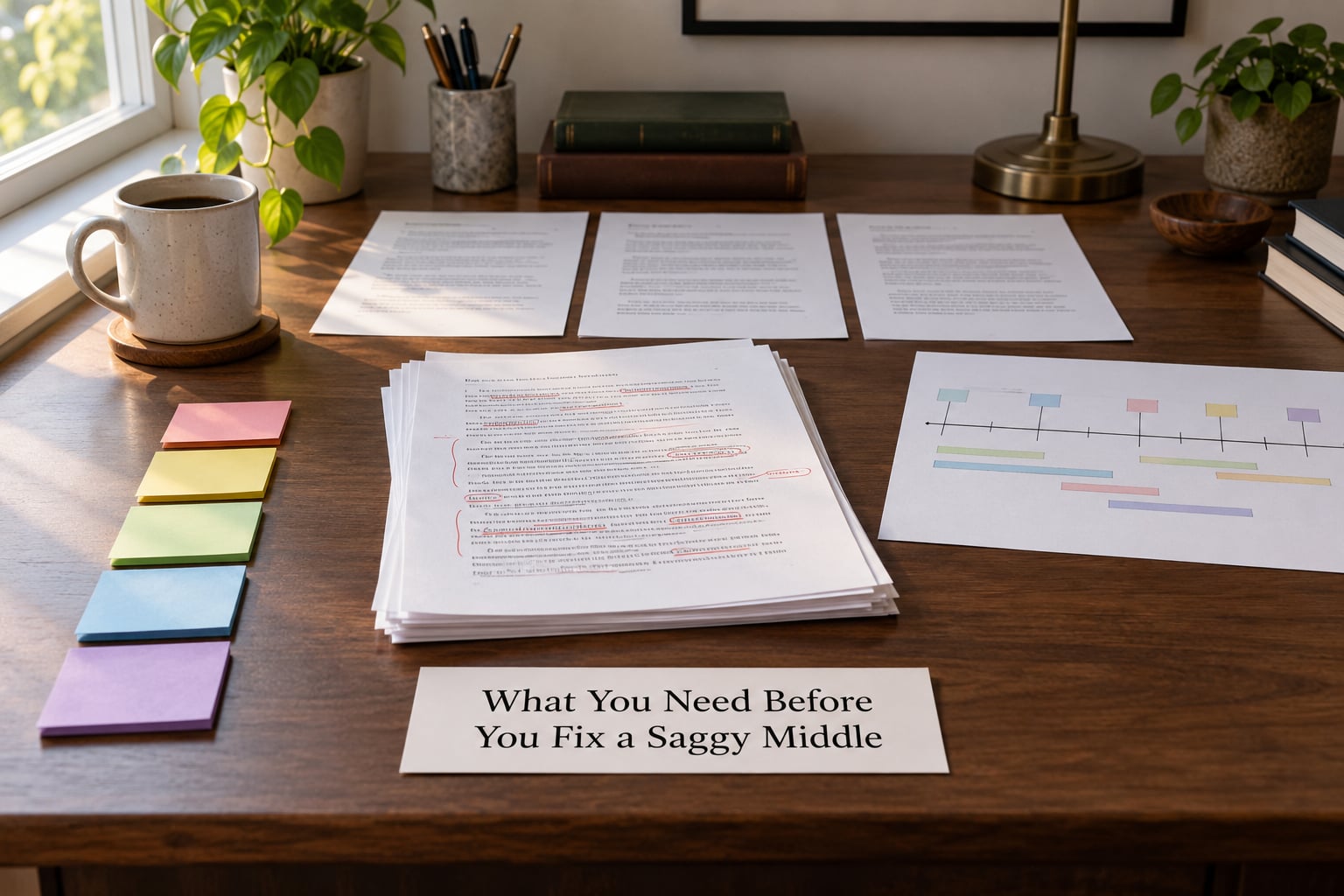
You need four documents and one piece of diagnostic software, and the software is a spreadsheet column. That is genuinely all of it.
First, the draft itself, printed or read on a screen that is not the one you wrote it on. Second, a synopsis of three pages or fewer, because if you cannot compress the plot that far you do not yet know what the middle is for. Third, a one-page character sheet that names your protagonist’s want, their need and the thing they are most afraid of losing. Fourth, a clue or information list: every fact the reader now knows, in the order they learned it, with the chapter it landed in.
The fifth item is the timeline, and for a thriller it should carry two rows. The story’s row holds events as the reader experiences them. The world’s row holds events that happen offstage, including everything the antagonist does while your protagonist is filling in forms.
Now the diagnostic column. In a spreadsheet or a Scrivener metadata field, give each scene four columns: page range, what the scene adds to the central question, what it costs the protagonist, and a one-word tension rating from one to five. Two or three hours of that produces the most honest diagnosis you will ever get, because it forces you to compare chapters instead of simply rereading them.
Plot the tension ratings on a line. A healthy thriller climbs. What you will usually see is a rise, a flat run of six to ten scenes somewhere between 35 and 65 percent of the book, then a sudden spike in the last quarter. That flat run is your sag, and you have just located it.
Step-by-Step: Diagnose the Middle, Then Rebuild It in Seven Moves
The order matters more than it looks. Diagnose the whole middle before you rewrite any part of it, or you will polish three chapters and end up with the same sag three chapters later.
Work through these seven steps in order. Each one depends on the last: you cannot escalate stakes you have not identified, and you cannot raise the cost of discovery until the protagonist is making choices. The goal of every step is escalation, not volume. Adding action to a flat middle produces a busy middle, which readers also abandon.
1. Diagnose Where the Middle Loses Momentum in a Thriller
Start by mapping three things across your middle third: the central conflict, the major events, and every change in what the reader knows. Lay them side by side and the sag announces itself.
Look for three markers. Scenes that repeat the same tension level. Scenes that delay the central question without adding pressure. And scenes that end without changing what the protagonist does next, which is the most common of the three and the least noticed, because those scenes read fine in isolation.
| What the scene does | Tension (1-5) | Diagnostic verdict |
|---|---|---|
| Detective interviews a fourth witness who confirms the first three | 3 | Repeat. Merge into an earlier scene and cut 2,000 words. |
| Detective visits the crime scene a second time | 3 | Delay. It adds texture, not information. Cut or convert to a reversal. |
| Lab returns a result the detective had already assumed | 4 | Working. It changes the plan, so the plan changes on the page. |
| Detective thinks about his divorce | 2 | Stall. Internal, no external pressure, no new choice. |
| Antagonist quietly moves the victim’s sister to a safe house | 5 | Excellent. Put this earlier and show the detective failing to stop it. |
A noir example makes the point. Before revision: five chapters in which the private eye re-walks the same warehouse district, questions a bartender who recalls nothing useful, and sits in his car thinking about how the city eats honest men. Nothing in that run changes his plan. After revision: the bartender remembers one detail that points at a shipping manifest, the manifest names a company the eye’s own client is tied to, and the eye now has to decide whether to break his client or keep following the trail. Same setting, same atmosphere, and now every scene costs him something.
That single swap is usually worth more than three new scenes.
2. Reconnect Every Scene to the Central Mystery
Take your central question and write it on the top of a page in one sentence: who killed the girl, who is lying, whether the protagonist can prove the conspiracy before the trial, whether the hostage is still alive. Then run every middle scene against that sentence.
A scene passes if it does at least one of three things: it changes what we believe about the central question, it raises the price of getting the answer, or it forces the protagonist to choose between two things they cannot both have. A scene that does none of these is atmosphere, and atmosphere in the middle of a thriller is a loan against a promise you are not keeping.
Do not delete failing scenes yet. Most of them have one salvageable beat inside them. Pull the beat, fold it into a neighbouring scene, and cut the scene. An interview chapter that contains one good line can donate that line to the chapter before it and disappear.
The test after the edit: could you delete the scene without the reader noticing a gap? If yes, delete it. If no, but you cannot say what changes if it stays, you have found a scene that carries weight you never stated.
3. Raise the Stakes at the Right Moment
Vague danger does not create tension. A sentence telling us the antagonist is dangerous is an assertion; a deadline with a named cost is a scene.
Build a progression in five stages rather than turning everything up to ten. Threatened inconvenience: the detective’s warrant is denied. Professional damage: his badge is suspended and his access to the case disappears. Relationship damage: his source stops answering, then a colleague is transferred out. Personal damage: someone in his care is now on the antagonist’s list. Irreversible loss: the victim, the witness or the case file is gone, and no amount of work brings it back.
Put one stage per three or four chapters. The mistake is making every scene equally loud, which flattens the reader’s ability to feel relief, and relief is what makes the next knock land. I wrote a book once where every chapter ended with a threat, and the revision notes from three beta readers said, in three different ways, that they had stopped worrying about any of them.
You want one beat where the reader exhales, and it should be immediately before the worst thing in the book.
4. Make the Protagonist Choose Under Pressure
A sagging middle usually contains plenty of plot and almost no decisions. Clues arrive, the protagonist absorbs them, and the story carries on at the same speed until someone else does something interesting.
Give each major scene three things: two goals that cannot both be pursued, at least one option that is incomplete, and a decision the protagonist makes with incomplete information. Then make that decision generate the next problem.
A noir version: the eye obtains a statement that will clear his client, but taking it into a formal interview will expose a witness who is the only reason the case is still open. He takes the statement. The witness disappears that night. The story now runs faster, and it runs there because of a choice he made, not because the plot required a coincidence.
This is where a lot of sag actually lives, and it is invisible while drafting because the writer knows what the protagonist intends to do. The reader does not. Written down on the page, intention reads as stasis.
5. Increase the Cost of Discovery
A revelation with no cost is a brochure. Attach something to every discovery: a contradiction it exposes, a person it endangers, or an option it permanently removes.
Stage evidence so that each find narrows the field while raising the personal risk of acting on it. The fingerprint is good. The fingerprint that clears your suspect and means you must now tell a grieving family that their son was not the killer is better, because it forces a scene you were avoiding.
Work through your clue list and mark every discovery as free or costly. Free discoveries are the engine of a sagging middle. Rewrite three of them, starting with the one your protagonist acts on most calmly, because a protagonist who shrugs off a bombshell on page 160 teaches the reader to stop feeling anything for the remaining 60 pages.
Cost does not have to mean catastrophe. Being three hours late for a meeting, and knowing that the person you disappointed will remember it, is enough.
6. Compress Repetition and Add Escalating Beats to Beat a Sagging Middle
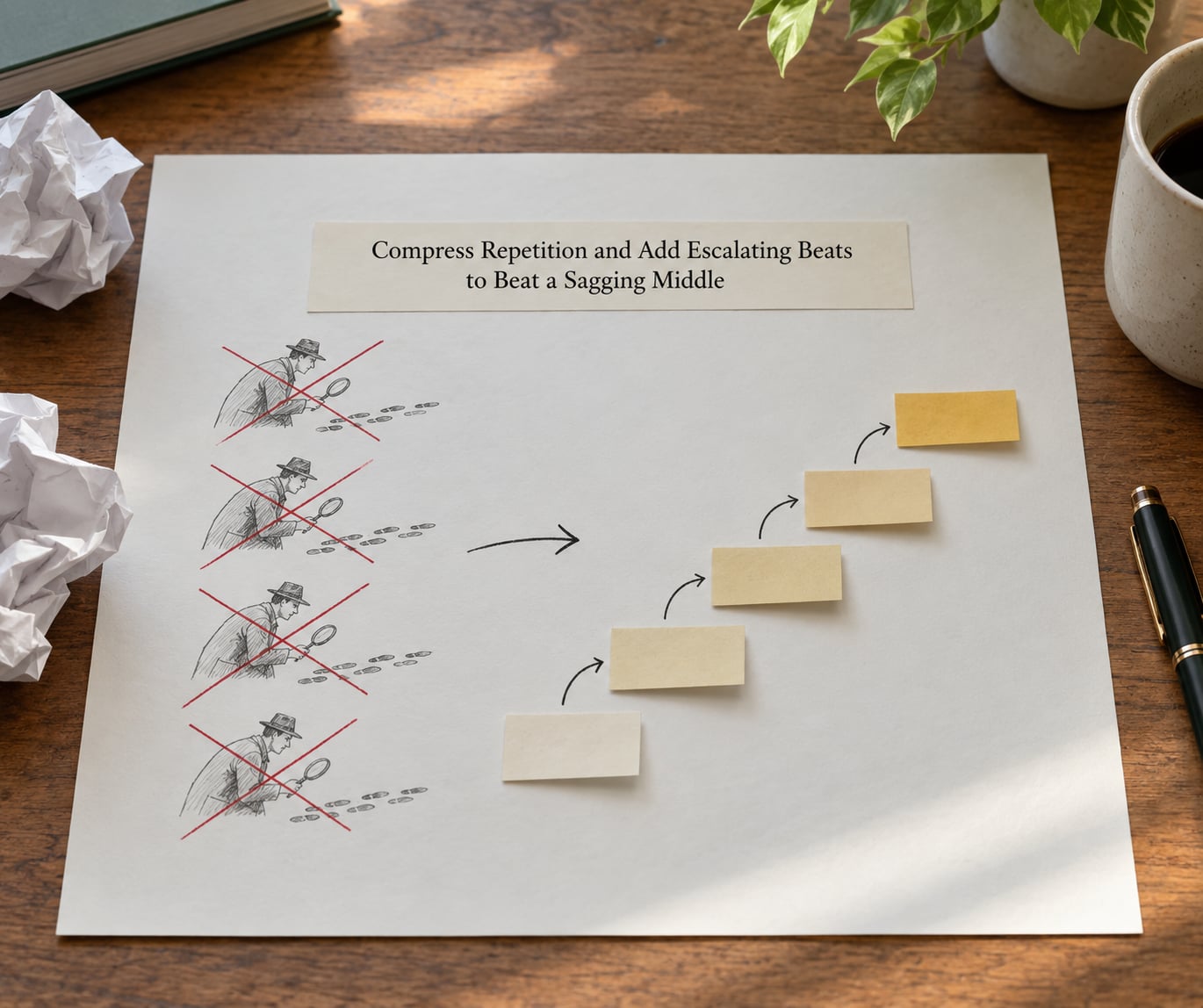
Find every scene that performs the same job and merge the job into one scene. Four witness interviews become one, with the sharpest detail lifted to the front and the rest summarised in two sentences.
Then run a pressure ladder across what is left. Setup, complication, reversal, setback, decision. Five beats for roughly twenty chapters. Setup earns the goal, complication raises the price, reversal flips the reader’s understanding, setback removes an option, and decision points straight at Act Three.
Most saggy middles have only two of those beats, usually a setup and one long complication that never resolves. Adding the missing reversal is often a single scene, and it can be written by taking the antagonist’s offstage plan from your timeline and putting it on the page ten chapters before the protagonist learns about it.
One warning about compressing: the clue you cut may be load-bearing in the final act. Read the last three chapters after every merge and check that the reveal still has the setup it needs. If it does not, the information belongs in the condensed scene, not in a separate chapter.
7. Rebuild the Handoff Into the Climax
The middle ends, and then the final act starts, and the reader feels the seam. That gap is what makes a climax feel abrupt even when the climax itself is well written.
Close the middle with a decision the protagonist makes under conditions they cannot undo, and let that decision cause the climax rather than precede it. Plant the final threat in the middle third, in passing, in a scene that seems to be about something else. A one-line mention that a second figure has been asking about the witness is worth more than a chapter of ominous foreshadowing, because the reader will not recognise it as foreshadowing and will feel clever on the way out.
Then write the causal chain backwards from your climax. What must be true at the end of chapter 30 for the climax to be inevitable? Work back through three or four links. If a link is missing, that is the last scene you write, not the first.
A thriller middle that ends with a locked door, a phone call and a decision to go anyway is handing the climax a running start. A middle that ends with the protagonist merely discovering something is handing it a starting gun.
Common Mistakes That Keep a Saggy Middle Saggy
Five errors account for most of the sag I see, and each has a specific corrective move rather than a general exhortation to add tension.
Solving the mystery too early. The reveal lands at 45 percent and the rest of the book is aftermath. Move the reveal to roughly 75 percent, and give the middle a false answer to run on instead.
Adding random violence. Explosions, threats and anonymous bodies raise volume, not pressure. The test is whether the reader would care if it did not happen. If not, it is scenery and it makes the real stakes harder to hear.
Giving the protagonist unlimited information. If she knows everything by chapter 14 and spends fifty pages acting on it, you have written a procedural, not a thriller. Delay a piece of information she needs, and let the delay cost her.
Slowing down for backstory. The history of the case belongs in two paragraphs during the action where it changes a decision. Everything else is an excuse to stop moving.
Letting consequences evaporate. Something is threatened in chapter 12 and never mentioned again. Audit every threat and every sacrifice from the first quarter; anything not paid off by the end of the middle is a lie the book told the reader.
One more worth naming, because writers reach for it instinctively: adding subplots to create motion. A new romance in the middle of a thriller does not fix pacing, it splits the reader’s attention and gives them somewhere better to be. That is a separate decision, and it should be made on structural grounds, not as a cure.
Frequently Asked Questions
How do I know if my thriller’s middle is really saggy?
Run the tension column test. Rate every middle scene from one to five, plot the ratings, and look for a flat run of six to ten scenes between 35 and 65 percent of the book. If the line is flat and nothing in those scenes changes the protagonist’s choices, you have a sag. If it dips but keeps rising in difficulty, you probably have a deliberate procedural build, which thriller readers accept.
Should I add a subplot to fix a sagging middle?
Usually no. A subplot added to solve pacing splits the reader’s attention and gives them somewhere more interesting than your murder to go. Add one only when it forces the protagonist into a harder choice than the A plot offers. If the subplot can be deleted without touching the mystery, it is comfort food and it belongs in a different book.
How do I increase tension without frantic prose?
Raise the stakes and tighten the delivery, not the other way round. Pressure comes from a deadline with a named cost, a choice with incomplete information, or a discovery that permanently removes an option. Keep the sentence work plain and short on page. Short sentences, white space and fewer adjectives carry dread better than strained, over-adjectived prose ever will.
When should I change the outline instead of rewriting scenes?
Change the outline when three or more consecutive scenes fail the same diagnostic, when the reveal falls before the 70 percent mark, or when the climax does not logically follow from the end of chapter 30. Scene-level rewriting fixes isolated stalling. Outline work is required when the sequence itself is wrong, and doing scene work first on a broken sequence just wastes the rewriting you will have to redo.
How long should the middle of a novel be?
About half the book. In a 90,000-word thriller that is roughly 40,000 words, or chapters 10 through 28 of a 30 to 35 chapter structure, measured from the first-act break to the point of no return. Judge the middle by function rather than length: it should contain a midpoint reversal, a rising ladder of obstacles and a decision that hands the climax its opening.
Can I fix a sagging middle after finishing the whole draft?
Yes, and most saggy middles are repaired at the structural level rather than the sentence level. Print the middle, build the tension column, identify the flat run, then rebuild those chapters around one deadline and one reversal. Merge the repetitive scenes, cut the atmosphere that carries no pressure, and rewrite only the scenes where the protagonist makes a decision. Expect to lose three to five chapters and gain back momentum.
Conclusion
A thriller middle sags because it stops keeping a promise: that the trouble is about to get worse and more personal. Diagnose before you rewrite, find the flat run, and rebuild it around a deadline, a reversal and a ladder of choices that each cost the protagonist something.
Start with one task. Print the middle third, build the tension column, and locate the first scene where the line goes flat. Then rewrite that scene, not the whole book. The first fix usually makes the next one obvious.