Learning how to write a comic script for a crime story comes down to one rule: every panel shows a single moment, and the reader connects the rest. A comic script is not a screenplay with pictures and not a prose chapter with speech tags. It is an instruction document broken into pages and panels, where every line of dialogue has to fit the space the artist draws for it. Most first attempts fail in the same two places — cramming far too much plot onto too few pages, and writing paragraphs inside balloons. Here is the whole process in ten steps, with a copyable script template, a beat sheet, and a worked interrogation rewrite. Budget two to four weeks for a first 22-page issue if you are starting cold, or a long weekend if you already have the prose story drafted.
Table of Contents
- What You Need
- Step-by-Step: How to Write a Comic Script for a Crime Story
- 1. Start with a focused crime premise
- 2. Build a suspect cast with distinct motives
- 3. Build a clue chain the reader can follow back
- 4. Outline the major story beats
- 5. Design the location and visual world
- 6. Break the story into pages and panels
- 7. Write dialogue that sounds dangerous and specific
- 8. Add sound, silence, and visual emphasis
- 9. Stage the climax and the final reveal
- 10. Revise, read aloud, and test the clues
- Common Mistakes in a Comic Script for a Crime Story
- Common mistakes and their quick fixes
- Frequently Asked Questions
- How do I start writing a comic script with no art experience?
- How many pages should a short crime comic script be?
- Should a crime comic be written in first person or third person?
- How do I make a mystery fair without making the solution obvious?
- How much detail should a comic script include before working with an artist?
- What is the easiest way to revise a comic script?
- Conclusion
What You Need
Before you write a single panel description, you need seven things in writing, not in your head.
- A logline. One sentence, under 30 words, that names the crime, the protagonist and the pressure on them. “A retired detective reopens her father’s cold case forty-eight hours before a city vote clears the neighbourhood.”
- A premise. Two sentences expanding the logline with the obstacle and the stakes. If it needs a third sentence, the scope is too wide for one comic.
- A cast with motives. Suspects, witnesses, the victim, one ally and one person who actively obstructs. Each entry needs motive, knowledge of the crime, and physical access.
- A location map. Every principal place, with its entrances, exits, sight lines and what it says about who holds power there.
- A beat sheet. The turning points of the investigation, in order, with a page number attached to each.
- A page and panel budget. Most comic pages carry five to seven panels; a standard single issue runs 20 to 24 pages. Decide your page count first and write to it.
- A revision method. At least three planned passes, because the first draft is always overstuffed.
Six terms come up constantly. A panel is one image on the page. The gutter is the space between panels. Closure is Scott McCloud’s word for the reader filling in the gaps themselves, which is the whole engine of sequential art. A splash page is a single full-page image used for a big moment. A caption is a narration box, and it is the cheapest tool you have for an unreliable point of view. The page turn is where suspense lives, and the 180 rule comes from it: when the reader flips the book, the next panel must be readable in a rotated orientation without them turning back a page.
Tooling is less important than people think. Any word processor works, and plenty of professional scripts are typed in Google Docs.
| Tool | Best for | Note |
|---|---|---|
| Google Docs or Word | Plain scripts, shared with an artist | What most writers and artists already use |
| WriterDuell | Script-only workflow | Built around page and panel numbering |
| Celtx | Story structure, beat tracking, schedules | Useful once you have several issues in flight |
| Clip Studio Paint | Thumbnails and rough page layouts | Worth learning if you draw at all |
Here is the format template to copy. Note that the panel description comes first and the dialogue second, that caption boxes are labelled, and that a panel with no words is marked SILENT PANEL.
PAGE 3

PANEL 1
WIDE — Interior, pawn shop back room, night. Rain on a wire window. A ledger
open on the counter, one page torn out. Detective Vance enters. The shopkeeper
does not look up.
CAPTION (box, top left): The ledger had forty entries. It had thirty-nine now.

PANEL 2
CLOSE — the torn stub, jagged edge, ink bleeding into the paper.
VANCE: You sold something Tuesday.
SHOPKEEPER: I sell things.

PANEL 3
SILENT PANEL — the shopkeeper's hand under the counter. Nothing else.
Step-by-Step: How to Write a Comic Script for a Crime Story
1. Start with a focused crime premise
Write the premise as: a crime, an investigator, an objective, an obstacle, the stakes, and one central question. A cold case, a detective who wants the case closed before a hearing, a council lawyer who will release the evidence if she stays quiet, and the question of who the missing witness is protecting.
Narrow until one comic can carry it. Cut the second conspiracy, the romantic subplot, the flashback to the victim’s childhood. Those belong in another issue, and stacking them is what makes beginner scripts collapse in the middle.
Test: say the premise out loud in one or two sentences. If you need a third, you are carrying a novel, not an issue.
2. Build a suspect cast with distinct motives
Give each suspect four attributes: what they wanted, what they know, what they could physically reach, and how they look on the page. That last one matters more than beginners expect — a suspect who is never visually distinct becomes a face the reader cannot remember at the reveal.
Three to five suspects is workable in 22 pages. Each one should produce a different answer to the central question, so that removing any single suspect breaks either the evidence or their behaviour in the later acts.
Test: delete one suspect. If the plot still resolves, that suspect was set dressing, not a suspect.
3. Build a clue chain the reader can follow back
Separate three things that beginners blur together. Evidence is a physical fact. Suspicion is a character’s reading of that fact. Proof is evidence the reader was given in advance and understood later, for the first time, at the reveal.
Plant each clue twice: once in a panel the reader scans past, once in the reveal panel, where the earlier image is repeated with different meaning. A wet glove print, a taxi receipt with the wrong date, a coat that is described before anyone mentions rain.
Do not withhold information to create a twist. The reader should be able to reconstruct the solution from the completed script, and be annoyed at themselves for missing it.
Test: hand the finished script to someone and ask them to name the culprit and the clue that gave it away. If they cannot do both, the chain has a gap.
4. Outline the major story beats
Map the investigation before you map any page. Decide what changes at each turning point, not just what happens, because a beat that changes nothing can be cut.
| Beat | Where it lands | What the reader gets |
|---|---|---|
| Hook | Page 1 | A crime already in progress, no setup |
| Inciting incident | Pages 2 to 4 | The reason the detective cannot walk away |
| Investigation | Pages 5 to 12 | Two clue plants and one wrong turn |
| Complication | Pages 13 to 16 | The first suspect dies, disappears, or talks |
| Confrontation | Pages 17 to 20 | The reveal and a choice with consequences |
| Afterimage | Pages 21 to 22 | One unresolved image, no explanation |
Attach a page number to each beat before drafting. If your investigation needs fifteen pages of talking to witnesses, cut witnesses.
5. Design the location and visual world
Every setting should hand the reader information: who controls the room, who is trapped, where the exits are. A stairwell with one bulb and a landing halfway up tells you about power before anyone speaks.
Then write an art-direction brief the artist can actually use. Noir lives on contrast — hard shadow, venetian-blind stripes across a face, sodium streetlight on wet asphalt, interiors lit by a single practical source. Pick two or three recurring motifs and let them recur: an umbrella, a specific clock, a red door.
For crime scenes and violence, decide what you are actually showing. You can convey a killing through aftermath, through a reaction panel, or through the gap in a conversation, and all three avoid putting the act on the page. Crime comics aimed at younger shelves work under Comics Code content rules; everything else follows the retailer and the market you are selling into.
Test: for each location, write one sentence of information the setting gives the reader. If you cannot, it is decoration.
6. Break the story into pages and panels
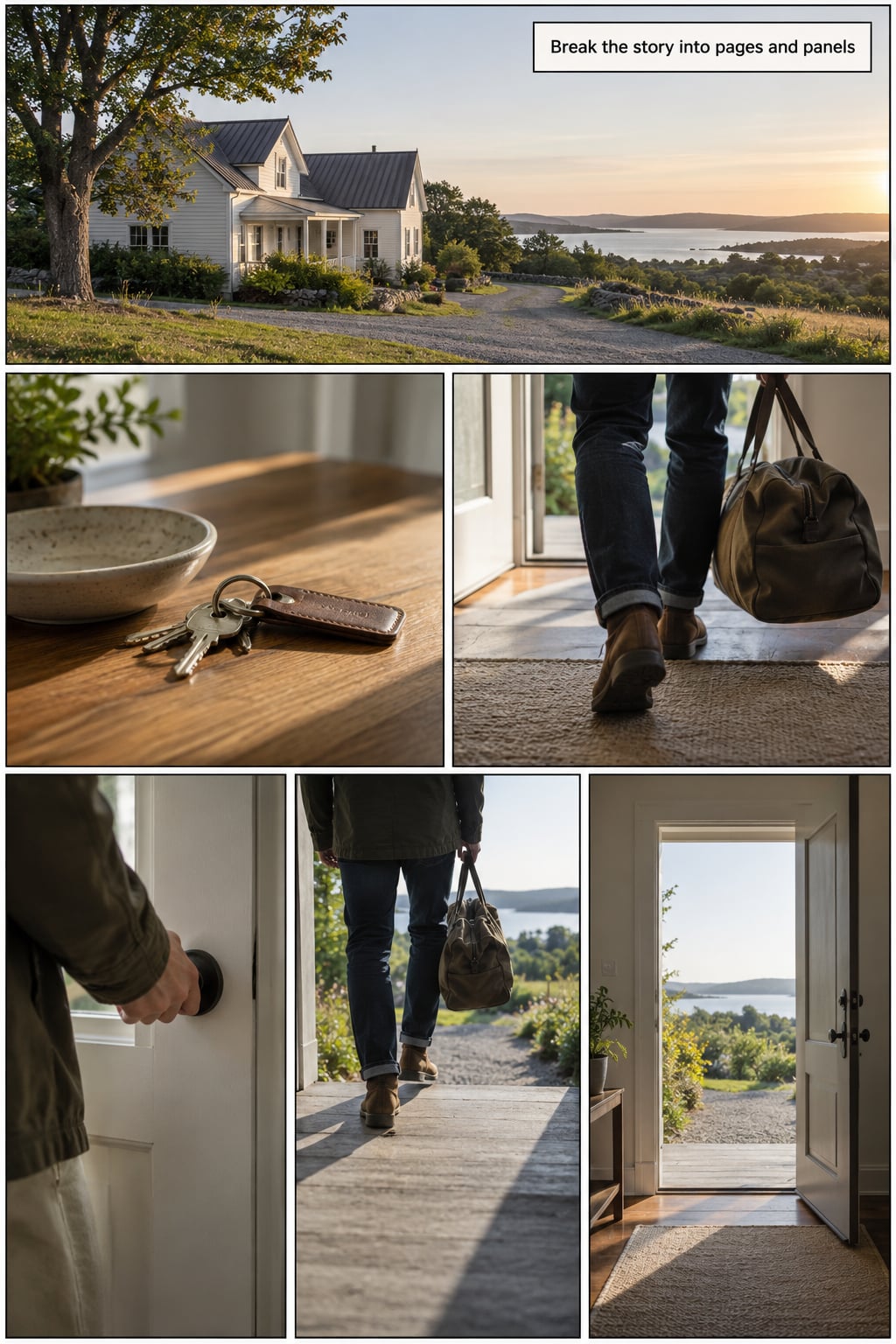
This is where most first drafts of a comic script for a crime story die. You have a story that wants forty pages and a page budget of twenty-two, so you cram it.
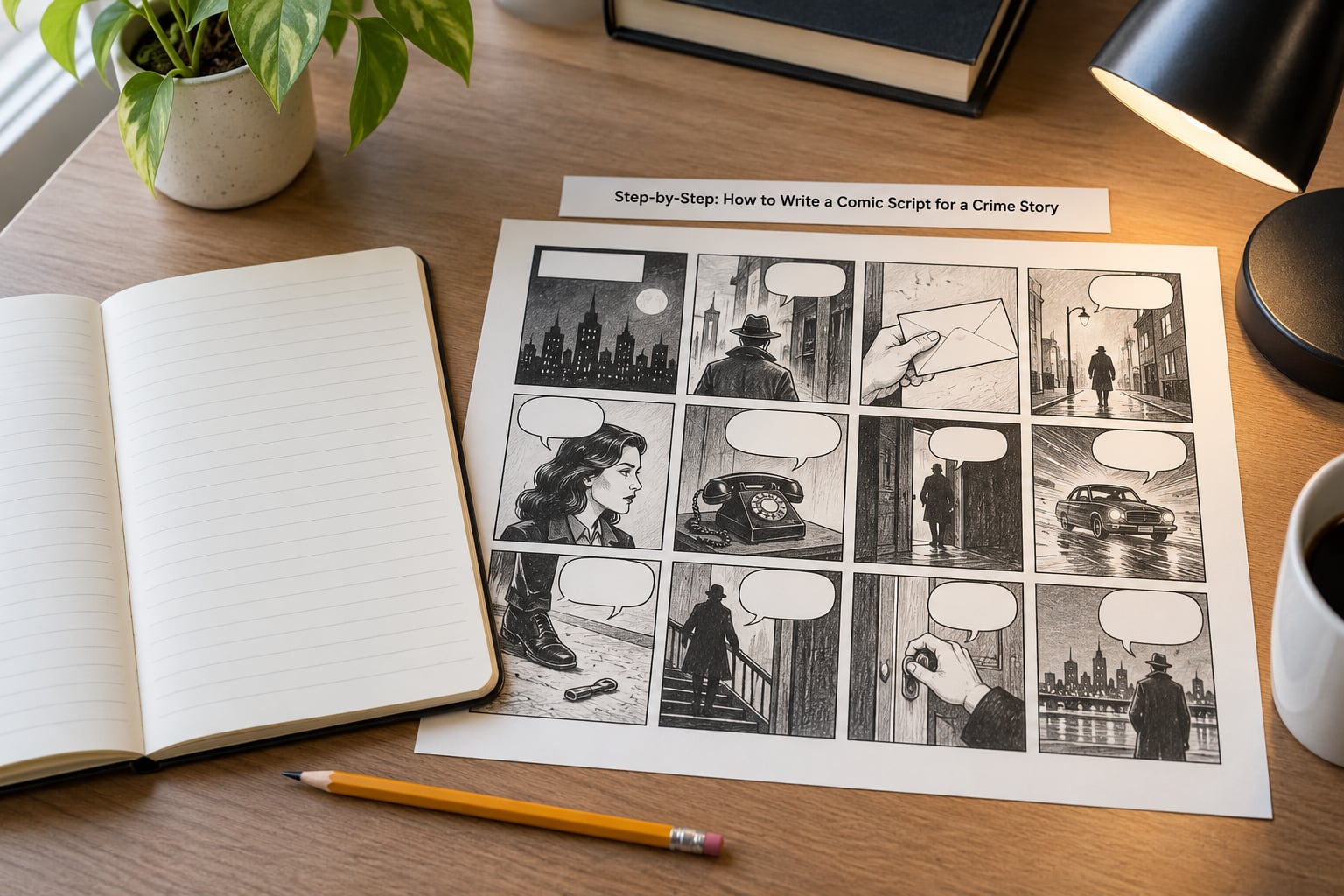
Budget five to seven panels per page, and remember that panels are not interchangeable. A wide establishing panel and a close-up of a key do different jobs, so a page with six panels is a rhythm, not a quota. Sequence it deliberately: wide to set the space, medium to follow action, close to land the detail that matters.
Then think about the turn. The bottom-right panel of a right-hand page is the most valuable real estate you have, because it is where the reader’s commitment peaks. End it on a question, not on a resolution. Readers on r/ComicWriting describe the 5-to-7 range as the mental model they wish they had started with, and it is roughly right.
Your final page needs one job: a visual that stays after the dialogue is forgotten. An empty doorway, a ledger with a torn stub, a car that has not moved in three days.
Test: does your beat outline fit the page count without a scene where someone explains the backstory in four panels?
7. Write dialogue that sounds dangerous and specific
Comic dialogue is budgeted against space, exactly as one r/writing thread puts it — your dialogue allowance is literally the white area left in the panel. Keep lines short. Give each character a different sentence length and a different evasion habit, so the reader can identify the speaker from an unattributed balloon.
Put information in subtext. Hard-boiled voice works because it says less than it means, and noir narration is most reliable when it lies calmly.
Before, an interrogation written as prose:
PAGE 14
PANEL 1
WIDE — Vance and the witness across a steel table, six hours into the
questioning. The witness finally speaks at length about the night of the
theft, explaining in detail where he was, who he spoke to, and why he had
waited eleven days to mention any of it.
After, the same beat with panel economy:
PAGE 14
PANEL 1
WIDE — Same table, same two figures. Neither has moved. A wall clock reads 4 a.m.
PANEL 2
CLOSE — the witness, mouth open mid-sentence.
WITNESS: I was at the bar. Eleven days. I know how that sounds.
PANEL 3
SILENT PANEL — Vance, absolutely still, waiting.
CAPTION: She had asked one question forty times.
The second version hands the reader more in the same space, and it keeps the confession for the panel where it is actually needed.
Test: read the dialogue alone, with the panel descriptions covered. It should still show tension and distinct voices.
8. Add sound, silence, and visual emphasis
Sound effects do work prose cannot. A single SFX in an otherwise silent page changes the reader’s breathing. Use them sparingly and place them in the gutter between panels when you want the sound to belong to the space rather than the image.
Silent panels are the cheapest suspense device you own. A wordless panel of a character deciding something, held for a full page width, will outperform three balloons of explanation.
Captions are where an unreliable narrator lives. A caption that states what the protagonist feels, sitting next to a panel showing the opposite, is the oldest trick in the medium and it still lands. Keep captions to time and place mostly, and save the editorialising ones for the three that matter.
Test: look at the page with all the dialogue greyed out. The mood and the emphasis should still read.
9. Stage the climax and the final reveal
A reveal is not an explanation delivered by a witness in three panels. It is a confrontation where the protagonist acts on what they already knew, and the reader watches the pieces land in a new order.
Plan three things before you draft the climax pages: which image carries the reveal, what the protagonist chooses to do, and what they refuse to do. Consequence is what separates crime comics from puzzle boxes. A detective who solves the case and gets nothing for it has made a different story from one who solves it and pays for it.
Then build the final page as a single composition rather than a series of panels. Keep one question open — who paid the witness, who signed the paperwork, whose coat was on that hook — and answer it in your next issue, not in a footnote.
Test: can you state the final image in one sentence? If the ending needs a paragraph of explanation, it is not an image yet.
10. Revise, read aloud, and test the clues
Revise in four passes, in order, and resist fixing the prose while you fix the structure.
Pass one, structure. Summarise the whole issue in eight sentences, without names or pictures. If the story does not work as a summary, no amount of dialogue polish will save it.
Pass two, paging. Check the panel count against your budget page by page. The usual fix is not adding panels but cutting scenes.
Pass three, dialogue. Read every balloon aloud. Anything you stumble over is too long or badly shaped.
Pass four, clues. Mark every clue on a printed copy, then check each one appears at least twice and that the reader could have understood it the first time.
Give the script to one reader who has not seen the pitch. Their confusion is your panel description’s fault, and it is the cheapest revision feedback available to you.
Common Mistakes in a Comic Script for a Crime Story
Common mistakes and their quick fixes
Too much story, too few pages. The single most common failure, and the one beginner writers hit hardest. Fix: cut a suspect, then cut a location, and only then compress dialogue. Never fix it by shrinking every panel into unreadable slivers.
Over-described panels. If your description dictates every finger position, you have removed the artist’s contribution and you will get art back you dislike. Fix: describe what must be true for the story — position, expression, object — and leave the rest.
Under-described panels. The opposite failure leaves the artist guessing about a crime scene’s geography, which is how readers get confused about who was where. Fix: specify camera angle and who is in frame, and stop there.
Paragraphs inside balloons. A character who explains his whole alibi in one balloon has done in words what three panels should do. Fix: cut the balloon in half and move half of it into a reaction panel.
Repetitive panel rhythm. Six identical rectangles read as a slideshow. Fix: alternate panel shapes so the eye accelerates through action and slows through a reveal.
Confusing reading order. Western reading order is not always clear, and crime comics lean on juxtaposition. Fix: let panel size and figure placement direct the eye, and put a small arrow on a panel that jumps across the page.
Clues that only work because you hid them. A reveal the reader could not have found is not a twist, it is a cheat. Fix: move the withheld fact into an early panel as background the reader had no reason to weigh.
Generic dialogue. Every character speaks the same measured voice. Fix: give each character one verbal tic and one thing they refuse to say, and check the balloons are distinguishable without attribution.
Exposition in the middle of the investigation. A character explaining what the reader already watched. Fix: cut it, and let the artist restate it visually if it turns out to matter.
Frequently Asked Questions
How do I start writing a comic script with no art experience?
You do not need to draw to write one. Start with a logline, a premise, and a beat sheet with page numbers attached, then describe each panel in words using the PAGE and PANEL template. You do need a sense of how panels are read and how much room a balloon takes, which you can learn by studying any five pages of a comic you like. A finished script plus rough thumbnails is a complete pitch.
How many pages should a short crime comic script be?
A standard single issue runs 20 to 24 pages, and that is the right target for a first complete crime story. Beginners often plan for five pages and cram an entire novel into them, which is why short stories feel rushed. If you want a shorter format, budget five to seven panels per page and cut suspects and locations rather than compressing dialogue.
Should a crime comic be written in first person or third person?
Both work, and the choice is about control. First-person noir puts the reader inside an unreliable narrator, which pairs well with caption boxes and short, self-justifying sentences. Third person widens the visual options, because you can show what the detective cannot see. Pick one and hold it. Flipping narration mid-issue reads as a device rather than a choice.
How do I make a mystery fair without making the solution obvious?
Plant each clue twice: once as background the reader scans past, and again at the reveal with different meaning. Keep the clue physically accurate and the interpretation wrong, so the reader was given the fact and drew the wrong conclusion from it. Then check your finished script and ask a reader to name the culprit and the clue that gave it away.
How much detail should a comic script include before working with an artist?
Describe what must be true for the story to work: who is in frame, where they are, camera angle, expression, and the object the reader must notice. Leave composition, shading and staging to the artist unless a specific choice carries plot information. r/Screenwriting regulars arriving from film need this translation most, since a screenplay describes the camera and a comic script should not.
What is the easiest way to revise a comic script?
Revise in four passes: structure, paging, dialogue, then clue fairness. Summarise the issue in eight sentences with no names to test structure. Check panel counts page by page to test paging. Read every balloon aloud to test dialogue. Then print it, mark each clue, and confirm every one appears twice. Never polish dialogue while the plot is broken.
Conclusion
Start with one page today. Write the premise in two sentences, name the three suspects and what each of them wants, then set your page count and write the hook on page one against your own script template.
The rest is revision in the right order, and the first version should be too long. Cut it back until the reveal is the only thing the reader could not have predicted, and leave one question open on the final page.