
To find a literary agent for crime fiction, you need a finished manuscript, a one-page synopsis, a short bio, and a list of 20 to 40 agents who already sell books like yours in your sub-genre. You build that list by checking agency websites and subscription databases, then send each agent a personalized query letter and sample pages within the window their guidelines allow. Most writers work at this for six to twelve months before landing representation, and the whole process costs nothing to you if every agent you contact follows standard industry practice.
Crime fiction rewards sharper targeting than most categories. The genre splits into cozy, noir, police procedural, legal thriller, historical mystery, and psychological suspense, and the editors who buy them barely overlap. An agent who loves a slow-burn noir with a corrupt county sheriff will not be reading your book about a cozy amateur sleuth in a village full of knitting circles, no matter how well you write it.
Table of Contents
- What You Need to Find a Literary Agent for Crime Fiction
- Step-by-Step
- 1. Define the kind of crime fiction you write
- 2. Prepare a submission-ready package
- 3. Build a targeted agent research list
- 4. Check fit before you query
- 5. Write a concise, personal query
- 6. Follow up without becoming a nuisance
- 7. Evaluate offers and representation carefully
- Common Mistakes
- Frequently Asked Questions
- Do I need a completed manuscript to find a literary agent for crime fiction?
- What genre should I list first when my crime novel blends several categories?
- How long does it usually take to get a response from literary agents?
- Can I query multiple agents at the same time?
- Should I query an agent who represents one of my favorite crime-fiction authors?
- What is the difference between a literary agent and a book publicist?
- Conclusion
What You Need to Find a Literary Agent for Crime Fiction
Before you contact anyone, four things have to exist in finished form.
- A complete manuscript. Crime fiction queries almost always require the full book plus the first ten pages pasted in the body of the email. A partial is a request for a phone call, not a submission.
- A synopsis of one page. This is your book’s structure written as plot, ending included. It is not a pitch and it is not the back-cover copy.
- A short bio of under a hundred words. Published work, relevant jobs, and anything that explains why you know this world. Ignore hobbies unless they shaped the book.
- A positioning line of one sentence. The kind of book it is, who the reader is, and one or two comparables published in the last three years.
Two more decisions matter before you start. First, rights: know whether you have sold film, television, or foreign rights to this story or to any previous work, because an agent will ask and undisclosed conflicts kill trust early. Second, timing: check when you can realistically submit, since a book you are still revising in eight months is not a book to query now.
Set a private budget for the work too. Commission is normally 15 percent of what you earn, taken by the agent, and readers are often asked to cover agency costs such as postage, copies, and phone charges on reads. No reputable agent charges you a fee to read your work, and any request for payment upfront is a reason to walk away.
Step-by-Step
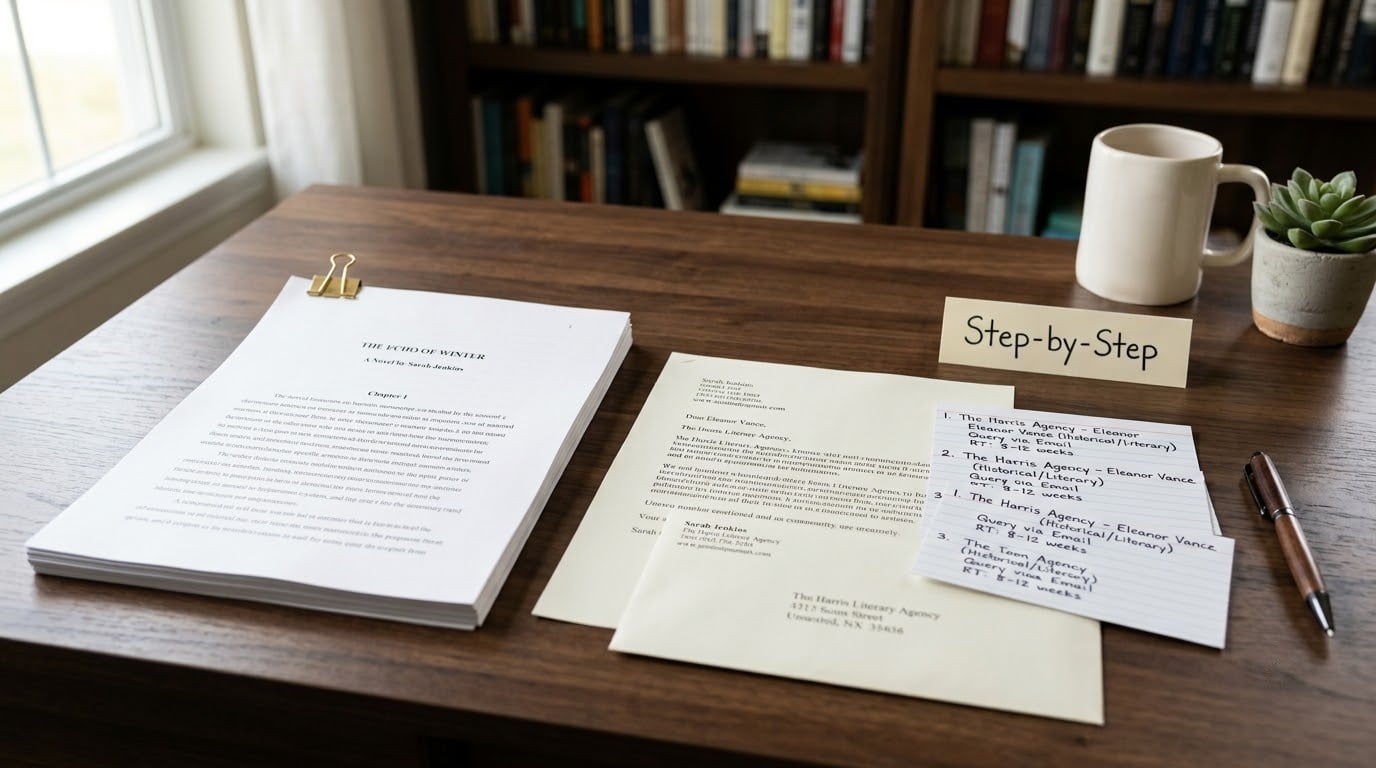
1. Define the kind of crime fiction you write
Name your sub-genre precisely before you name a single agent. Write it as a single phrase you could use in a conversation: northern noir, cozier with a forensic pathologist, police procedural set in a city police department, courtroom thriller with a wrongful conviction at its center, historical mystery set in 1890s London, psychological suspense with an unreliable narrator.
Then note the shelf it would sit on and the two books it resembles. If you cannot name two comparable books published in the last three years, the market position is undefined, and an agent will struggle to place it.
2. Prepare a submission-ready package
The package is four parts: the query letter, the synopsis, the first ten pages, and a short closing. Attach the complete manuscript as a separate file unless the agent’s guidelines say otherwise.
The query letter runs roughly 250 words in four paragraphs: what the book is about, who wrote it and why, a line on the writer’s background, and a polite request that follows the agency’s exact process. Keep crime-specific details out of the abstract. A line naming the city, the decade, the investigator’s damaged reputation, and the case that breaks open tells an agent more than any amount of voice description.
Read the guidelines twice and follow them literally, including the required subject line format and the stated response window. Guidelines exist because agents read hundreds of submissions a month and anything that ignores them gets skimmed.
3. Build a targeted agent research list

Start from the sources that are free and verifiable, then add the paid ones if you want depth.
- Agency websites. Authoritative on who an agent represents, what they read, and whether submissions are open right now. Many keep these pages current and update them when a client is on a tour or on leave.
- Subscription agent databases. These let you filter by genre, represent specific sub-genres, and see recent deal announcements showing what an agent has actually sold lately.
- Manuscript wish lists and agent interviews. Long-form interviews and published wish lists show which editors and agents are actively hunting for material, and they change every few months.
- Acknowledgments pages. The fastest, most reliable field research available. Pick twenty recent novels in your exact sub-genre, buy or borrow them, and read the acknowledgment section. Agent names appear there, on the book that made the money, in your shelf’s neighborhood.
- Writer organizations and conventions. Mystery and thriller writers’ organizations publish directories and run events where agents attend as guests and readers. Hearing a live pitch of a similar book is worth more than any database row.
Build the list in a spreadsheet with columns for agent, agency, sub-genres represented, submission status, response window, personalization note, date sent, and outcome. Aim for 20 to 40 names, then trim to the best 15 to 20 who genuinely match.
4. Check fit before you query
Run every name on your list through the same short checklist. Does this agent represent books in your sub-genre, not just adjacent suspense? Does the current client list include something recent and comparable, or only backlist titles and genre-hopping authors? Are they accepting unsolicited queries today, or do they only read referred work? Do they have a history of selling to the imprints that buy your kind of book? Do their stated response times match what you have seen from other writers?
Then check legitimacy. Membership of the professional association for literary agents is a useful signal because membership requires a verifiable sales history. No fees, ever. A traceable business address and a real phone number. A website or a documented record of sales. Writers on author forums repeatedly flag the same warning signs: reading fees, editing fees, contract-review fees, requests for bank details before a contract exists, and offers of representation with nothing attached.
One person per agency per batch. Two partners at the same agency reading the same query wastes your chance with that firm, because most agencies have a no-duplicate-resubmission rule that can last a year.
5. Write a concise, personal query
Personalization means one specific sentence that could only apply to that agent’s list. Reference a client whose recent book solves a problem you were wrestling with, or a genre conversation they had publicly about where the category is heading.
A practical structure: open with the premise and the complication in two sentences. Follow with the emotional temperature of the book, the reason the writer is the right person to write it, and one line on comparable recent titles. Close by asking whether they would like to see the manuscript, following the agency’s stated process exactly.
Proofread obsessively. A typo in the agent’s name is the one error no reader forgives. Keep the email body under 300 words, name the manuscript file clearly, and make sure the attached file is the right version before you send.
6. Follow up without becoming a nuisance
Respect the stated window first. Many crime fiction agents publish response times, and the usual ranges run from a few weeks to several months, with longer waits around holidays and personal leaves. Silence past the window is usually a no, but a single brief follow-up after six to eight weeks is considered normal professional practice.
Keep the follow-up to three sentences: your name, the book title, the date you queried, and one line of genuine interest. No apology for asking, no second pitch, no attachments. One follow-up only. If nothing comes back, consider the question answered and move on.
Batch your sends so you are not managing forty open queries at once. A common pattern is 10 to 15 queries at a time, a tracking period, then the next batch. Track every send date in the spreadsheet, because the volume of responses in week three tells you whether the positioning line is landing or needs rewriting.
7. Evaluate offers and representation carefully
Requests for the first ten pages, then the partial, then the full manuscript mean the query is working. An offer of representation means the agent wants to submit your book, and at that point you are choosing as much as they are choosing you.
Ask what commission applies and to what, whether the agency is a subsidiary arrangement with another firm, how many books the agent handles at once, which imprints they would target, and how communication works. Ask what happens if the book does not sell, and what happens to your rights if it does, including film, foreign, and audio. Ask how long they keep unpublished manuscripts on file before asking you to resubmit elsewhere.
Do not sign anything without having a qualified publishing lawyer or knowledgeable writer read the contract. This is the single point where paying for professional advice is worth every cent, because the difference between rights clauses is worth far more than any commission. Never sign while another offer is on the table without understanding the exclusivity terms, and never treat an offer as final until you have read and understood what you are signing.
Common Mistakes
Querying agents who do not sell your sub-genre. Being on an agent’s list is not enough. If none of their recent deals resemble your book, the query will land in a rejection pile. Fix: require two recent comparables on their record before sending.
Ignoring submission guidelines. Wrong file format, wrong subject line, sending during a closed window. Fix: read the guidelines the day you query and follow them to the letter.
Sending unsolicited manuscripts instead of querying. Mailing a bound manuscript to a hundred agents damages your name and usually violates agency policy. Fix: query properly, and send manuscripts only to agents who ask.
Positioning the book vaguely. “A thriller with heart” tells an agent nothing about shelf, tone, or buyer. Fix: name the sub-genre, the setting, and two comparables published within three years.
Chasing publishing data instead of building fit. Deal announcements and sales records matter, but they do not replace reading a client’s list. Fix: verify fit first, then use announcements to time your approach.
Agreements without understanding them. Signatures given in a hurry over enthusiasm produce regret. Fix: slow down, ask the questions in step seven, and get the contract reviewed by someone qualified.
Sending too many or too few queries. Fifty undifferentiated emails and two hopeful ones are both failure. Fix: send a tight batch of 15 well-matched, personalized queries and wait.
A few habits make the whole process lighter. Write your rejection tally without drama, treat silence as information rather than verdict, and keep writing the next book while queries are out. Writers who survive querying describe it less like a sequence of verdicts and more like a slow sorting process.
Frequently Asked Questions
Do I need a completed manuscript to find a literary agent for crime fiction?
Almost always yes. Crime fiction queries typically require the complete manuscript plus the first ten pages pasted into the email. Some agencies accept partials at proposal stage, but that is the exception rather than the rule. A synopsis alone rarely gets a request in this genre, because agents cannot judge pacing, voice, or procedural structure from a summary. Finish the book, revise it properly, and query.
What genre should I list first when my crime novel blends several categories?
Lead with the sub-genre that matches the reading experience, not the elements. A book with a police investigator, a court scene, and a twist belongs in the hands of crime and mystery editors first, with legal thriller as a secondary note in your positioning line. Look at where the tension and the resolution sit. Whichever category owns those pages is the shelf your agent will shop from.
How long does it usually take to get a response from literary agents?
Most crime fiction agents publish response times that run from a few weeks to several months, and that is normal. Longer waits often happen around holidays or when an agent is on leave. Writers commonly report sending 50 to 100 queries over a year or more before landing representation. Track every send date, follow up once after six to eight weeks if their guidelines allow, then move on.
Can I query multiple agents at the same time?
Yes, most agencies expect it, and a batch of 10 to 15 well-matched agents per round is standard practice. The exceptions matter though: some require exclusive submission, meaning no other queries until they decline, and most forbid querying two agents at the same agency. Read every guideline for exceptions. Batch querying is only safe when each agent’s stated rules allow it.
Should I query an agent who represents one of my favorite crime-fiction authors?
It helps but it is not enough on its own. An agent with one book you admire may sell in a different sub-genre, may not be taking unsolicited queries, or may already represent several authors writing very similar books. Check the full client list, confirm recent sales resemble your novel, and confirm submissions are open. Use the admiration as a personalization angle, not as the reason to query.
What is the difference between a literary agent and a book publicist?
An agent sells your manuscript to publishers, negotiates the contract, and manages the rights and the publishing career. A publicist handles publicity after a book exists: media outreach, interviews, events, and campaigns. An agent earns commission on what you make from the book, while a publicist is usually engaged by the publisher for a defined period and paid by the publisher. You need an agent before you have a book, and a publicist after.
Conclusion
Start with one hour of work: define your sub-genre in a single phrase, name two books published in the last three years that your novel belongs beside, and list ten novels in that same shelf. Read the acknowledgment pages of those ten books and see which agents keep showing up. That shortlist, paired with one honest page of synopsis and a two-hundred-word query, is where representation starts.